Get the simplified Class 8 Maths Extra Questions Chapter 3 A Story of Numbers Class 8 Extra Questions and Answers with complete explanation.
Class 8 A Story of Numbers Extra Questions
Class 8 Maths Chapter 3 A Story of Numbers Extra Questions
Class 8 Maths Chapter 3 Extra Questions – A Story of Numbers Extra Questions Class 8
Very Short Answer Type Questions
Question 1.
Why was zero considered a revolutionary invention in Mathematics?
Answer:
Because it enabled the development of the place value system.
Question 2.
Define a place value system.
Answer:
Do it yourself.
Question 3.
How did the Mesopotamians indicate a missing digit or empty space?
Answer:
By using a placeholder
Question 4.
Was the Mayan number system actually a base-20 system?
Answer:
No
Question 5.
Define Zongs and Hengs.
Answer:
Do it yourself.

Question 6.
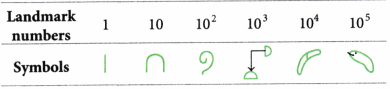
Write the first six landmark numbers of the Egyptian number system with their symbols.
Answer:
Short Answer Type Questions
Question 1.
Convert the following Roman numerals into Hindu-Arabic numerals.
(i) DXL
Answer:
We have, DXL
We know, D = 500
XL = 50-10 = 40
So, DXL = 500 + 40 = 540
(ii) CMXLIV
Answer:
(ii) We have, CMXLIV
We know, CM = 1000 – 100 = 900
XL = 50 – 10 = 40
IV = 5 – 1 = 4
So, CMXLIV = 900 + 40 + 4 = 944
(iii) LXXXIX
Answer:
We have, LXXXIX
We know, L = 50
XXX = 30
IX = 10 -1 = 9
So, LXXXIX = 50 + 30 + 9 = 89
Question 2.
Convert the following Hindu- Arabic numerals into Roman numerals.
(i) 388
Answer:
We have,
388 = 100 + 100 + 100 + 50 + 10 + 10 + 10 + 5 + 1 + 1 + 1
Then, in Roman numerals,
388 = CCCLXXXVIII
(ii) 2071
Answer:
We have, 2071 = 1000 + 1000 + 50 + 10 + 10 + 1
Then, in Roman numerals,
2071 = MMLXXI
(iii) 56
Answer:
We have, 56 = 50 + 5 + 1
Then, in Roman numerals,
56 = LVI
Question 3.
Add the following Roman numerals without converting them to Hindu numerals.
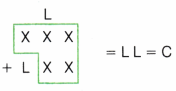
(i) XXX + LXX
Answer:
We have,
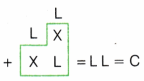
(ii) LX + XL
Answer:
We have,
(iii) CD + D
Answer:
We have,

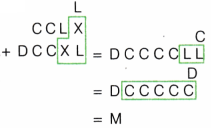
(iv) CCLX + DCCXL
Answer:
We have,
Question 4.
Use the extended Gumulgal number system (base-2 grouping) to perform the following operation without converting to Hindu numerals.
(i) (ukasar- urapon) + (ukasar- urapon)
Answer:
We have,
(ukasar- urapon) + (ukasar- urapon)
= ukasar – ukasar – ukasar
(ii) (ukasar- ukasar – ukasar- urapon) – (ukasar)
Answer:
We have,
(ukasar – ukasar – ukasar – urapon) – (ukasar)
= ukasar – ukasar – urapon
(iii) (ukasar – ukasar- urapon) × (urapon)
Answer:
We have,
(ukasar – ukasar – urapon) × (urapon)
= ukasar – ukasar – urapon
(iv) (ukasar – ukasar – ukasar – ukasar – urapon) + (ukasar-urapon)
Answer:
We have,
(ukasar – ukasar – ukasar – ukasar – urapon) + (ukasar – urapon)
= (ukasar – urapon – ukasar – urapon- ukasar – urapon) + (ukasar – urapon)
= ukasar – urapon
Question 5.
Convert the following numerals into Egyptian number system.
(i) 426
Answer:
We first write 426 as
426 = 100 + 100 + 100 + 100 + 10 + 10 + 1 + 1 + 1 + 1 + 1 + 1
Then, in Egyptian numerals,

(ii) 1032
Answer:
We first write 1032 as
1032 = 1000 + 10 + 10 + 10 + 1 + 1
Then, in Egyptian numerals,

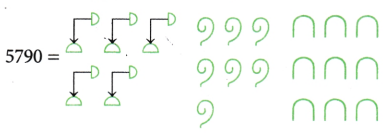
(iii) 5790
Answer:
We first write 5790 as
5790 = 5 × 1000 + 7 × 100 + 9 × 10
Then, in Egyptian numerals,
Question 6.
Convert the following numerals into Mesopotamian system.
(i) 43
Answer:
We have, 43 = 1 × 43
Then, in Mesopotamian numerals,

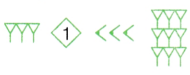
(ii) 219
Answer:
We have, 219 = 3 × 60 + 39
Then, in Mesopotamian numerals,
(iii) 1504
Answer:
We have, 1504 = 25 × 60 + 4
Then, in Mesopotamian numerals,

Question 7.
Convert the following Mayan numerals to Hindu-Arabic system.
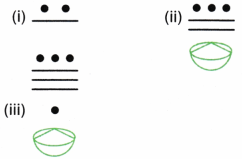
Answer:
(i) The Mayan numeral

written in
Hindu number system as 7.
(ii) We have,

Here, we break the symbols are as
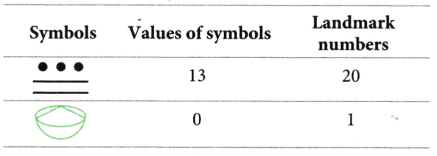
So, number = 20 × 13 + 0 × 1 = 260
(iii) We have,

Here, we break the symbol as
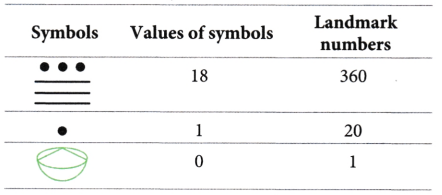
So, the required Hindu numeral
= 18 × 360 + 20 × 1 + 0 × 1
= 6500
Question 8.
Convert the following numerals into the Chinese rod numerals.
(i) 84
Answer:
We have, 84 = 8 × 10 + 1 × 4
Now, we write the Chinese symbols corresponding to each digit by identifying Zongs and Hong.
Here,
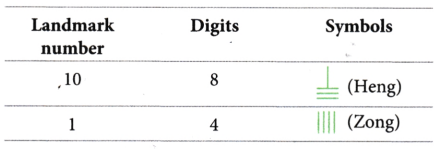
So, 84 in the Chinese number system is written as

(ii) 307
Answer:
Do it same as part (i)

(iii) 1926
Answer:
Do it same as part (i)

Long Answer Type-Questions
Question 1.
Describe how the Chinese rod numeral system worked. How were different digits and place values represented using rods? Provide examples to illustrate.
Answer:
Do it yourself.
Question 2.
(i) Explain the evolution of the idea of counting, beginning from the stone- age to the invention of the Hindu number system.
(ii) How did early humans keep track of quantity?
(ii) What methods did they use for representation before written numerals?
Answer:
Do it yourself.
Question 3.
(i) What is a positional number system?
(ii) Explain the concept using the Hindu number system with examples.
Answer:
Do it yourself.
Question 4.
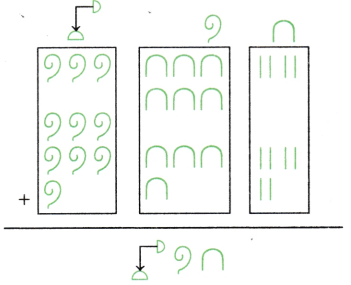
Add the following Egyption numerals.
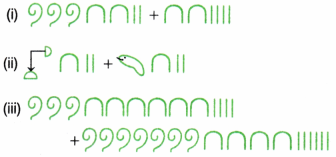
Answer:
(i) We have,
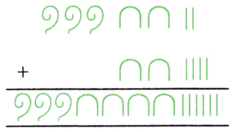
(ii) We have,
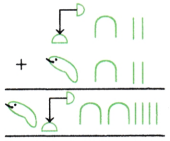
(iii) We have,
Question 5.
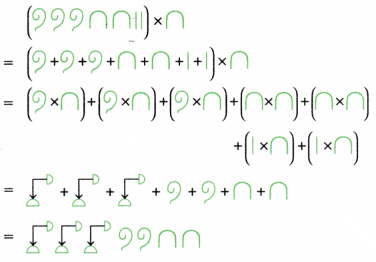
Find the following products.
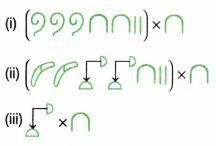
Answer:
(i) We have,
(ii) We have,
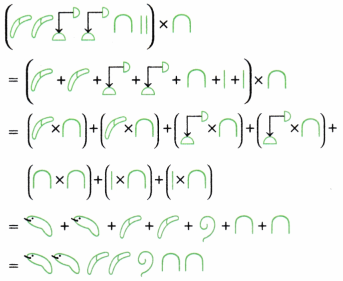
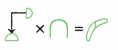
(iii) We have,
Skill Based Questions
Question 1.
Decode the Roman Code
Reema and her father are playing a game. He secretly chooses a three-digit number in Hindu numerals, writes it in Roman numerals and tells Reema only the total number of symbols he used.
One day, he says
“My number has exactly 12 Roman symbols when written.”
Can we guess which smallest number could it be?
Answer:
888 [DCCCLXXXVIII]
Question 2.
Mayan vs. Egyptian Race Reema challenges Riya for a race.
Both of them represent the number 720.
Riya uses the Egyptian system (base-10 system), while Reema uses the Mayan system (almost base 20-system).
Who will use fewer symbols to write 720?
Answer:
Reema
Case Study Based Question
Question 1.
A high priest is preparing 432 bundles of reeds for a festival ceremony and there are 3 temples to be supplied equally.
Now, based on the above information, answer the following questions.
(i) Write the Egyptian representation of 432.
Answer:
We have, 432 = 4 × 100 + 3 × 10 + 2 × 1
= 4 × 10² + 3 × 101 + 2 × 1
(ii) Use distributive law to compute total number of . bundles supplied to all the three temples, in Egyptian symbols only.
Answer:
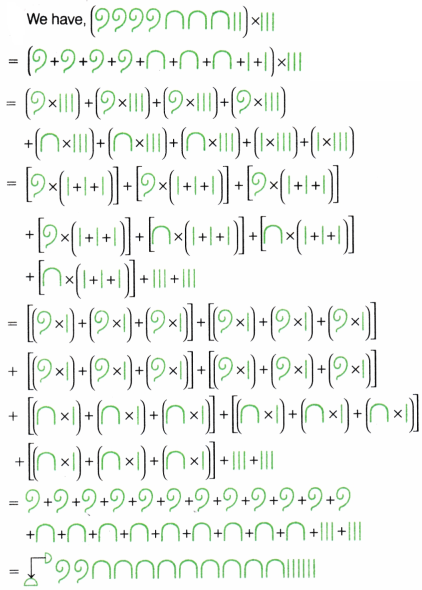
(iii) How many total bundles of reeds does he supply in Hindu-Arabic numerals?
Answer:
We have, 1000 + 100 + 100 + 9 × 10 + 6 × 1 = 1296
Question 2.
A Mayan priest is documenting days passed since a major religious event. He writes that 841 days have passed.
Now, based on the above information answer the following questions.
(i) Record these days in Mayan numerals.
Answer:
We have, 841 = 2 × 360 + 6 × 20 + 1
Then, in Mayan numerals,

(ii) Determine how many more days are needed until the 1000th day celebration.
Answer:
We have, 1000 – 841 = 159
So, 159 more days are needed until the 1000th day celebration.
(iii) Write one advantage and one disadvantage of this system.
Answer:
Do it yourself.