Get the simplified Class 7 Maths Extra Questions Chapter 3 A Peek Beyond the Point Class 7 Extra Questions and Answers with complete explanation.
Class 7 A Peek Beyond the Point Extra Questions
Class 7 Maths Chapter 3 A Peek Beyond the Point Extra Questions
Class 7 Maths Chapter 3 Extra Questions
Question 1.
Arrange the followings in increasing order
(i) 7 \(\frac{7}{10}\)
(ii) \(\frac{8}{10}\)
(iii) \(\frac{114}{10}\)
(iv) 15 \(\frac{1}{10}\)
Answer:
Let us first convert all the fractions in one-tenths as follow
(i) 7 \(\frac{7}{10}\) = 7 units and 7 one-tenths
= 70 one-tenths and 7 one-tenths
= 77 one-tenths
(ii) \(\frac{8}{10}\) = 8 one-tenths
(iii) \(\frac{114}{10}\) = 114 one-tenths
(iv) 15 \(\frac{1}{10}\) = 15 units and 1 one-tenth = 150 one-tenths and 1 one-tenth =151 one-tenths
Now, arrange these one-tenths into increasing order : 8 one-tenths, 77 one-tenths, 114 one-tenths, 151 one-tenths.
∴ Required order is \(\frac{8}{10}\), 7 \(\frac{7}{10}\), \(\frac{114}{10}\), 15 \(\frac{1}{10}\).

Question 2.
Ravi is measuring some of his body parts. The length of his lower arm is 3 \(\frac{2}{10}\) units and that of his upper arm is 4 \(\frac{8}{10}\) units. What is the total length of his arm?
Answer:
Method 1 To get the total length, consider the lower and upper arm length as 3 units and 2 one-tenths and 4 units and 8 one-tenths, respectively.
We have, 3 \(\frac{2}{10}\) + 4 \(\frac{8}{10}\) = (3 + 4) + (\(\frac{2}{10}\) + \(\frac{8}{10}\))
= 7 + \(\frac{10}{10}\)
= 7 + 1 = 8 units
Method 2
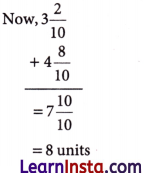
Method 3 Both the lengths can be converted to tenths and then added 3 \(\frac{2}{10}\) is 30 one-tenths and 2 one-tenth i.e. 32 one-tenths and 4 \(\frac{8}{10}\) is 40 one-tenths and 8 one tenth i.e. 48 one-tenths. So, total is (32 + 48) one tenths i.e. 80 one-tenths i.e. 8 units.
Question 3.
“The length of Anshu’s hand is 10 \(\frac{3}{10}\) units, and that of her palm is 7 \(\frac{8}{10}\) units. Then what will be the length of the longest (middle) finger?
Answer:
Method 1 To get the length of the middle finger, consider length of hand and palm as 10 units and 3 one-tenths and 7 units and 8 one-tenths, respectively. Then, the length of the middle finger

So, the length of the longest finger is 2 \(\frac{5}{10}\) units.
Extend the patterns
(i) First observe the given sequence of numbers.
(ii) Identify the change after each term.
(iii) Continue the change and extend the pattern.

Question 4.
Extend the following patterns after Identifying the change in each term:
(i) 5 \(\frac{13}{10}\), 7,7 \(\frac{7}{10}\), ____, ____, ____, ____
(ii) 9 \(\frac{8}{10}\), 9 \(\frac{4}{10}\), 9, ____, ____, ____, ____
Answer:
(i) Given terms can be written as

Question 5.
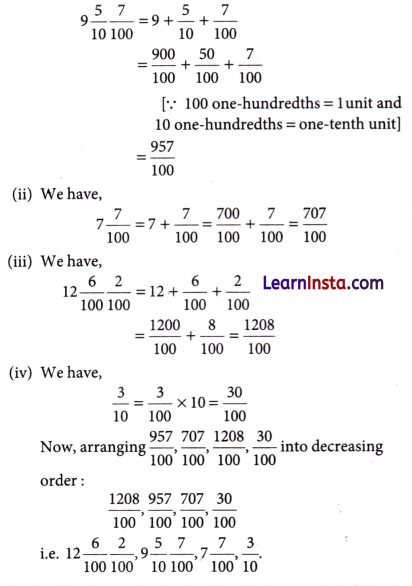
Arrange the following in decreasing order?
(i) 9 \(\frac{5}{10}\) \(\frac{7}{100}\)
(ii) 7 \(\frac{7}{100}\)
(iii) 12 \(\frac{6}{100}\) \(\frac{2}{100}\)
(iv) \(\frac{3}{10}\)
Answer:
Let us first convert all the fractions in one-hundredths as follow
(i) We have,
Question 6.
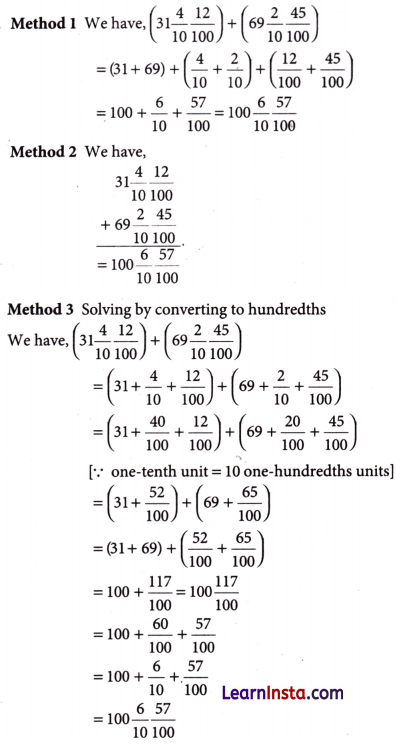
What will be the sum of 31 \(\frac{4}{10}\) \(\frac{12}{100}\) and 69 \(\frac{2}{10}\) \(\frac{45}{100}\) ?
Answer:
Question 7.
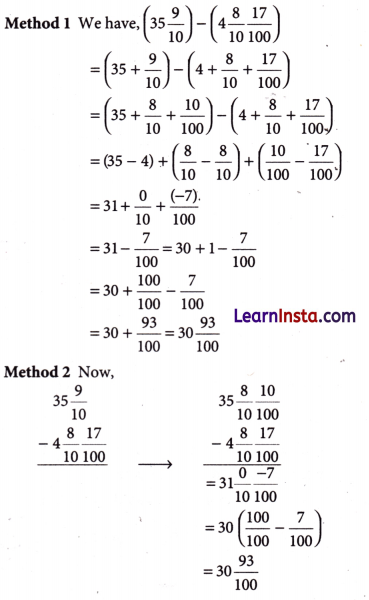
What is the difference 35 \(\frac{9}{10}\) -4 \(\frac{8}{10}\) \(\frac{17}{100}\) ?
Answer:
Question 8.
Write the following as decimals.

Answer:
Given number can be written as follows
(i)
4 hundreds + 2 tens + 8 ones + 1 tenth
= 4 × 100 + 2 × 10 + 8 × 1 + \(\frac{1}{10}\)
= 400 + 20 + 8 + 0.1 = 428.1
(ii)
9 hundreds + 2 tens + 3 ones + 4 tenths
= 9 × 100 + 2 × 10 + 3 × 1 + 4 × \(\frac{1}{10}\)
= 900 + 20 + 3 + 0.4 = 923.4
Question 9.
Write the following numbers in the place value table.
(i) 6.5
(ii) 30.5
Answer:
Let us make a place value table, assigning appropriate place value to the digits in the given numbers. We have,

Question 10.
Write each of the following as decimals.
(i) Three ones and six-tenths
(ii) Fifty and one-tenth
Answer:
(i) Three ones and six-tenths =3 + 6 × \(\frac{1}{10}\) = 3 + 0.6 = 3.6
(ii) Fifty and one-tenth =50 + 1 × \(\frac{1}{10}\) = 50 + 0.1 = 50.1
Question 11.
Write each of the following as decimals.
(i) 200 + 40 + 6 + \(\frac{2}{10}\) + \(\frac{3}{100}\)
(ii) 300 + 50 + 5 + \(\frac{1}{10}\) + \(\frac{1}{100}\)
Answer:
(i) We have, 200 + 40 + 6 + \(\frac{2}{10}\) + \(\frac{3}{100}\)
= 2 hundreds + 4 tens + 6 ones + 2 tenths + 3 hundredths
= 2 × 100 + 4 × 10 + 6 × 1 + 2 × \(\frac{1}{10}\) + 3 × \(\frac{1}{100}\)
= 200 + 40 + 6 + 0.2 + 0.03
= 246 + 0.23 = 246.23
(ii) We have, 300 + 50 + 5 + \(\frac{1}{10}\) + \(\frac{1}{100}\)
= 3 hundreds + 5 tens + 5 ones + 1 tenths + 1 hundredths
= 3 × 100 + 5 × 10 + 5 × 1 + 1 × \(\frac{1}{10}\) + \(\frac{1}{100}\)
= 300 + 50 + 5 + 0.1 + 0.01 = 355.11
Question 12.
Write \(\frac{3}{2}\) and \(\frac{4}{5}\) in decimal notation.
Answer:

Question 13.
Write the following decimals as fractions. Reduce the fractions to lowest form.
(i) 0.6
(ii) 2.5
Answer:

Question 14.
Write as fraction in lowest form.
(i) 0.06
(ii) 2.25
Answer:

Question 15.
Show 1.4 on the number line.
Answer:
We know that 1.4 is greater than 1 but less than 2. So, divide the unit length between 1 and 2 into 10 equal parts.
Here, each part represents 0.1 (one-tenth). So, take 4 parts from 1 as shown below

Thus, A represents 1.4 on the number line.
Question 16.
Write the decimal number represented by the points A, B, C and D on the given number line.

Answer:
Given number line is as follows:

(i) From the figure, it is clear that A = 0.8 as the unit length between 0 and 1 has been divided into 10 equal parts and 8 parts from 0 have been taken.
(ii) From the figure, it is clear that B = 13 as the unit length between 1 and 2 has been divided into 10 equal parts and unit length between 0 to 1 and then 3 parts from 1 have been taken.
(iii) From the figure, it is clear that C = 2.2 as the unit length between 2 and 3 has been divided into 10 equal parts and unit length between 0 to 1,1 to 2 and then 2 parts from 2 have been taken.
(iv) From the figure, it is clear that D = 2.9 as the unit length between 2 and 3 has been divided into 10 equal parts and unit length between 0 to 1,1 to 2 and then 9 parts from 2 have been taken.
Question 17.
When the number line is magnified then locate the number 4.876.
Answer:
We have, the number 4.876.

Question 18.
Which is greater?
(i) 2.0 9 or 2.1 9
(ii) 3.12 or 3.15
Answer:
(i) 2.09 = 2 + \(\frac{0}{10}\) + \(\frac{9}{100}\), 2.19 = 2 + \(\frac{1}{10}\) + \(\frac{9}{100}\)
Compare the whole part of 2.09 and 2.19, we get
2 = 2
So, compare the tenths part, we get
0 < 1 Hence, 2.19 > 2.09
(ii) We have, 3.12 or 3.15
Compare the whole part of 3.12 and 3.15, we get
3 = 3
So, compare the tenths part, we get
1 = 1
Now, compare the hundredths part, we get
2 < 5
Hence, 3.12 < 3.15
Question 19.
Add the following
(i) 280.64 + 25.5 + 28
(ii) 270.24 + 12.52 + 1.5
Answer:
(i) Here, 280.64 + 25.5 + 28 can be written as

∴ 280.64 + 25.5 + 28 = 334.14
(ii) Here, 270.24 + 12.52 + 1.5 càn be written as

∴ 270.24 + 12.52 + 1.50 = 284.26
Question 20.
Mahesh spent ₹ 30.55 for Mathematics book and ₹ 20.34 for Science book. Find the total amount spent by Mahesh.
Answer: Given, money spent for Mathematics book = ₹ 30.55 and money spent for Science book = ₹ 20.54.
∴ Total amount spent by Mahesh = 30.55 + 20.54 = ₹ 51.09
Question 21.
Subtract 0.95 from 2.29.
Answer:
Here, 2.29-0.95 can be written as

∴ 2.29 – 0.95 = 1.34
Question 22.
Ramesh purchased a book worth ₹ 300.80 from a bookseller and gave him a ₹ 500. How much balance did he get back?
Answer:
Given, the total money paid by Ramesh = ₹ 500.00 and cost of the book = ₹ 300.80
∴ Remaining balance = 500.00-300.80
= ₹ 199.20
Question 23.
(i) Estimate the sum 23.782 + 16.451.
(ii) Estimate the difference 23.782 – 16.451
Answer:
(i) Since, 23 + 16 = 39
∴ The sum will be greater than 39 and this sum will be less than
23 + 1 + 16 + 1 i.e. 41
Here, actual sum = 23.782 + 16.451
= 40.233
(ii) Since, 23 – 16 = 7
∴ Their difference will be more than 7 and less than 7 + 1 i.e. 8
Here, actual difference = 23.782 – 16.451
= 7.331
Question 24.
Consider the decimal numbers
2.89, 2.9, 2.99, 3.15, 2.09, 3.05
Which decimal number is closest to 3 ?
Answer:
First of all we have to arrange all the decimal numbers in ascending order, we get
2.09 < 2.89 < 2.90 < 2.99 < 3 < 3.05 < 3.15
Now, among the neighbours 2.99 and 3.05 of 3, we need to solve these two
3 – 2.99 = 0.01
3.05 – 3 = 0.05
Clearly, 0.01 < 0.05.
∴ 2.99 is the closest decimal number to 3.
Question 25.
Between which two whole numbers on the number line are the given numbers lie? Which of these whole numbers is nearer the number?

(i) 0.8
(ii) 5.1
(iii) 2.6
(iv) 6.4
(v) 9.1
(vi) 4.9
Answer:
Firstly, draw the number line and divide the unit length between two whole numbers into 10 equal parts, each of these equal parts represents 0.1 or 1 / 10. Now, locate the given decimals on this line.

(i) We have, 0.8
From the above figure, it is clear that number 0.8 lies between the whole numbers 0 and 1.
Hence, number 0.8 is nearer to number 1.
(ii) We have, 5.1
From the above figure, it is clear that number 5.1 lies between the whole numbers 5 and 6.
Hence, number 5.1 is nearer to number 5.
(iii) We have, 2.6
From the above figure, it is clear that number 2.6 lies between the whole numbers 2 and 3.
Hence, number 2.6 is nearer to number 3.
(iv) We have, 6.4
From the above figure, it is clear that number 6.4 lies between the whole numbers 6 and 7.
Hence, number 6.4 is nearer to number 6.
(v) We have, 9.1
From the above figure, it is clear that number 9.1 lies between the whole numbers 9 and 10.
Hence, number 9.1 is nearer to number 9.
(vi) We have, 4.9
From the above figure, it is clear that number 4.9 lies between the whole numbers 4 and 5.
Hence, number 4.9 is nearer to number 5.
Question 26.
Identify the change and write the next 3 terms for each sequence given below.
(i) 4.8,5.12,5.44, ________
(ii) 3.9,3.7,3.5, ______
(iii) 16.8,17.3,17.8, ______
Answer:
(i) Since, each term is getting added by 0.32.
∴ 4.8,5.12,5.44,5.76,6.08,6.4
(ii) Since, each term is getting subtracted by 0.2.
∴ 3.9,3.7,3.5,3.3,3.1,2.9
(iii) Since, each term is getting added by 0.5.
∴ 16.8,17.3,17.8,18.3,18.8,19.3
Question 27.
Convert the following as instructed.
(i) 35 m to cm
(ii) 4 m to mm
(iii) 10 mm to cm
(iv) 5.8 cm to mm
(v) 9080 mm to m
(vi) 850 cm to m
Answer:
(i) We know that
1 m = 100 cm
∴ 35 m = 35 ×100 cm
= 3500 cm

Question 28.
Fill in the blanks
(i) 759 g = ______ kg
(ii) 5.5 kg = ______ g
(iii) ______ g = 5608 mg
(iv) 2.9 kg = ______ mg
(v) 3905 mg = ______ kg
(vi) 3905 mg = ______ g
Answer:

Question 29.
Convert the following as instructed
(i) 2 5 paise to rupees
(ii) 2 5 rupees to paise
Answer:
(i) We know that
paisa = \(\frac{1}{100}\) rupee
∴ 25paise = 25 × \(\frac{1}{100}\) = \(\frac{25}{100}\) = 0.25 rupee
(ii) We know that
rupee =100paise
∴ 25rupees = 25 × 100paise = 2500paise
A Peek Beyond the Point Extra Questions Class 7
Question 1.
Write the following as decimals.

Answer:
(i) 538.1
(ii) 273.4
(iii) 354.6
Question 2.
Write the following decimals in the place value table.
(i) 19.4
(ii) 0.3
(iii) 10.6
(iv) 205.9
Answer:

Question 3.
Write each of the following as decimals.
(i) Seven-tenths
(ii) Two-tens and nine-tenths
(iii) Fourteen point six
(iv) One hundred and two ones
(v) Six hundreds point eight
Answer:
(i) 0.7
(ii) 20.9
(iii) 14.6
(iv) 102.0
(v) 600.8
Question 4.
Write each of the following as decimals.
(i) \(\frac{5}{10}\)
(ii) 3 + \(\frac{7}{10}\)
(iii) 200 + 60 + 5 + \(\frac{1}{10}\)
(iv) 70 + \(\frac{8}{10}\)
(v) \(\frac{7}{10}\) + \(\frac{6}{100}\) + \(\frac{4}{1000}\)
(vi) 137 + \(\frac{5}{100}\)
(vii) 20 + 9 + \(\frac{4}{10}\) + \(\frac{1}{100}\)
Answer:
(i) 0.5
(ii) 3.7
(iii) 265.1
(iv) 70.8
(v) 0.764
(vi) 137.05
(vii) 29.41
Question 5.
Write as fractions in lowest terms.
(i) 0.60
(ii) 0.05
(iii) 0.75
(iv) 0.18
(v) 0.25
Answer:
(i) \(\frac{3}{5}\)
(ii) \(\frac{1}{20}\)
(iii) \(\frac{3}{4}\)
(iv) \(\frac{9}{50}\)
(v) \(\frac{1}{4}\)
Question 6.
Show the following numbers on the number line.
(i) 0.2
(ii) 1.9
(iii) 1.1
(iv) 2.5
Question 7.
Which is greater?
(i) 0.3 or 0.4
(ii) 0.07 or 0.02
(iii) 3 or 0.8
(iv) 0.5 or 0.05
(v) 1.23 or 1.2
(vi) 0.099 or 0.19
(vii) 1.5 or 1.50
(viii) 1.431 or 1.490
(ix) 3.3 or 3.300
(x) 5.64 or 5.603
Answer:
(i) 0.4
(ii) 0.07
(iii) 3
(iv) 0.5
(v) 1.23
(vi) 0.19
(vii) Both are equal
(viii) 1.490
(ix) Both are equal
(x) 5.64
Question 8.
Find the sum in each of the following.
(i) 0.007 + 8.5 + 30.08
(ii) 15 + 0.632 + 13.8
(iii) 27.076 + 0.55 + 0.004
(iv) 25.65 + 9.005 + 3.7
(v) 0.75 + 10.425 + 2
(vi) 280.69 + 25.2 + 38
Answer:
(i) 38.587
(ii) 29.432
(iii) 27.630
(iv) 38.355
(v) 13.175
(vi) 343.89
Question 9.
Rashid spent ₹ 35 . 75 for Maths book and ₹ 32.6 0 for Science book. Then, find the total amount spent by Rashid.
Answer:
₹ 68.35
Question 10.
Find the value of
(i) 9.756-6.28
(ii) 21.05-15.27
(iii) 18.5-6.79
(iv) 11.6-9.847
Answer:
(i) 3.476
(ii) 5.78
(iii) 11.71
(iv) 1.753
Question 11.
Rani had ₹ 18.50. She bought one ice-cream for ₹ 11.75. How much money does she have now?
Answer:
₹ 6.75
Question 12.
Consider the following decimal numbers
1.11,0.28,1.22,0.15,2.1,0.95
Which decimal number is closest to 1 ?
Answer:
0.95
Question 13.
Complete the following decimal sequence.
(i) 4.5,4.95,5.4, ______
(ii) 6.75,6.71,6.67, ______
(iii) 0.56,2.06,3.56, ______
(iv) 8.06,7.34,6.62, ______
Answer:
(i) 5.85, 6.3, 6.75
(ii) 6.63, 6.59, 6.55
(iii) 5.06, 6.56, 8.06
(iv) 5.9, 5.18, 4.46
Question 14.
Express as metres using decimals.
(i) 15 cm
(ii) 6 cm
(iii) 2 m 45 cm
(iv) 9 m 7 cm
(v) 419 cm
Answer:
(i) 0.15 m
(ii) 0.06 m
(iii) 2.45 m
(iv) 9.07 m
(v) 4.19 m
Question 15.
Nasreen bought 3 m 20 cm cloth for her shirt and 2 m 5 cm cloth for her trouser. Then, find the total length of cloth bought by her.
Answer:
5.25 m
Question 16.
Express as kg using decimals.
(i) 2 g
(ii) 100 g
(iii) 3750 g
(iv) 5 kg 8 g
(v) 26 kg 50 g
Answer:
(i) 0.002 kg
(ii) 0.1 kg
(iii) 3.750 kg
(iv) 5.008 kg
(v) 26.050 kg
Question 17.
Aakash bought vegetables weighing 10 kg . Out of this, 3 kg 500 g is onions, 2 kg 75 g is tomatoes and the rest is potatoes. What is the weight of the potatoes?
Answer:
4.425 kg
Question 18.
Express as rupees using decimals.
(i) 5 paise
(ii) 75 paise
(iii) 20 paise
(iv) 50 rupees 90 paise
(v) 725 paise
Answer:
(i) ₹ 0.05
(ii) ₹ 0.75
(iii) ₹ 0.20
(iv) ₹ 50.90
(v) ₹ 7.25
Question 19.
If Vikas has 20 rupees 7 paise and his friend has 21 rupees 75 paise, then how much rupees do they have in total?
Answer:
₹ 41.82