These Class 6 Science Curiosity Worksheet and Class 6 Science Chapter 8 A Journey through States of Water Worksheet with Answers are excellent for board exam practice.
Class 6 Science Chapter 8 A Journey through States of Water Worksheet
Class 6 A Journey through States of Water Worksheet
Worksheet On A Journey through States of Water Class 6 – A Journey through States of Water Worksheet Class 6
A. Objective Type Questions
Multiple Choice Questions
Question 1.
During transpiration, plants lose water in the form of
(a) liquid water
(b) water vapour
(c) ice water
(d) cold water
Answer:
(b) water vapour
Question 2.
The process of changing water vapour into water is called
(a) condensation
(b) sedimentation
(c) evaporation
(d) boiling
Answer:
(a) condensation

Question 3.
Dew is the
(a) melting of ice on mountain peaks
(b) freezing of water in river and ponds
(c) condensation of water vapour in atmosphere
(d) condensation of water vapour near the Earth’s surface
Answer:
(d) condensation of water vapour near the Earth’s surface
Question 4.
In early winter mornings, we can see drops of water on the grass. This is because of
(a) photosynthesis
(b) transpiration
(c) condensation
(d) water cycle
Answer:
(c) condensation
Question 5.
Gaseous state of water is
(a) ice
(b) cloud
(c) vapour
(d) rain
Answer:
(c) vapour
Question 6.
Among which of the following cases, evaporation of water will be slowest?
(a) A bucket of water kept on rooftop
(b) A glass of water kept in a room
(c) A kettle of water kept on a burner
(d) A tray of water kept in sunlight
Answer:
(b) A glass of water kept in a room
Question 7.
Evaporation of water takes place faster in
(a) temperate condition
(b) humid condition
(c) hot condition
(d) cold condition
Answer:
(c) hot condition
Question 8.
We feel cool after we start sweating due to
(a) evaporation of water droplets
(b) condensation of water droplets
(c) freezing of water droplets
(d) solidification of salts in the water droplets
Answer:
(a) evaporation of water droplets
Question 9.
Clouds are formed due to
(a) evaporation only
(b) condensation only
(c) both evaporation and condensation
(d) sublimation only
Answer:
(b) condensation only
Question 10.
Cloud seeding is a technique that induces rain. What does the process involve?
(a) Adopting an agricultural practice that depends on clouds
(b) Introducing particles in clouds to facilitate condensation
(c) Making clouds and placing them in the sky
(d) Scattering clouds to form seed like structures
Answer:
(b) Introducing particles in clouds to facilitate condensation
Question 11.
The falling of water droplets of clouds is known as
(a) snow hail
(b) freezing
(c) condensation
(d) precipitation
Answer:
(d) precipitation
Question 12.
An example of underground water is
(a) river
(b) well
(c) sea
(d) lake
Answer:
(b) well
Question 13.
The purest form of water is
(a) rain water
(b) subsoil water
(c) spring water
(d) hand pump water
Answer:
(a) rain water
Question 14.
Choose the correct sequence of processes involved in the water cycle.
(a) Transpiration, condensation, evaporation, precipitation
(b) Evaporation, transpiration, condensation, precipitation
(c) Precipitation, evaporation, transpiration, condensation
(d) Condensation, evaporation, transpiration, precipitation
Answer:
(b) Evaporation, transpiration, condensation, precipitation
Fill in the Blanks
Fill in the blanks using the correct word and complete the statement.
groundwater, salt, precipitation, water vapour, evaporation, freezing, transpiration
Question 1.
The process of conversion of water into its vapour state is called ____.
Answer:
evaporation
Question 2.
_____ helps to cool the plant.
Answer:
Transpiration
Question 3.
Ice, water and ____ are the three state of the same substance.
Answer:
water vapour
Question 4.
The process where liquid water turns into solid ice when cooled below 0°C is known as ____.
Answer:
freezing
Question 5.
The falling of water is called ____.
Answer:
precipitation
Question 6.
The water in the sea and oceans has many dissolved ____ in it.
Answer:
salts
Question 7.
Rainwater can be used to recharge ____.
Answer:
groundwater
True/False
Rahul is provided with certain statements. After reading them he has to colour the arrow green colour if the statement is true and if the statement is false, then with red colour.
Question 1.
Water is a universal solvent.
Answer:
True
Question 2.
Water is found in four states.
Answer:
False
Question 3.
Water in the solid state has a fixed shape.
Answer:
True
Question 4.
On heating, water turns into water vapour.
Answer:
True
Question 5.
Water kept in a shady place will not evaporate.
Answer:
False
Question 6.
Water vapour enters the air due to the process of evaporation.
Answer:
True
Question 7.
Sunlight is essential to convert water into its vapour.
Answer:
True
Question 8.
The circulation of water in the environment is known as water cycle.
Answer:
True
Question 9.
Many tiny water droplets come together and fall down as rain, hail or snow.
Answer:
True
Question 10.
We should conserve water for future.
Answer:
True
Match the Following
Question 1.
Colour the block with same colour in Column I and Column II if it matches.
| Column I | Column II |
| (a) Rainfall | (i) Hand pump |
| (b) Water cycle | (ii) Winter morning |
| (c) Ground water | (iii) Monsoon season |
| (d) Dew on leaves of grass | (iv) Water released by plant |
| (e) Transpiration | (v) Circulation of water |
(a) ____
(b) ____
(c) ____
(d) ____
(e) ____
Answer:
(a)-(iii),
(b)-(v),
(c)-(i),
(d)-(ii),
(e)-(iv)
Question 2.
Match the Column I with Column II.

Answer:
(a)-(v).
(b)-(i),
(c)-(iv),
(d)-(ii),
(e)-(iii)
Assertion-Reason Questions
The question below consists of an Assertion (A) and a Reason (R) statements. Use the following key to choose the appropriate answer.
(a) Both A and R are true and R is the correct explanation of A.
(b) Both A and R are true, but R is not the correct explanation of A.
(c) A is true, but R is false.
(d) A is false, but R is true.
Question 1.
Assertion (A) Plants lose water through their leaves in the form of water vapour.
Reason (R) This process is called evaporation, which helps in cooling the plants.
Answer:
(c) A is true, but R is false. R can be corrected as
This process is called transpiration, wtiich helps in cooling the pants.
Question 2.
Assertion (A) Sea water changes to water vapours by the process of transpiration in the presence of sunlight.
Reason (R) When sea water changes into water vapour it leaves the dissolved salts behind.
Answer:
(d) A is false, but R is true. A can be corrected as
Sea water changes into water vapours by the process of evaporation in the presence of sunlight.
Question 3.
Assertion (A) The sea water is saline.
Reason (R) The sea water contains many dissolved salts.
Answer:
(a) Both A and R are true and R is the correct explanation of A.
Question 4.
Assertion (A) Role of oceans in supplying usable water is quite important.
Reason (R) When the sea water reaches us, in various other forms of sources of water, it is no more saline.
Answer:
(a) Both A and R are true and R is the correct explanation of A.
Case Based Questions
Question 1.
Heating is essential to convert water into its vapour. Water vapours so formed become a part of the air and cannot usually be seen. Water changes into its vapour also from the fields, roads, rooftops and other land areas. Let’s understand with the help of an activity that from where water gets the heat needed for evaporation. Take two similar plates. Place one of the plates in sunlight and keep the other under shade.
Now, pour equal amount of water in each of the plates. You can use a cap of a bottle to measure water. Make sure that water does not spill over. Observe the two plates after every 15 minutes. You’ll observe that water from the plate kept under sunlight disappeared first and faster than the one kept under the shade.
During the daytime, sunlight falls on the water in oceans, rivers, lakes and ponds. The fields and other land areas also receive sunlight. As a result, water from all these places continuously changes into vapour. However, the salts dissolved in the water are left behind.
From the above activity we found that water also disappeared from the plate kept in the shade, although it took more time. Thus, evaporation takes place from all open surfaces of water.
(i) Water can be converted into vapours through
(a) adding Salt
(b) evaporation
(c) heating
(d) All of these
Answer:
(b) evaporation
(ii) Evaporation of water is a process under sunlight.
(a) slow
(b) fast
(c) long
(d) None of these
Answer:
(b) fast
(iii) Which of the following is a source of water?
(a) Ocean
(b) Lake
(c) River
(d) All of these
Answer:
(d) All of these
(iv) Which of the following factors affect the rate of evaporation?
(a) Humidity
(b) Surface area
(c) Temperature
(d) All of these
Answer:
(d) All of these
Question 2.
Most of the water that falls on the land as rain and snow sooner or later goes back to the oceans. This happens in many ways. Snow in the mountains melts into water. This water flows down the mountains in the form of streams and rivers. Some of the water that falls on land as rain also flows in the form of rivers and streams. Most of the rivers cover long distances on land and ultimately fall into a sea or an ocean.
However, water of some rivers flows into lakes. The rainwater also fills up the lakes and ponds. A part of the rainwater gets absorbed by the ground and seems to disappear in the soil. Some of this water is brought back to the air by the process of evaporation and transpiration. The rest seeps into the ground. Most of this water becomes available to us as groundwater.
Thus, water from the ocean and surface of the earth goes into air as vapour; returns as rain, hail or snow and finally goes back to the oceans. The circulation of water in this manner is known as the water cycle. This circulation of water between ocean and land is a continuous process. This maintains the supply of water on land.
(i) Fresh water running underground are called ____.
(a) creeks
(b) aquifiers
(c) streams
(d) rivers
Answer:
(b) aquifiers
(ii) _____ water is drawn through tube wells or handpumps.
(a) rain
(b) lake
(c) ground
(d) river
Answer:
(c) ground
(iii) ____ maintains the supply of water on land.
(a) rain
(b) transpiration
(c) ground water
(d) water cycle
Answer:
(d) water cycle
(iv) When water droplets get large enough to fall from the clouds, it is called
(a) sublimation
(b) precipitation
(c) transpiration
(d) condensation
Answer:
(b) precipitation
B. Subjective Type Questions
Define the following terms
Question 1.
Transpiration
Question 2.
Fog
Question 3.
Humidity
Question 4.
Condensation
Very Short Answer Type Questions
Question 1.
Answer in one or two words.
(a) The process by which water vapour is formed from water.
(b) The process by which clouds cause rains.
(c) The largest source of water on earth.
(d) The process by which water is circulated between land and air.
Question 2.
Write the chemical formula of water.
Question 3.
In which form, water exists on the earth?
Question 4.
Which form of water is the densest: solid, liquid or vapour?
Question 5.
How are the clouds formed?
Short Answer Type Questions
Question 1.
Why does the water split on the floor disappear after sometime?
Question 2.
What is dew, and how does it form?
Question 3.
How is water present in the solid state in nature?
Question 4.
There are 4 containers A, B, C and D with same amount of water in each. Answer the following based on them.
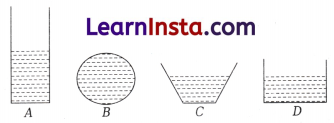
(a) Name the container in which water will evaporate faster than all others.
(b) Name the container in which water will evaporate very slowly.
Give reason for your answer.
Question 5.
The seat of a two-wheeler parked on a sunny day has become very hot. How can you cool it down?
Question 6.
During winters why do we see more fog in close areas where there are lots of trees?
Question 7.
Name two processes responsible for the formation of clouds.
Question 8.
What are the different ways by which water vapour is released into the atmosphere?
Question 9.
What happens to the water that rain and snow bring to various parts of the world?
Question 10.
Reflect on the statement “Water is our responsibility before it is our right.” Share your thoughts.
Question 11.
Fill in the blanks by selecting words from the following list: snow, rain, clouds, vapour, evaporation, transpiration.
Water, as ___ goes into atmosphere by the processes of ____ and ___ and forms ___ which on condensation fall in the form of ___ and ____.
Long Answer Type Questions
Question 1.
Explain the role of plants in adding water vapours into atmosphere.
Question 2.
During a hot summer day, Samaira after coming back from school, felt very warm. To cool down, she placed a wet cloth around her neck. She found that the cloth felt cooler as it dried. What can be the possible reason behind it? What happen if she used a dry cloth instead of a wet cloth?
Question 3.
The process of condensation plays an important role in bringing water back to the surface of earth. Explain how?
Question 4.
Fans move air around, creating a cooling sensation. It might seem strange to use a fan to dry wet clothes since fans usually make things cooler, not warmer. Normally, when water evaporates, it requires heat, not cold air. What do you think about this?
Question 5.
Usually, when sludge is removed from drains, it is left in heaps next to the drain for 3-4 days. Afterward, it is transported to a garden or a field where it can be used as manure. This approach reduces transportation cost of the sludge and enhances the safety of individuals handling it. Reflect upon it and explain how?
Skill Based Activities
Question 1.
Solve the following crossword puzzle with the help of clues given below.
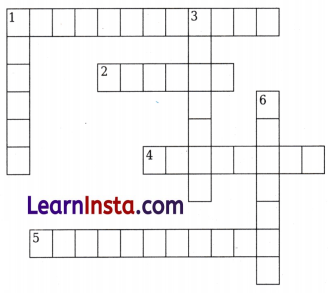
Across
1. Conversion of water vapour into water. (12)
2. Plants release excess of water in this form. (6)
4. Conversion of water into ice. (8)
5. Slow continuous conversion of water into steam. (11)
Down
1. Carriers of rain. (6)
3. The sound heard after a flash of lightning. (7)
6. Fast conversion of liquid into its vapour form. (7)
Question 2.
A list of jumbled words are given here. Write the correct form of each word,
- NOCNEDNOITAS
- TATNOIIPICERP
- VEAOPARNOIT
- TWAERCLEYC
Question 3.
Observe the following figure and give the answer of the following questions.

- What does this figures show?
- How do the clothes dry in sunlight?
Question 4.
There are certain terms which are used in the picture below. Define them in context to the picture.

Question 5.
Have you ever heard about Atmospheric Water Generator (AWG) machines? Find out detail about it.
Question 6.
Why does air containing water vapour go up in the atmosphere (thin layer of air that surrounds the Earth)?
Question 7.
The amount of water vapour in the air is also known as humidity. The daily humidity data for your area is reported in the newspapers and other sources. Compile the data for two months and study any patterns, if present and plot the graph.