Students can use Kaveri Class 9 English Book Solutions and Class 9 English Kaveri Book Poem 7 Question Answer Words as a quick reference guide.
Words Poem Class 9 Question Answer
Class 9 English Kaveri Poem 7 Question Answer
Class 9 Kaveri Poem 7 Words Question Answer
Reflect and Respond (NCERT Page 220)
I. Why are words important? Can we communicate without words? How? Share your answers with your classmates and teacher.
Answer:
- Words are important because they help us express our thoughts, feelings and ideas clearly.
- We cannot communicate properly without words, as they give meaning and structure to our messages.
II. Use the given sentences as clues to find words from the grid and fill the blanks. One example has been done for you.
My mother summoned me to introduce her friends.
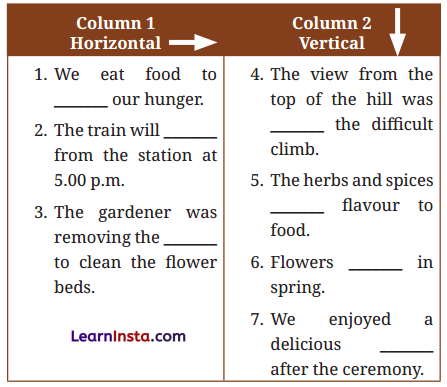
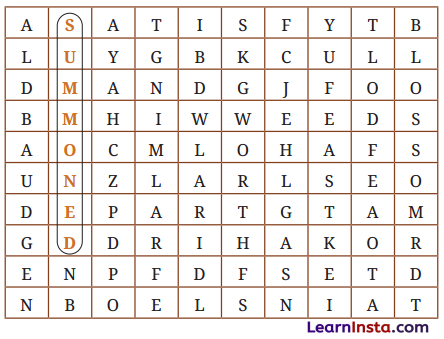
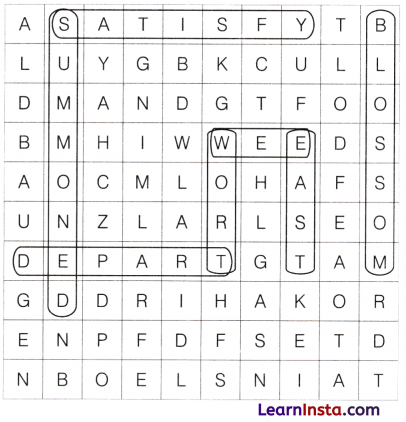
Answer:
1. satisfy
3. weeds
5. set
7. feast
2. depart
4. worth
6. blossom
Check Your Understanding (NCERT Page 222)
I. Fill in the blanks with one word from the poem. One example has been done for you.
In this poem, the poet reflects that words fail to truly satisfy what the heart wants to convey. Words are compared to summer birds who 1. _______ leaving nothing behind. The heart is equated to a 2. _______ who finds that words are as worthless as 3. _______ when needed. He feels that a few sincere words can bring more 4. _______ than many meaningless ones. He adds that a voice that brings happiness to a 5. _______ place does not say much, but the few words it does are very precious. Moreover, if words could satisfy us, the 6. _______ would celebrate but words often fail to do that. The poem ends on the note that empty words may look impressive with lots of flowers, but they cannot produce anything valuable, like a 7. _______ .
Answer:
- depart
- pilgrim
- weeds
- joy
- lonely
- world
- fruit
II. Let us appreciate the poem.
Question 1.
Read the poem again. Find any four sets of rhyming words and also write the rhyme scheme of the poem.
Answer:
Four sets of rhyming words are
- heart – depart
- care – air
- earth – worth
- needs – weeds
The rhyme scheme of the poem is ABAB CDCD EFEF.

Question 2.
Read the following phrases and sentences taken from the poem. Identify the poetic device in each of them and explain what the poet wants to communicate through their usage.
(i) But words, like summer birds, depart…
Answer:
Poetic device Simile
Explanation: Words are compared to summer birds using ‘like’. Just as summer birds stay briefly and then fly away, words also do not last long and fail to give lasting comfort to the heart.
(ii) heart, a pilgrim upon earth…
Answer:
Poetic device Metaphor
Explanation: The heart is described as a pilgrim, suggesting that it is always searching for meaning, comfort, and emotional fulfilment. Words alone cannot satisfy this deep inner journey.
(iii) words are of as little worth As just so many weeds
Answer:
Poetic device Simile
Explanation: Words are compared to weeds, which are useless and unwanted. This shows that empty or excessive words have little value, especially in times of real need.
(iv) If words could satisfy the chest… Oft satisfy the least!
Answer:
Poetic device Paradox
Explanation: The poet presents a contrast by saying that even if words could satisfy emotions, they often fail when needed most. This highlights the limitation of words in offering true comfort.
(v) The world might hold a feast…
Answer:
Poetic device Hyperbole
Explanation: The poet exaggerates by saying the world would celebrate if words could truly satisfy human emotions. This overstatement stresses how powerful words would be if they actually fulfilled emotional needs.
(vi) Like plants that make a gaudy show All blossom to the root
Answer:
Poetic device Simile
Explanation: Empty words are compared to showy plants that look attractive but lack substance. This suggests that impressive words without sincerity or action are shallow.
(vii) But whose poor nature cannot grow One particle of fruit!
Answer:
Poetic device Metaphor
Explanation: The fruit symbolises meaningful results or real emotional impact. The poet conveys that empty words, though attractive, fail to produce anything valuable or lasting.
Question 3.
Which words are repeated in the poem? Why does the poet use repetition?
Answer:
The words “words” and “heart” are repeated in the poem. The poet uses repetition to stress the contrast between empty words and true feelings of the heart, and to emphasise the main idea of the poem.
Question 4.
The stanzas 4, 5, and 6 end with exclamation marks. Choose the option that displays the emotions being expressed through them.
(i) 4. disillusionment
5. admiration and
6. frustration
(ii) 4. frustration
5. admiration and
6. disillusionment
(iii) 4. admiration
5. frustration and
6. disillusionment
(iv) 4. frustration
5. disillusionment and
6. admiration
Answer:
(ii) 4. frustration
5. admiration and
6. disillusionment
III. Identify examples of hyperbole from the given lines. If words could satisfy the chest, The world might hold a feast.
Work in pairs. Complete the sentences given below with hyperboles. Use the hints given in the brackets.
1. I have _______ things to do on this weekend. (lots of/tonnes of)
Answer: tonnes of
2. The player missed the basket by _______ (a mile/an inch)
Answer: a mile
3. My mother is so tired that she can sleep for a _______ (night/decade)
Answer: decade
4. I will be back in _______ (five minutes/two seconds)
Answer: two seconds
IV. Rhythm gives a lyrical quality to a poem. The rhythm (pattern of beats) in a line of poetry is described by a metrical form. A metre is formed by a stressed and an unstressed syllable. Syllable is the name given to a single unit of speech/beats of spoken language.
The metrical form in the first four lines is given below. The stressed syllables have been underlined.
If words could sa tis fy the heart,
The heart might find less care;
But words, like sum mer birds, de part,
And leave but emp ty air.
Now, listen to the teacher read the poem. As you listen, underline the syllables that are stressed in all the lines of the poem. Share your answers with the teacher.
Answer:
Do it Yourself
Critical Reflection (NCERT Page 224)
I. Read the following lines and answer the questions.
Extract 1
The heart, a pilgrim upon earth,
Finds often, when it needs,
That words are of as little worth
As just so many weeds.
(i) Why has the poet referred to the heart as ‘a pilgrim’?
Answer:
The poet calls the heart a pilgrim because it is always searching for true comfort, peace, and emotional fulfilment, just like a pilgrim travels in search of spiritual satisfaction.
(ii) When would a heart ‘need’ words?
Answer:
A heart would need words in times of emotional need, such as sorrow, loneliness, or suffering, when it seeks comfort, guidance, and understanding from others. Words become a bridge that connects one heart to another, offering hope and reassurance. They help express feelings that might otherwise remain hidden, bringing relief and healing through shared expression.
(iii) Complete the sentence with an appropriate reason. The words are like weeds because _______.
Answer:
They are useless and have little value when real comfort is needed.
(iv) Mention two emotions the heart might be experiencing when it finds words to be of ‘little worth’.
Answer:
The heart may be experiencing sadness and disappointment.
(v) What do these lines suggest about the nature of communication?
Answer:
These lines suggest that communication is meaningful only when it is sincere. Empty or excessive words do not truly satisfy emotional needs.
Extract 2
If words could satisfy the chest,
The world might hold a feast;
But words, when summoned to the test,
Oft satisfy the least!
(i) How can words ‘satisfy the chest’?
Answer:
Words can satisfy the chest (heart) by giving comfort, emotional relief, and happiness.
(ii) How can words be ‘summoned to the test’?
Answer:
Words are summoned to the test when they are used in difficult situations to see if they truly provide comfort or support.
(iii) What does ‘the world’ holding ‘a feast’ imply?
Answer:
‘The world’ holding ‘a feast’ implies great celebration and happiness. It means that if words could truly satisfy people’s emotions, everyone would celebrate joyfully.
(iv) Complete the sentence with an appropriate reason.
The poet mentions that words satisfy the least because _______ .
Answer:
they often fail to give real comfort when needed most.
(v) Select the word that does not mean the same as ‘oft’.
A always
B usually
C frequently
D often
Answer:
A always
II. Answer the following questions.
Question 1.
What is the comparison that the poet draws between words and ’empty air’?
Answer:
The comparison that the poet draws between ‘words’ and ’empty air’ is that words without true feeling are meaningless and disappear quickly without leaving any impact.
Question 2.
According to the poet, meaningful words are more precious than a lot of them. Explain.
Answer:
The poet believes that a few sincere and honest words are better than many meaningless ones. Meaningful words come from the heart and bring real happiness. Too many words without feelings are useless. So, true and simple words are more valuable than long speeches.
Question 3.
Do you agree that the poet presents contrasting ideas related to ‘words’ in the poem? If yes, why? If no, why not?
Answer:
Yes, I agree. The poet shows two sides of words. On one side, words often fail and feel empty. On the other side, a few sincere words can bring comfort and joy. This contrast helps us understand that not all words are useless; only empty ones are.
Question 4.
The theme of loneliness hovers over the poem. Support this statement with examples from the text.
Answer:
The theme of loneliness is clearly shown in the poem. The phrase ‘lonely home to cheer’ directly suggests emptiness and isolation. The heart is described as a pilgrim searching for comfort, which shows emotional longing. The poet also shows that words often fail to satisfy the heart, highlighting sadness and inner loneliness.
Question 5.
How does the poet convey the superficial nature of words? What ought to be done to address this?
Answer:
The poet conveys the superficial nature of words by comparing them to weeds and plants that blossom but bear no fruit, showing that many words may appear attractive but lack real meaning. To address this, people should use fewer words and speak with sincerity so that their words truly express the feelings of the heart.
Vocabulary in Context (NCERT Page 226)
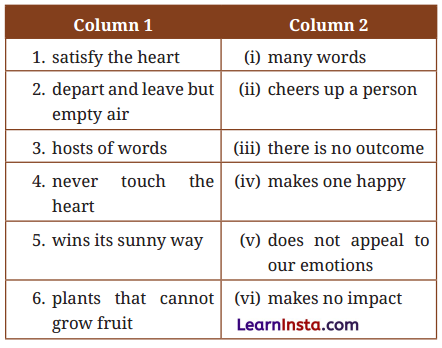
I. The poet has used some figurative phrases. Match the phrases in Column 1 with their correct meanings in Column 2. Use each phrase in a sentence of your own.
Answer:
| Column 1 | Column 2 |
| 1. satisfy the heart | (iv) makes one happy |
| 2. depart and leave but empty air | (vi) makes no impact |
| 3. hosts of words | (i) many words |
| 4. never touch the heart | (v) does not appeal to our emotions |
| 5. wins its sunny way | (ii) cheers up a person |
| 6. plants that cannot grow fruit | (iii) there is no outcome |
Sentences
- Kind words can satisfy the heart and make us feel happy.
- His promises departed and left but empty air, so nothing changed.
- He used hosts of words, but he did not say anything important.
- His speech did not touch the heart of the people.
- Her sweet voice wins its sunny way and cheers everyone.
- Empty words are like plants that cannot grow fruit, because they give no result.
II. Create a Word Map for each of the words from the poem given in the box.

To complete the word map, include:
- Meaning (in your own words)
- Synonyms of the word – Antonyms of the word
- Sentence using the word
- A quick sketch or symbol that represents the word. One example has been done for you.
Word: cheer
Meaning: to give a loud shout of approval or encouragement. Synonym comfort
Antonym sadden
Sentence: The audience cheered her for a great performance.
Sketch a picture of sunshine, a sunflower, or a smiling face.

Answer:
1. Word: depart
- Meaning: to go away
- Synonym leave
- Antonym arrive
- Sentence: The train will depart at 5 p.m.
- Sketch: A bus or train moving away.

2. Word: pilgrim
- Meaning: a person who travels to a holy place
Synonym traveller - Antonym resident
- Sentence: The pilgrim walked a long distance to the temple.
- Sketch: A person walking with a stick and bag.

3. Word: sunny
- Meaning: bright and full of sunlight
- Synonym bright
- Antonym cloudy
- Sentence It was a sunny day.
- Sketch A shining sun.

4. Word: satisfy
- Meaning: to make happy or fulfilled
- Synonym please
- Antonym disappoint
- Sentence: Good marks satisfy me.
- Sketch A smiling face.

5. Word: heart
- Meaning: feelings and emotions
- Synonym: mind (feelings)
- Antonym (no direct opposite, but) hatred
- Sentence: Her kind words touched my heart.
- Sketch A heart shape.

6. Word: word
- Meaning: something we speak or write
Synonym speech - Antonym silence
- Sentence: He kept his word.
- Sketch A speech bubble.

Speaking Activity (NCERT Page 227)
I. Read the following quotations and select the one you like the most. Explain the quotation and share the reason for your choice with your classmates and teacher. You may talk about a connected personal experience too.
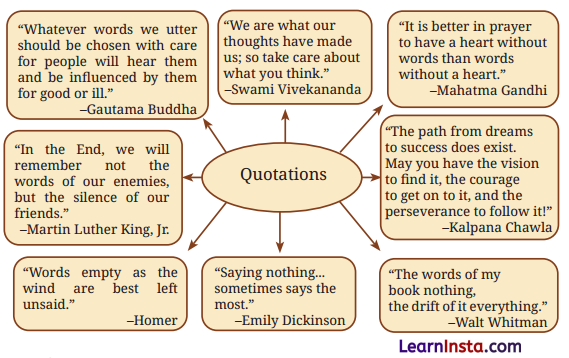
You may use the cues given below to state your choice and the reason.
- I chose _______ because…
- I selected _______ since…
- I decided on _______ due to…
- I picked _______ as…
- I settled for _______ because…
Answer:
I chose the quotation by Mahatma Gandhi, “It is better in prayer to have a heart without words than words without a heart,” because it teaches us that feelings are more important than big speeches. I think this quote is true because sometimes people say many words but do not mean them. In my life, I have seen that when someone speaks kindly from the heart, it feels more special. So, I like this quotation as it tells us to be sincere.
Writing Task (NCERT Page 228 & 229)
I. Write an essay on any one quotation from speaking activity. Follow the guidelines given below while drafting the essay.
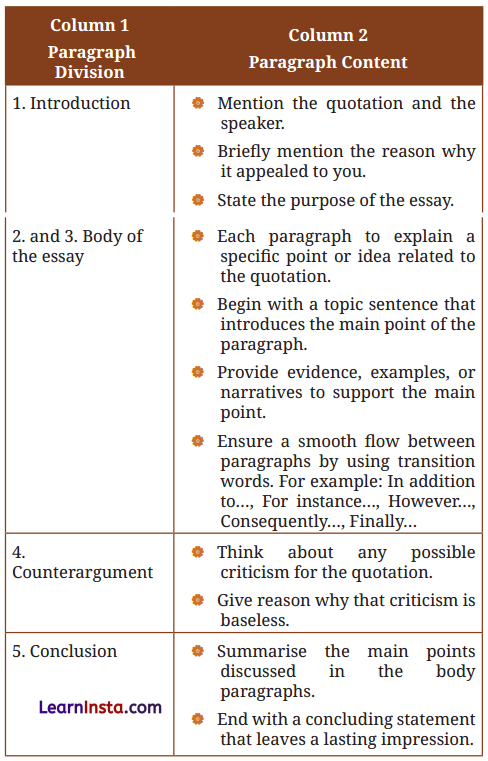
Answer:
The Path from Dreams to Success
“The path from dreams to success does exist. May you have the vision to find it, the courage to get on to it, and the perseverance to follow it!” said Kalpana Chawla. This quotation inspires me because it gives hope and motivation. It shows that success is possible if we work hard. In this essay, I will explain how dreams, courage, and perseverance help us succeed.
Firstly, dreams give direction to our lives. When we dream big, we set goals for ourselves. For example, Kalpana Chawla dreamed of becoming an astronaut and worked hard to achieve it. Similarly, students who dream of becoming doctors or teachers study sincerely to reach their aim.
Secondly, courage and perseverance are necessary to achieve success. However, the path to success is not easy. We face failures and difficulties. Consequently, we must stay strong and continue working hard. Finally, consistent effort leads to success.
Some people say that not everyone can achieve their dreams. However, this idea is baseless because hard work and determination can change our future. In conclusion, dreams, courage, and perseverance lead to success. We must never stop believing in ourselves.