Experts have designed these Class 9 Science Notes and Exploration Chapter 4 Describing Motion Around Us Class 9 Notes for effective learning.
Class 9 Science Chapter 4 Exploration Describing Motion Around Us Notes
Class 9 Science Exploration Chapter 4 Notes
Class 9 Science Chapter 4 Notes – Class 9 Describing Motion Around Us Notes
→ Average Acceleration: Change in velocity divided by time interval.
Formula:
a = \(\frac{v-u}{t_2-t_1}\)
SI unit is m/s2. Vector quantity.
→ Average Speed: Total distance travelled divided by the total time interval. Scalar quantity. SI unit is m/s.
→ Average Velocity: Displacement divided by time interval. It is the average rate of change of position. Vector quantity. SI unit is m/s.
Formula: vav = \(\frac{s}{t}\)
→ Circular Motion: Motion of an object along a circular path.
→ Displacement: The net change in position of an object between two instants of time. It is a vector quantity (has magnitude and direction). SI unit is metre (m). It can be positive, negative, or zero.
→ Distance: The total length of the actual path covered by an object during its motion. It is a scalar quantity. SI unit is metre (m). It is always positive.
→ Instantaneous Velocity: The velocity of an object at a particular instant of time (not over a time interval). It is the limiting value of average velocity as the time interval approaches zero.
→ Linear Motion (Motion in a Straight Line): Motion of an object along a straight line. It is the simplest form of motion.

→ Kinematic Equations: Mathematical equations that describe motion with constant acceleration.
The three equations are:
v = u + at,
s = ut + ½ at2,
v2 = u2 + 2as.
→ Magnitude: The numerical value (with unit) of a physical quantity. For displacement, the magnitude is the straight-line distance between the two positions.
→ Motion: An object is in motion when its position with respect to the reference point changes with time.
→ Non-Uniform Motion: Motion in which an object covers unequal distances in equal time intervals. The speed keeps changing.
→ Position: The distance and direction of an object from the reference point at any given instant of time.
→ Position-Time Graph: A graph where position is plotted on the y-axis and time on the x-axis. The slope gives the velocity. A straight line means constant velocity; a curve means changing velocity.
→ Rate of Change: The ratio of change in one quantity to the corresponding change in time. For example, velocity is the rate of change of position.
→ Reference Point: A fixed point chosen to describe the position of an object also called the origin.
→ Rest: An object is at rest when its position with respect to the reference point does not change with time.
→ Retardation (Deceleration): Negative acceleration. When the magnitude of velocity decreases, the acceleration is opposite to the direction of motion and is called retardation.
→ Scalar Quantity: A physical quantity that is completely described by its magnitude (numerical value with unit) alone, without needing direction. Examples: distance, speed, time, mass.
→ Tangent: A straight line that meets a circle at exactly one point. In uniform circular motion, the velocity at any point is directed along the tangent to the circle at that point.
→ Time Period (T): The time taken by an object to complete one full revolution in circular motion.
→ Uniform Acceleration: When the velocity of an object changes by equal amounts in equal time intervals, the acceleration is uniform (constant).
→ Uniform Circular Motion: Motion of an object along a circular path with constant (uniform) speed. Although speed is constant, velocity changes because direction changes continuously, making it an accelerated motion.
→ Uniform Motion: Motion in which an object covers equal distances in equal time intervals. The object moves at a constant speed.
→ Vector Quantity: A physical quantity that requires both magnitude and direction for complete description. Examples: displacement, velocity, acceleration, force.
→ Velocity-Time Graph: A graph where velocity is plotted on the y-axis and time on the x-axis. The slope gives acceleration. The area under the graph gives displacement.
→ Rest: A body is said to be at rest if it does not change its position with respect to its surroundings. A table lying in a room is at rest with respect to the walls of the room.
→ Motion: A body is said to be in motion if it changes its position with respect to its surroundings. Thus, motion means movement of bodies. A car running on the road is in motion with respect to the lamp posts, trees or bus stop on the roadside.
Motion in a Straight Line
When an object moves in a straight line, it is called linear motion or motion in a straight line. This is the simplest type of motion.
Example:
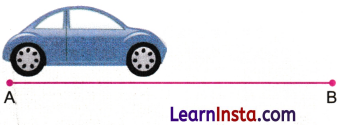
If a car moves from point A to point B along a straight road, it is an example of motion in a straight line.
Other Examples:
(i) An apple falling vertically from a tree,
(ii) An athlete running a 100-metre sprint on a straight track.
Describing Position
To describe the position of any object, we first need to fix a reference point. This fixed point is called the reference point or origin. The position of an object at any instant of time is described by its distance from the reference point and the direction in which it is located from that reference point.
An object is said to be in motion when its position with respect to the reference point changes with time. An object is said to be at rest when its position with respect to the reference point does not change with time. Note that both rest and motion are relative, meaning they depend on the choice of reference point.
For motion in a straight line, positions to the right of the origin are generally taken as positive (+) and positions to the left are taken as negative (-). This is a convention that we follow.
Distance Travelled and Displacement
Distance is the total path length covered by an object during its motion. It is a scalar quantity, meaning it has only magnitude (numerical value) and no direction. It can never be negative. The SI unit of distance is metre (m).
Displacement is the net change in position of an object between two given instants of time. It is a vector quantity, meaning it requires both a numerical value (magnitude) and a direction to be described completely. Displacement can be positive, negative, or zero.
The magnitude of displacement is the straight-line distance between the starting position and the ending position of the object. The direction is from the starting position towards the ending position.
Example:
An athlete starts from point O, runs to A (100 m away), then comes back to B (which is 40 m from O). Total distance = OA + AB = 100 + 60 = 160 m. But displacement = OB = 40 m in the positive direction.

Average Speed and Average Velocity
Average speed tells us how fast or slow an object moves overall. It is defined as total distance travelled divided by the total time interval.
Average speed = \(\frac{\text { Total distance travelled }}{\text { Time interval }}\)
Its SI unit is metre per second (m/s). It is also measured in kilometre per hour (km/h). It is a scalar quantity (no direction needed).

If an object covers equal distances in equal time intervals for all possible choices of time intervals, it is in uniform motion in a straight line. It moves at a constant speed. If it covers unequal distances in equal intervals, it is in non-uniform motion.
Average Velocity describes how fast the position of an object is changing and in which direction. It is defined as the change in position (displacement) divided by the time interval.
Change in position Average velocity = \(\frac{\text { Change in position }}{\text { Time interval }}\)
= \(\frac{\text { Displacement }}{\text { Time interval }}\)
or vav = \(\frac{s}{t}\)
where vav = average velocity,
s = displacement,
t = time interval
Its SI unit is also metre per second (m/s). It is a vector quantity.
Key Point:
- For motion in a straight line in one direction only (no turning back), the average speed and the magnitude of average velocity are equal. However, if the object turns back, average speed will be greater than the magnitude of average velocity. The average velocity can even be zero (when the object returns to its starting point) while the average speed is not zero.
- The reading of the speedometer of a vehicle is nearly (but not exactly) the same as the magnitude of the velocity of the vehicle at that instant. The direction of the tyres gives the direction of velocity at that instant.
Example 1:
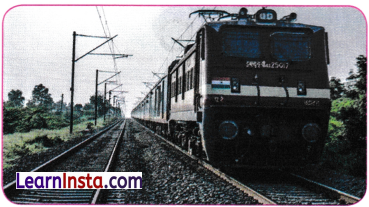
The Rajdhani Express travels from Mumbai to Delhi a distance of 1384 km. It starts from Mumbai at 4.00 p.m. and reaches Delhi at 9.00 a.m., the next day. What is its average speed?
Answer:
Here, total distance travelled = 1384 km
and total time taken = 4 pm to midnight + Midnight to 9 am
= 8 + 9 = 17 hours
Average speed = \(\frac{\text { Total distance travelled }}{\text { Time interval }}\)
= \(\frac{1384}{17}\)
= 81.4 km/h
Example 2.
A cheetah is the fastest land animal and can achieve a peak velocity of 100 km/h upto distances less than 500 m. If a cheetah spots its prey at a distance of 100 m, what is the minimum time it will take to get its prey, if the average velocity attained by it is 90 km/h.
Answer:
Here, v = 90 km/h
(∵ 1 km = 1000 m, 1 h = 60 × 60 = 3600 s)
= \(\frac{90 \times 1000 \mathrm{~m}}{3600 \mathrm{~s}}\)
= 25 m/s
and s = 100 m
Now we know that
vav = \(\frac{s}{t}\)
⇒ Minimum time, t = \(\frac{s}{v_{a v}}\)
= \(\frac{100}{25}\) = 4 s.
Average Acceleration
When the velocity of an object changes with time, the object is said to be accelerating. Average acceleration is the change in velocity divided by the time interval during which this change occurs.
Average acceleration = \(\frac{\text { Change in velocity }}{\text { Time interval }}\)
= \(\frac{\text { Final velocity – initial velocity }}{\text { Time interval }}\)
The formula is a = \(\frac{v-u}{t_2-t_1}\)
The SI unit of average acceleration is metre / second (ms-2). Like displacement and velocity, acceleration is also a vector quantity (both magnitude and direction are needed).
For motion in a straight line:
When the magnitude of velocity is increasing, acceleration is in the same direction as velocity (positive acceleration or speeding up). When the magnitude of velocity is decreasing, acceleration is opposite to the direction of velocity (negative acceleration or deceleration, also called retardation).
Acceleration can result from change in the magnitude of velocity (speed), or change in the direction of motion, or both. Even if an object moves at constant speed, it can still accelerate if its direction of motion changes.
An object can be moving very fast yet have zero acceleration (constant velocity). Acceleration depends on how quickly velocity changes, not on how fast the object is moving.
Graphical Representation of Motion
Plotting a Graph: A graph is a visual (pictorial) way of representing motion. It helps us see how position, velocity, or acceleration changes with time. We plot time on the x-axis (horizontal) and the quantity we want to study (position, velocity) on the y-axis (vertical).
Steps to plot a graph: Choose a suitable scale for each axis, mark values along both axes from the origin, plot each point by finding the intersection of the appropriate time and position values, and then join all the points with a smooth line or curve.
Position-Time Graphs
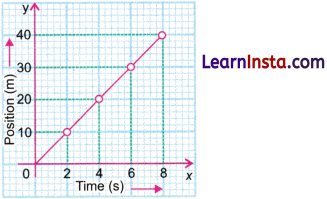
A position-time graph shows how the position of an object changes with time. Time is on the x-axis and position is on the y-axis.
What the shape tells us:
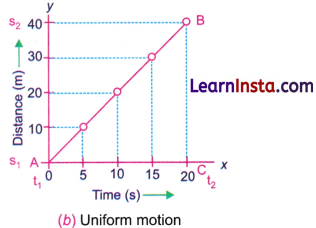
A straight line inclined to the time axis means the object is moving with a constant velocity (uniform motion). A curved line (getting steeper with time) means the velocity is changing, so the object is in accelerated motion. A straight line parallel to the time axis (horizontal line) means the position is not changing with time, so the object is at rest.
(a) Body at rest

(b) Uniform motion
What else can we find:
The slope (steepness) of the straight line on a position-time graph gives the magnitude of average velocity. A steeper line means higher velocity. If two objects are shown on the same graph, the one with the steeper line has higher velocity.
velocity = \(\frac{BC}{CA}\)
= \(\frac{s_2-s_1}{t_2-t_1}\)
Here BC is the vertical change in position and CA is the horizontal change in time in the triangle formed on the graph.
(c) speed = slope of curve
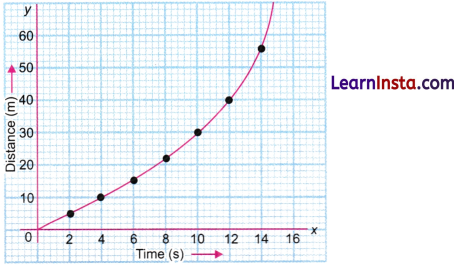
(d) Accelerated motion
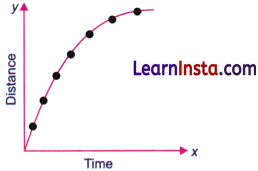
Velocity-Time Graphs:
A velocity-time graph shows how the velocity of an object changes with time. Time is on the x-axis and velocity is on the y-axis.
What the shape tells us:
A straight line parallel to the x-axis means velocity is constant and acceleration is zero (uniform motion). A straight line inclined upward (positive slope) means velocity is increasing with constant acceleration (uniform acceleration). A straight line inclined downward (negative slope) means velocity is decreasing with constant acceleration (deceleration).
Two things we can calculate from a velocity-time graph:
- The slope of the line gives the acceleration of the object.
Slope = \(\frac{\text { change in velocity }}{\text { change in time }}\) = acceleration. - The area enclosed by the velocity-time line and the time axis gives the displacement of the object in that time interval.
For a rectangle (constant velocity):
Area = velocity × time = displacement.
For a trapezium (changing velocity with constant acceleration):
Area = area of rectangle + area of triangle = displacement.
(a) Uniform (Constant) velocity (Zero acceleration))
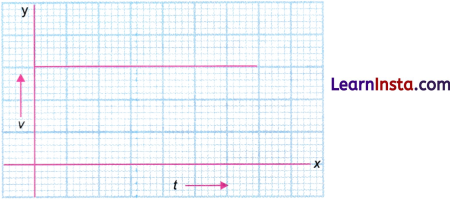
(b) Uniform velocity (Uniform +ve acceleration)
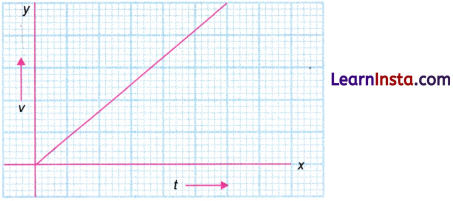
(c) Non-uniform velocity (Non-uniform acceleration)
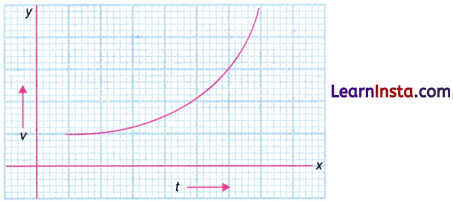
(d) Uniform velocity (Uniform -ve acceleration (retardation))

(e) Non-Uniform velocity (Non-uniform -ve acceleration)
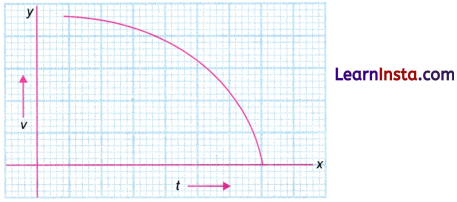
(f) Non-Uniform uneven velocity (Non-uniform uneven acceleration)
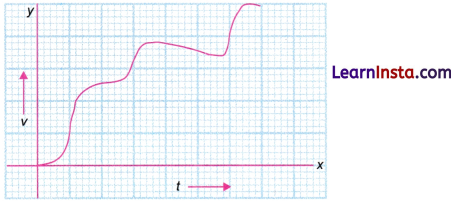
(g) Uniform acceleration
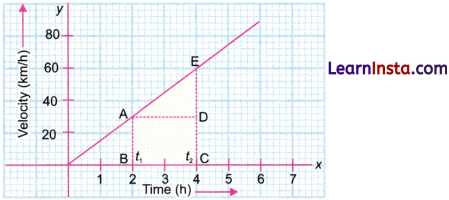
Example 3.
A moving train is brought to rest within 20 s by applying brakes. Find initial velocity if the retardation due to brakes is 1.5 ms-2.
Ans.
Here, t = 20 s,
v = 0,
a = – 1.5 m/s2,
u = ?
as v = u + at
∴ 0 = u – 1.5 × 20
or u = 1.5 × 20 = 30 ms-1
So the initial velocity of the train = 30 ms-1.
Example 4.
A car starting from rest on a straight road accelerates at a constant rate of 4 ms-2 for 7 seconds. How far does the car travel during this time?
Ans.
Here, u = 0,
a = 4 ms-2,
t = 7 s,
s = ?
s = ut + ½ at2
= 0 × 7 + ½ × 4 × 72 = 98m
∴ Distance travelled by the car = 98 m.
Example 5.
A wooden slab starting from rest, slides down an inclined plane of length 10 m with an acceleration of 5 ms-2. What would be its speed at the bottom of the inclined plane?
Ans.
Here, u = 0,
s = 10 m,
a = 5 ms-2
∵ v2 – u2 = 2 as
∴ v2 – 02 = 2 × 5 × 10 = 100
or v = \(\sqrt{100}\) = 10 m/s
∴ Speed of the slab at the bottom of inclined plane = 10 m/s.
Example 6.
Give one similarity and one dissimilarity between the following two graphs.
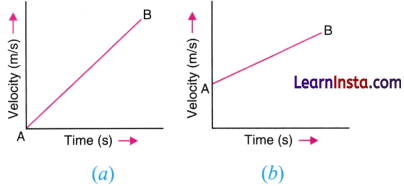
Ans.
Similarity: Both the graphs represent uniform acceleration.
Dissimilarity: The initial velocity of the object in graph (a) is zero while the object has some non-zero initial velocity in graph (b).
Example 7.
Draw velocity-time graphs for the following cases:
(i) when the object is at rest.
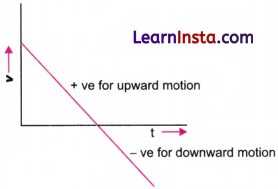
(ii) when the object is thrown vertically upwards.
Ans.
(i) When the object is at rest, v = 0. The v – t is a straight line on the time-axis, as shown in Fig (a).

(ii) When the object is thrown vertically upwards, it has decreasing velocity for upward motion and then increasing -ve velocity for downward motion, as shown in Fig. (b).
Kinematic Equations for Motion in a Straight Line with Constant Acceleration
These equations are valid only when acceleration is constant. There are three main kinematic equations that connect the five quantities: displacement (s), time interval (t), initial velocity (u), final velocity (v), and acceleration (a).
Equation 1: v = u + at.
This equation connects final velocity, initial velocity, acceleration, and time. Use this when you know three of these four and need to find the fourth.
Equation 2: s = ut + ½ at2.
This equation connects displacement, initial velocity, time, and acceleration. Use this when you need to find displacement or time.
Equation 3: v2 = u2 + 2as.
This equation connects final velocity, initial velocity, acceleration, and displacement. Use this when time is not given or not needed.
Two more equations that can be derived from the above:
s = ut – ½ at2.
And s = ½ (u + v) × t (average velocity formula for constant acceleration).
Note:
These equations are derived from the velocity-time graph. Equation 1 comes from the slope of the graph. Equation 2 comes from the area under the graph. Equation 3 is derived by eliminating t from equations 1 and 2.
Example 8.
The brakes applied to a car produce an acceleration of 6 m s-2 in the opposite direction to the motion. If the car takes 2 s to stop after the application of brakes, calculate the distance it travels during this time.
Solution:
Here a = – 6 ms-2
(negative because it is in the opposite direction of motion);
t = 2 s and v = 0 ms-1
We know that
v = u + at
⇒ 0 = u + (- 6) × 2
⇒ u = 12 m s-1
Also s = ut + ½ at2
= (12) × (2) + (- 6) (2)2
= 24 m – 12 m = 12 m
Thus, the car will move 12 m before it stops after the application of brakes.
Motion in a Plane
When an object moves in two dimensions (like a vehicle overtaking, a kicked ball, or a satellite in circular orbit), it is called motion in a plane or motion in two dimensions.
Uniform Circular Motion:
When an object moves in a circular path, its motion is called circular motion. When it moves in a circular path with constant (uniform) speed, it is called uniform circular motion.
For circular motion: The distance travelled in one complete revolution is the circumference of the circle = 2 πR (where R is the radius). However, the displacement after one complete revolution is zero because the object returns to its starting position.
The average speed (vav) in uniform circular motion = \(\frac{2 \pi R}{T}\),
where T is the time taken for one complete revolution (called the time period).
Must Remember:
- In uniform circular motion, the speed is constant, but the velocity is not constant. This is because the direction of motion changes continuously at every point on the circle. Since velocity changes, the object is accelerating (even though its speed is constant). This acceleration is due to change in direction only.
- The velocity of an object moving in a circle at any point is directed along the tangent to the circle at that point. A tangent is a straight line that meets the circle at exactly one point.
Examples of uniform circular motion:
A satellite moving in a circular orbit, a stone tied to a string and swung in a circle, an athlete running on a circular track at constant speed.