Experts have designed these Class 9 Science Notes and Exploration Chapter 5 Exploring Mixtures and Their Separation Class 9 Notes for effective learning.
Class 9 Science Chapter 5 Exploring Mixtures and Their Separation Notes
Class 9 Science Exploration Chapter 5 Notes
Class 9 Science Chapter 5 Notes – Class 9 Exploring Mixtures and Their Separation Notes
→ Alloy: A homogeneous mixture of two or more metals or a metal and a non-metal.
→ Alum: A substance used as a coagulant to help impurities clump together.
→ Centrifugation: A technique used to separate heavier solid particles from a solid-liquid mixture by rotating it at high speed.
→ Coagulation: The process in which a coagulant is added to make fine particles clump together and settle down.
→ Crystal: A solid in which particles are arranged in a regular geometric pattern.
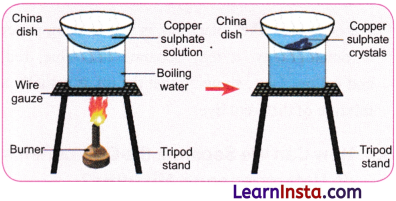
→ Crystallization: A technique used to obtain a pure solid from its saturated solution.
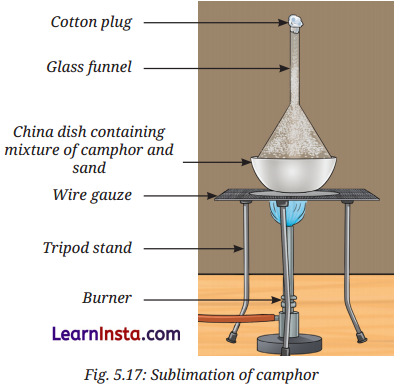
→ Deposition: The process in which vapours change directly into solid without becoming liquid.

→ Dispersing Medium: The solvent-like component in a colloidal solution in which the dispersed phase is distributed.
→ Dispersed Phase: The solute-like component present in a colloidal solution.
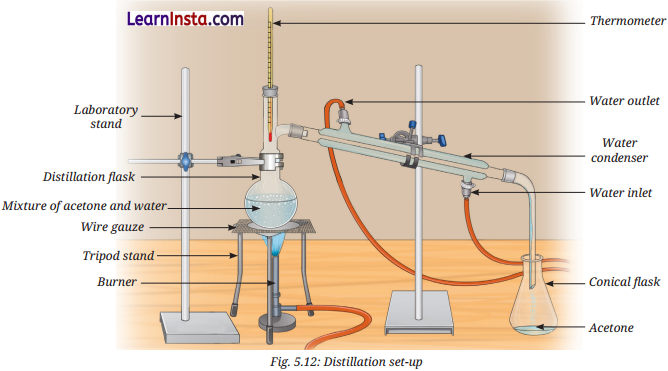
→ Distillation: A method used to separate two miscible liquids having a sufficient difference (generally 25°C or more) in their boiling points, or to obtain a liquid from a mixture of a liquid and a solid.
→ LPG (Liquefied Petroleum Gas): A fuel obtained by fractional distillation of crude (unrefined) petroleum.
→ ORS (Oral Rehydration Solution): A solution used to treat dehydration caused by loss of fluids.
→ Paper Chromatography: A technique used to separate components based on differences in their solubility and movement on paper.
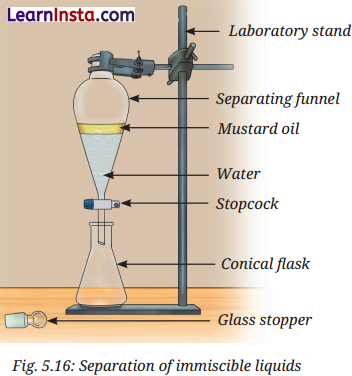
→ Separating Funnel: An equipment used to separate two immiscible liquids based on their different densities.
→ Solute: The component of a solution that dissolves in the solvent and is present in a smaller quantity.
→ Solvent: The component of a solution that dissolves the solute and is present in a larger quantity.
→ Sublimation: The process in which a solid changes directly into vapour without passing through the liquid state.
→ Sulphuric Acid: A chemical substance sometimes used in the crystallization of certain type of salts.
→ Tyndall effect: The phenomenon in which the path of light becomes visible due to scattering by colloidal particles.
→ Waste Segregation: The process of separating waste into dry waste (plastic, paper, glass, metal) for recycling and wet waste (food scraps, vegetable peels) for composting.
Introduction
A substance containing two or more elements or compounds in any proportion and the components which can be separated by simple mechanical (physical) methods is called a mixture.
Examples: Air, Gun powder, Steel etc.
How Can We Classify Mixtures?
Homogeneous Mixture (or a Solution): A mixture which has a uniform composition (evenly distributed) throughout is called a homogeneous mixture.
Examples: Sugar in water, Salt in water.
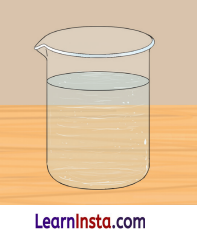
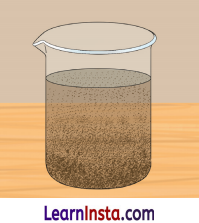
Heterogeneous Mixture: A mixture which contains physically distinct parts and has a non¬uniform composition (uneven distributed) is called a heterogeneous mixture.
Examples: Mixture of salt and iron filings, sand and water.
Solutions
Anything dissolved in a solution is referred to as a solute. Two of the most prevalent solutes in our daily lives are salt and sugar. Salt and sugar are solutes because they dissolve in water.
Examples of the solutes include dissolved carbon dioxide, oxygen, water vapour, carbon dioxide, argon, etc.
Solvent refers to the component of a solution that is most prevalent. If is the fluid in which the solute has been dissolved. Typically, a solvent is a liquid. The Latin term solv, which means “to loosen or untie,” is the source of the English word “solvent.”
Examples of the solvents include water, ethanol, methanol, acetone, tetrachloroethylene, toluene, methyl acetate, and ethyl acetate.
→ Concentration of a Solution: The amount of solute that has dissolved in a specific amount of solvent or solution is measured as solution concentration. A concentrated solution is one that has a fixed amount of dissolved solute in it. A diluted solution is one that has a relatively small amount of dissolved solute in it compared to the solvent.
→ How do we Express Concentration?
Concentration of a solution is commonly expressed in three ways:
A. Mass by mass percentage of a solution (% m/m or % w/w)
Mass by mass % of a solution refers to the mass of solute present per 100 g of the solution.
Mass by mass % of a solution = \(\frac{\text { Mass of solute}}{\text { Mass of solution }}\) × 100
Example 1.
What is the mass percent of caustic soda, if 10 grams of it are dissolved in 100 grams of water?
Solution:
Here, total mass of compound = 10 + 100 = 110 grams
We know that, mass percent = \(\frac{\text { Mass of solute of chemical }}{\text { Total mass of compound }}\) × 100
Mass percent of caustic soda = \(\sqrt{\frac{10}{110}}\) × 100
= 9.09%
Example 2.
6 g of urea was dissolved in 500 g of water. Calculate the percentage by mass of urea in the solution.
Solution:
Given:
Mass of solute (urea) = 6 g,
Mass of solvent (water) = 500 g
To find: Percent by mass = ?
Mass of solution = Mass of solute + Mass of solvent
= 6 g + 500 g = 506 g
Percentage by mass of urea = \(\frac{\text { Mass of solute}}{\text { Mass of solution }}\) × 100
= \(\frac{6}{506}\) × 100 = 1.185 %
B. Mass by volume percentage of a solution (% m/v or % w/v)
Mass by volume % of a solution refers to the mass of solute present per 100 mL of the solution.
Mass by volume % of a solution = \(\frac{\text { Mass of solute}}{\text { Volume of solution }}\) × 100
Example 3.
A solution contains 5 g of sugar dissolved in 100 mL of water. What is the % m/v of the solution?
Solution:
Here, % m/v = \(\frac{\text { Mass of solute}}{\text { Volume of solution }}\) × 100
= \(\frac{5}{100}\) × 100 = 5%
The solution is 5% m/v sugar solution.
Example 4.
How many grams of NaCl are needed to prepare 200 mL of a 0.9% m/v saline solution?
Solution:
Here, mass of solute = \(\frac{\% \mathrm{~m} / \mathrm{v} \times \text { Volume }}{100}\)
= \(\frac{0.9 \times 200}{100}\) = 1.8 g
We need 1.8 g of NaCl.
C. Volume by volume percentage of a solution (% v/v)
For gases and liquids, volumes are relatively easy to measure, so the concentration of a liquid or a gas solution can be expressed as a volume/volume percent (% v/v): the volume of a solute divided by the volume of a solution times 100:
Volume by volume percentage = \(\frac{\text { Volume of solute }}{\text { Volume of solution }}\) × 100
Example 5.
Determine the volume/volume percent of a solution made by combining 25 mL of ethanol with enough water to produce 200 mL of the solution.
Solution:
Given:
Volume of solute (ethanol) = 25 mL
Volume of the solution = 200 mL
Substitute the values in the given formula,
Volume/volume percent = \(\frac{\text { Volume of solute }}{\text { Volume of solution }}\) × 100
= \(\frac{25 \mathrm{~mL}}{200 \mathrm{~mL}}\) × 100 % = 12.5 %
Example 6.
A solution is prepared by dissolving 90 mL of hydrogen peroxide in enough water to make 3000 mL of solution. Identify the concentration of the hydrogen peroxide solution.
Solution:
The given parameters are:
Volume of solute (hydrogen peroxide) = 90 mL
Volume of solution = 3000 mL
Substitute the values in the given formula,
Volume/volume percent = \(\frac{\text { Volume of solute }}{\text { Volume of solution }}\) × 100
= \(\frac{90 \mathrm{~mL}}{3000 \mathrm{~mL}}\) × 100 % = 3 %
Solubility of Substances
A saturated solution is one that contains the maximum quantity of solute that can be dissolved in the solvent at a given temperature. Unsaturated solutions, on the other hand, are those that contain less solute than the maximum quantity the solvent can dissolved at. The amount of a solute that dissolves in a specific quantity of solvent is known as its solubility. The majority of solutes become more soluble when the solvent’s temperature rises. But in the case of gases dissolved in liquids, their solubility usually decreases as the temperature increases.
Factors Affecting Solubility:
- Temperature – Solubility increases with temperature. The situation is different for gases. With the increase in temperature, they became less soluble in each other and in water but more soluble in organic solvents.
- Pressure – For the majority of solid and liquid solutes, pressure does not affect solubility. The solubility of gas is directly proportional to the pressure of this gas.
Methods of Separation of Homogeneous Mixtures
→ Crystallization:
A crystal is a solid in which the particles—atoms, ions, or molecules—are arranged in a regular geometric pattern.
Crystallization is the process of forming crystals from a saturated solution. It is widely used in laboratories and industries for separating solids, purifying substances, and studying crystal structures.
→ Distillation: Distillation is a method used to separate a homogeneous mixture of two miscible liquids or to recover a solvent from a solution. The principle is based on differences in boiling points. When the mixture is heated, the liquid with the lower boiling point vaporises first. This vapour is then cooled in a condenser, turning back into liquid, and collected separately.
→ Paper Chromatography:
Paper chromatography is a simple separation technique. It is used to separate and identify the different components of a mixture, especially coloured substances like inks or plant pigments.
In this method, a small spot of the mixture is placed on a strip of chromatography paper. The paper is then dipped into a suitable solvent (such as water or alcohol), making sure the spot is above the solvent level. As the solvent rises up the paper by capillary action, it carries the substances in the mixture along with it. Different substances travel at different speeds depending on their solubility in the solvent and their attraction to the paper. This produces a pattern of separated spots at different heights, called a chromatogram.
For example, when black ink is tested using paper chromatography, it may separate into blue, red, and yellow spots, showing that the ink is actually a mixture of different dyes.
How Can We Separate the Components of Heterogeneous Mixtures?
→ Separation of two immiscible liquids
Immiscible liquids are those that do not mix uniformly with each other, such as oil and water. When poured into a separating funnel, they form two distinct layers because of their different densities. The heavier liquid (like water) settles at the bottom, while the lighter liquid (like oil) floats on top.
The separating funnel has a stopcock at the bottom. By carefully opening it, the heavier liquid can be drained out first into a container. Once the heavier liquid is removed, the stopcock is closed, and the lighter liquid is left behind in the funnel.
→ Sublimation: Sublimation is the process in which a solid changes directly into vapour without passing through the liquid state. Camphor is a common example: when its melt¬ing point, it sublimes into vapour. On cooling, these vapours condense back into solid without becoming liquid, and this reverse process is called deposition.
An alloy is a homogeneous mixture of two or more metals, or a metal and a non metal. The components of an alloy cannot be separated by physical methods because they are mixed at the atomic level. Alloys are prepared to make materials stronger, more rigid, or resistant to corrosion.
Examples of Alloys:
- Bronze: 80% copper + 20% tin
- Brass: 80% copper + 20% zinc
- Stainless steel: iron + carbon (0.03 – 0.8%) + chromium (16 – 18%) + nickel (10 – 14%) + molybdenum (2 – 3%)
Suspensions
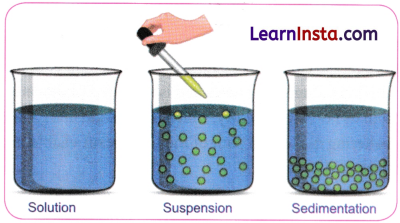
Suspensions are heterogeneous mixtures in which solid particles are spread throughout a liquid but do not dissolve. The particles are large enough to be seen with the naked eyes, they scatter light (showing the Tyndall effect), and they settle down on standing. Examples include muddy water, chalk powder in water, and flour in water.
A. Centrifugation is a technique used to separate insoluble particles from a liquid by spinning the mixture at high speed. The heavier particles settle at the bottom while lighter ones remain at the top. For example, cream can be separated from milk using centrifugation.
Centrifugation is widely used in laboratories to separate the components of blood.
B. Coagulation: Alum (fitkari) is commonly used in water purification because it helps remove fine suspended particles from muddy water. When powdered alum is added, it causes these particles to clump together in a process called coagulation. The larger clumps then settle down due to gravity (sedimentation) and can be separated by decantation or filtration.
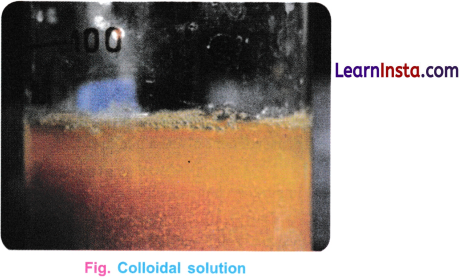
→ Colloids: Colloids are described as special mixtures that are neither true solutions nor suspensions. A colloid is a heterogeneous mixture in which very small particles of one substance are evenly spread throughout another. These particles are larger than those in a solution but smaller than those in a suspension, so they cannot be seen with the naked eye, yet they scatter light. Common examples include milk (fat particles dispersed in water), fog (tiny water droplets dispersed in air), smoke (solid particles dispersed in air), and starch solution.
Tyndall Effect
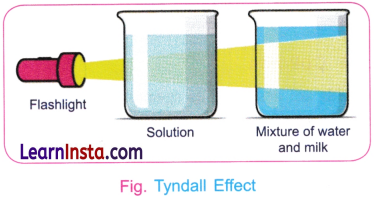
The Tyndall effect is the phenomenon in which the particles in a colloid scatter the beams of light that are directed at them. This effect is exhibited by all colloidal solutions and some very fine suspensions. Therefore, it can be used to verify if a given solution is a colloid. The intensity of scattered light depends on the density of the colloidal particles as well as the frequency of the incident light.
When a beam of light passes through a colloid, the colloidal particles present in the solution do not allow the beam to completely pass through. The light collides with the colloidal particles and is scattered (it deviates from its normal trajectory, which is a straight line). This scattering makes the path of the light beam visible, as illustrated below.
Dispersed phase: The solute like component or the dispersed particles are said to be dispersed phase.
Dispersion medium: The components of a colloid in which the dispersed phase is suspended is said to be dispersion medium.
Generally, blue light scatters to a greater extent when compared to red light. This is because the wavelength of blue light is smaller than that of red light. This is the reason why the smoke released by motorcycles sometimes appears blue.
The Tyndall effect was first discovered by (and is named after) the Irish physicist John Tyndall. The diameters of the particles that cause the Tyndall effect can range from 40 to 900 nanometers (1 nanometer = 10-9 meter). In comparison, the wavelength of the visi¬ble light spectrum ranges from 400 to 750 nanometers.
Examples of the Tyndall Effect:
- Milk is a colloid that contains globules of fat and protein. When a beam of light is directed at a glass of milk, the light is scattered. This is a great example of the Tyndall effect.
- When a torch is switched on in a foggy environment, the path of the light becomes visible. In this scenario, the water droplets in the fog are responsible for the light scattering.
- Opalescent glass has a bluish appearance when viewed from the side. However, orange-coloured light emerges when light is shined through the glass.