Teachers guide students to use Exploring Society India and Beyond Class 7 Solutions and Class 7 SST Part 2 Chapter 4 Turning Tides: 11th and 12th Centuries Question Answer NCERT Solutions for quick learning.
Turning Tides: 11th and 12th Centuries Questions and Answers Class 7 SST Chapter 4
Turning Tides: 11th and 12th Centuries Class 7 Question Answer (In-Text)
The Big Questions? (Page 97)
Question 1.
Why are the 11th and 12th centuries seen as a period of transition in Indian history?
Answer:
The 11th and 12th centuries are called a period of transition because major political and cultural changes took place in India during this time. For the first time, Turkic invaders like Mahmud of Ghazni and Muhammad Ghuri entered deeply into north India. This led to large-scale destruction of temples, cities, and centres of learning like Nalanda and Vikramashila.
At the same time, many powerful Indian kingdoms such as the Cholas, Hoysalas, Kakatiyas, Senas and Paramaras continued to rule large regions. While foreign invasions brought destruction, Indian trade, agriculture, art, literature and temple construction continued to thrive. Therefore, this period shows both change through invasions and continuity through Indian cultural and political strength.

Question 2.
Which new powers emerged during this period? What were the essential features of their economic, military and administrative systems?
Answer:
During the 11th and 12th centuries, new powers such as the Ghaznavids, Ghurids, Cholas, Hoysalas, Kakatiyas, Senas and Paramaras emerged. The Ghaznavids and Ghurids depended heavily on military power, cavalry, fast attacks and plunder-based economy. Indian kingdoms like the Cholas developed strong administration with village self governance, tax collection and irrigation systems.
The economy was mainly based on agriculture, supported by tanks, wells, canals and fertile river valleys. Overseas trade with China and Southeast Asia increased through powerful merchant guilds and seaports. Muhammad Ghuri introduced a more centralised administrative system by giving land assignments to officers in return for military service.
Question 3.
What high accomplishments in art, architecture, literature, science, etc., do we come across during this period?
Answer:
This period saw remarkable achievements in temple architecture, especially under the Cholas, Hoysalas, Chandellas and Eastern Gangas. The Brihadeshwara Temple at Thanjavur, Hoysala temples at Belur and Halebidu. Khajuraho temples, Jagannath Temple at Puri and the Sun Temple at Konark are important examples.
In science and mathematics, Bhaskaracharya wrote famous works like Lilavati, Bijaganita and Siddhanta Shiromani. In literature, Jayadeva composed the Gita Govinda. and King Bhoja wrote on architecture, poetry, yoga and medicine. Al-Biruni made a detailed study of Indian knowledge by learning Sanskrit and studying Indian texts. Social and religious reform was led by thinkers like Ramanujacharya and Basavanna, who promoted devotion and social equality.
Let’s Explore
Question 1.
Observe the sketch of the Khyber Pass given below. What kind of terrain does it depict? (Page 100)

Answer:
The Khyber Pass depicts a mountainous and rocky terrain. It runs through the Hindu Kush mountain range, showing narrow and steep pathways.
(i) What advantages would it offer to an army trying to reach the Indus plains? But also, what dangers?
Answer:
The Khyber Pass offered a direct and strategic route for armies to enter the Indus plains from Central Asia. It made movement of soldiers and horses possible through the mountains. However, the narrow paths made armies vulnerable to sudden attacks from enemies hiding on higher ground. Landslides, harsh weather, and supply problems also made military travel dangerous.
(ii) Thinking of the caravans of traders that passed through the Khyber Pass for many centuries, let’s ask the same questions about the advantages as well : as dangers.
Answer:
For traders, the Khyber Pass served as an important trade route connecting India with Central Asia. It allowed the movement of goods, ideas, and cultures for many centuries. However, travelling through the narrow mountain pass involved the danger of robbery and ambushes. The difficult terrain and harsh climate also made long journeys risky and tiring.
Question 2.
In later centuries, the Somanatha temple was rebuilt and destroyed again several times; the existing temple was built in 1950 and inaugurated the next year by the then President of India. Rajendra Prasad. Why do you think it was decided to fund the construction entirely from public donations? (Page 103)
Answer:
The Somanatha temple had great religious and cultural importance for the people of India. Funding it through public donations allowed people from all parts of the country to participate in its rebuilding. It symbolised national unity and collective responsibility rather than government control. This also showed that the temple belonged to the people and not to any single authority.
Question 3.
In the painting given below, can you make out who is the king and who is the guru? What does the king’s posture and general attitude express (Page 112)

Answer:
In the painting, Rajendra Chola is showm as the standing royal figure, while the guru is seated, indicating his spiritual authority. The king stands in a respectful posture before his teacher. This posture show’s humility, devotion, and reverence for knowledge. It also reflects the importance given to spiritifal guidance even by powerful rulers.
Question 4.
Writing some 60 years after Bakhtiyar Khilji ’s campaign through Bihar, the historian Minhaj al-Siraj Juzjani, recorded in his Tabakat-i-Nasiri how Bakhtiyar’s forces captured a ‘fortress’ and “acquired great booty.” He adds, “The greater number of the inhabitants of that place were Brahmans, and all those Brahmans had their heads shaven; and they were all slain. There were a great number of books there. … It was found that the whole of that fortress and city was a college, and in [their] tongue, they call a college bihar.”
Remembering the meaning of vihara and noting that Nalanda was known in ancient inscriptions as ‘Nalanda Mahavihara’, can you find two more clues in the above passage to identify the ‘fortress’ near the Nalanda university? (Hint: Who do you think these ‘Brahmans’ actually were?) (Page 117)
Answer:
The first clue is that the place contained a great number of books, showing that it was a centre of learning. The second clue is that the entire fortress and city was described as a college, which directly connects it to a mahavihara like Nalanda. The so-called ‘Brahmans’ mentioned in the passage were actually Buddhist monks, as monks shaved their heads. This confirms that the destroyed ‘fortress’ was a Buddhist educational centre near Nalanda.
Question 5.
In Kalyani, Basavanna established an anubhava mandapa (literally, ‘pavilion of experience’), where men and women from every social, economic, religious or linguistic background, including saints and philosophers, could assemble to discuss all aspects of life, including moral values and religion.
(i) Why, in your opinion, did Basava want people from all backgrounds to come together and exchange ideas? (Page 121)
Answer:
Basavanna wanted people from all backgrounds to come together to remove social inequalities. He strongly opposed caste discrimination and rigid social divisions. By allowing free discussion, he encouraged respect for every individual’s thoughts. This helped promote equality, unity and moral awareness in society.
(ii) If something like an anubhava mandapa existed today, what important topics do you think people ought to discuss there?
Answer:
People today could discuss topics like social equality, environmental protection and moral values. Education, corruption and women’s empowerment should also be discussed openly. Such discussions would help people understand each other better. It would promote responsible and thoughtful citizenship.
(iii) What lessons can we draw from the anubhava mandapa spirit to create a just and civil society today?
Answer:
The anubhava mandapa teaches us that everyone deserves equal respect in society. It encourages open dialogue and mutual understanding. It shows the importance of removing discrimination based on birth or status. These values help build a fair, peaceful and civil society even today.
Think About It (Page 100)
Question 1.
A word of caution: In Grade 8 you will read a ‘Note on History’s Darker Periods’. Briefly, it explains how history has recorded war, conquest and destruction more than peace, good governance or creativity, and how, the world over, historians have sometimes hesitated to draw attention to such darker periods. Our approach is that it is better to face them and analyse them so as to understand what made such developments possible and, hopefully, help avoid their recurrence in future. In addition, we should not forget that while past events cannot be erased or denied, it would be wrong to hold anyone responsible for them today. (Page 99)
Answer:
The paragraph clearly states that past events cannot be erased or denied. However, it also warns that people living today should not be blamed for actions that happened in the past. History should be studied for understanding and learning, not for spreading hatred. The purpose of studying dark periods is to analyse their causes. It helps society avoid repeating similar mistakes. Therefore, history must be approached with responsibility and fairness.
Question 2.
We will meet later in this chapter the Persian scholar al-BIrunT, who accompanied Mahmud in some of his campaigns. He wrote in his memoirs on India, “The Hindu Shahiya dynasty is now extinct, and of the whole house there is no longer the slightest remnant in existence. We must say that, in all their grandeur, they never slackened in the ardent desire of doing that which is good and right, that they were men of noble sentiment and noble bearing.” What conclusions can we draw from this remark by someone in Mahmud’s entourage? (Page 101)
Answer:
The remark shows that even though the Hindu Shahis were defeated and their dynasty became extinct, they were respected for their good character and noble conduct. It suggests that they were sincere rulers who always tried to do what was right. The statement also proves that the Ghaznavid invasion completely ended their rule. At the same time, it shows that courage and moral values of the Hindu Shahis were acknowledged even by their enemies.
Turning Tides: 11th and 12th Centuries Class 7 Solutions (Exercise)
Question 1.
Why is the period under consideration in this chapter regarded as a major transition in Indian history? Give two examples each of change and continuity from this period.
Answer:
The 11th and 12th centuries are regarded as a major transition because foreign rule began to take root in parts of north India. A major change was the repeated invasions by Mahmud of Ghazni and the territorial conquest by Muhammad Ghuri. Another change was the destruction of important centres of learning like Nalanda and Vikramashila.
At the same time, continuity is seen in the survival of powerful Indian kingdoms like the Cholas, Hoysalas, Kakatiyas and Senas. Another continuity was the continued growth of trade, agriculture, temple building, literature and science. Thus, the period shows both political disruption and cultural resilience.
Question 2.
Observe a graphical representation of the chief dynasties covered in the previous chapter and draw a similar ‘star of dynasties’ gathering all or most of the dynasties that appear in this chapter.
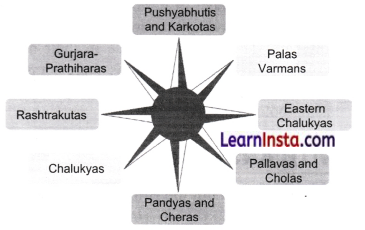
Answer:
The dynasties that appear in this chapter are:
- Ghaznavids
- Ghurids
- Cholas
- Hoysalas
- Kakatiyas
- Senas
- Paramaras
- Eastern Gangas
- Chahamanas (Chauhans)
Question 3.
Taking a map of the Subcontinent, draw a geographical tour that covers all or most dynasties in this chapter (you may draw inspiration from some of the ‘travels’ the chapter’s narration follows).
Answer:
On a map of the Indian Subcontinent, mark the following in travel order:
- Ghazni → Punjab → Delhi → Bengal (for Ghaznavids and Ghurids)
- Malwa (Paramaras – Dhar)
- Bengal (Senas – Nadia)
- Odisha (Eastern Gangas – Puri & Konark)
- Karnataka (Hoysalas – Belur & Halebidu)
- Telangana (Kakatiyas – Warangal)
- Tamil Nadu & Sri Lanka (Cholas – Thanjavur & Anuradhapura)
Draw arrows to show movement.
Question 4.
With the help of a map of India and Southeast Asia, can you calculate the approximate distance that Rājendra I’s fleet of ships had to navigate to reach their objective?
Answer:
Rajendra Chola I’s fleet travelled from the east coast of India to Southeast Asia. The route crossed the Bay of Bengal towards the region of present-day Malaysia and Indonesia. The approximate distance would be about 3,000 to 4,000 kilometres by sea. This long journey proves the strength of the Chola navy and overseas trade links
Question 5.
Match these two pairs:

Answer:
| Column A | Column B |
| 1. Eastern Gangas | (c) Konark Sun temple |
| 2. Chandellas | (d) Kandariya Mahadeva temple |
| 3. Paramaras | (e) Bhojeshwar temple |
| 4. Hoysalas | (a) Belur |
| 5. Cholas | (b) Brihadishvara temple |
Question 6.
Working in groups, compare the dynasties in this chapter and in the preceding one; create a table to list the dynasties present in both, those that disappear from the preceding period, and those that appear in this chapter’s period.
Answer:
Here is a simple comparison table showing dynasties from the preceding chapter and this chapter:
| Category | Dynasties |
| Dynasties present in both chapters | Cholas, Western Chalukyas, Eastern Chalukyas |
| Dynasties that disappear after the preceding period | Guptas, Harsha’s dynasty, Pratiharas, Rashtrakutas, Palas (decline begins) |
| Dynasties that appear or rise in this chapter | Ghaznavids, Ghurids, Chahamanas (Chauhans), Paramaras, Chandellas, Senas, Eastern Gangas, Kakatiyas, Hoysalas |
Some older dynasties declined after the early medieval period, while new regional powers and foreign rulers rose. This shows political change along with continuity in Indian history.
Question 7.
Using the chapter and any additional reading, prepare a short note explaining
(i) why centres of learning like Nalanda were important; (ii) how their destruction may have affected education and culture in India.
Answer:
(i) Importance of centres of learning like
Nalanda: Centres of learning such as Nalanda were among the greatest universities of the ancient world. They attracted students and scholars from different parts of India and from countries like China, Tibet, and Southeast Asia. Nalanda offered education in subjects such as philosophy, Buddhism, mathematics, astronomy, medicine, grammar, and logic.
It had large monasteries, residential facilities, and a vast library with thousands of manuscripts. Scholars freely debated ideas, translated texts, and preserved knowledge, making Nalanda an important centre for intellectual and cultural exchange.
(ii) Impact of their destruction on education and culture: The destruction of centres like Nalanda led to the loss of priceless manuscripts and the death or dispersal of scholars. Many teachers and students were forced to flee to safer regions, breaking long traditions of learning. This weakened higher education and scientific research in northern India and contributed to the decline of Buddhism there. Although learning continued in other regions, the destruction caused a serious setback to India’s educational and cultural life and interrupted the organised transmission of knowledge.
Question 8.
Why do you think Mahmud of Ghazni carry out repeated raids from Afghanistan into India, while Muhammad Ghuri sought territorial expansion into India and long-term control? Write a short note on how their motives shaped the outcomes of their campaigns.
Answer:
Mahmud of Ghazni carried out repeated raids into India mainly to obtain wealth and prestige. Rich temples and cities in India stored large amounts of treasure, which helped him finance his army and strengthen his empire in Central Asia. Since his goal was plunder rather than administration, he did not try to establish permanent rule in India. As a result, his campaigns led to widespread destruction and suffering but no lasting political control.
In contrast, Muhammad Ghuri aimed at territorial expansion and long-term rule. After defeating Indian rulers, he captured key regions and left trusted commanders to govern them. This approach resulted in the establishment of permanent Muslim rule in northern India and laid the foundation of the Delhi Sultanate. Thus, the difference in their motives explains why Mahmud’s raids were temporary, while Muhammad Ghuri’s campaigns brought lasting political change.