Students can use Kaveri Class 9 English Book Solutions and Class 9 English Kaveri Book Poem 3 Question Answer Canvas of Soil as a quick reference guide.
Canvas of Soil Poem Class 9 Question Answer
Class 9 English Kaveri Poem 3 Question Answer
Class 9 Kaveri Poem 2 Canvas of Soil Question Answer
Reflect and Respond (NCERT Page 86)
I. Work in pairs. Discuss what all you see in a garden. Think of the colours you see and where you see them. Share your responses with your teacher.
Answer:
In a garden, we see flowers, plants, trees, grass, soil, butterflies, bees and birds.
We notice green in leaves and grass, red, yellow, pink, and white in flowers, and brown in soil and tree trunks. Bright colours appear in blooming flowers, while soft greens are seen everywhere in plants.
II. Look at the picture (given in your NCERT Textbook page no. 86) of a garden and a painting given below. Speak about any similarities between the garden and the painting.
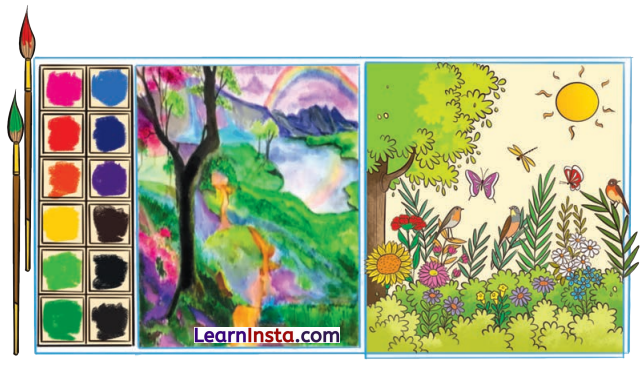
Speak using the following.
1. Just as a garden similarly, a painting ________.
Answer:
is full of colours and life, is filled with colours and beauty.

2. A garden and a painting, both ________ .
Answer:
show nature in a pleasant and attractive way.
3. ________ is common to both a garden and a painting.
Answer:
Harmony
4. Like a garden, a painting too ________ .
Answer:
gives joy and peace to the viewer.
Check Your Understanding (NCERT Pages 87-89)
I. Read the poem again and complete the summary of each stanza by filling in the blanks.
1. The ________ is portrayed as a rich palette where gardeners’ _ _ _ a_ s flourish in the form of ________ awaiting spring.
Answer:
earth, dreams, seeds
2. The garden flowers ________ into a beautiful display of different b _ _ _ _ _ ms, resembling a ________ by Mother Nature, in the light of morning.
Answer:
turn, blossoms, painting
3. Each garden is likened to a wide, _ _ n_ _ s, integrating art and ________ Through the efforts of gardeners, gardens transform into still-life ________ .
Answer:
canvas, life, paintings
II. Select the appropriate title for each stanza from those given below. There are two extra titles.
1. Nature’s Work of Art
2. Sweet-smelling Blossoms
3. Gardens as Living Canvases
4. Earth and Possibilities
5. The Painter’s Canvas
Answer:
- Stanza 1 – Earth and Possibilities
- Stanza 2 – Nature’s Work of Art
- Stanza 3 – Gardens as Living Canvases
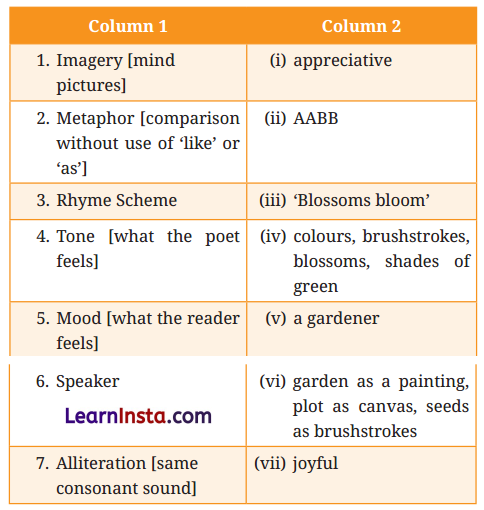
III. Match the poetic devices in Column 1 to the examples in Column 2. Discuss your responses in pairs. Then share the responses with your classmates and teacher.
Answer:
| Column 1 | Column 2 |
| 1. Imagery [mind pictures] | (iv) colours, brushstrokes, blossoms, shades of green |
| 2. Metaphor [comparison without use of ‘like’ or ‘as’] | (vi) garden as a painting, plot as canvas, seeds as brushstrokes |
| 3. Rhyme Scheme | (ii) AABB |
| 4. Tone [what the poet feels] | (i) appreciative |
| 5. Mood [what the reader feels] | (vii) joyful |
| 6. Speaker | (v) a gardener |
| 7. Alliteration [same consonant sound] | (iii) ‘Blossoms bloom’ |
Critical Reflection (NCERT Pages 89-91)
I. Read the given extracts from the poem and answer the questions that follow.
Extract 1
Brushstrokes of seeds, planted true, Awaiting spring’s vibrant hue.
(i) The poet has used a metaphor in ‘Brushstrokes of seeds’. Which option from those given below uses a metaphor?
A. Her mother’s heart heard her heartfelt request with kindness.
B. She has a heart of gold.
C. Her heart did a dance of joy on seeing the new doll.
D. She has a very kind heart.
Answer:
B. She has a heart of gold.
(ii) Complete the sentence appropriately.
The phrase ‘planted true’ is significant because it implies ________ .
Answer:
sincerity, care and honesty in the act of sowing seeds, reflecting dedication and hope for growth
(iii) Why has the poet used the word ‘hue’ instead of ‘colours’ in the extract?
Answer:
The poet uses the word ‘hue’ instead of ‘colours’ because ‘hue’ suggests softness, freshness, and artistic beauty, fitting the imagery of a painting and springtime renewal.
(iv) Complete the following analogy correctly with a word from the extract.
Summer: hot :: Spring: ________ .
Answer:
vibrant
(v) Read the Assertion (A) and the Reason (R) and select the option that is correctly suited.
(A) : Gardeners wait for spring.
(R) : Gardens are worth painting in Spring.
A. Both (A) and (R) are true and (R) is the correct explanation of (A).
B. Both (A) and (R) are true but (R) is not the correct explanation of (A).
C. (A) is true but (R) is false.
D. (A) is false but (R) is true.
Answer:
B. Both (A) and (R) are true but (R) is not the correct explanation of (A).
Extract 2
Each plot, a canvas wide,
Where art and life coincide.
(i) What does ‘Each plot’ refer to in this extract?
Answer:
‘Each plot’ refers to every piece of land in a garden where plants are grown.
(ii) Select which option imitates the rhyme scheme of the extract.
A. beautiful and clear laughter and cheer
B. beautiful and clear laughter and tears
Answer:
A. beautiful and clear laughter and cheer
(iii) Select the line from the extract that conveys that gardening blends aesthetic beauty with natural growth.
Answer:
“Where art and life coincide.”
(iv) Complete the following sentence appropriately.
The plot is likened to a canvas suggesting that ________ .
Answer:
a garden is a space where creativity and nature come together like an artwork
(v) Why has the poet most likely used the word ‘wide’ instead of ‘long’ in ‘canvas wide’?
Answer:
The poet uses the word ‘wide’ instead of ‘long’ because ‘wide’ suggests openness, freedom and vast creative possibilities, like a painter’s canvas.
II. Give reasons for the comparisons made by the poet in the poem.
1. A painter is compared to a gardener because ________ .
Answer:
both create beauty through patience, skill and careful effort
2. A palette is like earth as ________ .
Answer:
the soil holds endless possibilities of colour and life, just as a palette holds colours for a painting
3. The brushstrokes are like seeds because ________ .
Answer:
seeds, like brushstrokes, are the starting point from which beauty gradually emerges
4. A canvas is similar to a garden plot as ________ .
Answer:
both serve as the base where creativity and growth take shape
III. Answer the following questions.
Question 1.
How does the metaphor ‘Brushstrokes of seeds’, enhance the understanding of gardening as an art form?
Answer:
The metaphor ‘Brushstrokes of seeds’ presents gardening as an art form. It compares the act of sowing seeds to painting, showing that gardening requires creativity, vision and artistic care.
Question 2.
What can you infer about the poet’s perspective on the relationship between nature and creativity from the following lines?
‘Each plot, a canvas wide,/Where art and life coincide’.
Answer:
The poet views nature and creativity as deeply connected, suggesting that human art and natural growth come together harmoniously, making gardens living artworks.
Question 3.
Do you think the imagery in the poem successfully paints a vivid picture in the reader’s mind? If yes, why? If no, why not?
Answer:
Yes, the imagery successfully paints a vivid picture because the poet uses visual and artistic words like colours, brushstrokes, canvas and blossoms. These words help the reader imagine the garden as a painting.
Question 4.
Support the view that the poet’s mention of the colour yellow, besides red, blue and green, would have lent effectively to the imagery.
Answer:
The mention of the colour yellow, besides red, blue, and green, would have strengthened the imagery by adding brightness and warmth, often associated with sunlight, flowers and joy in nature.
Question 5.
Considering the line ‘Gardens become paintings still’, what can you interpret about the poet’s view on the timelessness of nature’s beauty?
Answer:
The line ‘Gardens become paintings still’ suggests that nature’s beauty remains timeless, as gardens preserve artistic beauty even after the gardener’s work is done.
Question 6.
Justify the title of the poem, ‘Canvas of Soil’.
Answer:
The title ‘Canvas of Soil’ is justified because the poem portrays the earth as a canvas on which gardeners create living artworks using seeds, care and imagination.
Speaking Activity (NCERT Page 94)
I. People wish to have a garden at home. Some like a flower garden and some a vegetable garden. Think and note some advantages of both these types, as gardens for homes.
Answer:
People wish to have a garden at home because it brings freshness, beauty and peace. A flower garden adds colour, fragrance and beauty to the surroundings. It creates a pleasant atmosphere, attracts birds and butterflies and helps reduce stress. A vegetable garden provides fresh, healthy and chemical-free vegetables. It also saves money, encourages healthy eating habits and teaches responsibility and patience.
II. Would you like to have a flower garden or a vegetable garden at home? Why?
Take turns with your partner and speak your points to express your preference, with reasons.
I prefer ________ to ________ because…
Answer:
I prefer a vegetable garden to a flower garden because it is useful as well as healthy.
For me, it is a ________ instead of a ________ due to…
Answer:
For me, it is a.source of fresh food instead of a decoration as it has practical benefits.
If I had a choice I’d rather have a ________ rather than a ________ as…
Answer:
If I had a choice, I’d rather have a vegetable garden rather than a flower garden as it supports a healthy lifestyle.
I would prefer ________ rather than ________ since…
Answer:
I would prefer growing vegetables rather than flowers since it helps my family eat fresh and nutritious food every day.
Writing Task (NCERT Page 91)
I. Write a descriptive piece of two to three paragraphs describing the details and colours in the garden you have visited.
- Focus on how different shades of blue, red, and green interact, create contrast, and bring the garden to life.
- Pay attention to details like the texture of petals, the varying greens of leaves, and the way light affects the colours.
Answer:
The garden I visited was filled with a calm yet lively blend of colours that immediately caught my attention. Different shades of green formed the base of the garden, from the pale green of new leaves to the deep, rich tones of mature plants. Bright red flowers stood out sharply against this green background, adding warmth and energy. Soft blue blossoms appeared scattered among them, creating a soothing contrast and balancing the boldness of the red.
A closer look revealed beautiful details in texture and form. The petals of the flowers felt smooth and delicate, while some had a slightly velvety surface. Leaves varied in shape and shade, some long and glossy, others broad and matte. Sunlight filtered gently through the trees, making the colours appear brighter in some areas and softer in others. This play of light and shade brought depth to the garden, making it feel alive, peaceful and visually enchanting.