Practicing Class 9 Science MCQ and Class 9 Science Exploration Chapter 8 MCQ Online Test with Answers, Journey Inside the Atom daily helps in time management.
Class 9 Science Chapter 8 Journey Inside the Atom MCQ
Journey Inside the Atom MCQ
Class 9 Science Chapter 8 MCQ online test
Question 1.
Who discovered the nucleus of the atom?
(a) J.J. Thomson
(b) Ernest Rutherford
(c) Niels Bohr
(d) James Chadwick
Answer:
(b) Ernest Rutherford
Question 2.
According to Bohr’s model, electrons revolve around the nucleus in:
(a) Random paths
(b) Fixed orbits with quantized energy
(c) Elliptical paths losing energy
(d) Orbits with variable energy
Answer:
(b) Fixed orbits with quantized energy
Question 3.
Which subatomic particle was discovered by J.J. Thomson?
(a) Proton
(b) Neutron
(c) Electron
(d) Positron
Answer:
(c) Electron

Question 4.
In Rutherford’s gold foil experiment, most alpha particles passed through the foil undeflected because
(a) The nucleus is very dense
(b) Most of the atom is empty space
(c) Electrons are very heavy
(d) Alpha particles are very light
Answer:
(b) Most of the atom is empty space
Question 5.
The atomic number of an element is equal to
(a) Number of neutrons
(b) Number of protons
(c) Mass number
(d) Number of nucleons
Answer:
(b) Number of protons
Question 6.
Isotopes are atoms of the same element having
(a) Same number of protons but different neutrons
(b) Same number of neutrons but different protons
(c) Same mass number but different atomic numbers
(d) Different numbers of electrons only
Answer:
(a) Same number of protons but different neutrons
Question 7.
Which scientist proposed that electrons revolve in fixed energy levels without losing energy?
(a) Dalton
(b) Rutherford
(c) Bohr
(d) Thomson
Answer:
(c) Bohr
Question 8.
Which of the following correctly represents the electronic distribution in the Mg atom?
(a) 3,8,1
(b) 2,8,2
(c) 1,8,3
(d) 8,2,2
Answer:
(b) 12Mg – 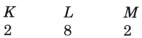
Question 9.
Rutherford’s ‘alpha (a) particles scattering experiment’resulted into discovery of
(a) electron
(b) proton
(c) nucleus in the atom
(d) atomic mass.
Answer:
(c) Rutherford’s alpha (a) particles scattering experiment resulted into discovery of nucleus in the atom. A large number of particles went straight through the atom, while a very small number of partîcles were deflected back showing the presence of positively charged nucleus.
Question 10.
The number of electrons in an element X is 15, and the number of neutrons is 16. Which of the following is the correct representation of the element?
(a) 15 31X
(b) 16 31 X
(c) 15 16X
(d) 16 15X
Answer:
(a) Number of electrons = 15,
Number of neutrons = 16
Hence atomic number of element X is 15 and atomic mass is 31. Hence, the element is represented as 15 31X
Question 11.
Dalton’s atomic theory successfully explained
(i) Law of conservation of mass
(ii) Law of constant composition
(iii) Law of radioactivity
(iv) Law of multiple proportions
(a) (i), (ii) and (iii)
(b) (i), (iii) and (iv)
(c) (ii), (iii) and (iv)
(d) (i), (ii) and (iv).
Answer:
(d) Dalton’s atomic theory successfully explained law of conservation of mass, law of constant composition, and law of multiple proportions.
Question 12.
Which of the following statements about Rutherford’s model of atom are córrect?
(i) Considered the nucleus as positively charged
(ii) Established that the α-particles are four times as heavy as a hydrogen atom
(iii) Can be compared to solar system
(iv) Was in agreement with Thomson’s model
(a) (i) and (iii)
(b) (ii) and (iii)
(c) (i) and (iv)
(d) only (i)
Answer:
(a) Rutherford’s model of atom explained presence of nucleus in the centre and electrons around the nucleus revolving in circular orbits like the solar system.
Question 13.
Which of the following are true for an element?
(i) Atomic number number of protons + number of electrons
(ii) Mass number = number of protons + number of neutrons
(iii) Atomic mass number of protons = number of neutrons
(iv) Atomic number = number of protons = number of electrons
(a) (i) and (ii)
(b) (i) and (iii)
(c) (ii) and (iii)
(d) (ii) and (iv)
Answer:
(d) Mass number = p + n
Atomic number = p = e
Question 14.
In the Thomson’s model of atom, which of the following statements are correct?
(i) The mass of the atom is assumed to be uniformly distributed over the atom.
(ii) The positive charge is assumed to be uniformly distributed over the atom.
(iii) The electrons are uniformly distributed in the positively charged sphere.
(iv) The electrons attract each other to stabilise the atom.
(a) (i), (ii) and (iii)
(b) (i) and (iii)
(c) (i) and (iv)
(d) (i), (iii) and (iv)
Answer:
(a) Thomson’s model could be compared with a raisin pudding model, according to which the mass of atom is uniformly distributed over the atom in the form of positive charge, and electrons are uniformly distributed over the atom. Electrons do not attract each other.
Question 15.
Rutherford’s α – particle scattering experiment showed that
(i) Electrons have negative charge.
(ii) The mass and positive charge of the atom is concentrated in the nucleus.
(iii) Neutron exists in the nucleus.
(iv) Most of the space in atom is empty.
Which of the above statements are correct?
(a) (i) and (iii)
(b) (ii) and (iv)
(c) (i) and (iv)
(d) (iii) and (iv)
Answer:
(b) Two important observations of Rutherford’s α-particles scattering experiment were –
- The mass and positive charge of the atom are concentrated in the nucleus.
- Most of the space in the atom is empty.
Question 16.
The ion of an element has 3 positive charges. Mass number of the atom is 27, and the number of neutrons is 14. What is the number of electrons in the ion?
(a) 13
(b) 10
(c) 14
(d) 16
Answer:
(b) Mass number of the atom = 27
Number of neutrons = 14
Number of protons = 27 – 14 = 13
Number of electrons in the atom: 13
Number of electrons in ion with 3 positive charges = 13 – 3 = 10
Question 17.
Identify the Mg2+ ion from the Fig., where n and p represent the number of neutrons and protons, respectively.

Answer:
(d) In magnesium atom: 1224Mg
Number of n = 12. p = 12, e = 12
Number of electrons in Mg2+ = 10
Question 18.
In a sample of ethyl ethanoate (CH3COOC2H.), the two oxygen atoms have the same number of electrons but a different number of neutrons. Which of the following is the correct reason for it?
(a) One of the oxygen atoms has gained electrons.
(b) One of the oxygen atoms has gained two neutrons.
(c) The two oxygen atoms are isotopes.
(d) The two oxygen atoms are isobars
Answer:
(c) Two isotopes have same number of electrons and protons but different number of neutrons.
Question 19.
Elements with valency 1 are
(a) always metals
(b) always metalloids
(c) either metals or non-metals
(d) Always non-metals.
Answer:
(c) An element with valency 1 can be both metals or a non-metal.
Question 20.
The first model of an atom was given by
(a) N. Bohr
(b) E. Goldstein
(c) Rutherford
(d) J.J. Thomson.
Answer:
(d) J.J. Thomson proposed the first model of an atom.
Question 21.
An atom with 3 protons and 4 neutrons will have a valency of
(a) 3
(b) 7
(c) 1
(d) 4.
Answer:
(c) For the atom n = 4, p = 3, hence e = 3 Distribution of electrons = 2,1
Question 22.
The electron distribution in an aluminium atom is
(a) 2.8,3
(b) 2,8,2
(c) 8,2,3
(d) 2.3.8.
Answer:
(a) Aluminium has 13 electrons. Its electron distribution is 2,8, 3.
Question 23.
Which of the following in Fig. do not represent Bohr’s model of an atom correctly?
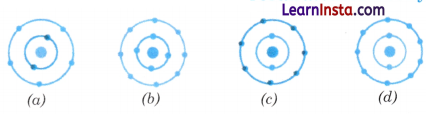
(a) (i) and (ii)
(b) (ii) and (iii)
(c) (ii) and (iv)
(d) (i) and (iv)
Answer:
(c) Fig. (ii) contains 4 electrons in K shell, and Fig. (iv) contains 9 electrons in L shell, which are not in accordance with Bohr’s model.
Question 24.
Which of the following statements is always correct?
(a) An atom has equal number of electrons and protons.
(b) An atom has equal number of electrons and neutrons.
(c) An atom has equal number of protons and neutrons.
(d) An atom has equal number of electrons. protons and neutrons.
Answer:
(a) An atom has equal number of electrons and protons since it is neutral.
Question 25.
Atomic models have been improved over the years. Arrange the following atomic models in the order of their chronological order
(i) Rutherford’s atomic model
(ii) Thomson’s atomic model
(iii) Bohr’s atomic model
(a) (i), (ii) and (iii)
(b) (ii), (iii) and (i)
(c) (ii), (i) and (iii)
(d) (iii), (ii) and (i).
Answer:
(c) Thomson’s atomic model, followed by Rutherford’s model, which is followed by Bohr’s model.
Journey Inside the Atom Class 9 Assertion and Reason Questions
Directions: For questions number (1) to (2), two statements are given – one labelled as Assertion (A) and the other labelled as Reason (R). Select the correct answer to these questions from the codes (a), (b), (c) and (d) as given below.
(a) Both Assertion (A) and Reason (R) are true and Reason (R) is the correct explanation of Assertion (A).
(b) Both Assertion (A) and Reason (R) are true, but Reason (R) is not the correct explanation of Assertion (A).
(c) Assertion (A) is true, but Reason (R) is false.
(d) Assertion (A) is false, but Reason (R) is true.
Question 1.
Assertion (A): Isotopes of an element have different physical properties but similar chemical properties.
Reason (R): Isotopes have the same atomic number but different mass numbers due to a different number of neutrons.
Answer:
(a) Both Assertion (A) and Reason (R) are true and Reason (R) is the correct explanation of Assertion (A).
Question 2.
Assertion (A): Valency of an atom depends on the number of electrons in its outermost shell.
Reason (R): Valency is always equal to the atomic number of an element.
Answer:
(c) Assertion (A) is true, but Reason (R) is false.
Journey Inside the Atom Class 9 Fill in the Blanks
1. The atom is made up of ________, ________ and ________.
Answer:
protons, neutrons, electrons
2. The particle discovered by J.J. Thomson is ________.
Answer:
electron
3. Rutherford’s gold foil experiment proved that most of the atom is ________.
Answer:
empty space
4. The positively charged part of the atom is called the ________.
Answer:
nucleus
5. The atomic number of an element is equal to the number of ________.
Answer:
protons
Journey Inside the Atom Class 9 True or False
1. Dalton’s atomic theory stated that atoms are indivisible.
Answer:
True
2. Thomson’s model suggested that electrons are embedded in a sphere of positive charge.
Answer:
True
3. Rutherford’s gold foil experiment proved that the atom has a dense nucleus at its centre.
Answer:
True
4. According to Rutherford’s model, electrons revolve in fixed energy levels.
Answer:
False
5. Bohr’s model explained atomic stability by introducing quantized energy levels.
Answer:
True
Journey Inside the Atom Class 9 Match the Following
Question 1.
Match the following items given in Column A with that in Column B.
| Column A (Scientists/ Concepts) | Column B (Discoveries/Models) |
| 1. J.J. Thomson | (a) Discovery of nucleus through gold foil experiment |
| 2. Ernest Rutherford | (b) Electrons revolve in fixed energy levels |
| 3. Niels Bohr | (c) Atoms are indivisible and indestructible |
| 4. James Chadwick | (d) Plum pudding model of atom |
| 5. Dalton | (e) Discovery of neutron |
Answer:
| Column A (Scientists/Concepts) | Column B (Discoveries/Models) |
| 1. J.J. Thomson | (d) Plum pudding model of atom |
| 2. Ernest Rutherford | (a) Discovery of nucleus through gold foil experiment |
| 3. Niels Bohr | (b) Electrons revolve in fixed energy levels |
| 4. James Chadwick | (e) Discovery of neutron |
| 5. Dalton | (c) Atoms are indivisible and indestructible |
MCQ On Journey Inside the Atom Class 9 for Practice
Choose the correct option in the following questions
Question 1.
Positive charge is carried by
(a) X-rays
(b) cathode rays
(c) γ-rays
(d) anode rays
Question 2.
α-particle is made up of
(a) 2 electrons and 2 protons
(b) 2 protons and 2 neutrons
(c) 2 electrons and 2 neutrons
(d) helium atoms
Question 3.
The atomic numbers of neon (Ne), magnesium (Mg2+), aluminium (Al3+) and phosphorus (P3-) are 10, 12, 13 and 15 respectively. Select the odd species in terms of electronic configuration.
(a) Ne
(b) Mg2+
(c) Al3+
(d) P3-
Question 4.
An atom with 3 protons and 4 neutrons will have a valency of:
(a) 3
(b) 7
(c) 1
(d) 4
Question 5.
Which one is not true of two isotopes?
(a) Similar mass number
(b) Similar atomic number
(c) Similar chemical properties
(d) Similar electronic configurations
Question 6.
Outermost shell of an atom cannot accommodate more electrons than
(a) 2
(b) 8
(c) 18
(d) 16
Question 7.
Isobars have
(a) same no. of protons and electrons
(b) same no. of protons and neutrons
(c) same no. of electrons and neutrons
(d) same no. of neutrons
Assertion-Reason Questions
Directions: For Questions number (1) to (2), two statements are given – one labelled as Assertion (A) and the other labelled as Reason (R). Select the correct answer to these questions from the codes (a), (b), (c) and (d) as given below:
(a) Both Assertion (A) and Reason (R) are true and Reason (R) is the correct explanation of Assertion (A).
(b) Both Assertion (A) and Reason (R) are true, but Reason (R) is not the correct explanation of Assertion (A).
(c) Assertion (A) is true, but Reason (R) is false.
(d) Assertion (A) is false, but Reason (R) is true.
Question 1.
Assertion (A): When fast moving α-particles strike the gold foil, majority of these particles pass undeflected.
Reason (R): These are heavily charged particles.
Question 2.
Assertion (A): The valency of fluorine is 7.
Reason (R): It contains seven electrons in the outermost orbit.
Fill in the Blanks
1. The mass number of an atom is equal to the sum of ________ and ________.
2. Bohr’s model proposed that electrons revolve around the nucleus in fixed ________.
3. Atoms of the same element with different mass numbers are called ________.
4. The outermost shell of an atom is called the ________ shell.
5. The maximum number of electrons that can be accommodated in the K shell is ________.
State whether the statements given below are True or False
1. The atomic number of an element is equal to the number of neutrons.
2. The mass number of an atom is the sum of protons and neutrons.
3. Isotopes are atoms of the same element with different numbers of protons.
4. The maximum number of electrons in the K shell is 2.
5. In a neutral atom, the number of protons equals the number of electrons.
Match the Columns
Question 1.
Match the following items given in Column A with that in Column B.
| Column A (Concept/Term) | Column B (Explanation/ Discovery) |
| 1. Atomic number | (a) Neutral particle discovered by James Chadwick |
| 2. Mass number | (b) Electrons present in the outermost shell |
| 3. Isotopes | (c) Discovered nucleus through gold foil experiment |
| 4. Neutron | (d) Sum of protons and neutrons |
| 5. Valence electrons | (e) Number of protons in the nucleus |
| 6. Rutherford | (f) Atoms of the same element with different mass numbers |
| 7. Bohr | (g) Proposed plum pudding model of atom |
| 8. Thomson | (h) Proposed electrons revolve in fixed energy levels |