Morning Star ICSE Total English Class 10 Solutions and Total English Class 10 Chapter 12 Adjectives, Test Paper 12 Answers Solutions make the process easier for students by providing all grammar-related topics.
Total English Class 10 ICSE Answers Chapter 12 Test Paper 12
A. Adjectives
Assignment
I. Underline the correct words given in brackets:
1. Did you hear the (latest, last) news?
Answer:
Did you hear the latest news?
2. He is not fond of (this, these) kind of sweets.
Answer:
He is not fond of these kind of sweets.
3. My friend lives in the (nearest, next) town.
Answer:
My friend lives in the next town.

4. Who is (more, most) beautiful, Anne or Rita?
Answer:
Who is more beautiful, Anne or Rita?
5. The Principal accepted the (latter, later) proposal.
Answer:
The Principal accepted the latter proposal.
6. Of the two brothers, Rakesh is the (elder, eldest).
Answer:
Of the two brothers, Rakesh is the elder.
7. Sarita came (later, latter) than I expected.
Answer:
Sarita came later than 1 expected.
8. Can you do this without (further, farther) delay?
Answer:
Can you do this without further delay?
9. Maya is my (older, elder) sister.
Answer:
Maya is my elder sister.
10. She is inferior (than, to) her in social position.
Answer:
She is inferior than her in social position.
II. Arrange the adjectives in the correct order before the noun, changing a and t an where necessary:
1. a coat (leather, black, dirty)
Answer:
a coat (dirty, black, leather)
2. a shirt (Indian, cotton, green)
Answer:
a shirt (green. Indian, cotton)
3. a car (black, small, Japanese)
Answer:
a car (small, black. Tapanese)
4. a carpet (beautiful, multi-coloured, oval)
Answer:
a carpet (beautiful, oval, multi-coloured.)
5. a table (teak, kitchen, handmade, brown)
Answer:
a table (teak, kitchen, brown, handmade.)
6. a necklace (old, gold, expensive, artistic)
Answer:
a necklace (artistic, old, expensive gold.)
7. a horse(brown, thin, countryside)
Answer:
a horsetthin, brown, countryside)
8. a room (narrow,i dark, dirty)
Answer:
a room (narrow, dark, dirty)
9. a sweet (buttery, straw-coloured, square, almond flavoured)
Answer:
a sweet square, straw-coloured, buttery, almond flavoured
10. a boy (brave, tall, ambitious)
Answer:
a boy tall, brave, ambitious
Total English Class 10 Test Paper 12 Answers
D. Test Paper-12
Question 1.
(Do not spend more than 30 minutes on this question.)
Write a composition (300- 350 words) on any one of the following.
i. Write an original short story to bring out the meaning of the proverb: “Once bitten twice shy.”
Answer:
Once upon a time, there were two friends named Jatin and Alka. They were very close and did everything together. One day, Jatin asked Alka to lend him some money. Alka was hesitant at first, but she eventually agreed. Jatin promised to pay her back within a week.
A week went by, and Jatin did not pay Alka back. Alka asked him about the money, but he kept making excuses. This went on for weeks, and Alka eventually lost patience. She demanded that Jatin pay her back immediately. Jatin got angry and told Alka that he would pay her back when he could.
Alka was hurt and angry. She could not believe that Jatin would treat her, this way. She t decided to end their friendship. Jatin tried to apologize, but Alka refused to forgive him.
A few months later, Jatin needed Alka’s help again. He asked her to help him move to a new apartment. Alka was reluctant to help him, but she eventually agreed. She did not want to see Jatin struggle, even though he had hurt her in the past.
Jatin and Alka moved the apartment together. It was a lot of work, but they managed to do it. After they were finished, Jatin thanked Alka for her help. He promised to never ask her for anything again.
Alka was glad that she had helped Jatin, but she was still cautious. She knew that he had hurt her in the past, and she did not want to get hurt again. She decided to keep her distance from Jatin, even though they were still friends.
The proverb “Once bitten, twice shy” means that someone who has been hurt or disappointed in the past is likely to be careful or cautious in the future. This is exactly what happened to Alka. She was hurt by Jatin when he did not pay her back, so she was cautious when he asked her for help again. She knew that he had the potential to hurt her again, so she did not want to get too close to him.
The proverb “Once bitten, twice shy” is a reminder that we should be careful about who we trust. We should not give people too much power over us, because they could hurt us. We should also be careful about forgiving people who have hurt us in the past. It is important to rem’ember that people can change, but it is also important to protect ourselves from being hurt again.
ii. Give an account of how you spend your weekends.
Answer:
During the weekends, I wake up very early as usual. After enjoying a leisurely and savoury breakfast prepared by my mother, I spend ten minutes reading the entertainment column in the newspaper. Besides that, I do some aerobic exercises to keep my body fit. Before T’ work out, I cycle around my neighbourhood with my new mountain bike which was purchased by my father five days ago.
On Saturdays, I like to keep in touch with my friends, as I normally meet them on the weekend. I usually do not have lunch at home on Saturdays as I go out with my friends. We go window shopping and have our meals there too. I prefer eating fast food or street food with my friends compared to eating at home. We laugh together and have a whale of a time at the fast food outlet.
Then, we continue our shopping trip. All of us feel overwhelmed by the elegant clothes and shoes with price tags on them which are displayed in the shops. My friends and I normally go out and paint the town red. We surf the web at an internet cafe. We play on-line games and have a blast in the internet cafe. Then, we have dinner. I sit and sip coffee and chat with my friends.
On the other hand, Sundays are always a family affair. My dad takes some time off from his’ busy schedule just to spend quality time with us. Early in the morning, we have a picnic at the park. We prepare breakfast together like toast, eggs and beverages. We relax our heart, mind and soul while listening to the birds chirping on the trees and feeling the cool breeze which makes the trees swing to and fro. The rest of the afternoon we spend watching television or listening to the music.
Apart from that, in the evening my siblings and I join my father for a game of badminton. f Badminton is a sort of game that can make us healthy. My mum who has green fingers prefers gardening. She plants lots of flowers and vegetables. Many neighbours praise her.
Then, every Sunday I cook dinner for my family. I drive my mum’s car to the supermarket and purchase all the ingredients. My family’s favourite meal is Chinese. After that we have our dinner.
After doing some revisions, I go to bed. It is crucial to do revisions before we go to sleep as it helps to enhance our memories. As soon as another week starts, I start looking forward to the next weekend.
iii. “Construction of big dams do more harm than good.” Express your views either for or against this statement.
Answer:
For
Big dams are plain bad. They flood people out of their homes and off their lands; wipe out endangered habitats and species; spread water-borne diseases; deprive flood plains of the water and sediments of life-giving floods (while increasing the damage floods cause to people); ruin beautiful landscapes and submerge places of great cultural or spiritual importance. Big dams even cause earthquakes, release greenhouse, destroy marine fisheries and lead to coastal erosion.
Land and water are ecologically linked in a natural system called a watershed. From the smallest droplet to the mightiest river, water works to shape the land, taking with it sediment and dissolved materials that drain to watercourses and, in most cases, eventually to the sea.
The river is a product of the land it flows through – the type of rock and soil, the shape of the land, and the amount of vegetation are some of the factors that determine the river’s shape, size and flow. When a large dam is constructed, these ties between the land and the river are broken and the consequences are felt throughout the watershed, as well as by the web of life it supports.
Large dams have forced some 40-80 million people from their lands in the past six decades, according to the World Commission on Dams. Indigenous, tribal, and peasant communities have been particularly hard hit. These legions of dam refugees have, in the great majority of cases, been economically, culturally and psychologically devastated.
Those displaced by reservoirs are only the most visible victims of large dams. Millions more have lost land and homes to the canals, irrigation schemes, roads, power lines and industrial developments that accompany dams. Many more have lost access to clean water, food sources and other natural resources in the dammed area. Millions have suffered from the diseases that dams and large irrigation projects in the tropics bring.
And those living downstream of dams have suffered from the hydrological changes dams bring to rivers and ecosystems; an estimated 400-800 million people -roughly 10 per cent of humanity- . fall into this category of dam-affected people.
In response to the massive human rights problems and environmental impacts of large dams, affected people and supporting local and international organizations have joined together to fight for change in how and whether dams are planned, designed and built. This movement includes thousands of environmental, human rights, and social activist groups around the world.
The most important social impact of a dam is displacement of people. The forced removal of f people from their homes and the land by which they make a living has been the tragic consequence of dams. Although the people are offered resettlement, the situation leads to disintegration of self-identity and place-connection for both individuals and communities.
The social connections are lost and the people find it hard to recover a sense of belonging to both community and the physical environment that supports their existence. No doubt the people get compensation, but the process is often long-drawn, and sometimes, the actual sufferers are not getting true value for the losses incurred. These are inadequate when compared to the permanent loss of livelihood, and the social and mental cost of displacement.
Hence dams should be built only after people have been re-located or they should be built in areas where there is no habitation and the environment does not suffer.
Against –
Dams are structures that are built across rivers and streams to control the flow of water. They can be used for a variety of purposes, including flood control, irrigation, water supply, and hydroelectric power generation. Big dams are particularly large and complex structures that can have a significant impact on the environment.
There are many benefits to the construction of big dams. First, they can help to control flooding. When a river floods, it can cause widespread damage to property and infrastructure. Bigidams can help to prevent flooding by storing excess water and releasing it slowly over time.
Second, big dams can provide irrigation water for crops. This is especially important in arid regions, where water is scarce. Big dams can also help to provide water for drinking, bathing, and other domestic uses.
Third, big dams can generate hydroelectric power. Hydroelectric power is a clean and renewable source of energy that does not produce greenhouse gases. Big dams can provide a significant amount of electricity to a region, which can help to reduce reliance on fossil fuels.
Finally, big dams can provide recreational opportunities. The reservoirs that are created behind big dams can be used for fishing, boating, and swimming. Big dams can also attract tourists, which can boost the local economy.
However, there are also some disadvantages to the construction of big dams. First, they can be very expensive to build and maintain. Second, they can displace people and wildlife from their homes. Third, they can disrupt the natural flow of rivers and streams, which can have a negative impact on the environment.
Overall, the construction of big dams can have both positive and negative impacts. It is important to weigh the benefits and drawbacks carefully before deciding whether or not to build a big dam.
iv. You had gone to a village fair along with your friends. Describe your experience.
Answer:
During the summer holidays, I visited a village fair with my friends. The fair was held in a large open field on the outskirts of the village. It was a hot and sunny day, but the excitement of the fair made us forget all about the heat.
As we entered the fair, we were greeted by a cacophony of sounds – the laughter, of children, t the music from the rides, and the shouts of the vendors. There were many stalls at the fair. Some of them sold handicrafts and clothes. Others sold toys and sweets. There was also a food court where we could buy delicious food. The air was filled with the delicious aromas of food being cooked. We wandered through the fair, stopping to admire the colourful stalls and to sample the different foods on offer.
We bought some cotton candy and then went on the Ferris wheel. From the top of the wheel, we had a bird’s-eye view of the fair. We could see the people milling around, the rides spinning, and the food stalls steaming.
After the Ferris wheel, we went on the roller coaster. It was a thrilling ride, and we all screamed with laughter as we went up and down the hills. We also went on the bumper cars and the carousel.
After a while, we started to get hungry. We stopped at a food stall and ordered some burgers and fries. The food was delicious, and we ate it all up.
After we had eaten, we decided to play some games. We played darts and ring toss, and we even won a few prizes. We spent the whole day at the fair. We bought some souvenirs, and played some games. We also watched a magic show and a puppet show. It was a lot of fun! As the sun started to set, we decided it was time to head home. We were all tired but happy. We had had a wonderful day at the village fair.
I really enjoyed my visit to the village fair. It was a great experience to see the different sights and sounds, and to try the different foods. I also enjoyed spending time with my friends and making new memories.
v. Study the picture given below. Write a story or a description or an account of what the picture suggests to you. Your composition may be about the subject of the picture or may take suggestions from it; however, there must be a clear connection between the picture and your composition.
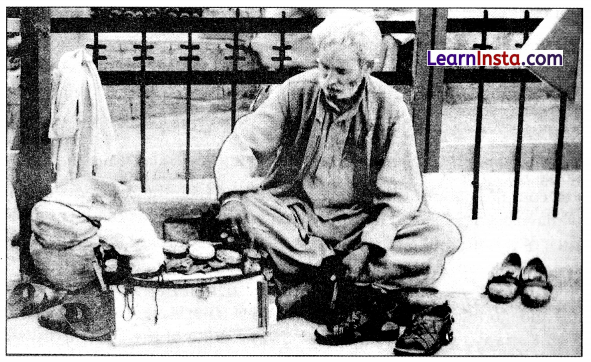
The cobbler wakes up early in the morning, before the sun has risen. He gets dfessed and eats a quick breakfast, then he heads to his workshop. The workshop is small and cluttered, but it is filled with the tools and materials that the cobbler needs to do his job.
The cobbler spends his days repairing shoes. He sews holes, replaces soles, and polishes scuffed shoes. He also makes custom-made shoes for people with special needs. The cobbler is a skilled craftsman, and he takes pride in his work.
The cobbler’s customers come from all walks of life. There are business people who need their shoes polished for a meeting, there are students who need their shoes repaired before a big dance, and there are elderly people who need their shoes made more comfortable. The cobbler is always happy to help his customers, and he takes the time to listen to their needs. The cobbler works hard all day long, but he doesn’t mind. He enjoys his work, and he is happy to be able to help people. At the end of the day, the cobbler cleans up his workshop and heads home. He is tired, but he is also satisfied with a job well done.
The cobbler’s life is a simple one, but it is a good life. He is a skilled craftsman who takes pride in his work. He is also a kind and generous man who is always happy to help others. The cobbler is a valuable member of the community, and he makes the world a better place.
Question 2.
(Do not spend more than 20 minutes on this question)
Select one of the following.
i. A pen-friend of yours living in Australia has recently seen a documentary on India and wants to know about the festival of Dussehra. Write a letter to him describing how the festival is celebrated and the spirit behind the celebration.
Answer:
12, Shavaji Marg Bondipore 13th August, 2024 Dear Derek
Hope you and your family are well in Australia. In your last letter you told me that you had seen a documentary on India and expressed a desire to know about the festival of Dussehra and how it is celebrated. The festival of Dussehra, is one of the most important festivals in India.
Dussehra, also known as Vijayadashami, is a festival that is celebrated on the tenth day of the Ashvin month in the Hindu calendar, which usually falls in September or October. The festival celebrates the victory of good over evil, and it is marked by a number of different rituals and traditions.
On this day people celebrate by the enactment of Lord Rama’s story that is organized on all nine days of Navratri. Shami Puja, Aparajita Puja, and Seema Avalanghan are traditionally conducted during the Aparahna time Some people prepare a mixture of rice, yogurt, and vermilion to apply tikka on the foreheads of their family members One of the most important rituals of Dussehra is the burning of effigies gf-Ravana, the t demon king who was defeated by Lord Rama and his brothers Meghnad, and Kumbhakaran in public squares. This ritual is meant to symbolize the triumph of good over evil.
In addition to the burning of effigies, Dussehra is also a time for people to come together and celebrate. There are often fairs and festivals held during this time, and people often wear new clothes and eat special foods.
The spirit behind Dussehra is one of hope and optimism. It is a time for people to celebrate the victory of good over evil and to look forward to a brighter future.
I hope this letter has given you a better understanding of the festival of Dussehra. If you have any other questions, please do not hesitate to ask.
Your friend,
Nitin
ii. The Principal of your school has put up a notice asking suggestions from students whether Financial planning should be included or not in the curriculum from the next session. Write a letter to the Principal giving your suggestions either in support or against the proposal.
Answer:
a. Letter in support of Financial Planning in curriculum
From t
Ritwik Sood
Class X To
The Principal St Paul School Varangal Sir
You had put up a notice asking for suggestions from students whether Financial planning should be included or not in the curriculum from the next session.
‘ I am writing to you today to express my strong support for the proposal to include financial planning in the curriculum from the next session.
I believe that financial planning is an essential life skill that all students should have the opportunity to learn. In today’s world, it is more important than ever for people to be able to manage their money effectively. Students who learn about financial planning in school will be better equipped to make sound financial decisions throughout their lives. There are many benefits to teaching financial planning in schools. First, it can help students to develop a budget and stick to it. This can be a valuable skill for anyone, but it is especially important for young people who are just starting out on their own. Second, financial planning can help students to understand the importance of saving for the future. This can help them to avoid debt and reach their financial goals. Third, financial planning can help students to make wise investment decisions. This can help them to build wealth and secure their financial future.
I believe that financial planning should be a mandatory part of the curriculum for all t students. It is a skill that everyone needs to know in order to be successful in life. I urge you to approve the proposal to include financial planning in the curriculum from the next session.
Thank you for your time and consideration.
Yours Sincerely,
Ritwik Sood Class X
b. Letter against including Financial Planning in curriculum
From
Ritwik Sood Class X
To
The Principal
St Paul School
Varangal
Sir,
I hope this le’tter finds you well. You had put up a notice asking for suggestions from students whether Financial planning should be included or not in the curriculum from the next session.
Hence I have taken the liberty to write to you today to express my concerns about your proposal to include financial planning in the curriculum from the next session.
I believe that financial planning is an important life skill, but I do not think that it is appropriate to include it in the school curriculum. There are a number of reasons for this.
First, financial planning is a complex topic that requires a deep understanding of economics and finance. Most high school students do not have the necessary background . knowledge to understand this topic.
Second, financial planning is a personal matter. Each person’s financial situation is different, and there is no one-size-fits-all approach to financial planning. What works for one person may not work for another.
Third, financial planning is a lifelong process. It is not something that can be learned in a single class or semester. Students need to be exposed to financial planning concepts throughout their lives in order to develop the skills and knowledge they need to make sound financial decisions.’
I believe that there are more important topics that should be included in the school curriculum, such as critical thinking, problem solving, and communication skills. These skills are essential for success in college, career, and life.
I urge you to reconsider the proposal to include financial planning in the curriculum. I believe that it is not an appropriate topic for high school students.
Thank you for your time and consideration. , –
Yours Sincerely,
Ritwik Sood Class X
Question 3.
i. You are Ankit/ Anita a student of Class X of New Bloom Public School. While playing basketball in the school playground you lost your locker keys, which were in the pocket of your track pants. Write a notice to be displayed on the school notice boards, requesting the finder to return the keys to you.
Answer:
New Bloom Public School
Notice
Lost Locker Keys
I, Ankit Yadav of class X, have lost my locker keys, which were in the pocket of my track pants, while playing basketball in the school playground. Anyone finding the keys, is requested to return it to me in Room 12. It is very important that the finder returns it at the earliest as I need my keys to open my school locker which contains my personal stuff and books.
Thank You
Ankit Yadav Class X
ii. Write an email to the In-charge of the ‘Lost and Found Department’ of your school requesting him/her to help you in finding keys.
Answer:
To: [email protected]
Sub: Help in search for locker keys
Sir/Madam
This is to request you to help me to find my locker keys which I lost while playing basketball in the school playground. The keys were in the pocket of my track pants and must have dropped in the basketball court. I will be very grateful if you could make an announcement in the classes or in the assembly regarding it. In case anyone finds the keys he/she should submit it in your office. I will collect the keys if you inform me in my class in Room No 12.
Thanking you
Ankit Yadav
Class X
Question 4.
Read the following passage carefully and answer the questions that follow:
Around 15 lakh engineering students graduate every year from various institutes in India. Unfortunately, very few have the employability skills, so much so that the industry is facing a problem about how to bridge the gap between what the job market requires and what is being taught.
The available jobs are static at 10,000 for many years. This means that only the best of the bist get placed in top-notch companies. There was a time when the demand and supply were at par. Today, the supply is 15 fold more than the demand. This has added to the problems that exist in private engineering colleges.
The problem is a cycle that is difficult to break. More and more private institutions are coming up who compromise on the quality of the knowledge they are imparting. This means that the skill sets required by the industry are not being met. Compounding this problem is the fact that, in India there are only three professions a child is told to pursue – he/she has to study to become a doctor, an engineer or an MBA. Parents need to understand that today, there are far better options available. Engineering is just one of them.
Institutions should not admit anybody who has only the money to pay the fee. A student’s calibre must be judged. Otherwise, the student will not get a job, the institute will lose its reputation and the industry will not have good engineers.
The demand for engineers remains high but the employers have difficulties recruiting the staff they need. In today’s competitive world, the employers don’t have the time or the money to train a recruit on the job. They want engineers to get down to work from day one.
The solution to this problem is – first, there must a be a capping in all engineering colleges for the next 10 years. Second, the focus should shift from quantity to quality. Third, colleges should cater to what the industry needs.
The industry on the other hand is of the opinion that if a doctor can upgrade his knowledge and a lawyer needs to be abreast of the latest laws, an engineer needs to know what is happening around the world. An engineer must know how the common man thinks and what he wants. Interdisciplinary learning is a must today. Besides, a student needs to gauge where his passion lies.
Following a herd mentality will not help. To be a good engineer, just doing your job is not enough. One has to be extremely dynamic to be the best among the best. This is because the technology has changed the expectations of society. The demand for better products and services is mounting. As competition intensifies, the speed of the market revolution has become one of the driving forces.
India has been uniquely positioned to meet the challenges in the world of work. We are one of the largest producers of engineers, management graduates and technically qualified staff. We have an ever increasing growth of people who can speak English and communicate easily with the English speaking world.
i. For each of the word given below choose the correct meaning (as used in the passage) from the options provided.
Question 1.
compromise (line 10)
(a) accept lower standards
(b) enter into a contract
(c) obtain a degree
(d) get into an argument
Answer:
(a) accept lower standards
Question 2.
calibre (line 17)
(a) rate
(b) capability
(c) rank
(d) marks
Answer:
(b) capability ARUNDEEP’S Total English (Lang.)-X
ii. Which word in the passage means the opposite of the word7changing’?
(a) bridge
(b) static
(c) demand
(d) knowledge
Answer:
(b) static
iii. Answer the following questions briefly in your own words.
a. Why do only a few engineers get a job in good companies?
Answer:
Only a few engineers get a job in good companies because very few have the employability skills and there is a huge gap between what the job market requires and what is being taught to the engineers in the colleges. Moreover the available jobs are static and are not increasing hence the demand and supply of engineers is not at par. The supply is 15 fold more than the demand so only the best of the best get placed in good companies.
b. What is the main drawback of the private engineering institutes?
Answer:
The main drawback of the private engineering institutes is that they compromise on the quality of knowledge hey impart. The skill sets required by the industry are not being met.
c. Why do the employers want their engineers to get down to work from the very first day?
Answer:
In the present scenario employers find it difficult to recruit the trained staff they require.
The employers do not have the time or the money to train a recruit on the job hence they want their engineers to be well trained when they join the companies so that they can get down to work from day one.
d. Give two reasons to justify that an engineering graduate needs to be extremely dynamic?
Answer:
An engineering graduate needs to be extremely dynamic so that he can be the best among the best and most updated regarding what is happening around the world. Firstly he needs to be dynamic and proactive because technology has changed the expectations of society. Secondly the demand for better products and services id mounting as competition is intensifying.
e. In what way India has an advantage over other countries in the world of work?
Answer:
India has an advantage over other countries in the world of work because she is one of the largest producer of engineers, management graduates and technically qualified staff. Besides this India has a fast multiplying number of people who can speak English and communicate easily with the English speaking world.
iv. In not more than 50 words, state why most of the engineering graduates are at a disadvantageous position as far as their employment is concerned.
Answer:
Most of the engineering graduates lack the required employability skills and calibre to get jobs in good companies. The engineering institutes have compromised on the quality of education imparted to the graduates who do not possess the required skill sets. The supply and demand for engineers is not at par.
Question 5 .
(i) Fill in each of the numbered blanks with the correct form of the word given in the brackets. Do not copy the passage but write in the correct serial order, the word or phrase appropriate to the blank space.
Frederick the Great, king of Prussia,….0…. (can) not sleep one night and ….1…. (call) the guard in the antechamber 2…. (bring) him a book. The guard, who….3…. (stay) up several night….4…. (fall) asleep on duty.
When no one answered the king got up and saw that the guard had fallen asleep .while….5… write) something. It was a letter to his mother.
“Mother I feel very sleepy because (stand) guard for the last few nights, although it was not my turn. I did this in order to earn more money and send it to you. (send)you some money that I have earned this way.”Reading this the king returned to s room, took a handful of gold coins and put them on the paper without 8…. (awake) the guard.
Answer: Frederick the Great, king of Prussia could not sleep one night and called the guard in the antechamber to bring him a book. The guard, who had stayed up several night had fallen asleep on duty.
When no one answered the king got up and saw that the guard had fallen asleep while writing something. It was a letter to his mother.
“Mother I feel very sleepy because I have stood guard for the last few nights, although it was not my turn. I did this in order to earn more money and send it to you. I am sending you some money that I have earned this way. “Reading this the king returned to his room, took a handful of gold coins and put them on the paper without awakening the guard.
ii. Fill in each blank with an appropriate word.
a. He prevailed me to withdraw my complaint.
Answer:
He prevailed upon me to withdraw my complaint.
b. A drowning man dutches a straw.
Answer:
A drowning man clutches at a straw.
c. She congratulated me my success.
Answer:
She congratulated me on my success.
d. We should not deviate telling the truth.
Answer:
We should not deviate from telling the truth.
e. We sat the shade of a tree.
Answer:
We sat under the shade of a tree.
f. The truck ran a dog.
Answer:
The truck ran over a dog.
g. The victim died loss of blood.
Answer:
The victim died from loss of blood.
h. Meet me the entrance to the stadium.
Answer:
Meet me at the entrance to the stadium.
iii. Join the following sentences to make one complete sentence without using and, but or so. Choose the correct option.
Question 1.
I have no aptitude for business. I cannot run a business.
(a) I cannot run a business if I have no aptitude for business.
(b) On having aptitude for business, I can run a business.
(c) I cannot run a business unless I have no aptitude for business.
(d) Since I have no aptitude for business, I cannot run a business.
Answer:
(d) Since I have no aptitude for business. I cannot run a business.
Question 2.
Ajay called Suman. Suman did not hear him.
(a) Suman called Ajay but he did not hear her.
(b) Suman did not hear when Ajay called her.
(c) Suman did not hear for Ajay called her.
(d) Suman did not hear since Ajay called her.
Answer:
(b) Suman did not hear when Ajay called her.
Question 3.
I will be studying. Ravi will arrive at the airport.
(a) Ravi will arrive at the airport when I was studying
(b) I am studying when Ravi will arrive at the airport.
(c) Ravi would be arriving at the airport while I was studying.
(d) Ravi will have arrived at the airport while I will be studying.
Answer:
(d) Ravi will have arrived at the airport while I will be studying.
Question 4.
He has risen from poverty. It is highly creditable.
(a) He has risen from poverty to be creditable.
(b) He will be creditable as he has risen from poverty.
(c) His rise from poverty is highly creditable.
(d) It is highly creditable if he could rise from poverty.
Answer:
(c) His rise from poverty is highly creditable.
iv. Choose the correct option to rewrite the following according to the instructions given after each sentence.
Question 1.
That is not the way a gentleman should behave. (Begin with: Is that…?)
(a) Is that how a gentleman should behave?
(b) Is that the way for a gentleman to behave?
(c) Is that not the way a gentleman should behave?
(d) Is that the way a gentleman should behave?
Answer:
(d) Is that the way a gentleman should behave?
Question 2.
This shop does not accept cheques. (Begin with: Cheques…)
(a) Cheques are not accepted by this shop.
(b) Cheques is not accepted by this shop.
(c) Cheques have not been accepted by this shop.
(d) Cheques will not be accepted by this shop.
Answer:
(a) Cheques are not accepted by this shop.
Question 3.
The result surprised everybody in the town. (Begin with: The result took…) ‘
(a) The result took everybody in the town in surprise.
(b) The result took everybody in the town with surprise.
(c) The result took everybody in the town for surprise.
(d) The result took everybody in the town by surprise.
Answer:
(d) The result took everybody in the town by surprise.
Question 4.
They said, “We are sure Anil was here last month.” (Begin with: They said that…)
(a) They said that they are sure that Anil was here last month.
(b) They said that they were sure that Anil was there the previous month.
(c) They said that they were sure Anil was here last month.
(d) They said that they are sure Anil will be here last month.
Answer:
(b) They said that they were sure that Anil was there the previous month.
Question 5.
Do not go away until I return. (Use: ‘as long as’)
(a) Do not return as long as I go away.
(b) Do not go as long as I am away.
(c) Do not go away as long as I do not return.
(d) Do not go as long as I return back.
Answer:
(c) Do not go away as long as I do not return.
Question 6.
He is too immature to represent us. (Remove: ‘too’)
(a) He is such immature that he cannot represent us.
(b) He is so immature that he cannot represent us.
(c) He was so immature that he cannot represent us.
(d) He is more immature for the task to represent us.
Answer:
(b) He is so immature that he cannot represent us.
Question 7.
To purchase a flat in the colony is beyond my meAnswer: (Begin with: It…)
(a) It is beyond my means to purchase a flat in the colony.
(b) It is not under my means to purchase a flat in the colony.
(c) It is above my means to purchase a flat in that colony.
(d) It is not beyond my means to purchase a flat in this colony.
Answer:
(a) It is beyond my means to purchase a flat in the colony.
Question 8.
You must work hard to pass the examination. (Use: or)
(a) You must not work hard or you will fail the examination.
(b) You must work hard or you will fail the examination.
(c) You must work hard or fail in the examination.
(d) You must not work hard to fail in the examination.
Answer:
(b) You must work hard or you will fail the examination.