These Class 6 Social Science Worksheet and Class 6 SST Chapter 4 Timeline and Sources of History Worksheet with Answers are excellent for board exam practice.
Class 6 SST Chapter 4 Timeline and Sources of History Worksheet
Class 6 Timeline and Sources of History Worksheet
Worksheet On Timeline and Sources of History Class 6 – Timeline and Sources of History Worksheet Class 6
Multiple choice questions
Question 1.
What does BCE stand for?
(a) Before the Common Era
(b) Before Christian Era
(c) Before the Common Event
(d) Before the Current Era
Question 2.
The Gregorian calendar starts counting years from:
(a) The birth of Buddha
(b) The birth of Jesus Christ
(c)The reign of Ashoka
(d) The beginning of the Common Era
Question 3.
Which of the following is NOT a source of history?
(a) Coins
(b)Manuscripts
(c)Future predictions
(d)Monuments
Question 4.
The last Ice Age ended approximately:
(a) 12,000 years ago
(b) 2,000 years ago
(c)1,000 years ago
(d) 5,000 years ago
Question 5.
What is a timeline?
(a) A tool to measure time in years
(b) A sequence of events in chronological order
(c) 10 years period
(d) A calendar of events
Question 6.
The Buddha was born around:
(a) 3000 BCE
(b) 560 BCE
(c) 320 CE
(d) 1000 CE

Question 7.
Which of the following would NOT be considered a historical source?
(a) A modern-day newspaper
(b) An ancient manuscript
(c) An oral story passed down generations
(d) A future prediction chart
Fill in the blanks
1. History is the study of the ___________.
2. The end of the last Ice Age led to the beginning of ___________
3. ___________ is the Indian Calendar system based on accurate calculations.
4. ___________ is a method used to arrange events in the order they happened.
5. Early humans were primarily ___________ and gatherers.
6. The study of ancient tools, pottery, and bones is called ___________.
7. ___________ was the first metal used by humans for making tools.
8. ___________ societies were the first to practice agriculture.
9. ___________ is a term for the exchange of goods and services between early human communities.
10. The study of ___________ involves analysing languages and literature of the past.
Match the table
| Table A | Table B |
| 1. Geologists | (a) A person who studies ancient inscriptions |
| 2. Archaeologists | (b) A person who studies the physical features of the earth |
| 3. Anthropologists | (c)A person who studies fossils |
| 4. Palaeontologists | (d) A person who studies buried past after excavation |
| 5. Epigraphists | (e) A person who studies culture from the oldest time to the present |
Assertion Reason-based Questions
Choose the correct option after analysing both the statements of assertion and reason.
(a) Both assertion and reason are correct, and reason is the correct explanation for the assertion.
(b) Both assertion and reason are correct, but reason is not the correct explanation for the assertion.
(c) The assertion is correct, but the reason is incorrect.
(d) The assertion is incorrect, but the reason is correct.
Assertion: The Common Era (CE) calendar is based on the birth of Buddha.
Reason: The Common Era calendar is used worldwide for its timekeeping accuracy.
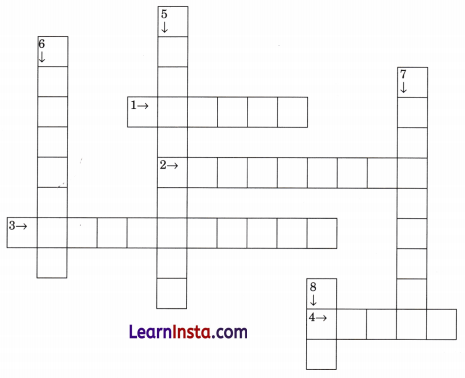
Crossword puzzle
| Across | Down |
| 1. Arrangement made by family and friends of a person when they are buried after death. | 5. Handwritten records of the past on paper, cloth or tree bark. |
| 2. A historical account of events arranged in chronological order. | 6. A statue, building, or other structure erected to mark an event and holds historical importance. |
| 3. Words that are written, carved or cut on some hard surface. | 7. Life after death. |
| 4. Earliest shelter of man. | 8. Age: When the earth was covered with ice. |
Find the reason
Question 1.
Why do we have so many calendars in the world?
___________________________________
Question 2.
Why are we not very sure about certain things of the past?
___________________________________
Question 3.
Why history is being reconstructed today and what role does technology have to play in it?
___________________________________
Question 4.
If we have to calculate the number of years between 176 BCE and 68 CE, it is 243 not 244 why?
___________________________________
Question 5.
Why are history recreating process is like a jigsaw puzzle?
___________________________________
Very short answer questions
Question 1.
What does CE, AD, BCE, or BC stand for in historical timelines?
___________________________________
Question 2.
What is the significance of a timeline in history?
___________________________________
Question 3.
How long is a millennium, a century, and an era?
___________________________________
Short answer questions
Question 1.
Explain how various sources contribute to our understanding of history.
___________________________________
Question 2.
What are the various professions involved in studying history? Describe their roles.
___________________________________
Question 3.
How and why did early humans become settled agrarians from hunters and gatherers?
___________________________________
Long answer questions
Question 1.
Discuss the evolution of human societies from the hunter-gatherer stage to the formation of complex communities.
___________________________________
Question 2.
Analyse the importance of timelines and chronological order in the study of history.
___________________________________
Question 3.
What do burials tell us about the life, beliefs, practices and living standards of people of old times?
___________________________________
Application-based questions
Imagine you are an archaeologist discovering a new site. Describe how you would go about uncovering and analysing the objects found to reconstruct the history of that site.
___________________________________
___________________________________
___________________________________
Activity
Sit with your parents and ask them about their parents and grandparents from the maternal and paternal sides and try to draw a family tree of four to five generations.
Picture based question
Draw a timeline and mention the following dates in the correct order and place,
(a) AD 68
(b) 140 CE
(c) 235 BCE
(d) AD 1947
(e) Your Birthday Year
(f) Wedding date of your parents
(g) 640 BCE
(h) 2500 BC
Let Us Do it
Draw a picture of the past with your imagination, keeping in mind that thousands of years back when marriage as an institution was not there, how did men and women manage their lives? How do they live, collect, and cook food for them and ensure their safety?