Class 6 Social Science Chapter 4 Notes Timeline and Sources of History
→ Many people study Earth’s history, uncovering its past and our own.
→ Geologists study physical features like soil, stones, hills, mountains, rivers, seas, and oceans.
→ Palaeontologists study fossils of plants, animals, and humans from millions of years ago.
→ Anthropologists study human societies and cultures from ancient times to the present.
→ Archaeologists study the past by digging up remains such as tools, pots, beads, bones, and teeth.
→ Societies have their own ways of measuring time, often starting new eras with major events.
→ Gregorian calendar is commonly used worldwide alongside Hindu, Muslim, Jewish, and Chinese calendars.
→ The period from the birth of Jesus Christ, when the Christian calendar starts counting years previously marked as AD (Anno Domini) and now as CE (Common Era).
→ The period before the birth of Jesus Christ, previously marked as BC (Before Christ) and presently as CE (Common Era)

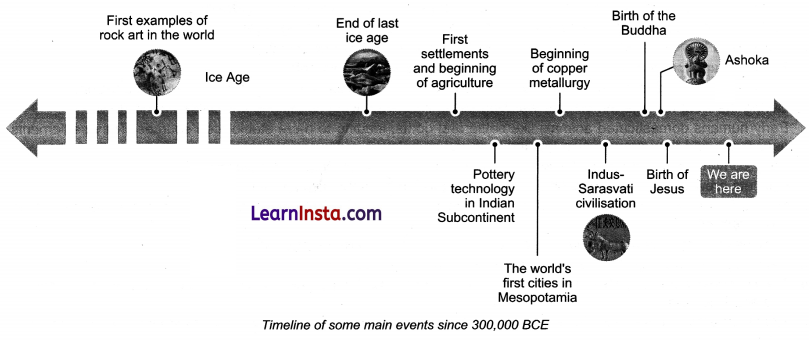
→ Timeline helps to understand the order of historical events and major landmarks.
→ Centuries are the periods of 100 years, counted from 1 CE for current era and going backward from 1 BCE. a Millenniums are the periods of 1,000 years, similarly counted from 1 CE and 1 BCE.
→ 8th Millennium BCE is marked in timelines to show significant historical periods.
→ Indian Calendars use positions of the sun and moon, detailed in panchangas with astronomical data, a Historical sources are objects and structures which help to reconstruct historical events.
→ Modern humans are Homo sapiens who have existed for about 300,000 years.
→ Early human faced natural challenges, lived in groups, and were hunters and gatherers. a Early humans had beliefs about nature and communicated using lost languages.
→ Made tools like stone axes, blades, and arrowheads, depicted in rock paintings.
→ Early humans made and exchanged ornaments like beads and pendants.
→ Ice Age was the periods when Earth was covered with ice, significantly affecting human living conditions.
→ During the Post-Ice Age the climate warming led to improved living conditions and settled agriculture.
→ Early humans domesticated animals like cattle and goats, leading to more stable food sources. They settlements near rivers and they grew in size leading to social complexity.
→ Early communities had no individual ownership and they work collectively for welfare.
→ Hamlets grew into villages, exchanging goods and forming communication networks.
→ During this period, development of pottery and use of metals like copper and iron led to the technological advancement.
→ Progress in the early period laid the foundation for the rise of civilisations.
→ Early humans’ courage and persistence ensured humanity’s survival.
→ Early human life and societies grew more complex over time. Cultural developments were influenced by environmental and social factors.
→ Recent scientific studies supplement traditional historical sources. Humans adapted to environmental changes over millennia.
→ Historians interpret events using a combination of sources and evidence. Understanding past human societies provides insights into present and future.
→ Geologist : A scientist who studies the physical features of the Earth, such as soil, stones, hills, mountains, rivers, seas, and oceans.
→ Palaeontologist : A scientist who studies the remains of plants, animals, and humans from millions of years ago in the form of fossils.
→ Anthropologist : A scientist who studies human societies and cultures from the oldest times to the present.
→ Archeologist : A scientist who studies the past by digging up remains left behind by people, plants, and animals, such as tools, pots, beads, and bones.
→ Era : A period of time marked by significant events, often used to measure time in history.
→ Gregorian Calendar : The calendar currently used worldwide, starting from the conventional year of Jesus Christ’s birth.
→ Common Era(CE) : The period of time counted forward from the traditional year of Jesus Christ’s birth, formerly referred to as AD.
→ Before Common Era (BCE) : The period of time counted backward from the traditional year of Jesus Christ’s birth, formerly referred to as BC.
→ Timeline : A visual representation of a sequence of events over a specific period, showing historical events and their order.
→ Century : A period of 100 years, with specific centuries counted from the year 1 CE.
→ Millennium : A period of 1,000 years, with specific millenniums counted from the year 1 CE.
→ Panchanga : An Indian calendar book of tables listing the days of each month along with related astronomical data.
→ Ice Age : A period when much of the Earth was covered with ice, occurring over 100,000 years ago to around 12,000 years ago.
→ Hunter-Gatherers : Early humans who relied on hunting animals and collecting edible plants and fruits for survival.
→ Rock Paintings : Early forms of art found in caves depicting simple figures, symbols, animals, or humans.
→ Domestication : The process of taming animals such as cattle and goats for human use.
→ Chieftain : A leader responsible for the well-being of a community in early human societies.
→ Pottery : The craft of making pots and other objects from clay, an early technological advancement.
→ Copper : A metal used by early humans to make durable tools and objects, before the use of iron.
→ Civilisation : A complex human society with developed cities, social structures, and cultural achievements.
→ Epigraphist : An expert who studies ancient inscriptions to learn about past cultures.
→ Fossil : Preserved remains or impressions of plants, animals, or humans from millions of years ago.
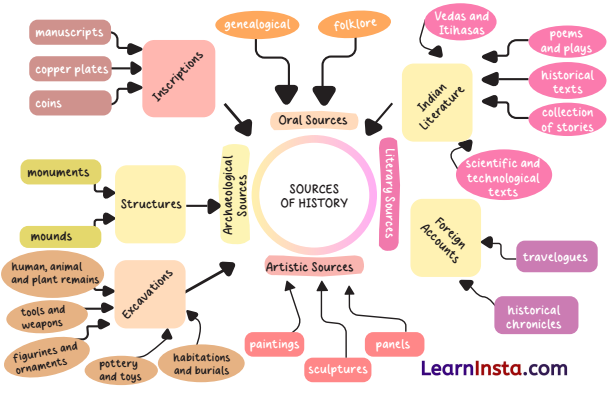
→ Historical Sources : Various types of evidence used to reconstruct and interpret past events.
→ Rock Shelter : A natural or semi-natural formation used by early humans for shelter.
→ Temporary Camp : A short-term living arrangement used by early human bands or groups.
→ Ornament : Simple decorative objects made by early humans, such as stone or shell beads.
→ Agriculture : The practice of cultivating cereals and grains, marking a significant shift in early human societies.
→ Settlement : The establishment of permanent living areas near water sources for better living conditions.
→ Trade Networks : Systems of exchange among early villages and towns for goods like food, clothing, and tools.
→ Scientific Studies : Modern methods used to supplement historical sources, such as studies of ancient climates and genetics.
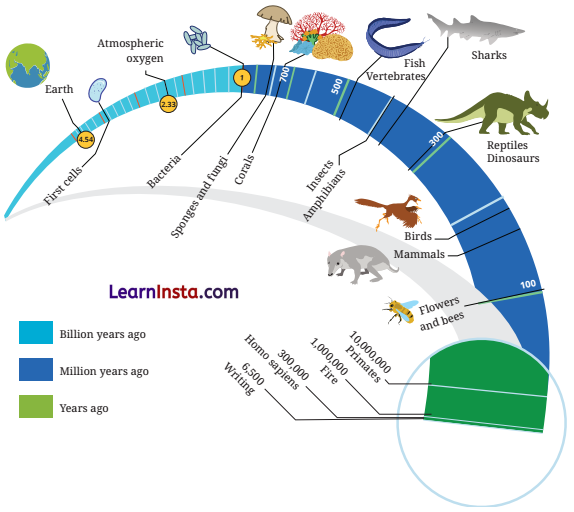
Timeline of a few important stages in the evolution of life on Earth.