Experts have designed these Class 8 Maths Notes and Part 2 Chapter 6 Algebra Play Class 8 Notes for effective learning.
Class 8 Maths Chapter 6 Algebra Play Notes
Class 8 Algebra Play Notes
Algebra is a powerful tool used to represent numbers using letters (variables). In this chapter, algebra is used not only to solve equations but also to understand puzzles, tricks and patterns. Instead of guessing, why and how a trick works, algebra helps us to prove that it will always work.
‘Think of a Number’ Tricks
This tricks involves a series of mathematical steps performed on a hidden number that lead to a predictable result.
Algebra is used to explain, why these tricks work by representing the unknown number as a variable.
e.g. Rules to make the final answer 2.
- Think of a number : x
- Double it: 2x
- Add four :2x + 4
- Divide by two 😡 + 2
- Subtract the original number you thought of: x + 2 – x – 2
The result will always be 2 regardless of the starting number.
Date Reading Trick
To perform this trick, ask the participant to perform a series of calculations on their secret date Month M and Day D. e.g.
Suppose, the month be M (1 -12) and the day be D (1 -31).
- Multiply the month by 5 : (5 M)
- Add 6 to the result: (5M + 6)
- Multiply the whole expression by 4 :
4 (5M + 6) = 20M + 24 - Add 9 to the result:
20M + 24 + 9 = 20M + 33 - Multiply the entire result by 5 :
5 (20M + 33) = 100M + 165 - Add the secret day (D):
100M +165 +D
The constant 165 is then subtracted from the final answer to isolate the term 100M+D.
The 100M+D encodes the month (M) and the day (D) using place value.
Since, the day almost 31 (a two-digit number), the last two digits of the numbers corresponds to D and the preceding digits correspond to M.
e.g. If the result is 126, D = 26 and M = 1

Number Pyramids
In a number pyramid, each number is the sum of the two numbers directly below it. Algebra helps to solve the missing values in the pyramid by setting up equations based on this rule.
e.g. For a four row number pyramid if the bottom row is a, b, c, d. Then, top row = a + 3b + 3c + d.
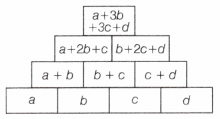
Note: The Virahanka-Fibonacci numbers refer to the sequence of integers, where each number is the sum of the two preceding ones 1, 2, 3, 5, 8, 13……….. while widely known in the west as the fibonacci sequence.
Calendar Magic Grids
This trick uses the structured nature of calendars to perform tricks.
In a 2 × 2 grid on a calendar if the top-left number is a then others are a + 1 (next day), a + 7 (same day next week) and a + 8.

By adding all four numbers, the sum is 4a + 16.
Algebra Grids with Shapes
In algebra grids, different shapes represent different unknown values.
In each row, the last column is the sum of the values to its left.
The Largest Product
The largest product explores how to arrange a given set of digits to create the largest possible product, when multiplied.
e.g. Let p, q and r be the three numbers.
If digits p < q < r, the largest product is always formed as qr × p. This means to get the largest product from three numbers, the largest digit should be the multiplier and the remaining digits should be arranged in decreasing order to form the multiplicand. Decoding Divisibility Tricks Algebra is used to justify, why certain operations always lead to numbers divisible by a specific factor. Let the two-digit number be ab. When it is reversed, the new number is ba. If b > a then ba > ab.
So, the difference is
(10b + a) – (10a + b) = 10b – b – 10a + a
= 9b – 9a
= 9 (b – a)
The difference is divisible by 9.
Also, if a > b, the difference is divisible by 9.
Similarly, the sum is divisible by 11.
Three-Digit Cycling
Let any 3-digit number, say abc (100a +10b + c).
Make two other 3-digit numbers from these digits by cycling these digits around yielding bca and cab.
Now, add the three numbers
= 100a + 10b + c + 100b + 10c + a + 100c + 10a + b
= 111a +111b + 111c
= 111 (a + b + c)
= 37 × 3 (a + b + c)
So, the sum is always divisible by 37 and 33.
Repeated Three-Digit Numbers
Any number abcabc can expressed as 1001 × abc.
i. e. abcabc = 7 × 11 × 13 abc.
Therefore, dividing abcabc by 7 then by 11 and then by 13 will always result in the original 3-digit number.