Experts have designed these Class 8 Maths Notes and Part 2 Chapter 4 Exploring Some Geometric Themes Class 8 Notes for effective learning.
Class 8 Maths Chapter 4 Exploring Some Geometric Themes Notes
Class 8 Exploring Some Geometric Themes Notes
This chapter explores the idea of self-similar shapes in nature and mathematics through fractals such as the Sierpinski Carpet, Sierpinski Triangle and Koch Snowflake. It also introduces nets of solids, shortest paths on surfaces and visualising solids through projections and isometric drawings.
Fractals, Sierpinski Carpet and Sierpinski Gasket
Fractals
A fractal is a shape or pattern that repeats itself again and again in smaller parts. Each smaller part looks similar to the whole shape.
e.g. The fern plant in which each leaf is a smaller copies of themselves.
Sierpinski Carpet
The Sierpinski carpet is a type of fractal pattern. It is made by starting with a square divided into 9 equal smaller squares, removing the central one then repeating this process on the remaining 8 squares infinitely.
Construction of Sierpinski Carpet
Step 0: Take a square.

Step 1: Divide the square into 9 equal smaller squares like a 3 × 3 grid.

Now, remove the middle square.

So, there are left 8 squares.
Step 2: Take each of the 8 remaining squares. Then, divide each into 9 equal parts and remove the middle square of each.

Repeat the same process again and again for every remaining square.

The number of remaining squares grows by a factor of 8 at each step and the number of holes is the sum of remaining squares from all previous steps.

Number of remaining square and holes
Let Rn represent the number of remaining squares at the nth step and Hn represent the number of holes at the nth step.
So, the number of remaining squares in nth step,
Rn = 8n
and the number of holes in nth step,
Hn+1 = Hn + Rn
Area of region remaining at the nth step
The Sierpinski carpet construction starts with an initial square and divides it into nine equal sub-squares, removing the central one. This removed square has an area of \(\frac{1}{9}\) of the original. At each sub sequent step, this process is repeated on the remaining eight squares. Thus, at each step, \(\frac{1}{9}\) of the current area is removed, meaning 1 – \(\frac{1}{9}\) i.e. \(\frac{8}{9}\) of the area remains.
Let An be the area of region remaining at the nth step and A0 be the initial area. Then, the area of remaining square after the nth step,
An = A0 × \(\left(\frac{8}{9}\right)^n\)
If the initial area A0 = 1 sq unit then
An = 1 × \(\left(\frac{8}{9}\right)^n\)
⇒ An = \(\left(\frac{8}{9}\right)^n\)
Sierpinski Gasket
Sierpinski gasket, also known as Sierpinski triangle, is a fractal pattern. It is constructed by dividing an equilateral triangle into four smaller congruent equilateral triangle by joining the mid-points of its sides and removing the central inverted triangle. This process is then repeated infinitely on the remaining three triangles.
Construction of Sierpinski Gasket
Step 0: Start with an equilateral triangle.

Step 1: Join the mid-points of the three sides. Now, divide the triangle into four congruent equilateral triangles and remove the central triangle.

Step 2: Repeat the same process on each of the three remaining triangles. Each triangle is again divided into four smaller triangles and the middle one removed.

Now, the number of remaining triangles is 9. Repeat the same process again and again for every triangles.
Number of Triangles at Step n
At each step, each triangle produces 3 smaller triangles.
At Step 0 The total number of remaining triangle = 1 = 3°
At Step 1 The total number of remaining triangles = 31 = 3
At Step 2 The total number of remaining triangle = 32 = 9
∴ The total number of remaining triangles at step n = 3n.
Area of the region remaining at the nth step
The Sierpinski triangle construction starts with an equilateral triangle and removes the central triangle formed by connecting the mid-points of its sides. This removed
triangle has an area of \(\frac{1}{4}\) of the original. At each subsequent step, this process is repeated on the remaining smaller triangles.
Thus, at each step, \(\frac{1}{4}\) of the current area is removed, meaning 1 – \(\frac{1}{4}\) i.e. \(\frac{3}{4}\) of the area remains.
Let An be the area of the region remaining at the nth step and A0 be the initial area.
Then, the area remaining after the nth step,
An = A0 × \(\left(\frac{3}{4}\right)^n\)
If’ initial area A0 = 1 sq unit then
An = 1 × \(\left(\frac{3}{4}\right)^n\)
An = \(\left(\frac{3}{4}\right)^n\)
Koch Snowflake
Koch Snowflake begins with an equilateral triangle in which each side divides into three equal parts and replacing the middle third with a outward equilateral triangle. This process is repeated infinitely to obtain further patterns.
Construction of Koch Snowflake
Step 0: The sequence starts with an equilateral triangle.

Step 1: For each side of the triangle, the middle third is removed and replaced by an equilateral triangle pointing outwards. The length of the new sides is \(\frac{1}{3}\) of the original side.

Step 2: The process from Step 1 is repeated for each of the 12 sides of the new shape.

The number of sides in the nth step
The number of sides of each step forms a sequence, where each term is four times the previous term.
In Step 0 Total number of sides = 3
In Step 1 Total number of sides = 3 × 4 = 12
In Step 2 Total number of sides = 12 × 4 = 3 × 42 = 48
In Step 3 Total number of sides = 48 × 4 = 3 × 43 = 192
∴ In nth step The number of sides = 3 × 4n, where n is whole numbers.
The perimeter of the shape at the nth step
The initial shape has 3 sides. At each step, every existing side is replaced by 4 smaller sides.
So, the length of each new side is one-third of the previous length.
The length of each side at step n = \(\left(\frac{1}{3}\right)^n\)
Let Pn be the total perimeter in step n and Sn be the number of sides in step n.
So, the total perimeter Pn at step n = Product of the number of sides and the length of each side

∴ The perimeter of the shape at the nth step of the sequence is 3 × \(\left(\frac{4}{3}\right)^n\)
Fractals in Art
Fractals appear in ancient Indian temples like Kandariya Mahadev (1025 CE) with recursive tower structures and sites like Madurai, Hampi. African Fulani blankets feature nested diamond patterns M.C. Escher’s ‘Smaller and Smaller’ shows lizards repeating at scales.
Visualising Solids
Visualising solids involves mental imagery, profiles from viewpoints, nets for construction, projections (front, top, side views), shadows, and isometric drawings on grids. Solids like cuboids, prisms, pyramids have faces (flat surfaces), edges (lines), vertices (points, where edges meet).
Faces, Edges and Vertices
- Faces Faces are the flat surfaces of a solid shape.
- Edges The sides (straight lines) of polygons that make up each face of the shape are called edges.
- Vertices The corner points of solid figures are called vertices.
e.g. ABCDEFGH is a cuboid.

The 6 faces of the cuboid are ABCD, EFGH, ADHE, BCGF, ABFE, DCGH. Out of these, four faces namely ABFE, DCGFl, BCGF and ADHE are called lateral faces of the cuboid.
The 12 edges of the cuboid are AB, BC, CD, DA, EF, GH, FG, EH,CG,BF, AE,DH.
The 8 vertices of the cuboid are A, B, C, D, E, F, G, H.
Now, observe the following 3D-shapes with their faces, vertices and Edges.
| Name of the Solid | Number of Faces | Number of Vertices | Number of Edges |
| Cuboid | 6 | 8 | 12 |
| Cube | 6 | 8 | 12 |
| Cylinder | 3 | 0 | 2 |
| Cone | 2 | 1 | 1 |
| Sphere | 1 | 0 | 0 |
| Triangular pyramid | 4 | 4 | 6 |
Nets for Building 3D-Shapes
A net is a pattern that can be cut out and folded to make a model of a solid shape.
e.g. Suppose, we have a cube and its net is shown in the given figure.

Shortest Paths on Surfaces
The shortest path on a surface is the minimum distance along the surface of a solid not through the interior. When moving on flat surfaces the shortest distance between two points is a straight line.
Basic steps to find the shortest distance
(i) Unfold (or open) the surface of the solid into a net.
(ii) Draw a straight line between the two points on the net. This straight line on the net represents the shortest path on the surface of the solid.
(iii) Make a right-angled triangle then apply Pythagoras theorem to find the shortest path.
Looking a Solid from Different Angles
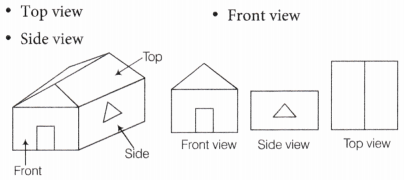
Looking at a solid from different angles means observing a three dimensional object from various position such as top, front and side to understand its shape and structure clearly.
By viewing a solid from these different directions, we get different two dimensional views of the same object, which helps us to imagine and represent the solid accurately.
These views are called
Visualising Solid by Shadowing
When light falls on a solid object, the dark outline formed on a surface is called the shadow of the solid. It shows the shape of the object from a particular direction.
e.g. If a torch is focused on a ball, a cylinder and an opened book, their shadows on the surface may appear as shown below.

Isometric Sketches
A rough drawing of a solid on isometric dot paper showing its three-dimensions (length, breadth and height) is called an isometric sketch.
e.g. Drawing a cube on isometric dot paper by measuring equal lengths , breadth and height along the dotted lines is an isometric sketch.
To draw isometric sketches of a cuboid of dimensions 2 × 2 × 3, following steps are used.
Step I: Draw a rectangle to depict the front face.

Step II: Draw four parallel line segments of length 3 starting from each of the four corners of the rectangle.

Step III: Join the matching corners with an appropriate line segments.

Hence, this is an isometric sketch of a cuboid.