Experts have designed these Class 8 Maths Notes and Chapter 3 A Story of Numbers Class 8 Notes for effective learning.
Class 8 Maths Chapter 3 Notes A Story of Numbers
Class 8 Maths Notes Chapter 3 – Class 8 A Story of Numbers Notes
Numbers are essential in our daily lives, influencing various activities from simple counting to complex calculations. But when early humans needed to keep track of things like animals in a herd, they struggled and used inefficient ways since they didn’t have numbers like we do today. They used simple tools like sticks or their fingers and body parts to count or represent numbers. Starting with early tally marks for basic counting, civilizations developed their own systems.
The Mayans utilized a base-20 system, while the Mesopotamians developed a base-60 system, evident in our timekeeping today. The Chinese contributed a decimal system that facilitated trade, and the Egyptians used special symbols to represent numbers. The introduction of Indo-Arabic numerals revolutionized mathematics. And now, the set of 10 symbols enables us to express any possible number in the world.
→ A number system is a way of representing numbers using a consistent set of symbols and rules.
→ Gumulgal number system: A group of indigenous people of Australia called Gumulgal. In this system they had the following words for their numbers.
- 1: urapon
- 2: ukasar
- 3: ukasar-urapon (literally “two and one”)
- 4: ukasar-ukasar (literally “two and two”)
- 5: ukasar-ukasar-urapon (literally “two and two and one”)
- 6: ukasar-ukasar-ukasar (literally “two and two and two”)
→ Gumulgal called any number greater than 6 ras.
→ The Roman numeral system is a numerical notation system from ancient Rome that uses letters from the Latin alphabet to represent numbers.
→ The system uses seven basic Latin letters, each with a set integer value:
I = 1, V = 5, X = 10, L = 50, C = 100, D = 500, M = 1000
But they had no symbol for zero.
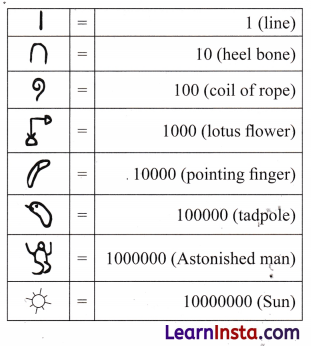
→ Egyptian number system is an ancient non-positional number system that was used in Ancient Egypt around 3000 BCE.
→ Egyptian number system is a base-10 (decimal) system. They used hieroglyphs for numbers, based on powers of 10. In this system each landmark number is 10 times the previous one.

→ In this notation there was a special sign for every power of ten. For I, a vertical line; for 10, a sign with the shape of an upside down U; for 100, a spiral rope; for 1000, a lotus blossom; for 10,000, a raised finger, slightly bent; for 100,000, a tadpole; and for 1,000,000, an “astonished man” with upraised arms.
101 can be regrouped as  , 102 can be regrouped as
  , 103 can be regrouped as
  , and so on.
A base-10 number system is also called a decimal number system.
→ Mesopotamian Number System: Mesopotamians were the first to develop a written number system (base-60 system), used for trade and astronomy.This number system is also called sexagesimal system and babyloynian number system.
This system used the symbol  for 1 and
  for 10.
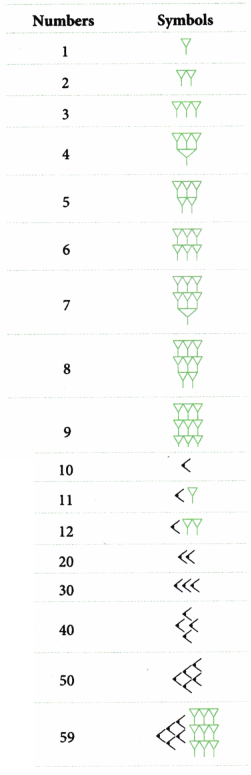
In Mesopotamian system, using and , numbers 1 to 59 can be represented.
→ Mayan Number System:The Mayan civilization (Central America) is generally dated from 3rd to 10th centuries CE. They developed a base-20 system with dots, bars, and seashell for zero.
Symbols in the Mayan Number System are placed vertically to represent a number.
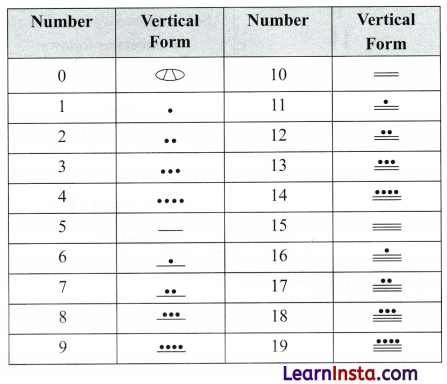
→ In order to write a number, there were only three symbols needed in this system. A horizontal bar  represented the quantity 5, a dot
  represented the quantity 1, and a special symbol seashell
  represented zero.
→ Chinese Number System : They used rod numerals and early decimal system.
The rod numeral system developed in china at least by 3rd century AD and were used till 17th century like other number system that is base 10 or decimal system. They also used symbols for 1-9 that are as follows:
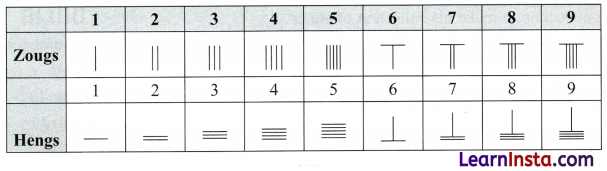
→ The Zongs represent units, hundreds, tens of thousands etc. and Hengs represent tens, thousands, hundreds of thousands. etc.
→ Hindu Arabic Number System: The system was developed in India, with evidence suggesting its use as early as the 1st to 4th centuries.
→ The Hindu-Arabic numeral system is a decimal place-value system using ten symbols (0,1,2,3,4,5,6,7,8, and 9) to represent numbers.
→ Each digit’s position in a number determines its value.
→ The system uses a base of ten, meaning each place value is a power of ten ones, tens, hundreds, thousands, etc
→ The inclusion of zero as a placeholder is a key feature of this system, allowing for the representation of numbers like 10, 100, etc.
In this chapter, we will explore the historical evaluation of number systems across different civilizations.
We will study systems such as Roman numerals, Egyptian number system, Mesopotamian number system, Mayan number system, Chinese number system and Hindu number system.
Primitive Methods of Counting
The need to count objects, days and events has existed since ancient times. Early humans depended on the basic techniques to count and record quantities.
The main ancient counting methods included the followings
1. One-to-one Mapping
The way of associating each object with a stick (stone or pebble) such that no two objects are associated or mapped to the same stick (stone or pebble), is called as a one-to-one mapping.
e.g. If a person had five cows, they would collect five sticks,
1. e. one stick for each cow. The final collection of sticks would tell the number of cows, which can be used to check if any cows have gone missing.
2. Counting using Body Parts
Many groups of people across the world have used their fingers, hands and other body parts for counting. This method helped people to count beyond ten without using tools or any written symbols.
3. Tally Marks
Tally marks were one of the oldest method of number representation by making repeated straight line marks on bones, stones or walls. Each mark represents one count and final collection of marks represents the total number of objects.
4. Counting by Grouping
Instead of counting each item individually which required a number of symbols, some groups used patterns based on grouping for counting, that is in groups of 2, 5, 10 or 20.
e.g. The Gumulgal people of Australia counted in group of 2.
The representation of numbers in Gumulgal system is shown below.
| Numbers | Word used | Breakdown |
| 1 | urapon | …….. |
| 2 | ukasar | …….. |
| 3 | ukasar-urapon | 2 + 1 |
| 4 | ukasar-ukasar | 2 + 2 |
| 5 | ukasar-ukasar- urapon | 2 + 2 + 1 |
| 6 | ukasar-ukasar-ukasar | 2 + 2 + 2 |
| 6 | ras | …… |
Note:
- Gumulgal had number names for numbers only till 6.
- Addition can be done by simply writing the number names together.
- Subtraction can be done by simpiy removing some words from the number name.
- Multiplication can be done by repeating the same word.
- Division can be done by splitting the word into equal groups.
Limitations of Ancient Methods of Counting
- These lacked of a standard way of writing or recording numbers.
- These lacked of place value chart.
- These could not represent the idea of ‘nothing’ or zero.
- The repetition of marks or objects became cumbersome when counting large quantities.
- These were informal and culture-specific.
Number System
A standard sequence of objects, names or written symbols that have a fixed order, is called a number system.
e.g. Hindu- Arabic number system which has 10 symbols in a fixed order 0, 1, 2, 3, 4, 5, 6, 7, 8, 9.
Numerals
The symbols representing numbers in a written number system are called numerals.
e.g. 0, 1,2, 3, 4, 5, 6, 7, 8, 9 are the numerals used in Hindu-Arabic number system.
Landmark Numbers
The landmark numbers are the numbers that are easily recognisable and used as reference points for understanding and working with other numbers in any number system.
e.g. The landmark numbers in Hindu-Arabic number system are
1,10, 100, 1000, 10000, …………….. i.e. 10°, 101, 102, 103
Positional Number System or Place Value System
A number system having a base that makes the use of the position of each symbol in determining the landmark number that is associated with is called positional number system or place value system.
e.g.Hindu-Arabic number system is a place value system.
Evolution of Nontber Systems
Before the development of our Modern numeral system, several ancient civilisations created their own ways of representing numbers.
These well-known early number systems are as follows
1. Roman Number System
The Roman number system was originated in ancient Rome and used specific letters as numerals to represents the following landmark numbers.
| Symbol | Landmark numbers |
| I | 1 |
| V | 5 |
| X | 10 |
| L | 50 |
| C | 100 |
| D | 500 |
| M | 1000 |
Conversion of a Number into Roman Number System
We first write the given number as a sum of landmark numbers starting from 1000 such that we can take as many 1000s as possible, 500s as possible and so on.
Then, we write their corresponding Roman numerals, e.g. We have, 2376 First, we write it as
2376 = 1000 + 1000 + 100 + 100 + 100 + 50 + 10 + 10 + 5 + 1
Then, in Roman numerals, 2376 is
M M C C C L X X V I
Conversion of a Roman Numeral into a Standard (Modern) Number
We first break the given Roman numeral into its individual symbols from left to right.
If a symbol is followed by one of equal or lesser value, its value is added and if a symbol is followed by a greater value, its value is subtracted from the next symbol.
Then, we add up all the values to get the required number.
e.g. We have, CLXIV First, we break it as
C= 100 (as L < C then addition follows)
L= 50 (as X < L then addition follows)
X= 10 (as I < X then addition follows) IV = 4 (as V > I then subtraction follows)
So, we have, CLXIV = 100 + 50 + 10 + (5 – 1)
= 100 + 50 + 10 + 4
= 164
Limitations of the Roman Number System
- Roman numerals allow very basic operations like addition or subtraction using directly symbols, but only for small values.
- It lacks in positional or place value system.
- It has no symbol for zero.
- Multiplication cannot be performed directly using Roman numerals without converting them to Hindu-Arabic numerals.
2. Egyptian NumberSystem
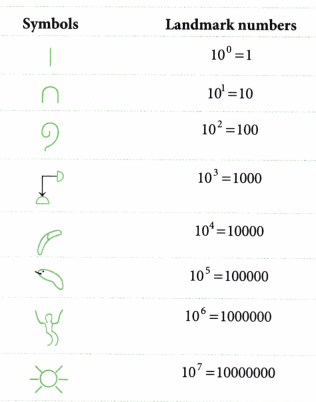
The Egyptian number system was developed in Egypt and used the landmark numbers to group and represent a given number.
In this system, 1 is the first landmark number and each landmark number is 10 times the previous number, i.e. they all are powers of 10.
That’s why this system is also known as base-10 number system.
The following symbols are given to the landmark numbers
Conversion of a Number into Egyptian Number System
We first write the given number as sum of landmark numbers starting from the largest landmark number less than the given number.
Then, assign their Egyptian numerals to get the required Egyptian number.
e.g. We have, 434.
We first write it as
434 = 100 + 100 + 100 + 100 + 10 + 10 + 10 + 1 + 1 + 1 + 1
Then, in Egyptian numerals, 434 is written as

Conversion of an Egyptian Number into a Standard (Modern) Number
First, identify the each symbol and its value. Then, simply add all the values to get the required number, as order doesn’t matter.
e.g. We have,

= 1000 + 100 + 100 + 100 + 100 + 10 + 10 + 10 + 10 + 10 + 1 + 1 + 1
= 1453
Addition in the Egyptian System
First, we write both numbers using their symbols and combine the same symbols in group of 10. Then, replace each group of 10 identical symbols with the next higher symbol.

Multiplication in the Egygjian System
Since, the Egyptian numerals are additive then their product with another Egyptian numeral holds the distributive law,
i.e. (a + b) × n = a × n + b × n
Then, the product simplifies to the product of two landmark numbers (or symbols), which we can easily compute.
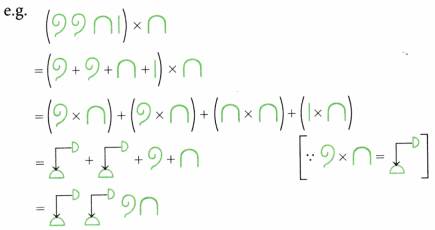
Note The product of any two landmark number is another landmark number.
3. The Base-n Number System
A number system having first landmark number to be 1 and every next landmark number is obtained by multiplying the current landmark number by some fixed number n is said to be a base-n number system, i.e. a number system whose landmark numbers are the powers of a number n is referred to a base-n number system.
e-g-
(i) The Egyptian number system is a base -10 number system. A base-10 number system is also known as a decimal number system.
(ii) Base-5 number system has landmark numbers as the powers of 5, i.e. 5°, 51, 52, 53, 54, 55, which corresponds to the following symbols.

e.g.
(a) We have, 1653
We first write it as
1653 = 625 + 625 + 125 + 125 + 125 + 25 +1+1+1
Then, in base-5 number system, 1653 is

(b) We have,

We Know,
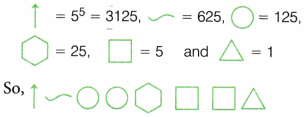
= 3125 + 625 + 125 + 125 + 25 + 5 + 5 + 1
= 4036
Advantages of a Base-n Number System
(i) It is easy to perform addition, subtraction and multiplication systematically.
(ii) The base-n number system involves only n different symbols, which makes easier to remember.
(iii) It uses the place value system.
Short comings (Limitations) of a Base-n Number System
(i) It has no symbol for zero.
(ii) It doesn’t allow the easier number representation of very large numbers due to repetition of symbols.
Abacus
The abacus is an ancient calculating tool based on decimal (i.e. base-10) number system which is used to perform arithmetic operations. It is a board consisting of lines starting from 1 and then each successive line represents the successive power of 10.
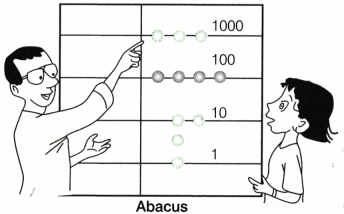
For each power of 10, as many counters were placed on its line as the number of times it occurred in the grouping. But the presence of a counter above a line contributed a value of 5. e.g. We have, 3637
We can write it as
3637 = 1000 + 1000 + 1000 + 100 + 100 + 100 + 100 + 100 + 100 + 10 + 10 + 10 + 1 + 1 + 1 + 1 + 1 + 1 + 1
Then, 3637 can be represented on abacus as shown below.

4. The Mesopotamiahl Number System
(i) The Mesopotamian number system was originated in Mesopotamia (present-day Iraq) by Sumerians.
(ii) This system is based on base-60 number system, which means first landmark number is 1 and then each landmark number is 60 times the previous one. That’s why it is also called as sexagesimal system or Mesopotamian sexagesimal system.
(iii) This system was adopted and improved by Babylonians. That’s why it is also known as Babylonian number system.
(iv) This system used the symbols 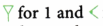 for 10. Then, using these two symbols, the numbers from 1 to 59 can be represented as follows.
(v) One can give his own symbols to their landmark numbers as

(vi) They used a symbol to denote a blank space as a placeholder symbol, just to remove ambiguity.
Conversion of a number into a Mesopotamian Numeral
We first break the given number into its place value digit using landmark numbers. Then, write their symbols corresponding to each digit ranging from 1 to 59 along with their landmark numbers symbols. Finally, combine all the symbols from the highest to lowest landmark numbers to get the required Mesopotamian numeral.
e.g. We have, 15026
First, we break it as 15026 = 4 × 3600 + 10 × 60 + 26
Now, we write the symbols for each digit and corresponding landmark numbers together to get the required Mesopotamian numeral.
So,

Note: This can also be represented just by leaving empty spaces for the landmark numbers’ symbols as

This is the compact representations which is not consistent in terms of uniform spacing for blanks.
Conversion of Mesopotamian Number into a Modern Number
First, we write the highest landmark number and the number of times, it occurs by identifying the leftmost symbol in given Mesopotamian number. Then, we go for the next second highest landmark number using the same process.
Now, multiply the corresponding landmark numbers with their count of occurrence and then add all of them to get the required number.
e.g. We have,

Here, the highest landmark number is 602 = 3600 which has occurred thrice, i.e.

So, the required Hindu numeral is
43200 + 1260 + 6 = 44466
5. The Mayan Number System
(i) The Mayan number system was originated in Central America by the Mayan civilisation.
(ii) This system is almost base-20 number system having landmarks.
1, 20, 20 × 18 = 360, 202 × 18 = 7200 203 × 18 = 144000
(iii) This system used mainly three symbols given as follows.

(iv) Symbols in the Mayan number system are placed vertically to represent a number.
(v) This system used dot (•) and bar (—) for all the numbers from 1 to 19.
(vi) It was the first number system which introduced the symbol for zero.
Conversion of a number into Mayan Number System
(i) We first write the given number as a sum of landmark numbers starting from the largest landmark numbers less than the given number,
e.g. We have, 1432
First, we write it as
1432 = 360 + 360 + 360 + 20 + 20 + 20 + 20 + 20 + 20 + 20 + 20 + 20 + 20 + 20 + 20 + 20 + 20 + 20 + 20 + 20 + 1 + 1 + 1 + 1 + 1 + 1 + 1 + 1 + 1 + 1 + 1 + 1
= 360 × 3 + 20 × 17 + 1 × 12
(ii) Then, we write the landmark numbers vertically from top (highest place) to bottom (ones), along with their count of occurrence and respective symbols.
e.g.

(iii) Finally, combine all the symbols to get the final number.
e.g. In the Mayan numerals, 1432 is written as

Conversion of a Mayan Number into Modern Number
We first start from the bottom of the vertical Mayan number till the top. Write the values of each vertically placed symbols along with the corresponding landmark numbers, starting from 1, 20, 360, 7200 and 144000 from bottom to top.
Finally, multiply the landmark numbers with their corresponding symbols’ values and then add all of them to get the desired result,
e.g. We have,

First, we write the symbols as

Now, on multiplying values of symbols with their landmarks numbers and then adding, we get
360 × 10 + 20 × 7 + 1 × 0
= 3600 + 140 + 0
= 3740
So, the Mayan numeral
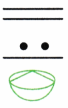
corresponds to Modern number 3740.
Limitations of the Mayan Number System
- As it was not actual base-20 number system, so it was a puzzling phenomenon.
- Writing numerals vertically could make reading and notations cumbersome, especially for large quantities.
- It was not suitable for performing arithmetic operations.
6. The Chinese Number System
(i) The Chinese used two number systems :
- a written system for recording quantities.
- a system making use of rods to perform computations (rod-based number system).
(ii) The numerals used in the rod-based number system are called as rod numerals.
(iii) This system was based on base-10 system (i.e. decimal system).
(iv) This system used
- vertically placed rods called zongs which represent units, hundreds, tens of thousands, etc.
- horizontally placed rods called as hengs which represent tens’, thousands, hundreds of thousands etc.
(v) The symbols for 1 to 9 are as follows.

(vi) The rod numerals used a blank space to indicate the skipping of a place value, though the space was uniform between the rods, which made it easier to locate them.
Conversion of a Number into a Chinese Numeral
(i) First, we break the given number into its place values using landmark numbers.
e.g. We have, 1276 First, we write it as
1276 = 1 × 1000 + 2 × 100 + 7 × 10 + 1 × 6
(ii) Now, write the Chinese symbols corresponding to each digit by identifying zongs and hengs. e.g.

(iii) Finally, combine all the symbols from highest to lowest landmark numbers to get the Chinese numerals,
e.g. The Chinese numeral corresponding to 1276 is

Conversion of a Chinese Number into a Modern Number
First, identify each Chinese character and its corresponding place value (i.e., the landmark numbers). Then, we multiply each value of character with its corresponding landmark number and finally, add all of them to get the final number.
e.g. We have,

Here,

Now, on multiplying symbols’ values with landmark number and then adding, we get
1 × 10³ + 5 × 10² + 3 × 10 + 9 × 1 = 1539
So, the Chinese numeral

corresponds to 1539.
7. The Hindu Number System or The Hindu Arabic Number System
- The Hindu number system was developed in India, which is now used throughout the world.
- It is a base-10 or decimal number system.
- It uses 10 symbols 0, 1,2, 3, 4, 5, 6, 7, 8, 9
- It has landmark numbers as 1, 10, 100, 1000,
i.e. the powers of 10. - It is a place value system.
- This system does not lead to any kind of confusion when reading or writing numerals due to the use of symbol 0 as a digit and as a number.
- It is efficient in performing all the arithmetic operations.