Students revise important topics using Class 7 SST Extra Questions and Class 7th SST Chapter 7 The Gupta Era An Age of Tireless Creativity Important Extra Question Answer before exams.
Class 7 SST Chapter 7 The Gupta Era An Age of Tireless Creativity Extra Questions
NCERT Class 7 Social Science Chapter 7 Extra Questions on The Gupta Era An Age of Tireless Creativity
The Gupta Era An Age of Tireless Creativity Class 7 Very Short Question Answer
Question 1.
What significant mathematical concept was introduced by Aryabhata during the Gupta period?
Answer:
The concepts of zero and the value of pi (π).
Question 2.
Which Gupta ruler is credited with establishing the “Classical Age” of India and promoting the art and learning?
Answer:
Chandragupta II (Vikramaditya).
Question 3.
What was the name of the famous university in the Gupta Empire that became a centre of learning and attracted scholars from around the world?
Answer:
Nalanda University.

Question 4.
Name one of Kalidasa’s celebrated compositions in Sanskrit.
Answer:
Meghadutam.
Question 5.
What important astronomical theory did Aryabhata propose about the Earth in his work Aryabhatiya?
Answer:
Aryabhata proposed that the Earth rotates on its axis.
The Gupta Era An Age of Tireless Creativity Class 7 Short Question Answer
Question 1.
What are the main sources of information about the Gupta period?
Answer:
The main sources about the Gupta period include literary works (Meghadutam, Aryabhatiya), inscriptions on pillars and temples, and foreign accounts (Prayaga Prashasti inscription, Faxian’s travelogue).
Question 2.
What is the significance of the inscriptions from the Gupta period?
Answer:
Inscriptions provide valuable information about the Gupta rulers, their administration, and religious practices. A notable example is the Prayaga Prashasti pillar inscription at Prayagraj, which describes the achievements of Samudragupta.
Question 3.
Who wrote the book Buddhist Records of the Western World and what does it describe?
Answer:
The book Buddhist Records of the Western World was written by Faxian, a Chinese traveller. It describes his journey to India and provides insights into the religious and social conditions of Gupta India.
Question 4.
What role did the Ashoka Pillars play as a source of the Gupta history?
Answer:
Although originally from the Maurya period, the Ashoka Pillars were used by the Guptas as models for inscriptions, offering details about royal achievements, religious policies, and administration.
The Gupta Era An Age of Tireless Creativity Class 7 Long Question Answer
Question 1.
Discuss the role of trade and commerce during the Gupta Empire.
Answer:
The Gupta Empire thrived on both inland and overseas trade. Goods such as spices, textiles, and precious stones were traded with countries like China, Sri Lanka, and South-East Asia. This boosted the economy and led to the rise of vibrant towns and cities. Gold coins were used ‘ for transactions, and there was a strong emphasis on craftsmanship and the role of merchants.
Question 2.
Explain the contributions of the Gupta period to the Indian art and architecture.
Answer:
The Gupta period is renowned for its distinctive style of art and architecture. The rock-cut temples of Mahabalipuram, sculptures of gods and goddesses, and the Ajanta caves are prime examples. This era also witnessed the creation of intricate temple architecture, featuring impressive carvings that depict mythological stories- showcasing both religious devotion and artistic excellence.
Question 3.
What was the impact of the Gupta period on science and technology?
Answer:
The Gupta period made significant advancements in mathematics, astronomy, and medicine. Aryabhata’s work on the concept of zero, the calculation of pi, and the rotation of the Earth were revolutionary. Gupta scholars also made important contributions in field of optics, surgery, and the use of medicinal herbs, influencing scientific thought in India and beyond for centuries.
The Gupta Era An Age of Tireless Creativity Class 7 Source Based Questions
Read the passage given below and answer the questions that follow:
Varahamihira was a mathematician, astronomer, and astrologer from the Gupta period. He lived in Ujjayini, a city renowned for its tradition of learning and scholarship. His encyclopaedic work, Brihat Samhita, covered a wide range of subjects, from astronomy and astrology to weather forecasting, architecture, town planning, and even farming. His ability to observe the world, apply logical reasoning, and combine it with traditional knowledge made him a pioneer of science.
Question 1.
Who was Varahamihira?
Answer:
Varahamihira was a mathematician, astronomer, and astrologer of the Gupta period
Question 2.
What is Ujjayini famous for?
Answer:
Ujjayini is a city famous for its tradition of learning and scholarship.
Question 3.
What is the name of his encyclopaedia?
Answer:
Brihat Samhita
Question 4.
What is covered in Brihat Samhita?
Answer:
Brihat Samhita covers a wide range of subjects, from astronomy and astrology to weather forecasting, architecture, town planning, and even farming.
Question 5.
What made him a pioneer of science?
Answer:
His ability to observe the world, apply logical reasoning, and combine it with traditional knowledge made him a pioneer of science.
The Gupta Era An Age of Tireless Creativity Class 7 Picture Based Questions
Look at the picture given and answer the questions that follow:
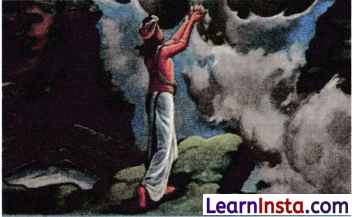
Question 1.
Who wrote Meghadutam?
Answer:
Meghadutam was written by Kalidasa.
Question 2.
What is the meaning of ‘Megha- dutam’?
Answer:
Meghadutam is a Sanskrit word which means megha (cloud) and duta (messenger), thus translating to “The Cloud Messenger.”
Question 3.
What is it about?
Answer:
It is about a Yaksha who asks a cloud to deliver a love message to his wife.
Question 4.
What is the cloud doing in the scene shown?
Answer:
The cloud is carrying a message from the Yaksha to his beloved-it is acting as a messenger.
Question 5.
What does this poem tell us about the culture and imagination of the Gupta period?
Answer:
The poem reflects the Gupta period’s appreciation for emotion, beauty, nature, and poetic imagination. It also highlights Kalidasa’s mastery in Sanskrit literature.
The Gupta Era An Age of Tireless Creativity Class 7 Competency Based Questions
Question 1.
Imagine you are a historian studying the Gupta period. Based on the available sources, how would you describe the role of the Gupta rulers in promoting education and learning? Use specific examples to support your answer.
Answer:
As a historian, I would highlight the significant role of Gupta rulers in promoting education by establishing renowned universities, such as Nalanda, which attracted scholars from around the world. They also patronised scholars like Kalidasa and Aryabhata, whose contributions to literature and science reflect the empire’s strong emphasis on learning. Gupta inscriptions and literature further demonstrate royal support for intellectual growth.
Question 2.
Suppose you are a trader in the Gupta Empire. How would the flourishing trade and commerce during the Gupta period affect your business? Explain how trade routes, coinage, and economic prosperity influenced your trade activities.
Answer:
As a trader in the Gupta Empire, I would benefit greatly from the flourishing trade. The well-established trade routes, including those leading to Central Asia and Southeast Asia, would enable me to sell goods such as textiles, spices, and jewellery to foreign lands. The use of gold coins would make transactions easier, and the general economic prosperity of the empire would ensure a steady demand for goods, boosting my business.
The Gupta Era An Age of Tireless Creativity Class 7 Skill Based Questions
Question 1.
You are a merchant in the Gupta Empire. Create a detailed trade route map, showing where you would travel to exchange goods such as textiles and spices. How would you manage the challenges of traveling long distances?
Answer:
As a merchant in the Gupta Empire, my trade route would extend from Pataliputra (the capital of the Gupta Empire) to various key regions, where I would exchange goods such as textiles, spices, and precious stones. The main destinations would include:
- West India (Saurashtra): For spices and gems.
- Central Asia: To exchange textiles and precious stones.
- Southeast Asia: For trading spices and silks.
- China: For porcelain and tea.
The management of travelling long distances would include:
- Long travel distances could be, managed by carrying sufficient supplies of food, water, and trade goods.
Weather and geographical obstacles:
- I would navigate by relying on experienced guides and seasonal knowledge.
- To protect myself from bandits and other threats, I would ensure that I travel with armed escorts and stay in secure trading hubs along the route, where merchants frequently gather for rest and exchange.
- By managing these challenges effectively, I would ensure the success of my trade ventures, contributing to the flourishing commerce of the Gupta Empire.
Question 2.
Write a letter from a Gupta scholar to a foreign student describing the importance of Sanskrit and the study of literature and mathematics during the Gupta period.
Answer:
Dear Student,
Greetings from the land of the Gupta Empire. I am writing to share with you the profound significance of Sanskrit, as well as the study of literature and mathematics in our time.
Sanskrit is the language of the gods and holds the key to understanding the vast wealth of knowledge passed down through epics such as the Mahabharata and Ramayana, as well as the literary works of scholars like Kalidasa. It connects us to spiritual wisdom and the rich cultural heritage of our empire.
In the field of mathematics, Gupta scholars have pioneered the use of zero and the decimal system, transforming the way we comprehend numbers and the universe. The astronomical work of Aryabhata has greatly advanced our understanding of the cosmos.
I encourage you to immerse yourself in these disciplines, as they will guide you on a path towards knowledge and enlightenment.
With Respect,
A Gupta Scholar
Class 7 The Gupta Era An Age of Tireless Creativity Extra Questions for Practice
A. Multiple Choice Questions
Question 1.
Which God did most Gupta rulers primarily worship?
(a) Shiva
(b) Vishnu
(c) Buddha
(d) Indra
Question 2.
Which famous Buddhist learning centre was supported by the Gupta rulers?
(a) Takshashila
(b) Nalanda
(c) Sarnath
(d) Amaravati
Question 3.
Why is the Gupta period often referred to as the ‘Classical Age’ of India?
(a) Due to frequent wars
(b) Due to architecture
(c) Due to achievements in literature, science, and the arts
(d) Because of distinct cultural practices
Question 4.
Who among the following was a famous Sanskrit poet during the Gupta period?
(a) Aryabhata
(b) Kalidasa
(c) Chanakya
(d) Harsha
Question 5.
Which metal object from the Gupta period is famous for its rust-resistant quality?
(a) Silver coin
(b) Iron Pillar
(c) Copper seal
(d) Gold statue
B. Fill in the Blanks
Question 1.
Faxian was a Buddhist monk from …………. who visited India during the Gupta period.
Question 2.
One significant stop on the way to the Mediterranean markets was …………
Question 3.
………… literature flourished with Kalidasa’s work and the Puranas.
Question 4.
The Prayaga Prashasti inscription includes the achievements of ……….
Question 5.
Faxian described the Gupta administration as ……….. and just, with mild punishments.
C. State Whether True or False
Question 1.
The Gupta Empire did not encourage external trade.
Question 2.
India traded with the Mediterranean world, Southeast Asia, and China during the Gupta period.
Question 3.
Spices and gemstones were major items of export in the Gupta period.
Question 4.
Socotra Island had no connection with Indian traders.
Question 5.
The Indian Ocean trade network helped connect Indian ports to distant markets.
D. Match the Columns
| Column A | Column B |
| A Vikramaditya | (i) Author of Aryabhatiya |
| B Iron Pillar at Mehrauli | (ii) Patron of scholars and poets |
| C Harisena | (iii) Describes Samudragupta’s victories |
| D Decimal System | (iv) Important scientific advancement |
| E Sanskrit | (v) Language used in Gupta inscriptions |
E. Assertion and Reason Questions
There are two statements marked as Assertion (A) and Reason (R). Mark your answer according to the code given below.
Question 1.
Assertion (A): Scholars like Varaha- mihira made important contributions during the Gupta period.
Reason (R): Varahamihira was a famous physician who performed surgeries.
Codes:
(a) Both (A) and (R) are true and (R) is not the correct explanation of (A)
(b) Both (A) and (R) are true and (R) is the correct explanation of (A).
(c) (A) is true but (R) is false.
(d) (A) is false but (R) is true
Question 2.
Assertion (A): Gupta temples were built using bricks and stones.
Reason (R): Temples during this period had flat roofs and simple designs.
Codes:
(a) Both (A) and (R) are true and (R) is not the correct explanation of (A).
(b) Both (A) and (R) are true and (R) is the correct explanation of (A).
(c) (A) is true but (R) is false.
(d) (A) is false but (R) is true
F. Very Short Answer Type Questions
Question 1.
Who was the father of Chandragupta II?
Question 2.
Name the famous work written by Varahamihira, combining knowledge of astron¬omy, astrology, and other sciences.
Question 3.
What is the significance of the Iron Pillar in Delhi, which dates back to the Gupta period?
Question 4.
Which mathematical advancement during the Gupta period laid the foundation for modern-day algebra and trigonometry?
Question 5.
What was the primary religion fol¬lowed by the Gupta rulers?
G. Short Answer Type Questions
Question 1.
How does the literary work Aryab- hatlya serve as a source of information about the Gupta period?
Question 2.
What is the importance of coins as a source of information about the Gupta Empire?
Question 3.
Give a brief account of the rulers of the South during the Gupta period.
H. Long Answer Type Questions
Question 1.
Describe the significance of Harishena’s inscription on the Allahabad Pillar. What does it tell us about Samudragupta and the Gupta Empire?
Question 2.
Write about the contributions of Aryabhata in the fields of mathematics and astronomy.