Experts have designed these Class 8 Maths Notes and Part 2 Chapter 2 The Baudhayana Pythagoras Theorem Class 8 Notes for effective learning.
Class 8 Maths Chapter 2 The Baudhayana Pythagoras Theorem Notes
Class 8 The Baudhayana Pythagoras Theorem Notes
This chapter explores the Baudhayana-Pythagoras theorem, establishing the fundamental geometric relationship between the sides of a right-angled triangle. It details Baudhayana’s early methods for doubling and combining squares, decimal representation of numbers, Baudhayana triples and historical significance of fermat’s last theorem. We also see some application based question for Baudhayana triples.
Square
A square is a plane figure with four equal sides and four right angles (90°).
In figure, ABCD is a square in which BD and AC are the diagonals of the square.
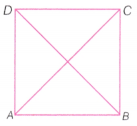
- The opposite sides are parallel.
- The diagonals are equal in length.
- The diagonals bisect each other at right angles (90°).
- If the length of each side of a square is a then its area is given by a2.
Doubling a Square
Baudhayana in Sulba-Sutra provides an elegant way to create a square that is exactly double the area of a given one.
This can be understood by following the steps given below.
Step I Take two identical square
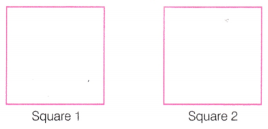
Step II Draw one diagonal in both squares (from one corner to the opposite corner).
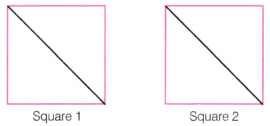
Step III Cut by diagonally and get 4 congruent right angled triangles.
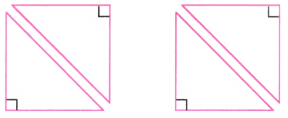
Step IV Arrange all triangles so that their right angles meet in the centre to form a new square.
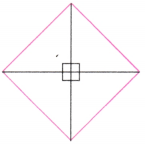
Hence, the area of the new square = 2 × Area of the original square.

Doubling a Square using Paper
Here, we can prove this ‘doubling’ concept using a simple paper-cutting exercise.
For this, we use following steps given below.
Step I: Take two identical squares of the same size.
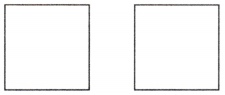
Step II: Cut second square into 4 triangular pieces (by cutting along its diagonals).
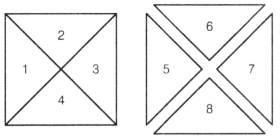
Step III Take the 4 triangular pieces from the second square and place one triangle on each side of the intack square. Arrange the triangle so that their outer edges from a perfect square.
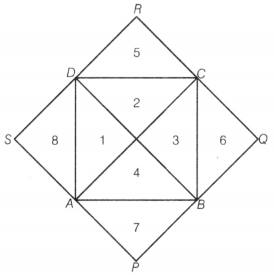
Hence, Area of square PQRS = 2 × Area of square ABCD.
Halving a Square
1. Using Mid-points
A smaller square is drawn inside the given square in a tilted position such that its vertices lie at the mid-points of the sides of the larger square.
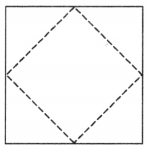
By drawing horizontal (east-west) and vertical (north-south) lines through the centre of the square, the given square is divided into four equal smaller squares. The tilted inner square occupies exactly two of these four equal parts.
Hence, the area of the inner squares is half the area of the outer square.

2. Halving a Square Using Paper
To halves the square using paper method, we use following steps given below.
Step I: Cut out a square from a paper sheet.
Step II: Fold the square inward such that the crease lines pass through the mid-points of all four sides.
Step III PQRS (formed by the fold paper) is the required square with half the area of square ABCD.

Hypotenuse of An Isosceles Right-Angled Triangle
An isosceles right-angled triangle is a triangle in which two sides are equal in length and one angle is a right angle (90°).’

If the base and perperndicular is a then
- Area of right-angled triangle = \(\frac{a^2}{2}\) sq units
- Length of the hypoteuse of right-angled triangle = a√2 units
Combining Two Different Squares
Combining two different squares means forming a new square, whose area is equal to the sum of the areas of the two different squares. This is done by making a right-angled triangle with sides equal to the sides of the two squares.
The square constructed on the hypotenuse of this triangle represents the combined area of the two squares.

Baudhayana-Pythagoras Theorem
Baudhayana-Pythagoras theorem states that in a right-angled triangle, the square of the length of the hypotenuse is equal to the sum of the squares of the lengths of the other two sides.

i.e. If the sides of a right-angled triangle ABC are a, b and c, where c is the hypotenuse then a2 + b2 = c2.
This theorem shows the relationship between the three sides of a right-angled triangle.
Baudhayana Triples
A Baudhayana triple is a set of three positive integers (a, b, c) that can be the sidelengths of a right-angled triangle and satisfy the relation
a + b =c
Such triples are also called Baudhayana-Pythagoras triples or Pythagorean triples.
e.g. (3, 4, 5), (5, 12, 13), (8,15, 17), (7, 24, 25) and so on.
Primitive Baudhayana Triples
A Baudhayana triple that does not have any common factor greater than 1 is called a primitive Baudhayana triple, e.g. (3,4, 5) is primitive triple.
Let (a, b, c) be a primitive triple and we multiply it by any positive integer k i.e. (ka, kb, kc)
(ka)2 + (kb)2 = (kc)2
⇒ k2a2 + k2b2 = k2c2
⇒ k2(a2 + b2) = k2c2
⇒ a2 + b2 = c2
Here, (ka, kb, kc) a scaled verison of (a, b, c).
Non-Primitive Baudhayana Triples
A non-primitive Baudhayana triple is a Baudhayana triple in which the three numbers have a common factor greater than 1.
These are obtained by multiplying a primitive triple by the same integer k > 1.
e.g. (6, 8, 10) = 2 × (3, 4, 5) and (9, 12, 15) = 3 × (3, 4, 5)
Other Method to find the Baudhayana Triples
We know that the sum of the first n odd numbers = n2
1 + 3 + 5 +…. + (2n – 1) = n2

Since, sum of first (n – 1) odd numbers = (n – 1)2
∴ (n – 1)2 + (2n – 1) = n2
where (2n -1) is a perfect square of an odd number,
e.g. Let 2n – 1 = 72
⇒ 2n – 1 = 49
⇒ 2n = 49 + 1
n = \(\frac{50}{2}\) = 25
We know that (n – 1)\(\frac{1}{2}\) + (2n – 1) = n\(\frac{1}{2}\)
⇒ (25 – 1)\(\frac{1}{2}\) + 7\(\frac{1}{2}\) = (25)\(\frac{1}{2}\)
⇒ 24\(\frac{1}{2}\) + 7\(\frac{1}{2}\) = 25\(\frac{1}{2}\)
Thus, the Baudhayana triple is (7, 24, 25).
Note: According to Fermat’s Last Theorem, for any integer n > 2, the equation x” + y” = f has no solution in natural numbers.
Applications of the Baudhayana-Pythagoras Theorem
The Baudhayana-Pythagoras theorem is one of the fundamental theorems of geometry.
Let us see some of its applications with the help of following examples.
Decimal Representation of √2
The number √2 is the length of the hypotenuse of an isosceles right triangle with sides 1 unit each.
- If side of a square is 1 unit then the area of a square is 1 sq unit.
- If side of a square is √2 unit then the area of a square is 2 sq unit.
- If side of a square is 2 unit then the area of a square is 4 sq unit.
1 < √2 < 2
Checking closer decimals of √2,
1.12 = 1.21
1.22 = 1.44
1.32 = 1.69
1.42 = 1.96
1.52 = 2.25
⇒ 1.4 < √2 < 1.5
For more closer decimal,
1.412 =1.9881 and 1.422 = 2.0164
⇒ 1.41< √2 < 1.42
1.4142 = 1.999396 and 1.4152 = 2.002225
⇒ 1.414 < √2 < 1.415
Thus, 42 lies between 1.414 and 1.415
Hence, √2 = 1.414…
√2 expressed in fraction or not?
If √2 could be expressed as \(\frac{m}{n}\) then √2 = \(\frac{m}{n}\), where m and n are counting numbers.
On squaring both sides, we get
2 = \(\frac{m^2}{n^2}\)
⇒ 2n2 = m2
Since, the prime factorisation of a square number, each prime occure an even number of times.
So, 2n2 = m2, the prime 2 would occur an odd number of times on the left side and an even number of times on the right side. i.e. impossible.
Thus, √2 cannot be expressed as a fraction \(\frac{m}{n}\).
So, √2 has a non-terminating decimal representation and its value lies between 1.414 and 1.415