Students often prefer our concise Class 8 English Poorvi Worksheet and Class 8 English Chapter 9 Spectacular Wonders Worksheet with Answers Pdf for quick practice.
Class 8 English Chapter 9 Spectacular Wonders Worksheet with Answers
Class 8 English Spectacular Wonders Worksheet
Class 8 English Chapter 9 Worksheet – Class 8 Spectacular Wonders Worksheet
Let us do these activities before we read
I. Look at the pictures given below and sort them into natural and man-made wonders.
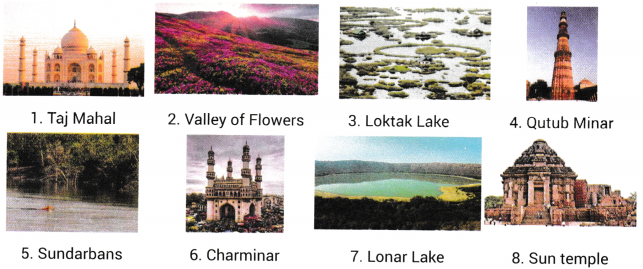
Natural: ______, _________, _____ and _____
Man-made: _____, _____, _____ and _____
II. Which of the following natural wonders would you like to visit the most and why?
- Valley of Flowers
- Loktak Lake
- Dudhsagar Falls
- Living Root Bridges
Write a few lines explaining your choice. Then, share your thoughts with your classmates.
____________________________________________________
____________________________________________________
____________________________________________________
____________________________________________________
III. Work in pairs. Choose one man-made wonder of India and describe what makes it unique. Write 3-4 sentences. Discuss your answers with your partner and then share them with your class.
____________________________________________________
____________________________________________________
____________________________________________________
____________________________________________________
IV. Work in groups. Complete the web chart with words or phrases you associate with the idea of ‘Human Creativity’.

Let us Discuss
I. Complete the information in the table given below:
| Natural and man-made wonders | Location | One unique Feature |
| 1. Magnetic Hills | ||
| 2. The Valley of Flowers | ||
| 3. The Invisible Chandipur Beach | ||
| 4. Glowing Waters | ||
| 5. The Living Root Bridges | ||
| 6. The Lonar Crater Lake | ||
| 7. The Sundarbans |
Think beyond
I. Read the given extracts and answer the questions that follow.
1. The sea can actually be witnessed disappearing and reappearing. This is because the sea water moves. It retreats by 2-5 km during ebb tide, the duration between the high tide and low tide, and comes back to the shore at the time of high tide. This unusual natural phenomenon keeps on happening daily, where one can actually see the sea, and then watch it disappear in front of their eyes!
Questions:
(i) What causes the sea to appear and disappear daily?
(a) Change in weather
(b) Movement of sea water during tides
(c) Earthquakes under the sea
(d) Heavy rainfall
(ii) Complete the similarity by choosing the correct option,
tide : sea :: _____: _____
(a) moon : sky
(b) wind : trees
(c) ebb : retreat
(d) gravity : movement
(iii) Identify whether the following statement is True of False.
The sea appears and disappears once every week due to tidal waves.
(iv) What does the phrase “the sea can actually be witnessed disappearing and reappearing” mean in the context of the passage?
____________________________________________________

2. This phenomenon is called bioluminescence, and is caused by a high concentration of micro-planktons in the sea, which are small organisms found in marine and freshwater. This beautiful sight has captured the attention of locals as well as tourists, making Kumbalangi an eco-tourism village in India. One can experience the village life in all its beauty and simplicity, and acquaint oneself to their cuisine and culture.
Questions:
(i) What causes the phenomenon of bioluminescence in the sea?
(a) Reflection of moonlight on water
(b) Pollution in the sea
(c) Movement of large fish
(d) High concentration of micro-planktons
(ii) Complete the following sentence appropriately:
Kumbalangi has become an eco-tourism village because of the natural phenomenon of and its rich village life and culture.
(iii) Select the option that is correct for both Assertion (A) and Reason (R).
(A): Kumbalangi has become an eco-tourism village in India.
(R): The phenomenon of bioluminescence caused by micro-planktons attracts both locals and tourists.
(a) Both (A) and (R) are true, and (R) is the correct explanation of (A).
(b) Both (A) and (R) are true, but (R) is not the correct explanation of (A).
(c) (A) is true, but (R) is false.
(d) (A) is false, but (R) is true.
(iv) What does the phrase”acquaint oneself to their cuisine and culture” mean in the context of the passage?
____________________________________________________
II. Answer the following questions.
Question 1.
Describe the Valley of Flowers and explain why it is considered a spectacular natural wonder.
____________________________________________________
Question 2.
What are living root bridges, and how do they reflect the harmony between nature and indigenous knowledge?
____________________________________________________
Question 3.
Explain the unique phenomenon observed at Chandipur Beach in Odisha and the science behind it.
____________________________________________________
Question 4.
What makes the Lonar Crater Lake a geological wonder, and how was it formed?
____________________________________________________
Question 5.
How do the natural wonders mentioned in the text contribute to India’s cultural, ecological, and scientific heritage?
____________________________________________________
Let us Learn
I. Fill in the blanks with the correct expression given in the box:
| Optical illusion, eco-tourism village, disappearing sea, stunning backdrop, rugged terrain, celestial impact |
1. The Magnetic Hill creates an _____ where vehicles appear to roll uphill.
2. Kumbalangi has become an _____ that offers both natural beauty and cultural experiences.
3. Tourists gather at Chandipur Beach to witness the _____ during ebb tide.
4. The Valley of Flowers blooms against the _____ of the Himalayan ranges.
5. The Lonar Crater Lake lies in the middle of a _____, making it a truly unique sight.
6 The Lonar Crater is a rare result of a powerful _____ that formed a massive depression.
II. Choose the correct synonym of the following words.
1. futile: useful, pointless, exciting, bright
2. intertwined: separated, confused, twisted together, covered
3. whopping: tiny, surprising, huge, sharp,
4. colossal: narrow, small, massive, soft
5. rugged: polished, smooth, rough, broken
III. Match the binomials in Column 1 with their meanings in Column 2.
| Column 1 | Column 2 |
| 1 hide and seek | A. Generally |
| 2. up and down | B. Very clean and tidy |
| 3. far and wide | C. In every direction or place |
| 4. neat and clean | D. Fluctuating or not steady |
| 5. now and then | E. Occurring occasionally |
| 6. by and large | F. A playful game of finding and hiding |
IV. Participles are verb forms that can function as adjectives, and they come in two types: present participles (‘living’ and ‘striking’) usually ending in —ing. and past participles (‘rugged’) usually ending in -ed, -d, -t, -en, or -n.
Use the following verbs as present participle and past participle in a sentence.
| Verb | Present Participle | Past Participle |
| 1. shine | ||
| 2. build | ||
| 3. disappear | ||
| 4. nestle | ||
| 5. glow |
V. Gerunds are verb forms that can function as nouns and they end in —ing. They can serve as the subject, complement, or object in a sentence, as well as the object of a preposition
Examples: I love reading books.
Reading is a good habit.
Underline the gerunds and participles in the following sentences. Write ‘G’ for gerunds and ‘P’ for participles in the space provided.
| Sentence | Gerund (G) | Participle (P) |
| 1. Swimming in the ocean is my favourite summer activity. | ||
| 2. The crying baby was quickly comforted by her mother. | ||
| 3. He avoided talking about the problem. | ||
| 4. The burnt toast had a bitter taste. | ||
| 5. Running every morning helps improve your stamina. | ||
| 6. The girl reading under the tree didn’t hear her name being called. | ||
| 7. She enjoys painting landscapes during her free time. |
VI. Fill in the blanks with the gerund or participle form of the verb in brackets
1. The man _____ (sing) on stage is a famous artist.
2. My sister is good at _____ (draw).
3. The _____ (bark) dog frightened the children.
4. He kept _____ (talk) during the entire movie.
5. _____ (walk) quickly, she reached the bus stop on time.
Let us Listen
Listen to a conversation between two friends about natural and man-made wonders of India, read out by your teacher/friend/family member. Mark four true statements out of the eight statements given. (Read the Transcript at the end of this book Pg. No. 153)
Statements:
1. The Ajanta Caves are an example of a natural wonder.
2. The Himalayas are a natural wonder of India.
3. The Sundarbans and the Valley of Flowers are man-made structures.
4. The Konark Sun Temple is a man-made wonder.
5. Aarav and Meera visited the Ajanta Caves and the Himalayas.
6. The Taj Mahal is mentioned as a natural wonder.
7. The conversation mentions both natural and man-made wonders of India.
8. Meera believes all Indian wonders are modern constructions.
Let us speak
Make a PowerPoint presentation on any famous historical monument of India and present it in your class. Share your presentation with your classmates and teacher.
Use the following guidelines for your slides:
- Name of the Monument
- Location
- Built by/Built in (period)
- Historical Importance
- Architectural Style/Materials Used
- One Interesting Fact
- Picture of the Monument
- Show a map of India marking where the monument is located.
- Add 2-3 fun facts or quiz questions to make it interactive.
- Summarize what we can learn from these monuments.
- Highlight how such a monument reflects India’s diversity and artistic excellence.
Let us Write
Write a short paragraph describing one natural and one man-made wonder of India. Include the following details:
- Name and location
- What it looks like (describe its beauty or structure)
- Why it is special or famous
- How it makes you feel
Example topics: Taj Mahal, Sundarbans, Ajanta Caves, Himalayas, Valley of Flowers
Let us explore
Enjoy reading about some of the ancient wonders of India.
1. Fort – Golkonda Fort, Hyderabad: Golkonda Fort, located in Hyderabad, Telangana, is one of the most impressive forts of ancient India, known for its remarkable military architecture and acoustic system. Originally built by the Kakatiya kings in the 12th century and later expanded by the Qutb Shahi dynasty, the fort became a powerful center for diamond trade. It is believed that famous gems like the Kohinoor were once stored here.
The fort complex includes massive gates, high bastions, and long outer walls. A unique feature of Golkonda is its acoustic design-a hand clap at the entrance can be heard at the top of the fort, nearly a kilometeraway, a system once usedforcommunication.
The fort also has palaces, mosques, and royal halls. Though in ruins today, Golkonda still stands as a symbol of historical ingenuity and grandeur, drawing historians, tourists, and architecture lovers from across the world.

2. The Meenakshi Temple, Madurai, Tamil Nadu: The Meenakshi Amman Temple, located in Madurai, Tamil Nadu, is one of India’s most iconic and ancient temples, dedicated to Goddess Meenakshi (a form of Parvati) and Lord Sundareswarar (Shiva). Originally built by the Pandya kings and later expanded during the Nayak dynasty in the 16th century, the temple is a brilliant example of Dravidian architecture. It is famous for its 12 towering gopurams (gateway towers) covered with thousands of colorful sculptures of gods, goddesses, demons, and mythical creatures. Inside the temple, there are stunning mandapams (pillared halls), including the Thousand Pillar Hall, each pillar intricately carved. The temple is not only a place of worship but also a vibrant cultural center. Every year, it hosts the Meenakshi Thirukalyanam festival, celebrating the divine marriage of Meenakshi and Sundareswarar. The temple remains a living symbol of Tamil culture, art, and devotion.

3. Mysore Palace, Karnataka: The Mysore Palace, also known as the Amba Vilas Palace, is one of the most magnificent palaces in India, located in Karnataka. Originally built in the 14th century and rebuilt in its present form in 1912, it was the royal residence of the Wadiyar dynasty, rulers of the Kingdom of Mysore.
The palace is an outstanding example of the Indo- Saracenic style, blending Hindu, Muslim, Rajput, and Gothic architectural elements. With its grand domes, intricately carved doors, stained glass ceilings, and vast halls, the palace reflects the opulence of the royal family.
One of its most famous attractions is the Durbar Hall, where kings once held court. During the Dasahara festival, the palace is illuminated with thousands of lights, attracting tourists from all over the world. The Mysore Palace is a symbol of royal heritage and continues to be a major cultural and historical landmark in southern India.
