Students can use Poorvi Book Class 8 Solutions Unit 3 Mystery and Magic Chapter 9 Spectacular Wonders Questions and Answers as a quick reference guide.
Spectacular Wonders Class 8 Questions and Answers
Spectacular Wonders Class 8 Question Answer
NCERT Class 8 English Poorvi Chapter 9 Spectacular Wonders Question Answer
Spectacular Wonders Question Answer – Let us do these activities before we read. (Page 137)
I. Look at the pictures given below and sort them into natural and man-made wonders.
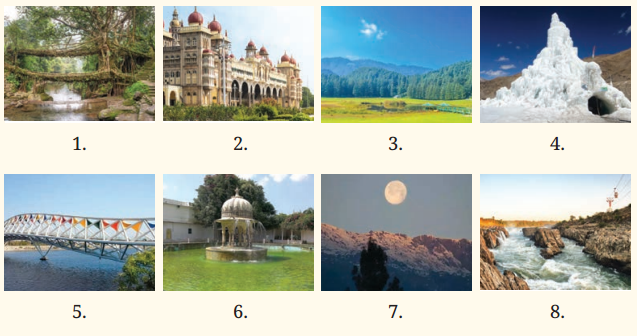
Answer:
Natural:
1. Intertwined roots bridge,
2. Palace,
5. Steel bridge, and
6. Dome shaped fountain
Man-made:
3. Hills and forest,
4. Snow cave
7. Moon in the sky, and
8. Waterfall

II. Which of these wonders-man-made or natural—are more appealing and why? Share your answers with your classmates and teacher.
Answer:
Natural wonders are more appealing because they are created by nature without human intervention. They display the true beauty and power of the Earth. The sight of mountains, waterfalls, and rainbows is calming and awe-inspiring.
III. Work in pairs. Write down two wonders of nature that have amazed you. Discuss what makes them impressive. Share your answers with your classmates and teacher.
Answer:
The two wonders that have amazed me are:
1. The Aurora Borealis, also known as the Northern Lights, is a stunning natural light display in the sky, mainly seen in high-latitude regions near the Arctic. It occurs when charged particles from the Sun interact with Earth’s magnetic field and atmosphere, creating vibrant waves of green, pink, purple, and blue light. It’s one of nature’s most breathtaking spectacles!
2. The Grand Canyon is a breathtaking natural wonder in Arizona, USA, known for its immense size and stunning rock formations. Carved by the Colorado River over millions of years, it stretches about 446 km long and up to 1.8 km deep. Its colourful layers reveal Earth’s geological history, making it both a scenic and scientific marvel!
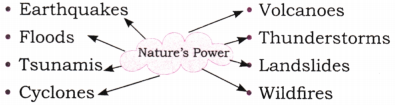
IV. Work in groups of four. Complete the web chart given below with words that you associate with the phrase, ‘Nature’s Power’. Share your answers with your classmates and teacher.

Answer:
Web Chart for “Nature’s Power”:
Spectacular Wonders Class 8 Question Answer – Let us Discuss (Page 142)
I. Complete the information in the table given below. One example has been done for you. Share your answers with your classmates and teacher.
| Amazing Natural Phenomena | Location | One Unique Feature |
| 1. The Valley of Flowers | Chamoli district, Uttarakhand | Around 600 species of exotic flowers |
| The Living Root Bridges | ||
| 3. | Buldhana district, Maharashtra | |
| 4. Magnetic Hills | ||
| 5. Glowing Waters | ||
| 6. | West Bengal | |
| 7. | Balasore district, Odisha |
Answer:
| Amazing Natural Phenomena | Location | One Unique Feature |
| 1. The Valley of Flowers | Chamoli district, Uttarakhand | Around 600 species of exotic flowers |
| 2. The Living Root Bridges | Meghalaya | Made of intertwined roots, can last for centuries |
| 3. The Lonar Crater Lake | Buldhana district, Maharashtra | Formed by a meteorite impact; third largest in the world |
| 4. Magnetic Hills | Leh district, Ladakh | Creates an optical illusion where vehicles roll uphill |
| 5. Glowing Waters | Kumbalangi, Kerala | Caused by bioluminescence of microplanktons |
| 6. The Sundar- bans | West Bengal | Mangrove forest with Bengal tigers and estuarine Crocodiles |
| 7. The Invisible Beach | Balasore district, Odisha | Sea disappears and reappears due to ebb tide |
Class 8 English Spectacular Wonders Question Answer – Let us Think and Reflect (Pages 142-144)
I. Read the given extracts and answer the questions that follow.
1. India is home to some of the most mystifying natural phenomena that surprise and spark our imagination.
(i) Replace the underlined phrase with one from the extract. India is the birthplace of several rare species of flora and fauna that thrive in its diverse ecosystems.
Answer:
India is home to several rare species of flora and fauna that thrive in its diverse ecosystems.
(ii) What does the phrase ‘nature’s unusual side’ suggest about the phenomena described?
Answer:
The phrase ‘nature’s unusual side’ suggests that the phenomena are rare and seen. They are extraordinary features of nature that amaze and flame up our imagination.
(iii) Complete the similarity by choosing the correct option.
spark: imagination :: ________________ :________________
A. inspiration; creativity
B. wonder; amazement
C. effort; reward
D. knowledge; books
Answer:
A. inspiration ; creativity
Explanation: Just as a spark leads to an imagination, inspiration leads to creativity.
(iv) Identify whether the following statement is true or false.
Some natural phenomena can surprise people.
Answer:
True
2. Have you seen things disappearing in front of your eyes? Well, such things happen at times, when we keep things at some place, and just forget where we have kept them. But, what if there’s a sea that disappears?
This happens in Odisha. It is a beach in the Balasore district where one can witness the sea disappearing mysteriously-the Chandipur Beach which is known for its unique feature of playing hide-and-seek with its visitors.
(i) Complete the following sentence with a suitable reason.
The writer’s most likely purpose to introduce the information about the Chandipur Beach phenomenon with a question is to ________________. (engage the reader’s curiosity and create a sense of suspense/draw the reader to learn more about the unusual phenomenon/ set the tone for the surprising nature of the content that follows)
Answer:
The writer’s most likely purpose to introduce the information about the Chandipur Beach phenomenon with a question is to engage the reader’s curiosity and create a sense of suspense.
(ii) Select the option that is correct for both Assertion (A) and Reason (R).
(A): Chandipur Beach in Odisha is known for its unique feature of the sea disappearing.
(R): The tides retreat drastically, exposing the Chandipur beach.
A. Both (A) and (R) are true, and (R) is the correct explanation of (A).
B. Both (A) and (R) are true, but (R) is not the correct explanation of (A).
C. (A) is true, but (R) is false.
D. (A) is false, but (R) is true.
Answer:
A. Both (A) and (R) are true, and (R) is the correct explanation of (A).
(iii) What does the term ‘unique’ suggest about the beach in Balasore?
A. very popular
B. one of its kind
C. ancient place
D. far from city
Answer:
B. one of its kind
(iv) What does the writer want to convey with the use of the phrase ‘playing hide-and-seek with its visitors’?
Answer:
The writer wants to convey that the Chandipur Beach has a mysterious and playful quality because the sea appears to vanish and return, much like a game of hide-and-seek, creating surprise and wonder for visitors.
II. Answer the following questions.
Question 1.
How are the living root bridges a boon for the local people of Meghalaya?
Answer:
The living root bridges are a boon for the local people of Meghalaya because they help people cross rivers and streams, especially during heavy rains. These strong and long-lasting bridges, made from tree roots, have been used for generations and are an excellent example of indigenous engineering.
Question 2.
Why is the Lonar Crater Lake considered a remarkable and rare site?
Answer:
The Lonar Crater Lake is considered a remarkable site as it was formed by a meteorite impact thousands of years ago. It is the only crater in India formed in basaltic rock and ranks among the world’s five largest craters. Its unique origin and scientific importance make it rare.
Question 3.
What might be the writer’s purpose of highlighting the awe-inspiring natural wonders of India?
Answer:
The writer aims to showcase the uniqueness and beauty of India’s natural landscapes, spark curiosity and appreciation for nature, and encourage people to value and protect these natural treasures.
Question 4.
The writer uses descriptive language and introductory questions for some of the natural phenomena. What impact does it have on the readers?
Answer:
This technique engages readers, arouses their curiosity, and makes them feel wonder and amazement. It helps readers connect emotionally with the content and inspires them to learn more about the phenomena.
Question 5.
Which of these unusual phenomena did you find the most interesting and why?
Answer:
I found the Chandipur Beach in Odisha most interesting because the sea disappears and reappears, making it look like a game of hide-and-seek. This rare natural phenomenon is both mysterious and fascinating.
Spectacular Wonders Class 8 Questions and Answers – Let us Learn (Pages 144-148)
I. Fill in the blanks with the correct expressions from the text given in the box below.

1. I have read many stories _____________________.
2. Do you know when this little town _____________________?
3. His hard work has helped him _____________________.
4. There are no simple solutions to the _____________________ of traffic jams.
5. He opened the ancient wooden box and stared at the treasure _____________________
6. The garden is _____________________ in spring with lots of beautiful flwers in bloom.
Answer:
1. I have read many stories to name a few.
2. Do you know when this little town came into existence?
3. His hard work has helped him to no end.
4. There are no simple solutions to the age-old problem of traffic jams.
5. He opened the ancient wooden box and stared at the treasure in disbelief.
6. The garden is in full glory in spring with lots of beautiful flowers in bloom.
II. Select the correct synonyms from the box given below that match the list of words in 1-5. You may refer to a thesaurus.
| colossal exotic serene enigmatic spectacular |
1. mysterious, puzzling, baffling
2. mighty, gigantic, huge
3. breath-taking, stunning, awe-inspiring
4. peaceful, calm, tranquil
5. unusual, peculiar, foreign
Answer:
1. enigmatic: mysterious, puzzling, baffling
2. colossal: mighty, gigantic, huge
3. spectacular: breath-taking, stunning, awe-inspiring
4. serene: peaceful, calm, tranquil
5. exotic: unusual, peculiar, foreign
III. The expressions ‘hide-and-seek’ and ‘flora and fauna’ are used in the text. These are called binomials—a pair of fixed words joined by ‘and’ or ‘or’.
|
GOLDEN GRAMMAR TIPS In English grammar, binomials are pairs of words joined by a conjunction (usually “and” or “or”) that are commonly used together in a fixed order. These expressions add rhythm and fluency to speech and writing. Examples:
|
Match the binomials in Column 1 with their meanings in Column 2. You may refer to a dictionary. 1 ~
| Column 1 | Column 2 |
| 1. odds and ends | (i) put different things together to get a range of possibilities |
| 2. on and off | (ii) complete part of or belong to |
| 3. mix and match | (iii) choose only the best (things, people, etc.) |
| 4. all or nothing | (iv) at some time in the future |
| 5. part and parcel | (v) sometimes, occa-sionally |
| 6. pick and choose | (m) increase or develop very quickly |
| 7. sooner or later | (vii) small, unimportant things |
| 8. leaps and bounds | (viii) something to be done completely or not at all |
Answer:
| Column 1 | Column 2 |
| 1. odds and ends | (vii) small, unimportant things |
| 2. on and off | (v) sometimes, occa-sionally |
| 3. mix and match | (i) put different things together to get a range of possibilities |
| 4. all or nothing | (viii) something to be done completely or not at all |
| 5. part and parcel | (ii) complete part of or belong to |
| 6. pick and choose | (iii) choose only the best (things, people, etc.) |
| 7. sooner or later | (iv) at some time in the future |
| 8. leaps and bounds | (vi) increase or develop very quickly |
Use the binomials given in Column 1 in sentences of your own.
Answer:
Here are sentences using the binomials from Column 1:
1. I cleaned out the drawer and found all sorts of odds and ends inside.
2. It rained on and off throughout the day.
3. You can mix and match these shirts and trousers for different looks.
4. He believes in an all or nothing approach when it comes to sports.
5. Failure is part and parcel of the learning process.
6. At the buffet, you can mck and choose what you want to eat.
7. Sooner or later, you 11 have to tell the truth.
8. Her English has improved by leaps and bounds since she joined the new school.
IV. Study the highlighted words in the following sentences from the text.
- The living root bridges are one of Meghalaya’s most beautiful…
- …creating a striking visual contrast against the surrounding rugged terrain.
In the given sentences, the highlighted words ‘living’, ‘striking’, and ‘rugged’ are examples of verbs used as adjectives. Such verbs are called participles.
|
GOLDEN GRAMMAR TIPS Participles are verb forms that function as adjectives or help form verb tenses. They add detail to sentences and make descriptions more vivid. There are two main types: 1. Present Participles (ending in -ing):
2. Past Participles (often ending in -ed, -d, -t, -en, or -n):
|
Now, fill in the blanks using present participle or past participle form of the verbs in the box given below.
| stand amaze carve scatter glow |
1. The _______________ marble monument looks even more spectacular in the moonlight.
2. The _______________ view of the Himalayas from Darjeeling attracts visitors from all over the world.
3. The Sun Temple in Konark features intricately _______________ stone wheels and walls.
4. _______________ at a height of 182 m, the Statue of Unity is dedicated to Sardar Vallabhbhai Patel.
5. The _______________ islands of the Andaman and Nicobar offer some of the cleanest beaches in India.
Answer:
1. The glowing marble monument looks even more spectacular in the moonlight.
2. The amazing view of the Himalayas from Darjeeling attracts visitors from all over the world.
3. The Sun Temple in Konark features intricately carved stone wheels and walls.
4. Standing at a height of 182 m, the Statue of Unity is dedicated to Sardar Vallabhbhai Patel.
5. The scattered islands of the Andaman and Nicobar offer some of the cleanest beaches in India.
V. Study the highlighted word in the following sentence from the text.
Crossing the many waterways without bridges was difficult for people in the past, during monsoons.
In the given sentence, the highlighted word ‘crossing’, is one example of – a verb used as a noun. Such a verb is called gerund.
|
GOLDEN GRAMMAR TIPS A gerund is a verb that ends in “-ing” but functions as a noun in a sentence. It can act as a subject, object, or complement. For example:
Gerunds are different from present participles, which also end in “-ing” but function as adjectives or verbs in continuous tenses. |
Underline the gerunds and participles in the following sentences. Write ‘G’ for gerunds and ‘P’ for participles in the space provided. One example has been done for you.
1. Dancing is a great way to express emotions. G
2. Travelling can broaden your perspective.
3. The falling leaves signalled the arrival of autumn.
4. She enjoys cooking new recipes for her family.
5. Reading helps improve your vocabulary.
6. He watched the shimmering stars in the night sky.
7. Forgetting the keys inside, Kanchan locked the door.
Answer:
1. Dancing is a great way to express emotions. [G]
2. Travelling can broaden your perspective. [G]
3. The falling leaves signalled the arrival of autumn. [P]
4. She enjoys cooking new recipes for her family. [G]
5. Reading helps improve your vocabulary. [G]
6. He watched the shimmering stars in the night sky. [P]
7. Forgetting the keys inside, Kanchan locked the door. [P]
VI. Combine the following pairs of sentences using participles or gerunds. You may use the clues given in brackets. One example has been done for you.
1. Nitesh entered the room. He saw his friend sitting in the corner, (participle)
2. Smitha walked carelessly. She slipped on the doormat, (participle)
3. Sleep for eight hours. It is good for health, (gerund)
4. Ranjith felt happy about the result. He called his parents, (participle)
5. Father encouraged Meena. Meena joined the course, (gerund)
Answer:
1. Entering the room, Nitesh saw his friend sitting in the comer.
2. Walking carelessly, Smitha slipped on the doormat.
3. Sleeping for eight hours is good for health.
4. Feeling happy about the result, Ranjith called his parents.
5. Father encouraged Meena joining the course.
Spectacular Wonders Question Answer Class 8 – Let us Listen (Page 148)
I. You will listen to a brother and sister discuss a natural phenomenon.
As you listen, mark the four true statements from 1-6 given below. (Transcript for teacher on page. 153)

Brother : I liked the pictures Uncle Dileep posted yesterday from the Republic of Peru. Can you guess which was my favourite?
Sister : I know it was the Rainbow Mountain. I say that because it was certainly my favourite.
Brother : Really! I didn’t know it was your favourite too. Can you imagine the creativity in Nature? What a marvellous natural phenomenon!
Sister : I could not believe my eyes when I saw that picture. There are so many colours there. Do you know how it’s formed?
Brother : Of course! It’s actually quite amazing. The mountain gets its colours from layers of minerals like clay, limestone, and sandstone that got deposited millions of years ago.
Sister : Wow, I read that too. I think each colour is due to a diffrent mineral. Like, the green comes from copper, and the red from clay. It’s like nature painted the mountain!
Brother : I cannot believe the fact that it was all buried under snow until recently.
Sister : Oh! The melting snow must have made it visible again. That’s why it looks so fresh and bright today.
Brother : Those layers of minerals were actually deposited by water from ancient seas and lakes.
Sister : Each colour represents a diffrent time in history. That’s why it’s called the rainbow mountain.
1. The brother was taken aback to see the posted pictures.
Answer:
False
2. The brother admitted to not knowing about his sister’s favourite picture.
Answer:
True
3. The sister stated that the rainbow mountain was like any other mountain.
Answer:
False
4. The brother was aware of the reason for the formation of colours on the mountain.
Answer:
True
5. The brother was surprised to learn about the mountain being covered with snow till recently.
Answer:
True
6. The sister understood nature’s role in the beauty of the mountain.
Answer:
True
Class 8 English Chapter 9 Question Answer – Let us Speak (Page 149)
I. Work in groups of four. Make a presentation on a place of interest in and around your region that people like to visit. You may use the following guidelines to make your presentation.

Guidelines:
1. Slides 1–2: Choose any popular place of interest in your region.
2. Slides 3–4: Mention where it is located and how to reach there.
3. Slides 5–6: Describe the attractions of the place, why it is popular and explain its historical importance, if any.
4. Slides 7–8: List out weather conditions, local food, customs, and language.
5. Slides 9–10: Suggest the best time of the year to visit and why you recommend this place.
Answer:
Students to read the text from NCERT textbook from page 149 and make the presentation themselves.
NCERT Class 8 English Poorvi Chapter 9 Question Answer – Let us Write (Page 149)
|
GOLDEN WRITING TIPS A descriptive essay is a type of writing that vividly portrays a person, place, object, or event using sensory details. It aims to create a strong visual and emotional experience for the reader by engaging their senses—sight, sound, touch, taste, and smell. Writers use expressive language, similes, metaphors, and rich descriptions to make their subject come alive. The goal is to paint a picture with words, allowing the reader to feel as if they are experiencing the scene firsthand! For practice on Descriptive Essays see Page No. 348 in Writing Section under the heading Descriptive Essays. |
I. You just read vivid descriptions of the natural wonders of our country. Write a descriptive essay for your school magazine describing anything from nature that attracted your attention. It may be an object, a place, or an event experienced by you. Remember to give a title to your essay.
Use proper format and content organisation begin with a title, include introduction (one paragraph), body (two to three paragraphs), and conclusion (one paragraph).
Answer:
The Magic of the Valley of Flowers
India is a land of breathtaking natural wonders, but the Valley of Flowers in Uttarakhand is something truly special. When I first saw pictures of this place, I was instantly drawn to its vivid colours and untouched beauty. It felt like nature had painted a masterpiece just for us to admire.
The Valley of Flowers is nestled in the Chamoli district and is a part of the Nanda Devi Biosphere Reserve. What makes it magical is the wide variety of flowers that bloom during the monsoon season. From blue poppies to rare orchids, the valley becomes a rainbow of colours. The gentle breeze carries the sweet scent of blossoms, making the experience even more delightful.
As I walked through the valley during my visit last summer, I could hear the soft rustle of leaves and the buzzing of bees busy collecting nectar. The mountains stood tall around the valley, protecting it like ancient guardiAnswer:I also saw rare butterflies and even spotted a snow leopard from a distance!
What amazed me most was how peaceful and untouched the area felt. Despite being a popular tourist spot, the valley maintained its serenity and charm. It reminded me how important it is to protect nature’s treasures.
Visiting the Valley of Flowers was like stepping into a dream. It showed me the power
and beauty of nature in its purest form. I believe everyone should witness such wonders once in their life—it not only fills you with awe but also teaches you to respect and care for the world around you.
Class 8th English Chapter 9 Spectacular Wonders Question Answer – Let us Explore (Page 150)
I. Man-made Wonders Answer:Students [S] to read the text from NCERT
1. Kallanai Dam (The Grand Anaicut) in Tamil Nadu is one of the world’s oldestdamsandisstillinuse.TheKallanaiDamrepresentsasignificant achievement in ancient Indian hydraulic engineering. It was built by the Chola King Karikala around 150 CE.
2. Another spectacular legacy of ancient wisdom that we have is the world’s fist residential university at Nalanda in Bihar. Nalanda was established much before any European university, providing higher education to thousands of students. It was declared as a UNESCO heritage site in 1980.
You may visit the site given below to know more about this.
3. Hampi, a town in Karnataka, is also a UNESCO World Heritage Site. The Vittala Temple in Hampi was built in the 15th century. This temple has 56 special pillars known as the SaReGaMa pillars. When these pillars are tapped, they produce musical notes that can be heard clearly.

4. Some of the man-made wonders of modern India include the Bandra–Worli Sea Link in Mumbai; Statue of Unity in Gujarat; Bhupen Hazarika Setu (The Dhola-Sadiya Bridge) in Assam; and many more.
Scan the QR Code to know about “ the history of Nalanda University.

II. Some micro-planktons in the sea are bioluminescent. Have you seen any other life form that has this quality? Identify the insect given below and find out what it is called in your language. Look out for it when you visit a field or a place with a wetland.

Answer:
The insect shown in the image is a firefly. Fireflies produce light through a natural chemical reaction in their bodies.
They are commonly found in fields, forests, and near wetlands, especially during warm summer nights.
They use their light to attract mates and communicate.
In Hindi language, it is called (Jugnu).