These Our Wondrous World Class 5 Worksheet and Class 5 EVS Chapter 9 Rhythms of Nature Worksheet with Answers Pdf are excellent for board exam practice.
Rhythms of Nature Class 5 EVS Worksheet Chapter 9
Class 5 EVS Rhythms of Nature Worksheet
Class 5 EVS Chapter 9 Worksheet – Class 5 Rhythms of Nature Worksheet
This chapter explains how nature changes in a regular pattern called rhythms. It helps students observe changes that happen daily, like day and night, and yearly, like seasons. They learn how Earth’s rotation causes day and night, and how seasonal changes affect plants, animals, people’s activities, food, clothes, crops and festivals. Students also explore six Indian seasons and record their own observations through journaling and group activities. This helps them connect deeply with their local environment and notice repeating patterns in nature. They also learn that many festivals are connected with the changing seasons.
Multiple Choice Questions
Question 1.
What causes day and night on the Earth?
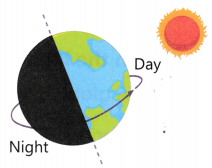
a. The Sun’s movement
b. The Moon’s shadow
c. The Earth’s rotation
d. The stars’ light
Question 2.
Which side of the globe has night during torchlight activity?
a. The side facing light
b. Both sides
c. The side away from the light
d. The top of the globe
Question 3.
In which season do flowers bloom and trees get new leaves?
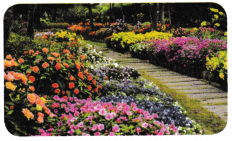
a. Monsoon
b. Spring
c. Winter
d. Autumn
Question 4.
Which of the following is a winter crop?
a. Maize
b. Watermelon
c. Peas
d. Rice
Question 5.
Which festival is linked to harvest?
a. Holi
b. Diwali
c. Pongal
d. Christmas
Question 6.
Read the statements given below and choose the correct option. Statement I: The blue part of the globe represents seas and oceans. Statement II: Seas are usually bigger than ocean.
a. Statement I is true.
b. Statement II is true.
c. Both statements I and II are true.
d. Both statements I and II are false.
Fill in the blanks.
1. A globe is a model of the ___________.
2. During monsoon, farmers grow crops that need more ___________.
3. In India, we have ___________ seasons.
4. The hottest season of the year is ___________.
5. The other name for the Monsoon season is ___________.
6. Farmers grow different ___________ in summer and winter.
7. Trees shed dry leaves in the ___________ season.

State True (T) or False (F).
1. Ghevar is an Indian sweet that people usually eat in summer.
2. Nature follows a repeating pattern.
3. Seas and oceans cover about three-fourth part of the Earth.
4. Hemant is the Indian name for the autumn season.
5. Diwali is an autumn festival.
6. All changes around us happen very slowly.
7. The whole world has daytime at the same time.
Unscramble the letters with the help of the given hints.
1. RSDHAA ___________
A season when the weather becomes cooler and dry leaves fall.
2. HIOL ___________
A colourful festival of spring where people play with colours.
3. WAIDLI ___________
A festival of lights celebrated in autumn.
4. U S I V H ___________
A new year and harvest festival.
5. YHTMRH ___________
A regular natural pattern, like seasons or day and night.
Match the following.
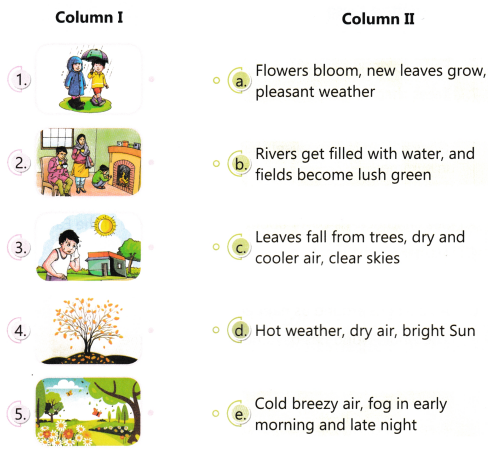
Answer in one word.
1. The movement of the Earth around itself ___________
2. A crop that grows in winter ___________
3. A crop that grows in summer ___________
4. A season in which leaves fall from trees ___________
5. The season between autumn and winter ___________
6. A season also known as shishir ___________
Solve the Riddles.
1. I shine bright and rise in the east,
I give you light and warmth at least.
Who am I? ___________
2. I am hot and long, with blazing heat,
You will need a fan and light clothes neat
Watermelon is my treat,
What season am I that’s hard to beat? ___________
3. I come with blooms, so fresh and bright,
The days grow warm, and hearts feel light
Butterflies dance, the skies are clear,
What season brings this joyful cheer? ___________
Answer the following questions.
Question 1.
Does the Sun move across the sky during the day?
Answer:
__________________________________
Question 2.
How do seasons affect human activities?
Answer:
__________________________________
Question 3.
What does the word ‘rhythm’ mean in this chapter?
Answer:
__________________________________
Question 4.
What is a globe?
Answer:
__________________________________
Question 5.
How do you think observing nature can help us predict seasons?
Answer:
__________________________________
Question 6.
Differentiate between summer and winter crops.
Answer:
__________________________________
Question 7.
Name any four festivals and mention the season in which each one is celebrated.
Answer:
__________________________________
Read the activity and answer the following questions.
The teacher showed a simple activity using a globe and a torch.
The torch was used to represent the Sun, and the globe represented the Earth. The torch was pointed at one side of the globe, showing day on that side and night on the other. Then, the teacher slowly turned the globe. The students saw how different parts of the globe came into light and moved into darkness. They learned that the Earth rotates around itself, and this movement causes day and night.

Question 1.
What objects were used in this activity, and what did they represent?
Answer:
__________________________________
Question 2.
What did the students observe when the globe was rotated?
Answer:
__________________________________
Question 3.
Which movement of the Earth causes day and night?
Answer:
__________________________________
Question 4.
Why does only one part of the Earth have light at a time?
Answer:
__________________________________
Question 5.
What do you think would happen if the Earth stopped rotating?
Answer:
__________________________________
Learn with Fun
Create a colourful Seasons Wheel. Choose a colour that you feel matches each season (for example, yellow for summer, blue for winter, etc.). Paste colourful paper or pictures in each section. Write the name of the season and its local name used in your area. Also, write how people dress during that season and what changes happen in nature, such as the weather, trees, or flowers.

Look at the images given below. Write the name of the food item and the season in which it is mostly eaten.

Create a mini weather journal for a week. Tick (✓) whether it was sunny. rainy, or cloudy each day.
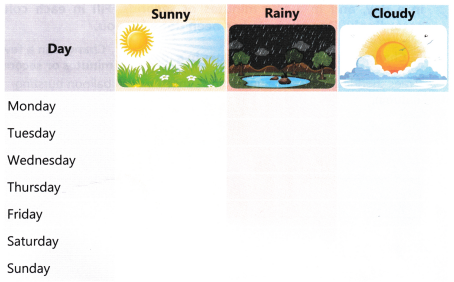
With the help of an elder, cut out pictures of different crops from newspapers, chart papers, or magazines. Paste each picture in the correct column of the table below. Write the name of each crop next to its picture.

Look at the columns given below. Observe your surroundings carefully and write the changes you notice that happen in a year, in a day, and in a few minutes or seconds. Fill in each column accordingly. One example has been done for you.

Observe your surroundings and record the changes that occur in different months throughout the year in the table below.

Word Puzzle
Find ten words related to this chapter in the given word search puzzle.
