Teachers guide students to use Exploring Society India and Beyond Class 8 Solutions and Class 8 Social Science SST Chapter 2 Reshaping India’s Political Map Question Answer NCERT Solutions for quick learning.
Class 8 Social Science Chapter 2 Question Answer Reshaping India’s Political Map
NCERT Class 8 Social Science Chapter 2 Reshaping India’s Political Map Questions and Answers Solutions
Reshaping India’s Political Map Class 8 Question Answer (In-Text)
The Big Questions? (Page 21)
Question 1.
How did foreign invasions and the rise of new dynasties reshape India’s political boundaries during this period?
Answer:
Foreign Invasions
(i) Turkish Invasions (11th – 12th century):
Invasions by Mahmud of Ghazni and Muhammad Ghori led to the fall of many Rajput kingdoms and paved the way for Muslim rule in North India.
(ii) Establishment of the Delhi Sultanate (1206):
After Muhammad Ghori’s death, his generals, like Qutb-ud-din Aibak, created the Delhi Sultanate, which replaced many small kingdoms with a centralized Islamic empire.
(iii) Timur’s Invasion (1398): Timur’s attack severely weakened the Delhi Sultanate. This allowed regional kingdoms such as Vijayanagara, Bahmani, and Bengal Sultanates to assert greater independence.
(iv) Babur’s Invasion (1526): Babur defeated the Delhi Sultan Ibrahim Lodi in the First Battle of Panipat and founded the Mughal Empire. This marked a major shift in political control, leading to new boundaries across North and Central India.
Rise of New Dynasties
(i) Mughal Dynasty (1526-1707 and beyond):
The Mughals, starting with Babur, gradually extended their rule across most of India. Under rulers like Akbar, Jahangir, and Shah Jahan, the empire reached its peak, absorbing many former sultanates and kingdoms.
(ii) Vijayanagara Empire (1336-mid-1600s):
In the south, the Vijayanagara Empire rose to power in response to northern invasions. It became a major southern power, controlling vast parts of the Deccan and protecting Hindu traditions.
(iii) Marathas and Sikhs (Late 17th century):
Aurangzeb’s long wars weakened the Mughal Empire. This gave rise to powers like the Marathas in the Deccan and the Sikhs in Punjab, who started asserting independence and redrawing regional borders.
(iv) Decline of Central Authority: After Aurangzeb’s death, the Mughal Empire fragmented. Many provinces became independent or semiindependent, leading to a politically divided and unstable India with changing boundaries.

Question 2.
How did Indian society respond to invasions? How did India’s economy adapt during times of political instability?
Answer:
The Indian society respond to invasion in the following ways:
- Indian society often adjusted to new mlers while trying to preserve local traditions and customs.
- Some communities actively resisted foreign invasions. For example, the Rajputs, Sikhs, and Marathas stood up against powerful rulers.
- Over time, different cultures mixed. This led to new styles in art, architecture, language, and food.
- Religious and spiritual movements like the Bhakti and Sufi movements grew stronger, helping people find unity during tough times.
India’s economy adapted during times of political instability in the following ways:
- Agriculture remained the backbone of the economy. Even when rulers changed, farmers continued to grow crops and pay taxes.
- Trade and crafts continued through local guilds and merchant groups, which often operated independently of kings and governments.
- Systems like hundis (credit notes) helped merchants move money safely across regions, reducing risks during war or conflict.
- Temple-based and community-based economies supported local life, even when large empires collapsed.
- Though there were famines and hardships, Indian society showed resilience by rebuilding and-adapting its systems after conflicts ended.
Question 3.
What impact did this period have on the lives of the people?
Answer:
During the medieval period in India, the lives of the people were shaped by a mix of hardship and cultural development. Frequent invasions and political instability often led to wars, destruction of property, and the displacement of communities, especially peasants and rural populations. Farmers bore a heavy burden through high land taxes, which sometimes left them with very little to survive on. Despite these difficulties, this period also saw significant progress in art, literature, music, and architecture under mlers like the Mughals and the Vijayanagara kings.
Crafispeople and traders contributed to a growing economy, and merchant groups became influential. Religion played a key role in society, with spiritual movements like Bhakti and Sufism promoting peace, social harmony, and devotion beyond caste or religious divisions. The interaction between different cultures gave rise to new traditions in food, dress, language, and customs, forming a shared heritage. Even as kingdoms rose and fell, loca! riIlage governance systems continued to function, providing some stability at the grassroots level. Thus, while the period brought many challenges, it also inspired resilience and creativity among the people
Lets Explore
Question 1.
Looking at the below figure. why do you think Ala-ud-din Khilji called himself the second Akxander? (page 26)
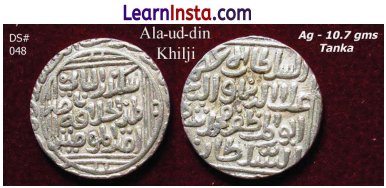
Answer:
Ala-ud-din Khilji called himself ‘Sikander Sani’ or the second Alexander’ to compare himself with Alexander the Great, one of history’s most famous and powerful conquerors. By using this title on his coins, Ala-ud-din wanted to show that he was a mighty ruler and a great military leader, just like Alexander. It was a way of building his image as a fearless conqueror who expanded his empire and defeated powerful enemies. This also helped him gain respect and authority among his subjects and rivals, showing that he was not just a king but a legendary warrior in his own right.
Question 2.
What kind of resources do you think were needed to maintain an army and wage war in those days? Discuss the various types of expenditure involved, from weapons or food for soldiers to animals used in warfare, road construction, etc. (Page 26)
Answer:
Maintaining an army and waging war in those days required a wide range of resources. First, large amounts of money were needed to pay soldiers and officers regularly. Armies had to be equipped with weapons like swords, spears, bows, arrows, and later, gunpowder-based arms. Armour and shields for protection also added to the cost.
Food and water had to be supplied to thousands of soldiers, often for long campaigns, which required proper planning and storage. Animals such as horses, elephants, camels, and oxen were used in warfare and for transport. These animals needed to be fed, trained, and cared for. War elephants especially were expensive to maintain.
Road construction and maintenance were also important, as armies had to move quickly across regions. Temporary shelters, tents, and medical help for injured soldiers also had to be arranged. In addition, war required the support of craftsmen, blacksmiths, cooks, and messengers, whose services added to the overall expenditure. All of this was supported by collecting taxes, land revenue, and sometimes loot from conquered regions.
Question 3.
Why do you think such locations (like Kumbhalgarh Fort) were chosen for many of the medieval forts? Discuss pros and cons. (Hint: Think of issues of strategy, security, vulnerability, etc.) (Page 31)
Answer:
Such locations, like the Aravalli hills where Kumbhalgarh Fort was built, were chosen for medieval forts primarily due to their strategic and defensive advantages. Being surrounded by forests, steep slopes, and rugged terrain made these areas naturally difficult to access, offering protection from enemy attacks. The elevation provided a clear view of the surrounding area, allowing defenders to spot approaching enemies from a distance and prepare accordingly. The long, continuous walls added another layer of defense, making it extremely difficult for invaders to breach the fort.
The main advantage of such locations was security. They were hard to attack, easy to defend, and allowed rulers to maintain control over their region even in times of political instability. These forts also served as safe havens for the royal family and the military during times of war.
However, there were also some disadvantages. The remote and hilly locations made it challenging to transport supplies such as food, water, and weapons. Maintaining communication with other regions was also difficult. In times of siege, the lack of’easy access to resources could create hardships for those inside the fort.
Despite these drawbacks, the protection and strategic benefits offered by such sites made them ideal for building forts during the medieval period. They symbolized power, control, and resilience against invasion.
Question 4.
In the figure given below, what elements do you observe? What do they tell you about life then? (Hint: observe the weapons, the animals, the activities.)
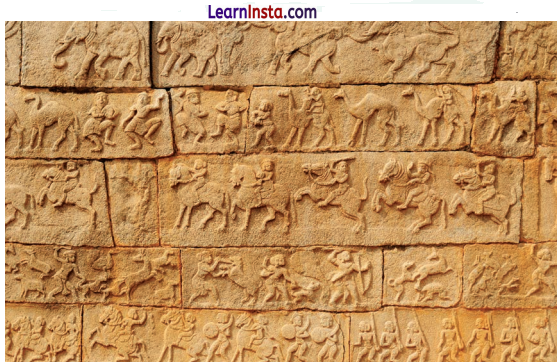
In the panel from the Vitthala temple, several detailed elements can be observed that provide valuable insights into life during the time it was built. The carvings often depict soldiers holding bows, swords, or spears, which shows that warfare and military preparedness were important aspects of society. Some figures may be riding horses or elephants, suggesting that these animals were not only used in warfare but also held cultural and symbolic importance.
There are also scenes of musicians playing instruments, dancers performing, and people engaging in rituals or celebrations. These reflect a vibrant cultural life, with music, art, and festivals being significant parts of daily and religious activities. The attention to detail in dress, jewellery, and hairstyles shows the richness of craftsmanship and the importance of social status.
Thus, the panel tells us that life during this period included both martial and artistic elements. Society was deeply rooted in tradition and religion, but it also celebrated creativity and public life. The carvings are a window into a world where warfare, religion, art, and everyday human experiences were closely connected.
Question 5.
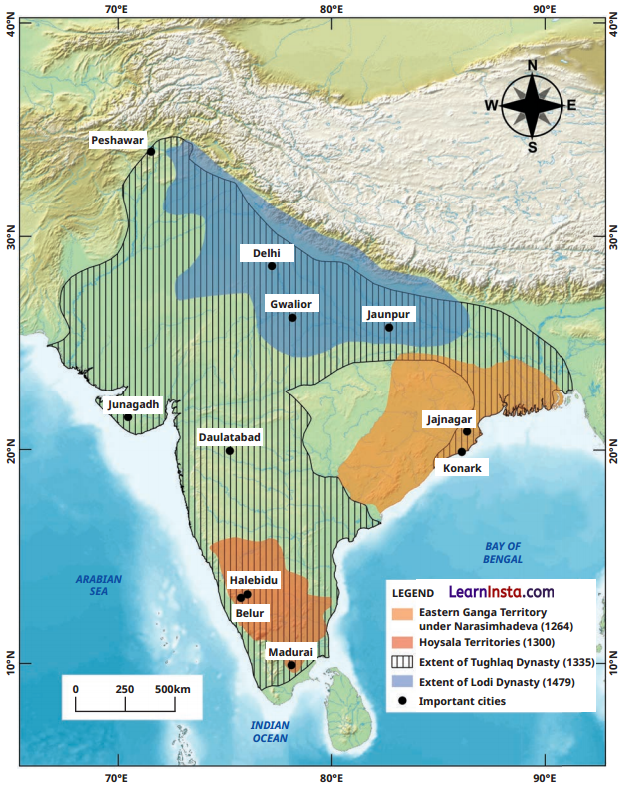
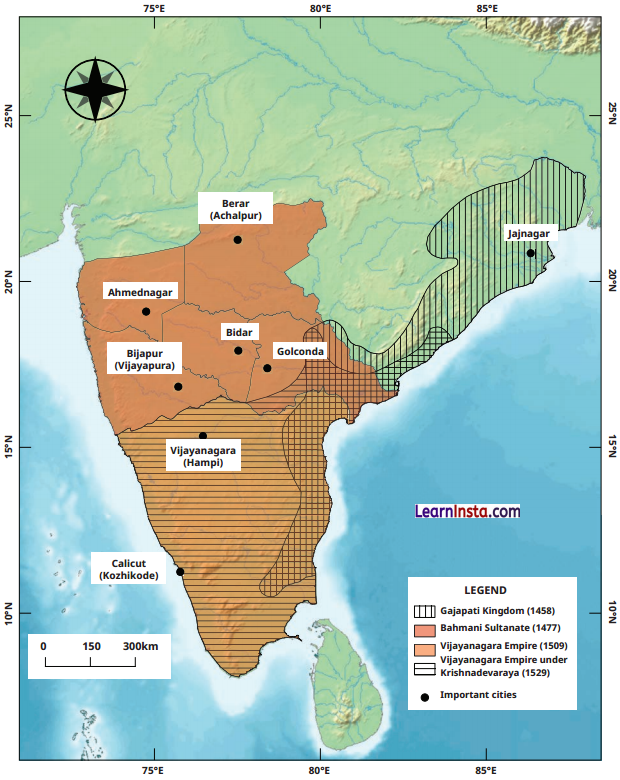
Compare the below maps. What differences do you notice? What is the ‘reshaping’ that has occurred? (Page 41)
Map – 1
Map – 2
Map – 3
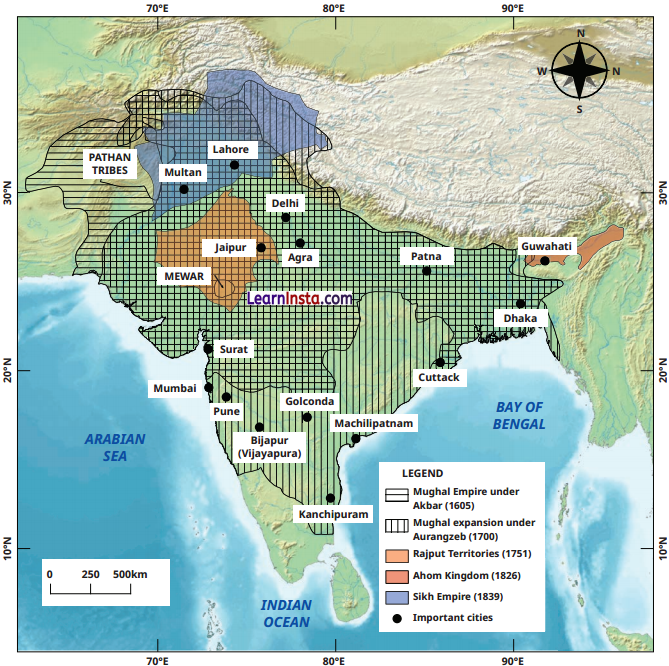
Answer:
Map 1 shows the Delhi Sultanate under the Tughlaqs and Lodis. Most of the power was in North India, with smaller kingdoms in the south and east.
Map 2 shows strong kingdoms in the south, like the Vijayanagara Empire and Deccan sultanates. Power shifted from the north to the south.
Map 3 shows the large Mughal Empire. Later, as the Mughals became weak, many regional powers like the Marathas and Sikhs rose.
The reshaping shows how power moved from north to south , and then to different regions. Over time, big empires broke into smaller kingdoms.
Question 6.
In his last letters to two of his sons, Aurangzeb wrote. “I came alone and am going away alone. I know not who I am and what 1 have been doing …. 1 have not done well for the country and the people, and of the future there is no hope. I was helpless [in life] and I am departing helpless.” What do these words tell us about Aurangzeb? How do you feel about them?
Answer:
Aurangzeb’s final words reveal a deep sense of regret, disillusionment, and inner conflict. Despite ruling one of the largest empires in Indian history, he felt isolated and helpless in the end. His statement, “7 have not done well for the country and the peopled’ suggests that he recognized the damage caused by his policies — particularly his religious intolerance, endless wars, and harsh treatment of rivals — which weakened the empire over time. The line “came alone and am going away alone” reflects a profound loneliness and the spiritual uncertainty he experienced in his final days.
These words show that beneath his powerful exterior, Aurangzeb was a deeply troubled man who perhaps realized too late the consequences of his actions. Personally, the quote feels tragic — a reminder that even the mightiest rulers are human, capable of doubt, guilt, and sorrow. It also serves as a lesson that leadership without compassion or foresight can lead to emptiness, both for the ruler and the realm.
Question 7.
Discuss in class how the paik system affected the daily lives of the people in the Ahom kingdom, both in terms of challenges and benefits, and helped the king manage both the army and the economy. (Page 48)
Answer:
The paik system in the Ahom kingdom required every adult male to serve the state for a few months each year. This included working in the army or on public projects like building roads and forts. It was challenging for families, as men were away from home and farms. However, it also helped the king manage both the army and the economy without high costs. People sometimes received land in return, and the system created a shared responsibility in developing the kingdom.
Question 8.
How did the Ahorns use the rivers, hills and forests of Assam to their advantage? Can you think of ways in which the geography helped them build defences and fight wars?
Answer:
The Ahoms cleverly used the geography of Assam its rivers, hills, and forests—for defence and warfare. The Brahmaputra River and its many tributaries acted as natural barriers and helped in transportation and supply during wars. The dense forests and hilly terrain made it hard for enemies to invade or move quickly, allowing the Ahoms to launch surprise attacks or escape when needed. They also built forts in hilly areas and used forest resources like wood and elephants for construction and military use. The geography gave them strong defensive positions and made it easier to protect their kingdom.
Think About It
Question 1.
Why do we use the term ‘image’ rather than common terms like ‘idol’ or ‘icon’? The latter two terms are considered pejorative in the context of Judaism, Christianity and Islam, whose orthodox
Answer:
Map 1 shows the Delhi Sultanate under the Tughlaqs and Lodis. Most of the power was in North India, with smaller kingdoms in the south and east.
Map 2 shows strong kingdoms in the south, like the Vijayanagara Empire and Deccan sultanates. Power shifted from the north to the south.
Map 3 shows the large Mughal Empire. Later, as the Mughals became weak, many regional powers like the Marathas and Sikhs rose.
The reshaping shows how power moved from north to south, and then to different regions. Over time, big empires broke into smaller kingdoms.
Question 6.
In his last letters to two of his sons, Aurangzeb wrote, “I came alone and am going away alone. I know not who I am and what I have been doing …. I have not done well for the country and the people, and of the future there is no hope. I was helpless [in life] and I am departing helpless.” What do these words tell us about Aurangzeb? How do you feel about them? (Page 45)
Answer:
Aurangzeb’s final words reveal a deep sense of regret, disillusionment, and inner conflict. Despite ruling one of the largest empires in Indian history, he felt isolated and helpless in the end. His statement, “have not done well for the country and the peoplesuggests that he recognized the damage caused by his policies particularly his religious intolerance, endless wars, and harsh treatment of rivals — which weakened the empire over time. The line “came alone and am going away alone” reflects a profound loneliness and the spiritual uncertainty he experienced in his final days.
These words show that beneath his powerful exterior, Aurangzeb was a deeply troubled man who perhaps realized too late the consequences of his actions. Personally, the quote feels tragic a reminder that even the mightiest rulers are human, capable of doubt, guilt, and sorrow. It also serves as a lesson that leadership without compassion or foresight can lead to emptiness, both for the ruler and the realm.
Question 7.
Discuss in class how the paik system affected the daily lives of the people in the Ahom kingdom, both in terms of challenges and benefits, and helped the king manage both the army and the economy. (Page 48)
Answer:
The paik system in the Ahom kingdom required every adult male to serve the state for a few months each year. This included working in the army or on public projects like building roads and forts. It was challenging for families, as men were away from home and farms. However, it also helped the king manage both the army and the economy without high costs. People sometimes received land in return, and the system created a shared responsibility in developing the kingdom.
Question 8.
How did the Ahoms use the rivers, hills and forests of Assam to their advantage? Can you think of ways in which the geography helped them build defences and fight wars? (Page 49)
Answer:
The Ahoms cleverly used the geography of Assam its rivers, hills, and forests for defence and warfare. The Brahmaputra River and its many tributaries acted as natural barriers and helped in transportation and supply during wars. The dense forests and hilly terrain made it hard for enemies to invade or move quickly, allowing the Ahoms to launch surprise attacks or escape when needed. They also built forts in hilly areas and used forest resources like wood and elephants for construction and military use. The geography gave them strong defensive positions and made it easier to protect their kingdom.
Think About It
Question 1.
Why do we use the term ‘image’ rather than common terms like ‘idol’ or ‘icon’? The latter two terms are considered pejorative in the context of Judaism, Christianity and Islam, whose orthodox sects condemn ‘idolatry1 or the worship of ‘idols’ or ‘icons’. India’s classical texts used words like murti, vigraha, pratima, rupa, etc., to designate images, often statues, used for worship in temples or homes. In English, ‘image’ is a neutral term. (Page 28)
Answer:
We use the word “image” instead of “idol” or “icon” because it is more respectful and neutral. Words like idol are often seen as negative, especially in religions like Judaism, Christianity, and Islam, where worshiping images is considered wrong. Icon is mostly used in Christianity, especially for pictures of Jesus or saints. In Indian traditions like Hinduism, there are special words like murti, pratima, or rupa that mean a statue or form of a god used in worship. These are not seen as bad or wrong. So, using the word “image” is a way to talk about these sacred forms without judging them. It helps people from different religions and cultures understand and respect each other better.
Question 2.
During the time of the Tughlaqs, the Musunuri Nayakas, Telugu chieftains, rallied over 75 more chieftains of the region, formed a confederacy that defeated smaller provinces, formed a confederacy that defeated the Delhi Sultanate forces, and expelled Muhammad bin Tughlaq’s army from Warangal (present-day Telangana) around 13301336. Do you think it would have been an easy task to bring together 75 leaders in those days? (Page 29)
Answer:
No, it would not have been an easy task to bring together 75 leaders in those days. In the 1300s, communication and travel were very slow compared to today. Messages had to be sent by messengers on foot or horseback, which took a long time. Many local chieftains had their own power, land, and interests. Convincing them to unite under one cause required strong leadership, trust, and a shared goal – like defeating a powerful enemy such as the Delhi Sultanate. There may have been disagreements, rivalries, or fear of betrayal. So forming a confederacy of 75 different rulers was a remarkable achievement, showing how serious the situation was and how much the Musunuri Nayakas inspired others to fight for their region and freedom.
Question 3.
Have you noticed the term pati in titles like ‘Gajapati’? Pati means ‘lord’ or ‘master’ and Iwas commonly used by many ruling dynasties of this period to signify power and stature. The Vijayanagara kings were called ‘Narapati1, the Bahmani Sultanate rulers ‘Ashwapati’, and the Maratha rulers ‘Chhatrapati’ – each title reflecting different aspects of kingship and power. Can you guess what these three terms might mean? (Page 32)
Answer:
Yes, the word “pati” means “lord” or “master” and was often used in royal titles to show power.
(i) Narapati: “Nara” means man or people, so Narapati means “lord of men” or “king of people”. It shows that the ruler had control over his subjects.
(ii) Ashwapati: “Ashwa” means horse, so Ashwapati means “lord of horses”. This suggests the ruler had a strong cavalry and military strength.
(iii) Chhatrapati: “Chhatra” means umbrella, a symbol of royal protection. So Chhatrapati means “lord of the umbrella” or “protector of the people”. Each title highlights a different part of kingship: ruling over people, military power, and protection.
Question 4.
What strikes you in Babur’s impressions of India? Discuss in groups. (Page 37)
Answer:
What strikes me in Babur’s impressions of India is how honest and detailed he was. He admired some things but also criticized others.
For example:
- He found the land very rich and fertile, with plenty of fruits and resources.
- But he didn’t like the cities and buildings. He thought they were not as beautiful or well- planned as in Central Asia.
- He also noticed that people dressed and lived differently, and he sometimes found their customs strange.
What stands out is that Babur looked at India with fresh eyes-as an outsider and shared both the good and the bad. His observations help us understand how India appeared to someone coming from a different culture in the 16th century.
Question 5.
Why do you think Akbar employed different strategies to expand his empire, while the earlier rulers of Delhi relied mostly on military might? (Page 40)
Answer:
Akbar employed different strategies to expand his empire because he understood that using only military force was not enough to rule a large and diverse country like India.
Here are a few reasons why:
(i) India was very diverse: People followed different religions, spoke many languages, and had different customs. Akbar knew that force alone wouldn’t win their loyalty.
(ii) He wanted long-lasting rule: Instead of just defeating rulers in battle, Akbar made alliances through marriage, diplomacy, and fair treatment, which helped create peace and stability.
(iii) He respected local rulers: Akbar gave them important jobs in his court and allowed them to keep their lands if they accepted his rule. This made them more willing to support him.
(iv) He promoted tolerance: By treating people of different religions fairly, he gained the trust of his subjects and avoided rebellions. So, unlike earlier rulers who mainly used military power, Akbar used a mix of force, friendship, and fairness to grow his empire and keep it united.
Question 6.
We saw above that Delhi sultans’ average reign lasted about nine years. This figure becomes 27 years in the case of Mughal emperors up to Aurangzeb; and 16 years if we consider all Mughal rulers, up to the end of the empire in the 19th century. What do you make of these numbers of years of reign? (Page 43)
Answer:
These numbers show that Mughal emperors ruled for much longer periods than the Delhi Sultans: Here’s what we can understand from this:
- A longer reign usually means greater stability. The Mughals, especially up to Aurangzeb, were able to build a strong and organized empire.
- The Delhi Sultans ruled for shorter periods on average, which suggests there may have been more conflicts, power struggles, or weak leadership during their time.
- The average dropped to 16 years when we include later Mughal rulers, showing that the empire became less stable after Aurangzeb. So, these numbers tell us that the early Mughals had stronger and more stable rule compared to the Delhi Sultans and the later Mughals.
It says that while some rulers and times in history were peaceful and kind, many were cruel, corrupt, or violent. Wars, abuse, and suffering are sadly a part of history in many places. Historians often ask: how much should we talk about these dark periods? Should we ignore them, mention them briefly, or study them deeply?
The best way, according to the passage, is to study them carefully and honestly, but with detachment and sensitivity . This means:
- We should not blame people living today for what happened long ago.
- We should try to understand why such bad things happened, so we can avoid them in the future.
- We must remember the victims of the past with respect.
For example, World War II caused great suffering, but we do not blame people today for what their ancestors did. The goal is to leam from the past, not to create more hate or blame. This helps us build a better, more peaceful future.
Question 8.
Answer the following questions:
(a) Why do you think Guru Tegh Bahadur endured torture rather than convert? Why did he think his sacrifice would make a difference?
(b) What values did the Sikh Gurus and the Khalsa embody?
(c) How are they relevant in today’s world? (Page 52)
Answer:
(a) Guru Tegh Bahadur chose to endure torture rather than convert to protect the freedom of religion. He believed that everyone should have the right to follow their own faith. By refusing to convert, he stood up for justice and the rights of others, even if it meant giving up his life. He believed that his sacrifice would inspire people to stand up against oppression and protect their beliefs. His courage showed that standing for truth and justice is more powerful than fear. His actions gave hope and strength to others facing similar pressures.
(b) The Sikh Gurus and the Khalsa stood for values like bravery, honesty, equality, justice, selflessness, and faith. They taught people to help others, speak the truth, protect the weak, and live with dignity.
(c) These values are very important today. In a world with conflict, injustice, and discrimination, the teachings of the Sikh Gurus remind us to stand up for what is right, support freedom for.all, and treat everyone with respect. Their message encourages us to be strong, kind, and fair in our daily lives.
Class 8 SST Chapter 2 Reshaping India’s Political Map Question Answer (Exercise)
Question 1.
Compare the political strategies of the Delhi Sultanate and the Mughals. What similarities and differences existed between them?
Answer:
Both the Delhi Sultanate and the Mughal Empire aimed to establish control over vast regions of India, but their strategies differed significantly.
Similarities:
- Both used military campaigns to expand their territories.
- Both extracted revenue through taxes such as land tax and trade duties.
- Both introduced administrative systems like iqta (Sultanate) and mansabdari (Mughals) to manage their empires.
- Both faced resistance from regional kingdoms and local communities.
Differences:
- The Delhi Sultanate relied more on plunder, raids, and violent succession. Almost two out of every three sultans seized power violently.
- The Mughals, especially Akbar, emphasized political alliances, marriage diplomacy, and religious tolerance.
- The Sultanate’s reigns were generally short and unstable, whereas Mughal emperors, especially Akbar and Aurangzeb, ruled for decades.
- Akbar’s sulh-i-kul policy and administrative reforms brought more stability and inclusiveness than the Sultanate’s methods.
Question 2.
Why did kingdoms like the Vijayanagara Empire and the Ahom Kingdom manage to resist conquest for a longer time compared to others? What geographical, military, and social factors contributed to their success?
Answer:
Several factors helped the Vijayanagara and Ahom kingdoms resist conquest longer:
Geographical Factors:
- Vijayanagara was located in a hilly, rugged terrain with natural defenses, especially around Hampi.
- The Ahoms were based in Assam’s dense forests, hills, and river valleys, which were difficult for invaders to navigate.
Military Factors:
- Vijayanagara maintained a strong military and used horses traded from the Portuguese.
- The Ahoms used the paik system to mobilize manpower efficiently and practiced guerrilla warfare.
- In the Battle of Saraighat (1671), the Ahoms used their river skills to defeat a much larger Mughal force.
Social Factors:
- Both kingdoms had strong local support and integrated local populations into their defense.
- The Ahoms promoted cultural assimilation and unity, while Vijayanagara rulers were seen as protectors of the southern culture and faith.
Question 3.
Imagine you are a scholar in the court of Akbar or Krishnadevaraya. Write a letter to a friend describing the politics, trade, culture, and society you are witnessing.
Answer:
Dear Friend,
Greetings from the majestic court of Emperor Akbar! Life here is a blend of power, learning, and wonder. The emperor is not only a great conqueror but also a patron of knowledge. He encourages interfaith dialogue and has established a translation bureau where sacred Sanskrit texts are being translated into Persian.
The court is full of scholars, poets, and artists, and every day brings new discussions and discoveries. Trade flourishes across the empire. From the ports of Surat to the bazaars of Agra, goods like textiles, spices, and crafts are exchanged with traders from Arabia, Persia, and even Europe.
Despite the grandeur, I see common people struggling under heavy taxes. Yet, there is also resilience in villages and temples, which remain centers of economic and cultural activity.
Do visit if you can. This is a time of transformation.
Yours truly,
A Court Scholar
Question 4.
How come Akbar, a ruthless conqueror in his young days, grew tolerant and benevolent after some years? What could have led to such a change?
Answer:
Akbar’s early reign was marked by brutal conquests, such as the siege of Chittor. However, over time, his outlook changed due to:
- Growing knowledge and maturity: He admitted in his court that with increased understanding, he felt ashamed of earlier persecutions.
- Exposure to diverse religious and cultural ideas through dialogue with scholars, Jesuits, and Hindu thinkers.
- His desire for a stable and unified empire encouraged tolerance and inclusion.
- The failure of forced conversions made him realize that genuine loyalty and harmony could not be achieved through violence.
This shift led to policies like abolishing jizya, promoting sulh-i-kul (peace with all), and appointing non-Muslims in high positions.
Question 5.
What might have happened if the Vijayanagara Empire had won the Battle of Talikota? Imagine and describe how it could have changed the political and cultural history of south India.
Answer:
If the Vijayanagara Empire had won the Battle of Talikota in 1565:
- The empire might have continued to flourish, possibly expanding further north.
- The southern cultural renaissance in literature, temple architecture, and trade would likely have intensified.
- Deccan Sultanates may have been weakened or even absorbed into the Vijayanagara domain.
- The spread of Islam in parts of the south may have been limited.
- The empire might have become a strong counterforce to the Mughals, changing the entire power balance in the subcontinent.
South India may have remained more politically unified and culturally distinct for a longer time.
Question 6.
Many values promoted by early Sikhism, including equality, seva, and justice, remain relevant today. Select one of these values and discuss how it remains relevant in contemporary society.
Answer:
Seva (selfless service) is a deeply important value promoted by early Sikhism and remains highly relevant in today’s world.
In contemporary society, where inequality, conflict, and suffering are widespread, the practice of seva encourages individuals to serve others without expecting reward, regardless of religion, caste, or background. It fosters compassion and unity, helping communities come together during crises such as natural disasters or pandemics.
We see Sikh communities worldwide running free kitchens (langars), offering food to anyone in need. Seva is also practiced through volunteering, caring for the sick, cleaning public spaces, and supporting the underprivileged.
By focusing on selfless service, society becomes more humane, inclusive, and just, echoing Guru Nanak’s vision of compassion and equality.
Question 7.
Imagine you are a trader in a port city (Surat, Calicut or Hooghly). Describe the scenes you see as regards goods, people you trade with, movement of ships, etc.
Answer:
As a trader in Surat, I witness a bustling and vibrant scene every day. Ships from Arabia, Persia, Central Asia, and even Europe dock at our port. Caravans unload precious goods-silk, spices, fine textiles, dyes, and jewelry. Local craftsmen bring their cotton fabrics, metal utensils, and ornaments to trade.
The streets are filled with oxen pulling carts, merchants haggling, and interpreters translating between languages. Gold and silver coins change hands, and hundis are used to transfer large sums securely. I see Hindu, Muslim, Jain, and foreign traders working together, proving how trade bridges cultures. The markets are alive with energy, and the city thrives on trust, skill, and the flow of goods across seas and kingdoms. This trade sustains thousands of livelihoods and connects our land to the larger world.