Practicing Class 9 Maths MCQ and Ganita Manjari Class 9 Maths Chapter 12 Quadrilaterals MCQ Questions Online Test with Answers daily helps in time management.
MCQ on Quadrilaterals Class 9
Quadrilaterals MCQ Class 9
Class 9 Maths Quadrilaterals MCQ
Question 1.
The quadrilateral formed by joining the midpoints of the sides of a quadrilateral PQRS, taken in order, is a rhombus, if
(a) PQRS is a rhombus
(b) PQRS is a parallelogram
(c) diagonals of PQRS are perpendicular
(d) diagonals of PQRS are equal
Answer:
(d) diagonals of PQRS are equal
Explanation:
The quadrilateral formed by joining the midpoints of the sides of quadrilateral PQRS, taken in order, is a parallelogram (Varignon parallelogram). Its sides are half of the diagonals of PQRS.
For this parallelogram to be a rhombus, its adjacent sides must be equal.
\(\frac{1}{2}\)PR = \(\frac{1}{2}\)QS
PR = QS
Therefore, the formed quadrilateral will be a rhombus if the diagonals of PQRS are equal.
Hence, (d) is the correct answer.
Question 2.
If bisectors of ∠A and ∠B of a quadrilateral ABCD intersect each other at P, of ∠B and ∠C at Q, of ∠C and ∠D at R and of ∠D and ∠A at S, then PQRS is a
(a) rectangle
(b) rhombus
(c) parallelogram
(d) quadrilateral whose opposite angles are supplementary
Answer:
(d) quadrilateral whose opposite angles are supplementary
Explanation:
∠P = 180° – \(\frac{\angle \mathrm{A}+\angle \mathrm{B}}{2}\)
∠R = 180° – \(\frac{\angle \mathrm{C}+\angle \mathrm{D}}{2}\)
∠P + ∠R = 360° – \(\frac{\angle \mathrm{A}+\angle \mathrm{B}+\angle \mathrm{C}+\angle \mathrm{D}}{2}\)
Since ∠A + ∠B + ∠C +∠D = 360°, we get
∠P + ∠R = 360° – \(\frac{360^{\circ}}{2}\) = 180°
Similarly, ∠Q + ∠S = 180°
Therefore, opposite angles of PQRS are supplementary.
Hence, (d) is the correct answer.
Question 3.
The figure formed by joining the midpoints of the sides of a quadrilateral ABCD, taken in order, is a square only, if
(a) ABCD is a rhombus
(b) diagonals of ABCD are equal
(c) diagonals of ABCD are equal and perpendicular
(d) diagonals of ABCD are perpendicular.
Answer:
(c) diagonals of ABCD are equal and perpendicular
Explanation:
The quadrilateral formed by joining the midpoints of the sides of quadrilateral ABCD, taken in order, is a parallelogram (Varignon parallelogram). Its sides are parallel to and half of the diagonals of ABCD. For this parallelogram to be a square, its adjacent sides must be equal. So the diagonals of ABCD must be equal.
AC = BD
Its adjacent sides must be perpendicular, so the diagonals of ABCD must be perpendicular.
Therefore, the diagonals of ABCD must be equal and perpendicular.
Hence, (c) is the correct answer.

Question 4.
Which of the following is not true for a parallelogram?
(a) Opposite sides are equal.
(b) Opposite angles are equal.
(c) Opposite angles are bisected by the diagonals.
(d) Diagonals bisect each other.
Answer:
(c) Opposite angles are bisected by the diagonals.
Explanation:
Opposite angles are bisected by the diagonals. This is not true for a parallelogram.
Hence, (c) is the correct answer.
Question 5.
The diagonals of a quadrilateral ABCD are perpendicular to each other. The quadrilateral formed by joining the midpoints of its sides is always a:
(a) Rhombus
(b) Rectangle
(c) Trapezium
(d) Square
Answer:
(b) Rectangle
Explanation:
The sides of the Varignon parallelogram are parallel to the diagonals of the original quadrilateral. If the original • diagonals are perpendicular, the adjacent sides of the
Varignon parallelogram are perpendicular, making it a rectangle.
Hence, (b) is the correct answer.
Question 6.
In ∆ABC, P and Q are the midpoints of sides AB and AC, respectively. If BC = 11.6 cm, the length of PQ is:
(a) 5.8 cm
(b) 23.2 cm
(c) 11.6 cm
(d) 4.5 cm
Answer:
(a) 5.8 cm
Explanation:
By the Midpoint Theorem,
PQ = \(\frac{1}{2}\) BC = \(\frac{11.6}{2}\) = 5.8 cm
Hence, (a) is the correct answer.
Question 7.
The centroid of a triangle divides each median from the vertex in the ratio:
(a) 1 : 2
(b) 1 : 1
(c) 2 : 1
(d) 3 : 1
Answer:
(c) 2 : 1
Explanation:
By Theorem 8, the segment connecting the vertex to the centroid is twice the length of the segment connecting the centroid to the opposite side’s midpoint.
Hence, (c) is the correct answer.
Question 8.
The two diagonals are not always equal in
(a) square
(b) rectangle
(c) parallelogram
(d) None of these
Answer:
(c) parallelogram
Question 9.
ABCD is a rhombus such that ∠ACB =60°. Then, ∠ADB is.
(a) 40°
(b) 45°
(c) 60°
(d) 30°
Answer:
(d) 30°
Explanation:
Hint Diagonals of a rhombus bisect the angles, so ∠ACD = 60°
Also, sum of adjacent angles is 180°.
∠BCD + ∠ADC = 180°
Question 10.
If ABCD is a parallelogram, P is a point on AD such that AP = \(\frac{1}{3}\)AD and Q is a point on BC such that CQ = \(\frac{1}{3}\)BC then APCQ is a
(a) rhombus
(b) rectangle
(c) parallelogram
(d) square
Answer:
(c) parallelogram
Explanation:
Since, ABCD is a parallelogram.
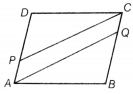
AD =BCand AD ∥ BC
⇒ \(\frac{1}{3}\)AD = \(\frac{1}{3}\)BC and AD ∥ BC
⇒ AP = CQ
and AP ∥ CQ
Thus, APCQ is a quadrilateral such that one pair of opposite sides AP and CQ are parallel and equal.
Hence, APCQ is a parallelogram.
Question 11.
∆ABC is an isosceles triangle in which AB = AC. D and E are the mid-points of sides AB and AC, respectively. If AD = 4.5 cm and DE = 35 cm then the perimeter of ∆ABC is
(a) 16 cm
(b) 25 cm
(c) 36 cm
(d) 42 cm
Answer:
(b) 25 cm
Explanation:
Given, a ∆ABC in which AB = AC,
D and E are the mid-points of AB and AC, respectively.
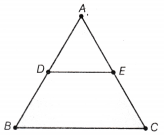
AD = DB = 45 cm
⇒ AB = 2 × 4.5 = 9 cm and AB = AC = 9 cm
Since, D and E are the mid-points of AB and AC, respectively.
So, by mid-point theorem,
DE ∥ BC and DE = \(\frac{1}{2}\)BC
Then, BC = 2 DE = 2 × 35 = 7 cm
[∵ DE = 35 cm, given]
Now, perimeter of ∆ABC = AB + BC + CA
= 9 + 7 + 9 = 25 cm
Question 12.
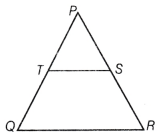
Which of the following relation is correct, if S is the mid-point of PR such that TS ∥ QR ?
(a) 2QR = TS
(b) PT = 2TQ
(c) TS = \(\frac{1}{2}\)QR
(d) PS = TS
Answer:
(c) TS = \(\frac{1}{2}\)QR
Explanation:
Hint By mid-point theorem
Question 13.
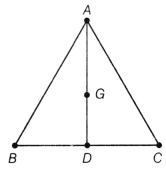
The centroid G of ∆ABC lies on median AD. If GD = 4 cm, then AG is
(a) 2 cm
(b) 4 cm
(c) 8 cm
(d) 12 cm
Answer:
(c) 8 cm
Explanation:
Given, G is the centroid of A ABC, AD is a median and GD = 4 cm
By the Centroid Theorem, the centroid divides each median in the ratio 2: 1, with the longer part towards the vertex.
Therefore, AG : GD = 2 : 1
Hence, AG = 2 × GD
On substituting GD = 4 cm, AG = 2 × 4 = 8 cm
Hence, correct option is (C).
Question 14.
In quadrilateral ABCD, P, Q, R, S are the mid-points of AB, BC, CD, DA respectively. The PQ is parallel to
(a) AB
(b) BC
(c) AC
(d) BD
Answer:
(c) AC
Explanation:
Given, P, Q, R and S are the mid-points of AB, BC, CD and DA, respectively.
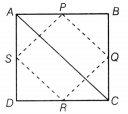
In ABC, P and Q are the mid-points of AB and BC, respectively.
Therefore, by the Mid-point Theorem, PQ ∥ AC
Question 15.
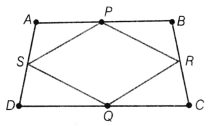
In the given figure, QR is equal to
(a) AC
(b) BD
(c) AC
(d) BD
Answer:
(b) BD
Explanation:
Given, Q and R are the mid-points of BC and CD, respectively.
In ∆BCD, Q and R are the mid-points of two sides.
Therefore, by the Mid-point Theorem, QR = \(\frac{1}{2}\)BD
Question 16.
The quadrilateral formed by joining the mid-points of the sides of a quadrilateral PQRS, taken in order, is a rectangle, if
(a) PQRS is a rectangle
(b) PQRS is a parallelogram
(c) diagonals of PQRS are perpendicular
(d) diagonals of PQRS are equal
Answer:
(c) diagonals of PQRS are perpendicular
Explanation:
Since, the quadrilateral ABCD formed by joining the mid-points of quadrilateral PQRS is a rectangle.
AC = BD [v diagonals of a rectangle are equal]
⇒ PQ = QR
Thus, quadrilateral PQRS is a rhombus.
Hence, diagonals of PQRS i.e. PR and QS are perpendicular.
[∵ diagonals of a rhombus are perpendicular to each other]
Question 17.
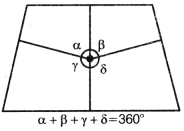
For tiles to meet exactly around a point, the sum of the angles around that point must be
(a) 90°
(b) 180°
(c) 270°
(d) 360°
Answer:
(d) 360°
Explanation:
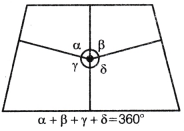
Given, several tiles meet exactly around a common point. “
The angles around a point together form one complete angle.
Therefore, α + β + γ + δ = 360°
Question 18.
A tiling which repeats after a fixed translation is called

(a) non-convex tiling
(b) periodic tiling
(c) irregular polygon
(d) mid-point tiling
Answer:
(b) periodic tiling
Explanation:
Given, a tiling repeats after a fixed translation. A tiling which repeats itself after a fixed translation is called a periodic tiling.
Question 19.
Which transformation always preserves the size and shape of a quadrilateral tile?
(a) Stretching
(b) Rotation
(c) Unequal scaling
(d) Shearing
Answer:
(b) Rotation
Explanation:
A rotation preserves the lengths of all sides and the measures of all angles. Therefore, the size and shape of the quadrilateral remains unchanged. Stretching, unequal scaling and shearing do not necessarily preserve both size and shape.
Quadrilaterals Class 9 Assertion and Reason Questions
Two statements are given, one labelled as Assertion (A) and the other labelled as Reason (R). Select the correct answer from the options (a), (b), (c), and (d) given below.
(a) Both Assertion (A) and Reason (R) are true and Reason (R) is the correct explanation of the Assertion (A).
(b) Both Assertion (A) and Reason (R) are true, but Reason (R) is not the correct explanation of the Assertion (A).
(c) Assertion (A) is true, but Reason (R) is false.
(d) Assertion (A) is false, but Reason (R) is true.
Question 1.
Assertion (A): A kite is not a rhombus. ,
Reason (R): A kite has two pairs of adjacent of sides equal and only one pair of opposite angles equal.
Answer:
(a) Both Assertion (A) and Reason (R) are true and Reason (R) is a correct explanation of Assertion (A).
Explanation:
A rhombus is a quadrilateral with all four sides equal in length, while a kite has only two pairs of adjacent sides equal. Additionally, a rhombus has two pairs of equal opposite angles, whereas a kite only has one pair of equal opposite angles.
Question 2.
Assertion (A): Every square is a rhombus.
Reason (R): It has four equal sides and also have four 90° angles.
Answer:
(a) Both Assertion (A) and Reason (R) are true and Reason (R) is a correct explanation of Assertion (A).
Explanation:
A rhombus has all four sides equal in length, and every square has all its four sides equal in length.
Question 3.
Assertion (A): All the four angles of a quadrilateral cannot be obtuse.
Reason (R): An obtuse angle is greater than 90°.
Answer:
(a) Both Assertion (A) and Reason (R) are true and Reason (R) is a correct explanation of Assertion (A).
Explanation:
The sum of the interior angles of a quadrilateral is always 360°. Since an obtuse angle measure greater than 90°, if a quadrilateral had four obtuse angles, the sum of its four interior angles would exceed 360°, which is not possible.
Question 4.
Assertion (A): If the diagonals of a parallelogram are equal, then it is a rectangle.
Reason (R): If the diagonals of the parallelogram are equal, then each of its angle is 90°.
Answer:
(a) Both Assertion (A) and Reason (R) are true and Reason (R) is the correct explanation of the Assertion (A).
Explanation:
Equal diagonals of a parallelogram make all its angles 90°, so it becomes a quadrilateral with each angle 90° and opposite sides equal and parallel, that is a rectangle.
Question 5.
Assertion (A): A regular hexagon can tile the plane by itself, but a regular pentagon cannot.
Reason (R): The internal angle of a regular polygon must divide 360° without remainder to tile the plane.
Answer:
(a) Both Assertion (A) and Reason (R) are true and Reason (R) is the correct explanation of the Assertion (A).
Explanation:
Hexagon angle = 120°(\(\frac{360}{120}\) = 3), whereas pentagon angle = 108°(\(\frac{360}{108}\) = 3.333…….)