Experts have designed these Class 8 Maths Notes and Chapter 4 Quadrilaterals Class 8 Notes for effective learning.
Class 8 Maths Chapter 4 Notes Quadrilaterals
Class 8 Maths Notes Chapter 4 – Class 8 Quadrilaterals Notes
Any 4-sided polygon is called a quadrilateral. It has four sides, four vertices and four angles. In the adjoining figure, ABCD is a quadrilateral, where AB, BC, CD and DA are its sides. A, B, C and D are the vertices and ∠A, ∠B, ∠C, and ∠D are the four angles of the quadrilateral ABCD. ∠A and ∠B, ∠B and ∠C, ∠C and ∠D, ∠D and ∠A are the adjacent angles and ∠A and ∠C, ∠B and ∠D are the opposite angles.
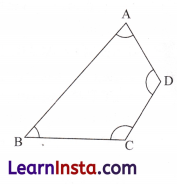
→ Sum of all interior angles of a quadrilateral is 360°. Quadrilaterals could be regular or irregular. There are different types of quadrilaterals, depending on the nature of their sides and angles.
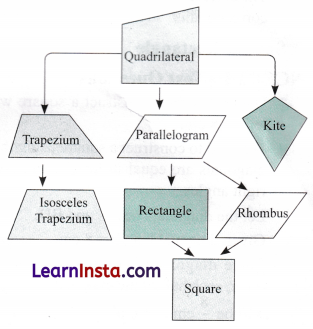
→ Any quadrilateral with all of its angles at 90 degrees is called a rectangle. Opposite sides of rectangle are parallel and equal to each other. Diagonals of a rectangle bisect each other.
→ A quadrilateral that has all of its angles of 90 degrees and all of its sides of the same length is called a square. Opposite sides of square are also parallel to each another. Diagonals of a square bisect each other at right angles.
→ A parallelogram is a quadrilateral in which opposite sides are parallel and equal. The adjacent angles add up to 180°, and the opposite angles are equal. The diagonals of a parallelogram bisect each other.
→ A rhombus is a quadrilateral in which all the sides have the same length. The opposite sides of a rhombus are parallel to each other. The adjacent angles add up to 180°, and the opposite angles are equal. The diagonals of a rhombus bisect each other at right angles.
→ A kite is a quadrilateral with two non-overlapping adjacent pairs of sides having the same length.
→ A trapezium is a quadrilateral having at least one pair of parallel opposite sides.
→ Quadrilaterals are basically classified into three categories: Trapeziums, kites and parallelograms.
In this chapter, we will study about some interesting types of four-sided figures and solve problems based on them. Such figures are commonly known as quadrilaterals. We will study about kite, trapezium, parallelogram, rhombus, rectangle and square.

Quadrilateral
A quadrilateral is a polygon having four sides, four vertices and four angles. The quadrilateral with vertices A, B, C and D is generally called the quadrilateral ABCD.
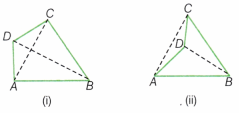
Elements of a Quadrilateral
(i) Sides The line segments forming the quadrilateral are called its sides.’
In the quadrilateral ABCD, the four line segments AB, BC, CD and DA are called its sides.
(ii) Adjacent sides Two sides of a quadrilateral are called its adjacent sides if they have a common end point.
In the above figures (i) and (ii), AB, BC; BC, CD;
CD, DA and DA, AB are four pairs of adjacent sides of the quadrilateral ABCD.
(iii) Opposite sides Two sides of a quadrilateral are called opposite sides, if they do not have a common end point.
In the above figures (i) and (ii), AB, CD and AD, BC are two pairs of opposite sides of the quadrilateral ABCD.
(iv) Diagonals The line segments joining the vertices, which are not adjacent are called diagonals.
In the quadrilateral ABCD, the line segments AC and BD are called its diagonals.
(v) Angles In the quadrilateral ABCD, ∠DAB, ∠ABC, ∠BCD and ∠CDA are called its angles. These angles are denoted by ∠A, ∠B, ∠C and ∠D, respectively.
(vi) Adjacent angles Two angles of a quadrilateral are called adjacent angles, if they have a common side as an arm.
In the above figures (i) and (ii), ∠A and ∠D, ∠A and ∠B, ∠B and ∠C, ∠C and ∠D are four pairs of adjacent angles of the quadrilateral ABCD.
(vii) Opposite angles Two angles of a quadrilateral which are not adjacent angles, are known as opposite angles of a quadrilateral.
In the above figures (i) and (ii), ∠A, ∠C and ∠B, ∠D are two pairs of opposite angles of the quadrilateral ABCD.
Types of Quadrilateral
Based on the nature or angles of a quadrilateral, the special types of quadrilateral are given below.
Trapezium
A quadrilateral, which has one pair of parallel opposite sides is called trapezium.
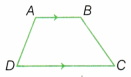
Note: The sum of the adjacent angles along the same leg of a trapezium is supplementary i.e. in trapezium ABCD,
∠A + ∠D = 180° and ∠B + ∠C = 180°
A trapezium is called an isosceles trapezium if the non-parallel sides of a trapezium are of equal length.
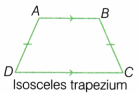
The arrow marks indicate parallel lines.
Note In an isosceles trapezium, the base angles
i. e. in isosceles trapezium ABCD,
∠D = ∠C and ∠A = ∠B.
Kite
A kite is a type of quadrilateral whose 2 pairs of adjacent sides are equal.
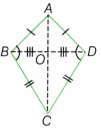
In a kite ABCD,
AB = AD and BC = DC.
A kite has following properties
(i) The diagonals are perpendicular to each other,
i. e. ∠AOB = ∠AOD
= ∠BOC = ∠DOC = 90°.
(ii) The longer diagonal bisects the shorter diagonal,
i. e. OB = OD.
(iii) The two angles are equal where the unequal sides meet i.e. ∠B = ∠D.
Note: The sides with the same marking in the figure are equal.
Parallelogram
A parallelogram is a quadrilateral whose opposite sides are parallel and equal.
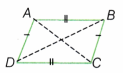
In a parallelogram ABCD,
- Opposite sides AB, DC and AD, BC are two pairs of equal opposite sides.
- Opposite angles ∠A, ∠C and ∠B, ∠D are two pairs of equal opposite angles.
- Adjacent sides AB, BC; BC, CD; DA, AB and CD, DA are pairs of adjacent sides.
- Adjacent angles ∠A, ∠B; ∠B, ∠C; ∠D, ZA and ∠C, ∠D are pairs of adjacent angles which are supplementary.
- Diagonals The diagonals AC and BD of a parallelogram bisect each other.
Some Special Parallelograms
Rhombus
A quadrilateral whose all sides are of equal length, is called rhombus.
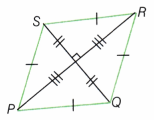
A rhombus has following properties.
- Rhombus have all the properties of a parallelogram.
- Diagonals are perpendicular and bisect each other.
- Diagonals of a rhombus bisect its angles.
Rectangle
A parallelogram whose opposite sides are equal and parallel, is called rectangle.
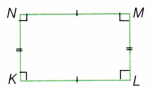
A rectangle has the following properties.
- A rectangle has all the properties of a parallelogram.
- Each of the angle is a right angle.
- Diagonals are equal in length and bisect each other.
Square
A parallelogram whose all sides are equal and all angles are right angle, is called square.
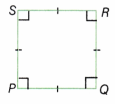
A square has following properties.
- In a square, the diagonals bisect each other and are of equal length.
- Diagonals of a square are perpendicular to each other.
- The opposite sides of a square are parallel to each other.
- All the angles of a square are 90°.
- The diagonals of a square bisect the angles of the . square.
Note: it A square has all the properties of a parallelogram, rhombus and rectangle.