Get the simplified Class 8 Maths Extra Questions Chapter 4 Quadrilaterals Class 8 Extra Questions and Answers with complete explanation.
Class 8 Quadrilaterals Extra Questions
Class 8 Maths Chapter 4 Quadrilaterals Extra Questions
Class 8 Maths Chapter 4 Extra Questions – Quadrilaterals Extra Questions Class 8
Very Short Answer Type Questions
Question 1.
If four angles of a quadrilateral are in the ratio 3 : 8 :10 : 3, then find its all angles.
Answer:
Let the angles be 3x, 8x, 10x and 3x.
So, 3x + 8x + 10x + 3x = 360°
[angle sum property of a quadrilateral]
⇒ 24x = 360°
⇒ x = 360° × \(\frac{1}{24}\) = 15°
Thus, the angles are 3 × 15° = 45°, 8 × 15° = 120°, 10 × 15° = 150° and 3 × 15° = 45°.
Question 2.
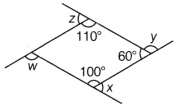
In the following figure, find the value of x + y + z + w.
Answer:
By linear pair property and angles sum property of a quadrilateral,
(180° – x) + (180° – y) + (180° – z) + (180° – w) = 360°
⇒ 720° – (x + y + z + w) = 360°
⇒ (x + y + z + w)
= 720° – 360°
= 360°
Question 3.
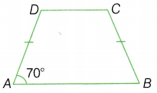
Find all angles of given trapezium. [NCERT Exemplar]
Answer:
In the given trapezium ABCD, ∠DAB = 70°
We know that ∠A + ∠D = 180°
⇒ ∠D =180° – 70° = 110°
Since, the trapezium ABCD is an isosceles trapezium.
∠A = ∠B = 70°
So, ∠C = 110°
Question 4.
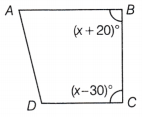
Find the value of x in the trapezium ABCD given below.
Answer:
In the trapezium ABCD, we have
AB ∥ CD
Also, sum of adjacent angles B and C is 180°.
(x + 20)° + (x – 30)° = 180°
⇒ 2x° – 10° = 180°
⇒ 2x° =190°
⇒ x° = 95°

Question 5.
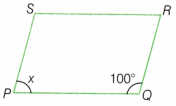
Find the value of x in the given parallelogram.
Answer:
In a parallelogram, ∠Q = 100°
Since, opposite angles are equal.
∠P = ∠R = x
and ∠Q = ∠S = 100°
Now, by angles sum property of a quadrilateral,
∠P + ∠Q + ∠R + ∠S = 360°
⇒ x + 100° + x + 100° = 360°
⇒ 2x = 360° – 200°
⇒ x = \(\frac{160}{2}\) = 80°
Question 6.
One of the diagonals of a rhombus and its sides are equal. Find the angles of the rhombus, [NCERT Exemplar]
Answer:
Let PQRS be a rhombus such that its diagonal PR is equal to its side,
i.e. PQ = QR = RS = PS = PR.
So, ΔPRS and ΔPQR are equilateral.
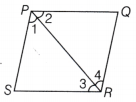
∠S = ∠Q = 60°
[each angle of an equilateral triangle is 60°]
and ∠P = ∠1 + ∠2
= 60°+ 60° = 120 ° = ∠R
Hence, ∠S = ∠Q = 60° and ∠P = ∠R = 120°
Short Answer Type Questions
Question 1.
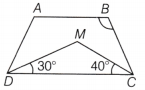
In a trapezium ABCD , MC and MD are bisectors of ∠C and ∠D, respectively. Find ∠ABC and ∠BAD.
Answer:
Given, MD and MC are bisectors of ∠ADC and ∠BCD, respectively.
So, ∠MCB = 40°, ∠ADM = 30°
In a trapezium,
∠B+ ∠C = 180°
⇒ ∠B + ∠DCM + ∠MCB = 180°
⇒ ∠B + 40°+ 40° = 180°
⇒ ∠B = 180° – 80°= 100°
∴ ∠B = 100°
Similarly, ∠A + ∠D = 180°
⇒ ∠A + ∠MDA + ∠MDC = 180°
⇒ ∠A + 30°+ 30° = 180°
∴ ∠A= 180° – 60°= 120°
Question 2.
PQRS is a trapezium such that PQ ∥ RS, ∠P : ∠S = 2 : 1, ∠Q : ∠R = 7 : 5. Find the angles of the trapezium.
Answer:
We have, a trapezium PQRS such that PQ || RS.
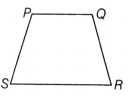
Let ∠P and ∠S be 2x, x respectively and ∠Q, ∠R be 7y and 5y, respectively.
But ∠P + ∠S = 180° and ∠Q + ∠R = 180°
⇒ 2x + x = 180° and 7y + 5y = 180°
⇒ 3x = 180° and 12y = 180°
⇒ x = 180° x – and y = 180° × \(\frac{1}{12}\)
⇒ x – 60° and y = 15°
∠P = 2 × 60° = 120° and ∠S = 60°,
∠Q = 7 × 15° = 105° and ∠R = 5 × 15° = 75°
Thus, angles of the trapezium PQRS are 120°, 105°, 75° and 60°.
Question 3.
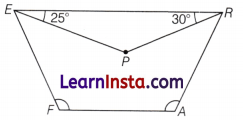
In a trapezium FARE, EP and RP are bisectors of ∠E and ∠R, respectively. Find ∠FAR and ∠EFA.
Answer:
We have, FARE is a trapezium, where ER || FA and EP
and RP are bisectors of ∠E and ∠R, respectively.
Thus, ∠PEF = ∠PER and ∠PRE = ∠PRA
∠PEF = 25° and ∠PRA = 30°
So, ∠E = 25° + 25° = 50°
and ∠R = 30° + 30° = 60°
Now, we know that in a trapezium,
∠E + ∠F = 180° and ∠R + ∠A = 180°
∠P= 180° – 50° = 130°
and ∠A = 180° – 60° = 120° or ∠EFA= 130° and ∠FAR = 120°
Question 4.
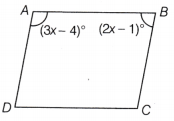
The adjacent angles of a parallelogram are (3x – 4)° and (2x – 1)°. Find all angles of the parallelogram.
Answer:
We know that in a parallelogram, sum of any two adjacent angles is 180°.
Let ∠A = (3x – 4)°
and ∠B = (2x – 1)°
(3x – 4)° + (2x – 1)° = 180°
⇒ 5x° – 5° = 180°
⇒ 5x° = 180° + 5°
x° = 185° × \(\frac{1}{5^{\circ}}\) = 37°
∠A = 3 × 37°- 4 = 107°
∠B = 2 × 37° – 1° = 73°
Since, in a parallelogram ABCD, opposite angles are equal.
∠A = ∠C = 107° and ∠B = ∠D = 73°
Question 5.
In a parallelogram PQRS, the bisectors of ∠P and ∠Q meet at 0. Find ∠POQ.
Answer:
Since, OP and OQ are the bisectors of ∠P and ∠Q, respectively (see the figure given below).
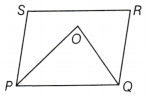
So, ∠OPQ = \(\frac{1}{2}\)∠P
and ∠OQP = \(\frac{1}{2}\)∠Q
In ∆POQ,
∠OPQ + ∠PQO + ∠POQ = 180°
[angle sum property of a triangle]
⇒ \(\frac{1}{2}\)∠P + ∠POQ + \(\frac{1}{2}\)∠Q = 180°
⇒ ∠POQ = 180° – \(\frac{1}{2}\)(ZP + ZQ)
= 180° – \(\frac{1}{2}\) × 180° = 90°
Question 6.
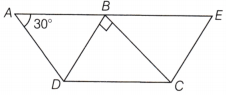
In the given figure, ABCD and BDCE are parallelograms with common base DC. If BC1 BD, then find ZBEC.
Answer:
We have, parallelograms ABCD and BDCE and BC ± BD.
∠ABC = 180° – 30° = 150°
[since, ∠DAB and ∠ABC are adjacent angles of parallelogram ABCD]
∠CBE = 180° – ∠ABC = 180° – 150° = 30°
Also, it is given that ∠DBC = 90°
∠DBE = 90°+ 30° = 120°
But ∠DBE = ∠DCE = 120°
∠BEC = 180° – 120° = 60°
[since, ∠BEC and ∠DCE are adjacent angles of parallelogram DCEB]
Question 7.
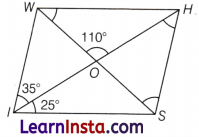
In a parallelogram WISH, find ∠SWH – ∠OSH and ∠SHQ
[NCERT Exemplar]
Answer:
We have, a parallelogram WISH.
Here, WH\\IS and IW\\HS
∠WIH = ∠IHS = 35° [alternate angles]
Similarly, ∠HIS = ∠IHW = 25° [alternate angles]
Now, using angle sum property of a triangle in ΔWOH, we get
∠WOH + ∠OWH + ∠OHW = 180°
⇒ 110° + ∠OWH + 25° = 180°
[Y ∠OHW = ∠IHW]
⇒ ∠OWH= 180° – (110° + 25°)
= 180° – 135° = 45° = ∠SWH
In ΔOHS, we have
∠HOS = 180° – 110° =70°
⇒ ∠OHS = 35° [proved]
70° + 35° + ∠OSH = 180°
⇒ ∠OSH = 180° – 105° = 75°
Question 8.
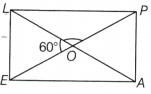
In the following rectangle LEAP, find the value of ∠EAL., ∠LAP and ∠LOP. [Competency Based Question]
Answer:
We have, ∠EAP is a rectangle and ∠LOE = 60°.
Since, ∠EOP = Straight angle = 180°
∠EOL + ∠LOP =180°
⇒ 60°+ ∠LOP =180°
⇒ ∠LOP = 180° – 60° = 120°
In a rectangle, we can say that
LO = OP = OA = OE
∠OPA = ∠OAP = x (say)
Now, in A OP A, we have
∠AOP = 60° = ∠LOE
[∵ vertically opposite angles]
∠AOP + x + x = 180°
⇒ 60°+2x=180°
⇒ 2x = 180° – 60° = 120°
x = 60°
⇒ ∠OAP = 60° = ∠LAP
∠EAP = 90°
⇒ ∠EAL + ∠LAP = 90°
⇒ ∠EAL + ∠OAP = 90°
⇒ ∠EAL = 90° – ∠OAP
= 90° – 60° = 30°
Question 9.
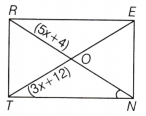
If RENT is a rectangle. Its diagonals meet at 0. Find the value of x if OR = (5x + 4)and OT = (3x + 12).
Answer:
Since, diagonals of rectangle bisect each other and
OB = \(\frac{1}{2}\)RN and OT = \(\frac{1}{2}\)TE.
Also, diagonals of a rectangle are equal.
RN = TE
⇒ \(\frac{1}{2}\)RN = \(\frac{1}{2}\)TE
⇒ OR = OT
⇒ 5x + 4 = 3x + 12
⇒ 5x – 3x = 12 – 4 = 8
⇒ 2x = 8
x = 4
Question 10.
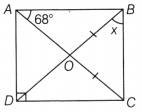
ABCD is a rectangle with ∠BAC = 68°. Determine the value of ∠DBC.
Answer:
We have, ABCD is the rectangle and let O be the intersection point of AC and BD, where ∠BAC = 68°
In a rectangle, diagonals are equal.
AC = BD ⇒ \(\frac{A C}{2}=\frac{B D}{2}\)
⇒ OC = BO
[∵ in a rectangle, diagonals bisect each other]
⇒ ∠CBO = ∠OCB = x (say)
[∵ angles opposite to the equal sides in a triangle are equal]
Also, we have AB || CD and AC is transversal.
∠CAB = ∠ACD = 68° [alternate angles]
and ∠BCD = 90°
⇒ ∠DCO + ∠OCB = 90°
⇒ ∠DCA + ∠OCB = 90°
⇒ 68° + x = 90° [∵ ∠DCA =68°]
⇒ x = 90° – 68° = 22°
⇒ ∠OCB = 22°
⇒ ∠OBC = 22° [∵ ∠OCB = ∠OBQ]
So, ∠DBC = 22°
Question 11.
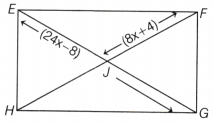
Quadrilateral EFGH is a rectangle, in which J is the point of intersection of the diagonals. Find the value of x if JF = (8x + 4) and EG = (24x – 8).
Answer:
Since, EFGH is a rectangle.
∴ HF = 2JF = 2 × (8x + 4) = 16x + 8
and EG = 24x – 8 [given]
Thus, HF = EG
[∵ diagonals are equal in a rectangle]
16x + 8 = 24x – 8
⇒ 24x – 16x = 8 + 8
⇒ 8x = 16
⇒ x = 16 × \(\frac{1}{8}\) = 2
Thus, the value of x is 2.
Question 12.
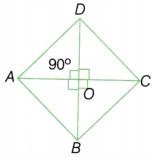
Construct a square whose length of diagonal is 6 cm.
Answer:
The steps of construction are as follows.
(i) Draw a line segment AC of length 6 cm.
(ii) Mark the mid-point O of AC.
(iii) Draw another line segment BD of length 6 cm, passing through O, such that O is also the mid-point of BD.
Ensure the angles ∠AOB = ∠BOC = ∠COD.
= ∠DOA = 90°
(iv) Connect the end-points A,B,C and D to form the quadrilateral ABCD as square.
Long Answer Type Questions
Question 1.
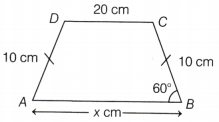
In the following figure, AB || DC and AD = BC. Find the value of x.
Answer:
Draw a line parallel to BC from D which cuts AB at E.
Thus, DC || EB and EC || DE
which gives a parallelogram DCBE.
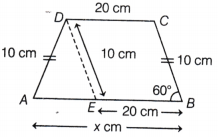
DC = EB = 20 cm and BC = DE = 10 cm
Now, in ∆ADE, we have
AD = DE = 10 cm ∠DAE = ∠DEA =60°
So, by angle sum property in ∆ADE,
we have ∠DAE + ∠AED + ∠EDA = 180°
or ∠EDA = 180° – (∠DAE + ∠AED)
= 180° – (60°+ 60°)
= 180° – 120° = 60°
So, ADE is an equilateral triangle.
Now, AD = DE = EA = 10 cm
AB = AE + EB
or x = 10 + 20 = 30 cm
So, the value of x is 30 cm.
Question 2.
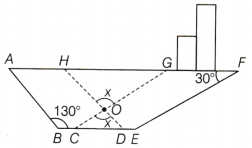
In the following figure of a ship, ABDH and CEFG are two parallelograms. Find the value of x.
[Competency Based Question]
Answer:
We have, two parallelograms ABDH and EFGC.
∠ABD = ∠AHD = 130°
[opposite angles of a parallelogram]
and ∠GHD = 180° – ∠AHD = 180° -130°
⇒ 50 ° = ∠GHO
Also, ∠EFG + ∠FGC = 180°
[adjacent angles of a parallelogram]
⇒ 30° + ∠FGC = 180°
⇒ ∠FGC = 180° – 30° = 150°
∠HGC = 180° – ∠FGC = 180° – 150°
= 30° = ∠HGO
Now, in AHGO, using angle sum property,
∠GHO + ∠HGO + ∠HOG = 180°
⇒ 50° + 30° + x = 180°
⇒ x = 180° – 80° = 100°
Question 3.
If two adjacent angles of a parallelogram are in the ratio 3: 7, then find the measure of all the angles of the parallelogram.
Answer:
Let the adjacent angles be 3x and 7x, respectively.
We know that in a parallelogram sum of two adjacent angles is 180°.
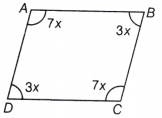
3x + 7x = 180°
⇒ 10x = 180°
⇒ x = 180° × \(\frac{1}{10}\)
⇒ x = 18°
So, the adjacent angles are
3 × 18° = 54° and 7 × 18° = 126°
Also, we know that in a parallelogram opposite angles are equal.
Thus, all the angles of the parallelogram are 54°, 126°, 54° and 126°.
Question 4.
The angle between the two altitudes of a parallelogram through the vertex of an obtuse angle of the parallelogram is 45°. Find the measure of the obtuse angle.
Answer:
Let ABCD be a parallelogram and the obtuse angles of the parallelogram are ∠A and ∠C.
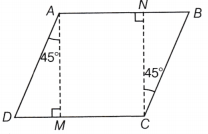
Let AM be the altitude drawn from the vertex A on DC and CN be the altitude drawn from the vertex C on AB. ZDAM = 45° and ∠NCB = 45° [given]
In AAMD, we know that sum of the interior angles of a triangle is 180°.
∠D + 45° + 90° = 180°
⇒ ∠D = 180°- 45° – 90°
= 180° – 135° = 45°
Similarly, in ACNB
∠B = 45°
Now, ∠A + ∠D = 180°
[sum of adjacent angles in a parallelogram is 180°]
∠A + 45° =,180° [∵∠D = 45°]
⇒ ∠A= 180° – 45° = 135°
Also, ∠A = ∠C
[∵ opposite angles of a parallelogram are equal]
∠C = 135°
Thus, the obtuse angle of the parallelogram is 135°.
Question 5.
Two sticks each of length 7 cm are crossing each other such that they bisect each other at right angles. What shape is formed by joining their end points? Give reason. [NCERT Exemplar]
Answer:
Let AC and BD be two sticks, each of the length 7 cm. On joining their end points A, B, C and D, we will get a shape of a rhombus.
[since, in a rhombus diagonals bisect each other at right angle].
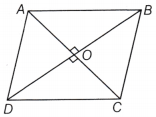
Now, we will see whether it is a square or not. Let O be the intersection point of AC and BD.
Now, we see that = CO = DO
Since, both AC and BD are of equal length and bisected by O.
Further in ∆ABO, we see that
∠AOB = 90° and AO = OB
which implies that ∠OAB = ∠OBA = x (say)
90° + x + x = 180°
[angle sum property of a triangle]
⇒ 2x = 90°
⇒ x = 45°
Similarly, we see that ∠OBC, ∠OCB, … etc are 45°.
So, finally we can say that the shape, so obtained will be of a square.
Note A square is a rhombus but a rhombus is not a square.
Question 6.
RISE is a recta ngleahcHts diagonals meet at 0.
If RO = (3x + 15) and 10 = (5x + 7),then find the value of x.
Answer:
Since, in a parallelogram diagonals bisect each other and we know that rectangle is a parallelogram.
So, RO = OS and IO = OE
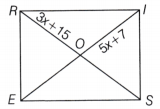
or RS 2RO and IE = 207
RS = 2 × (3x + 15)
and IE = 2 × (5x + 7)
or RS = 6x + 30
and IE = 10x + 14
Now, we again know that in a rectangle diagonals are equal.
So, RS = IE
⇒ 6x + 30 = 10x + 14
⇒ 30 – 14 = 10x – 6x
⇒ 16 = 4x
⇒ 16 × \(\frac{1}{4}\) = x 4
⇒ 4 = x
⇒ x = 4
Question 7.
A photo frame is in the shape of a quadrilateral with one diagonal longer than the other. Is it a rectangle?
Why Or why not? [Competency Based Question]
Answer:
Let ABCD be the shape of given photo frame as shown below.
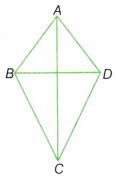
It is given that AC ≠ BD
Since, we know that in a rectangle diagonals are equal to each other, i.e. AC should be equal to BD which is not the case here. So, ABCD is not a rectangle.
Case Study Based Question
Question 1.
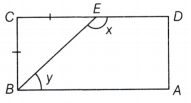
A playground is in the form of a rectangle ABCD. Two players Ram and Vishnu are standing at the points B and E respectively, where EC = BC.
(i) Find the value of x.
(ii) Find the value of 2x + 3y.
(iii) What kind of values do you depict from sports person? (Competency Based Question]
Answer:
In ABCE, ∠BCE = 90°
and CE = BC
∠CBE = ∠BEC – z (say)
Using angle sum property of the triangle,
z + z + 90° = 180°
⇒ 2z = 180° – 90°
⇒ z = \(\frac{90^{\circ}}{2}\) = 45
(i) x = 180°-45° = 135°
[∵ ∠DEC = 180° and ∠CEB = 45°]
and y = 90° – 45° = 45° [∵ ∠CBA = 90°]
(ii) Here, 2x + 3y = 2 × 135 + 3 × 45
= 135 (2 + 1) = 405°
(iii) A sports person has energy, stamina and a healthy body as well as he has a team spirit to motivate others in a team.
Question 2.
A rectangle MORE is shown below.
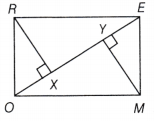
Answer the following questions by giving appropriate reason.
(i) Is RE = OM?
Answer:
Yes,RE = OM.
This is because the opposite sides are equal in any rectangle.
(ii) Is ∠MYO = ∠RXE?
Answer:
Yes, ∠MYO = ∠RXE.
Here, MY and RX are perpendicular to OE.
Since, ∠RXO = 90° ⇒ ∠RXE = 90°
and ∠MYE = 90° ⇒ ∠MYO = 90°
(iii) Is ∠MOY = ∠REX?
Answer:
Yes, ∠MOY = ∠REX
Since, these are alternate interior angles, as RE ∥ OM and EO is a transversal.
(iv) Is ΔMYO ≅ ΔRXE?
Answer:
Yes, ΔMYO ≅ ΔRXE.
In ΔMYO and ΔRXE, we see that
MO = RE [proved]
∠MOY = ∠REX [proved]
∠MYO = ∠RXE [proved]
AMYO = ARXE [by AAS]
(v) Is MY = RX?
Answer:
Yes,MY = RX
Since, these are corresponding part of congruent triangles.