Get the simplified Class 8 Maths Extra Questions Chapter 2 Power Play Class 8 Extra Questions and Answers with complete explanation.
Class 8 Power Play Extra Questions
Class 8 Maths Chapter 2 Power Play Extra Questions
Class 8 Maths Chapter 2 Extra Questions – Power Play Extra Questions Class 8
Very Short Answer Type Questions
Question 1.
Write the expression for the thickness of a paper after n folds if its initial thickness is t cm.
Answer:
Given, the initial thickness = t
So, the thickness of a paper after n folds = t × 2n.
Question 2.
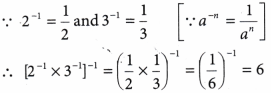
Find the value of [2-1 × 3-1]-1.
Answer:
We have, [2-1 × 3-1]-1
Question 3.
Write the value of (13)-13 + (13)13.
Answer:
We have, (13)-13 + (13)13 = (13)-13-13 = (13)-26
[an ÷ am = an-m]
= \(\frac{1}{(13)^{26}}\) [∵ a-n = \(\frac{1}{a^n}\)]
Question 4.
Find the standard form of 32500000000.
Answer:
The standard form of 32500000000 is 325 × 1010.
Question 5.
Write 0.0000056789 in the standard form.
Answer:
The standard form of 0.0000056789 is 5.6789 × 10⁻⁶.

Question 6.
Write the usual form of 2.8 × 10⁻¹⁰.
Answer:
The usual form of 2.8 × 10⁻¹⁰ is 0.00000000028.
Question 7.
Expand the number 4050 in power of 10.
Answer:
We have, 4050 = 4 × 1000 + 0 × 100 + 5 × 10 + 0
= 4 × 10³ + 0 × 102 + 5 × 101 + 0 × 100
Short Answer Type Questions
Question 1.
The cells of a bacteria double itself every hour. How many cells will there be after 12 h, if initially we start with 1 cell? Express the answer in powers.
Answer:
The cells of a bacteria double itself every hour i.e. the cells of a bacteria after 1 h = 2
[∵ if initially we start with 1 cell]
The cells of a bacteria after 2h = 2 × 2 = 22
The cells of a bacteria after 3h = 2 × 22 = 23
∴ The cells of a bacteria after 12 h = 212
Question 2.
Express as a power of a rational number with negative exponent.
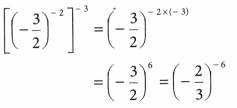
(i) \(\left[\left(-\frac{3}{2}\right)^{-2}\right]^{-3}\)
Answer:
(ii) (25 ÷ 28) × 2-7
Answer:
(25 ÷ 28) × 2-7 = (25 × \(\frac{1}{2^8}\)) × 2-7
= 25-8 × 2-7
= 28 × 2-7
= 2-3+(-7)
= 2-3-7
= 2-10
Question 3.
How many seconds are there approximately in 3.8 months, if one month has about 2.6 x 10⁶ seconds?
Answer:
Given, the number of seconds in one-month = 2.6 × 10⁶
So, the number of seconds is 3.8 months
= 2.6 × 3.8 × 106
= 9.88 × 10⁶
Question 4.
Express \(\frac{1.5 \times 10^6}{2.5 \times 10^4}\) in the standard form.
Answer:
We have, \(\frac{1.5 \times 10^6}{2.5 \times 10^4}=\frac{1.5 \times 10^2 \times 10^4}{2.5 \times 10^4}=\frac{150}{2.5}\) × 104-4
= \(\frac{150}{2.5}\) × 100
= 60 × 1 = 60
= 6.0 × 101
= 6.0 × 10
Question 5.
An electron’s mass is approximately 9.1093826 × 10⁻³¹ kg. What is this mass in grams?
Answer:
Given, an electron’s mass = 9.1093826 × 10⁻³¹ kg
∵ 1 kg = 1000 g = 10 × 10 × 10 g = 103 g
∴ An electron’s mass in grams
= 9.1093826 × 10-31 × 10-3 g
= 9.1093826 × 10⁻³¹+3 g
= 9.1093826 × 10⁻²⁸ g
Long Answer Type Questions
Question 1.
The cells of a bacteria double in every 30 min.
A scientist begins with a single cell.
(i) How many cells will be there after (a) 10h? (b) 25 h?
Answer:
The cells of a bacteria double in every 30 min
i.e. number of cells of a bacteria after 30 min =2
[∵ a scientist begins with a single cell]
∴ Number of cells of a bacteria after 1 h
= 2 × 2 = 22 = 22×1
Number of cells of a bacteria after 1\(\frac{1}{2}\) h
= 2 × 23 = 24 = 22×\(\frac{3}{2}\)
and number of cells of a bacteria after 2 h = 2 × 23 = 4 = 22×2
(a) Thus, the number of cells after 10 h = 22×10= 220
(b) The number of cells after 25 h =22×25 = 250
(ii) What type of value is depicted by the cells of bacteria?
Answer:
The value depicted by the cells of bacteria is that it double itself after 30 min or it grows itself in t h by 22×t.
Question 2.
If a = – 1 and b = 2, then find the value of the following.
(i) ab + ba
(ii) ab – ba
(iii) ab x ba
(iv) ab + ba
Answer:

Question 3.
Astronomy The table shows the mass of the planets, the Sun and the Moon in our solar system.
| Celestial Body | Mass (kg) | Mass (kg) in Standard Notation |
| Sun | 1990000000000000000000000000000 | |
| Mercury | 330000000000000000000000 | |
| Venus | 4870000000000000000000000 | |
| Earth | 5970000000000000000000000 | |
| Mars | 642000000000000000000000000000 | |
| Jupiter | 1900000000000000000000000000 | |
| Saturn | 568000000000000000000000000 | |
| Uranus | 86800000000000000000000000 | |
| Neptune | 102800000000000000000000000 | |
| Pluto | 12700000000000000000000 | |
| Moon | 73500000000000000000000 |
(i) Write the mass of each celestial body in standard notation.
Answer:
Mass of each celestial body in standard in notation is given below.
- Mass of Sun = 1.99 × 1030 kg
- Mass of Mercury = 3.3 × 10²³ kg
- Mass of Venus = 4.870 × 1024 kg
- Mass of Earth = 5.970 × 1024 kg
- Mass of Mars = 6.42 × 1029 kg
- Mass of Jupiter = 1.9 × 1027 kg
- Mass of Saturn = 5.68 × 1026 kg
- Mass of Uranus = 8.68 × 1025 kg
- Mass of Neptune = 1.02 × 1026 kg
- Mass of Pluto = 1.27 × 10²² kg
- Mass of Moon = 7.35 × 10²² kg
(ii) Arrange the planets and the Moon according to their mass, from least to greatest.
Answer:
On observing the masses of the all given planets and the Moon in the exponent form, we see that the order of planets and the Moon by mass from least to greatest is
Pluto < Moon < Mercury < Venus < Earth < Uranus < Neptune < Saturn < Jupiter < Mars
(iii) Which planet has same mass as the Earth (approx.)?
Answer:
∵ Mass of Earth = 5.970 × 1024 kg and
mass of Venus = 4.870 × 1024 kg
Thus, we can say that planet Venus has about same mass as the Earth.
Question 4.
The given table shows the crop production of a state in the year 2008 and 2009. Observe, the table given below and answer the given questions.
| Crop | 2008 Harvest (in hectare) | Increase/Decrease in 2009 (in hectare) |
| Bajra | 1.4 × 10³ | -100 |
| Jowar | 1,7 × 10⁶ | – 440000 |
| Rice | 3.7 × 10³ | -100 |
| Wheat | 5.1 × 10⁵ | +190000 |
(i) For which crop(s) did the production decrease?
Answer:
Production decreased for bajra, jowar and rice,
(ii) Write the production of all the crops in 2009 in their standard form.
Answer:
Production of bajra in 2008 = 14 × 103and decrease in production of bajra in 2009 = 100 = 0.1 × 10³
So, production of bajra in 2009
= 1.4 × 10³ – 0.1 × 103
= (14 – 0.1) × 103
= 1.3 × 10³
Production of jowar in 2008 = 1.7 × 10⁶ and
decrease in production of jowar in 2009 = 440000 = 0.44 × 10⁶
So, production of jowar in 2009
= 17 × 106 – 0.44 × 106 = (17 – 0.44) × 106 = 126 × 106
Production of rice in 2008 = 3.7 × 10³ and
decrease in production of rice in 2009 = 100 = 0.1 × 10³
So, production of rice in 2009
= 3.7 × 10³ – 0.1 × 103
= (3.7 – 0.1) × 103
= 3.6 × 10³
Production of wheat in 2008 = 5.1 × 10⁵
and increase in production of wheat in 2009 = 190000 = 19 × 105
So, production of wheat in 2009
= 5.1 × 10⁵ + 19 × 105
= (5.1 + 19) × 105
= 7.0 × 10⁵
(iii) Assuming the same decrease in rice production each year as in 2009, how many acres will be harvested in 2015? Write in standard form.
Answer:
Decrease in production of rice in 2009 = 0.1 × 10³
The number of years from 2009 to 2015 is 6.
The total decrease = 6 × 0.1 × 103 = 0.6 × 10³
So, production of rice in 2015
= 3.7 × 10³ – 0.6 × 103
= (3.7 – 0.6) × 103
= 3.1 × 10³ hec
Hence, 3.1 × 10³ hec will be harvested in 2015.
Skill Based Questions
Question 1.
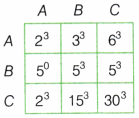
Fill the boxes with the numbers having exponent so that each horizontal and vertical equations are correct. Use knowledge of powers and exponents.

Clues
(i) Evaluate the expressions using exponents.
(ii) Each row and column must form a valid product equation.
(iii) Use positive whole numbers only.
(iv) Each row and column gives the correct product i.e. AB = C.
Answer:
Question 2.
Exponent Puzzle Challenge!
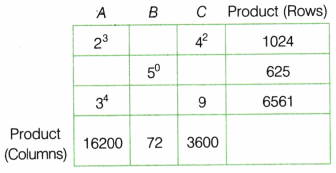
Instruction In the grid below, some numbers are given in the form of powers (exponents). The product of each row and column is also given. Fill the boxes with appropriate numbers (written as powers of whole numbers) so that the product of each row and column is correct.
Your Task!
(i) Fill the boxes with numbers in exponential (power) form such that each row and column gives the correct product.
Answer:
Compute grid is as
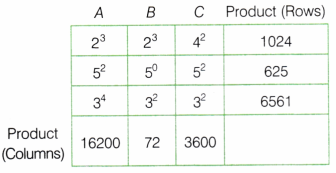
(ii) Write each number in exponential form.
Answer:
Rows 1024 = 210
625 = 54
6561 = 38
Columns 16200 = 23 × 34 × 52
72 = 23 × 32 × 50
3600 = 24 × 32 × 52
Case Study Based Question
Question 1.
The distance between planets varies depending on their position on their orbital path around Sun. The table given below shows the average distance between two planets.
| Planets | Average distance between them |
| Venus to Earth | 40000000 km |
| Earth to Mars | 225000000 km |
(i) What is the distance (in km) between Venus and Earth in exponential form?
Answer:
4 × 10⁷
(ii) How much further is Mars from Earth than Venus?
Answer:
1.85 × 10⁸
(iii) Finds the ratio of the distance between the Venus to the Earth and the distance between the Earth to Mars?
Answer:
8 : 45