Students can use Exploration Class 9 Science Solutions Chapter 12 Patterns in Life Diversity and Classification Question Answer NCERT Solutions as a quick reference guide.
Class 9 Science Exploration Chapter 12 Question Answer
Class 9 Science Ch 12 Patterns in Life Diversity and Classification Question Answer
Patterns in Life Diversity and Classification Class 9 Questions and Answers (Exercise)
Revise, Reflect, Refine (NCERT Textbook Page No. 249 – 251)
Question 1
Meena and Hari observed an animal in their garden. Hari called it an insect, while Meena said it was an earthworm. Choose the correct option which confirms that it is an insect.
(i) Bilateral symmetrical body
(ii) Body with jointed legs
(iii) Cylindrical body
(iv) Body with little segmentation
Answer:
(ii) Body with jointed legs.
Insects belong to phylum Arthropoda, whose defining feature is the presence of jointed appendages (legs). Bilateral symmetry is found in many animal groups, and a cylindrical body is a feature of annelids like earthworms.
Question 2.
Sponges represent one of the simplest animal body plants. Their bodies lack true tissues and organs. Which feature of sponge cells supports its classification under the animal kingdom?
(i) Absence of mitochondria
(ii) Ability to photosynthesise
(iii) Presence of a cell membrane
(iv) Presence of a cell wall
Answer:
(ii) Presence of a cell membrane.
Sponges are classified as animals because their cells have a cell membrane but no cell wall. The absence of a cell wall and the heterotrophic mode of nutrition are key animal characteristics.

Question 3.
Observe two different animals in your immediate environment. What features help you distinguish between them? How do these features help place them into different groups?
Answer:
By taking the examples of a butterfly and a dog, we can distinguish them on the basis of:
- body covering (scales vs. fur)
- mode of movement (flying vs. walking)
- body symmetry
- number of legs
- presence or absence of wings and
- level of body organisation.
These features help place the butterfly under phylum Arthropoda (jointed legs, exoskeleton) and the dog under class Mammalia of phylum Chordata (vertebral column, fur, mammary glands).
Question 4.
How would a scientist justify choosing cellular organisation as a more fundamental characteristic for the basis of classification rather than the presence of xylem and phloem?
Answer:
A scientist would choose cellular organisation as a more fundamental basis for classification because it is a basic and universal feature of all living organisms. Cellular organisation distinguishes organisms as unicellular or multicellular, which reflects the most basic level of life structure. It applies to all kingdoms of life, including those without xylem and phloem. In contrast, xylem and phloem are specialised tissues found only in higher plants, so they cannot be used to classify all organisms.
Question 5.
You find an unlabelled slide of a single-celled organism that has a well-defined nucleus and multiple cilia. Which group would it most likely belong to? Give reasons.
Answer:

It would most likely belong to Kingdom Protista. The organism is unicellular and has a well- defined (membrane-bound) nucleus, making it a eukaryote. These features place it in Protista. The presence of cilia suggests it could be Paramecium, a well-known protist.
Question 6.
How does the diversity of organisms contribute to the balance and stability of an ecosystem?
Answer:
Every organism plays a specific role in the ecosystem.
(i) Plants produce food and oxygen
(ii) Decomposers recycle nutrients
(iii) Pollinators help in plant reproduction and
(iv) Predators control prey populations.
Greater diversity means more interconnections, which makes the ecosystem more stable. If one species declines, others may fill its role, preventing collapse of the ecosystem.
Question 7.
If all unicellular organisms were grouped into a single kingdom, what problems would arise?
Answer:
Grouping all unicellular organisms would ignore fundamental differences. For example:
- Bacteria are prokaryotes and lack a nucleus and membrane-bound organelle, while Amoeba and Paramecium are eukaryotes with a true nucleus.
- Their cell structures, modes of nutrition and evolutionary histories are very different. Such grouping would make it difficult to study their unique features and relationships.
Question 8.
Viruses were studied in earlier classes. Why are they not placed in any of the five kingdoms? Give reasons.
Answer:
Viruses are not placed in any of the five kingdoms because they do not possess cellular organisation. They cannot carry out metabolic activities independently and can reproduce only inside a host cell. They show both living and non-living characteristics, which makes their classification difficult.
Question 9.
If you were asked to revise the five kingdom classification, would you create a separate category for viruses or keep them outside the system? Justify your answer and explain what this indicates about the evolving nature of scientific classification?
Answer:
- A separate category for viruses could be justified because they contain genetic material (DNA or RNA) and can evolve, which are features of living organisms. However, they lack cells and independent metabolism.
- Creating a separate category would acknowledge their unique nature.
- This also shows that scientific classification is an evolving process that changes as our understanding deepens.
Question 10.
Viruses contain genetic material like living organisms but lack cellular organisation. Which features prevent them from fitting into the five kingdom system? What does this tell about the limitations of classification systems?
Answer:
Viruses lack cellular organisation (no cell membrane, cytoplasm or organelles), cannot carry out metabolic activities on their own and can only reproduce inside a host cell.
Since the five-kingdom system is based on cell structure, organisms without cells cannot be classified within it. This reveals that classification systems have limitations and may not cover all biological entities.
Question 11.
Both pteridophytes and bryophytes lack flowers and seeds, yet they are placed in different groups. Explain this classification using their key features.
Answer:
Bryophytes lack true roots, stems, leaves and vascular tissue. They are small and depend on moisture for reproduction.
Pteridophytes have true roots, stems, leaves and well-developed vascular tissue (xylem and phloem) for transporting water and food. This key difference in body organisation and transport system places them in different groups.
Question 12.
In the classification hierarchy, which group- class or genus- has fewer members but more features in common? Explain your answer.
Answer:
Genus has fewer members but more features in common. As we move down the classification hierarchy (Kingdom → Phylum/Division → Class → Order → Family → Genus → Species), each level has fewer organisms that share an increasing number of common characteristics.
Class is a broader group that contains many orders and families, while genus contains only closely related species.
Question 13.
A scientist discovers a new organism with the characteristic features of locomotion and autotrophic nutrition. Which character(s) would help the scientist identify the organism belonging to Protista according to the five kingdom classification?
Answer:
The scientist should check whether the organism is unicellular and eukaryotic. If yes, it belongs to Kingdom Protista.

The organism described shows both animal-like (locomotion) and plant-like (autotrophic nutrition) features, which is characteristic of protists such as Euglena. Euglena can photosynthesise and also move using a flagellum.
Question 14.
A researcher identified a unicellular eukaryotic organism as fungi. What identification key would you suggest according to the five kingdom classification to keep a unicellular organism in the Kingdom Fungi?
Answer:
To place a unicellular organism in Kingdom Fungi, the researcher should use identification keys based on fungal characteristics, not just being unicellular and eukaryotic.
Key identification features for Kingdom Fungi:
- Cell wall made of chitin
- Heterotrophic nutrition by absorption (no photosynthesis)
- Lack of chlorophyll
- Reproduction by spores
- Mostly non-motile
Question 15.
During a long-term ecological study, students examined organisms collected from three different environments—a freshwater pond, damp soil near decaying logs and the digestive tract of animals. Instead of naming organisms directly, scientists recorded only structural, cellular and nutritional features as given in the table below.
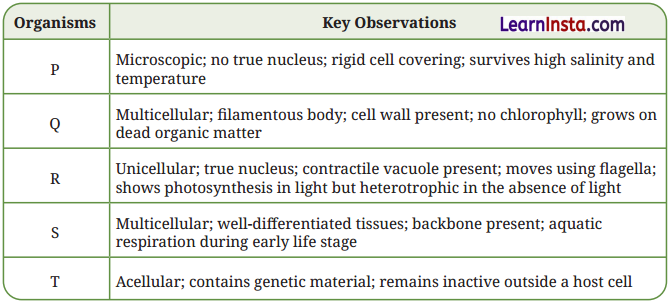
The students realised that some organisms fit neatly into Whittaker’s five kingdom classification, while others challenged the very basis of this classification.
Based on the case study, answer the following questions—
(i) Identify one organism that clearly belongs to the Kingdom Fungi. State one observation that supports your answer.
Answer:
Organism Q belongs to the Kingdom Fungi.
Observations:
It is multicellular with a filamentous body, has a cell wall, lacks chlorophyll and grows on dead organic matter (saprophytic nutrition), which are characteristic features of fungi.
(ii) Which organism would be placed in the Kingdom Monera? Mention one characteristic that justifies this placement.
Answer:
Organism P belongs to Kingdom Monera.
Characteristic:
It has no true nucleus (prokaryotic) and has a rigid cell covering, which matches the features of bacteria and archaea in Monera.
(iii) Organisms R and Q are both eukaryotic, yet they are placed in different kingdoms. Analyse the criteria that separate them.
Answer:
R is unicellular and eukaryotic (Protista), while Q is multicellular and eukaryotic (Fungi). R can photosynthesise and shows heterotrophic nutrition in the dark. Q lacks chlorophyll and grows on dead matter.
The separating criteria are: level of organisation (unicellular vs. multicellular), mode of nutrition and cell wall composition.
(iv) Explain why organism S cannot be classified using the mode of nutrition alone.
Answer:
Organism S is multicellular, has a backbone and shows aquatic respiration in early life (like an amphibian). Mode of nutrition alone (heterotrophic) would also place it with fungi, protists and many other animals.
More specific criteria like body organisation, presence of a vertebral column and life cycle are needed to classify it correctly.
(v) Organism T does not fit into any of the five kingdoms. Which fundamental characteristic used in classification does it lack, and what does this reveal about the limitations of classification systems?
Answer:
Organism T is acellular (lacks cellular organisation) and is inactive outside a host cell, like a virus. It lacks the fundamental characteristic of cellular structure on which the five-kingdom system is based.
This reveals that classification systems have limitations and may not cover all biological entities.
(vi) If classification were based only on habitat, which organisms might be incorrectly grouped together? Explain the scientific consequences of such a classification.
Answer:
Organisms P (high salinity), Q (damp soil) and R (freshwater pond) might be grouped together based on similar habitats, even though they differ fundamentally in cell structure and nutrition. Such a grouping would be scientifically inaccurate because habitat does not reflect evolutionary relationships.
(vii) Imagine scientists discover a new organism that is multicellular, eukaryotic, lacks chlorophyll and absorbs nutrients from a host externally. Should it be placed under fungi or animalia? Justify your reasoning using classification criteria.
Answer:
The organism should be placed under Fungi. It is multicellular, eukaryotic, lacks chlorophyll and absorbs nutrients externally, which are characteristic features of fungi. Animals ingest their food (take it inside the body).
The mode of obtaining food (absorption vs. ingestion) is the deciding criterion.
Class 9 Science Chapter 12 Patterns in Life Diversity and Classification Question Answer (InText)
Think it Over (NCERT Textbook Page No. 228)
Question 1.
What do you understand by biodiversity?
Answer:
Biodiversity refers to the enormous variety of living organisms found on the Earth.
It includes all forms of life, from microscopic bacteria to giant trees, and from tiny insects to large mammals, living in different habitats.
Question 2.
How does the grouping of organisms help us understand diversity?
Answer:
Grouping organisms based on common characteristics helps us organise information, understand relationships among organisms, and systematically study life.
It makes it easier to study millions of different life forms.
Question 3.
On what basis are plants and animals classified?
Answer:
Plants and animals are classified based on their similarities and differences, such as:
- Body structure
- Habitat
- Mode of nutrition
- Presence or absence of specific features (like feathers, fur, scales, etc.)
Question 4.
How does classification help address problems in farming?
Answer:
Classification helps farmers and scientists identify crop varieties with useful traits such as drought tolerance, pest resistance, and the ability to grow in nutrient-poor soils. This supports food security and reduces the risk of crop failure.
Pause And Ponder (NCERT Textbook Page No. 231)
Question 1.
If many organisms share common features, could they also share a common ancestry?
Answer:
Yes. When many organisms share common features, it strongly suggests that they have evolved from a common ancestor. Similar features in organisms indicate a shared evolutionary history, which is one of the reasons they are grouped together.
Pause And Ponder (NCERT Textbook Page No. 236)
Question 2.
How can a single-celled organism carry out all its life processes when billions of cells are required to perform similar functions in multicellular organisms like us?
Answer:
- In a unicellular organism, the single cell carries out all essential life functions such as nutrition, respiration, excretion, and reproduction.
- In unicellular organisms, the cell has specialised organelles (like mitochondria, vacuoles and the nucleus) that work together to perform all these processes within one cell.
Pause and Ponder (NCERT Textbook Page No. 238)
Question 3.
Which plant features reduce their dependence on water but still require moist conditions?
Answer:
Plants like bryophytes and pteridophytes have reduced their dependence on water but still need moist conditions. They can live on land, but water is still required for fertilisation, so they survive in damp or moist places.
Question 4.
Why do taller plants need specialised transport tissues?
Answer:
Taller plants cannot rely on simple diffusion to move water and nutrients through their bodies. They need vascular tissues, xylem (for water transport) and phloem (for food transport), to carry substances over long distances from roots to leaves and vice versa.
Question 5.
How do seeds and fruits affect where and how plants can survive?
Answer:
- Seeds protect the developing embryo and contain stored food, which helps plants survive harsh conditions.
- Fruits help in the dispersal of seeds to new locations through wind, water or animals.
- Together, seeds and fruits enable plants to colonise a wide range of environments.
Pause and Ponder (NCERT Textbook Page No. 242)
Question 6.
An earthworm (Annelida) and a beetle (Arthropoda), both have segmented bodies but the beetle has a hard external skeleton. How does the beetle’s external skeleton help it survive?
Answer:
The beetle’s hard external skeleton (exoskeleton) provides protection from predators, reduces water loss from the body and supports powerful muscles for flight and movement. This allows beetles to survive in dry and exposed environments where soft-bodied organisms like earthworms cannot.
Pause And Ponder (NCERT Textbook Page No. 247)
Question 7.
Does the term ‘biodiversity ’ relate only to the variety of organisms, or does it encompass other elements?
Answer:
Biodiversity does not refer only to the variety of organisms. It also includes:
- Genetic diversity: variation within a species (differences among individuals)
- Species diversity: variety of different species in an area
- Ecosystem diversity: variety of habitats and ecosystems like forests, deserts, ponds, etc.
Question 8.
If you find a new organism in a pond, what features will you observe to classify it and why?
Answer:
The following features would be observed:
- Cell structure (prokaryotic or eukaryotic)
- Level of organisation (unicellular or multicellular)
- Presence or absence of a cell wall
- Mode of nutrition (autotrophic or heterotrophic)
- Body organisation and method of reproduction
These features form the basis of the five-kingdom classification system.
Question 9.
Why do genetic studies provide deep information about living beings?
Answer:
In genetic studies we compare the DNA of organisms. Since DNA carries hereditary information, organisms with similar DNA sequences are likely to share a common ancestor. DNA analysis reveals relationships that may not be visible from external features alone, helping scientists understand evolutionary links accurately.
Question 10.
How can climate changes affect biodiversity?
Answer:
Changes in climate can affect biodiversity by altering the temperature, rainfall, and habitat conditions that organisms need to survive.
- Some species may not adapt and become extinct.
- Habitats like forests, wetlands, and coral reefs may get damaged or disappear.
- The distribution of species changes as they move to more suitable areas.
- Food chains and ecosystems get disturbed.
Class 9 Science Chapter 12 Question Answer (Activities)
Activity 12.1:
Let us compare and classify (NCERT Textbook Page No. 230)
The figure below shows the diversity of animals in an ecosystem. Observe the image. Can you guess how the organisms are grouped in the image?

1. Ponder on the questions given below:
- Which animals can you identify in the given picture?
- Where are they seen?
- Which animals in the picture seem active:
- during the day?
- during the night?
- both during the day and the night?
2. Record your observations in Table 1.
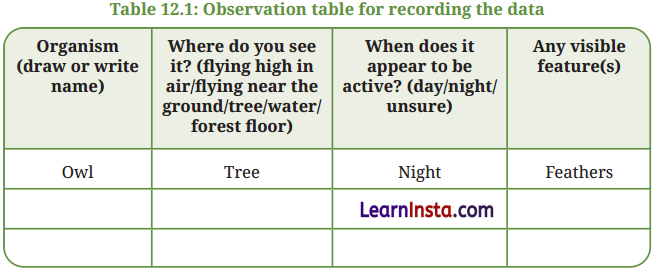
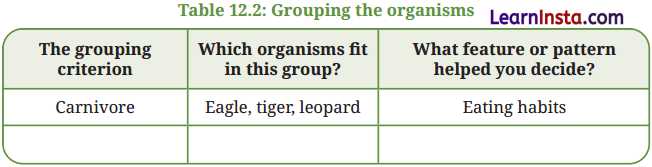
3. Now, try grouping the same organisms in more than one way. Each time change the criterion you are using for grouping (Table 2).
Answer:
In this activity, observations are recorded in a table, noting each animal’s location, time of activity (day/night / both), and visible features.
Examples:
Table 1:
- Owl: seen on a tree, active at night, has feathers.
- Eagle: seen flying high in the air, active during the day, has feathers.
- Tiger: seen on the forest floor, active at night, has fur.
Organisms can be regrouped using different criteria, such as:
Table 2:
- Carnivore: eagle, tiger, leopard (eating habits).
- Herbivore: deer, cow (eating habits).
- Flying: eagle, owl, bat (mode of movement).
Conclusion:
The same organism can fit into different groups depending on the criterion chosen. This leads us to the idea of a systematic classification based on scientifically chosen features.
Activity 12.2:
Let us read a case study (Pakke Tiger Reserve) (NCERT Textbook Page No. 232)
Carefully read the given case study of Pakke Tiger Reserve.
The Pakke Tiger Reserve in Arunachal Pradesh is a forest where scientists have recorded nearly 300 bird species, which is striking given that India as a whole has about 1,300 bird species. Pakke is also known for supporting four species of hornbills—the Rufous-necked Hornbill, the Oriental Pied Hornbill, the Great Hornbill, and the Wreathed Hornbill (Fig.). These large birds nest only in large, old trees with suitable cavities and feed on specific fruits. As a result, different hornbill species are found in different parts of the forest depending on tree size and fruit availability. Studying such patterns allows scientists to ask precise questions about biodiversity, such as—
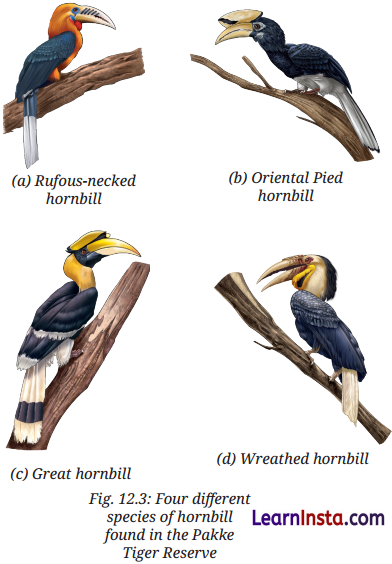
- How are species distributed within a forest? Which plants and animals are closely linked?
- How does classifying the four hornbill species help us understand biodiversity?
- Think and discuss the case based on the following questions—
- How can scientists keep track of so many species?
- The four hornbills look similar in some ways. What features can help scientists distinguish them from one another?
- What would happen if the large, old trees disappeared from the forest?
Answer:
- The case study of Pakke Tiger Reserve shows that scientists track species by careful observation and classification.
- The four hornbill species can be distinguished by features such as size, neck and beak colour, and casque shape.
- If the large, old trees disappeared, hornbills would lose their nesting sites, and their populations would decline, affecting the entire ecosystem.
Activity 12.3:
Let us study (Five Kingdom Concept Map) (NCERT Textbook Page No. 234)
- Study the concept map (Fig.).
- List the criteria that form the basis of five-kingdom classification.
- Compare the criteria you have listed after studying the concept map and the criteria given below:
- Cell type – prokaryote or eukaryote
- Cell structure – presence or absence of a cell wall
- Level of organisation – unicellular or multicellular
- Mode of nutrition – autotrophic or heterotrophic
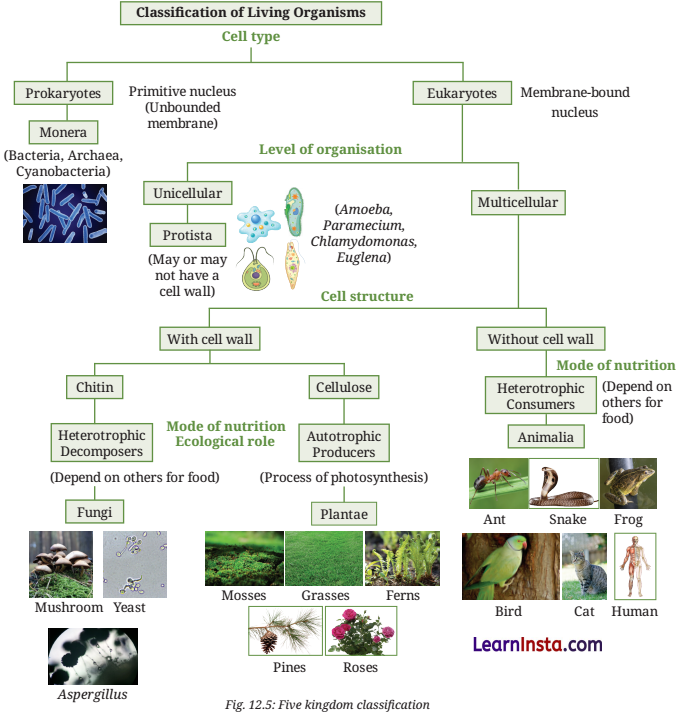
Answer:
The criteria forming based on the five-kingdom classification are:
- Cell type: prokaryote or eukaryote.
- Cell structure: presence or absence of a cell wall, and the material it is made up of (chitin or cellulose).
- Level of organisation: unicellular or multicellular.
- Mode of nutrition: autotrophic or heterotrophic.
Activity 12.4:
Let us explore (Bacteria and Cyanobacteria under microscope) (NCERT Textbook Page No. 235)
- In the school laboratory, observe the available permanent slides of bacteria and cyanobacteria under the microscope.
- Compare them with Fig. What do you observe?
Answer:
Permanent slides of bacteria and cyanobacteria under the microscope are observed and compared with Fig.
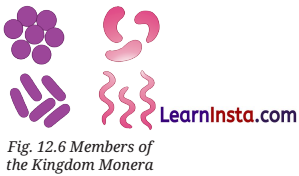
Observations show that
- Both are unicellular prokaryotes with no true nucleus.
- Bacteria appear as small rod-shaped, spherical or spiral cells, while cyanobacteria appear bluish-green due to their photosynthetic pigments.
- Both are classified under the Kingdom Monera.
Activity 12.5:
Let us make (Hay Infusion) (NCERT Textbook Page No. 235)
To make a hay infusion, follow the steps given below—
- Collect a small sample of grass after the lawn has been mowed, or collect straw or fodder.
- Take a small glass bottle and fill one-fourth of it with the grass, straw or fodder.
- Fill the bottle with stagnant water or pond water and mix it with the collected plant material.
- Cover the bottle with a muslin cloth and tie it using a thread.
- Keep the bottle aside undisturbed for a week.
- Slightly open the mouth of the bottle by removing the muslin cloth, just enough to insert a dropper inside it and carefully take a drop of water.
- Put the drop of water on a clean slide and observe it under a microscope.
Caution:
Wear a lab coat, mask, and gloves. The hay infusion may smell bad. Discard the hay infusion after autoclaving.
Do you notice moving organisms in the drop of water under the microscope?
Can you identify them by comparing them with Fig.?
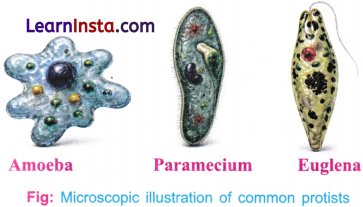
Answer:
After a week, a drop of the infusion observed under a microscope shows moving organisms such as Amoeba, Paramecium, and Euglena. These are unicellular eukaryotic protists. These can be identified by comparing them with Fig.
Activity 12.6:
Let us explore (Bryophytes) (NCERT Textbook Page No. 238)
1. Observe some bryophytes with the help of a hand lens. Collect them in a watch glass.
2. Put a drop of water on it and observe it under a dissecting microscope. A dissecting microscope enables us to view magnified images of live specimens.
How do they differ from the leaves that you usually observe in your surroundings?
Answer:
Bryophytes observed under a hand lens and a dissecting microscope show simple leaf-like structures that are much thinner and smaller than the leaves of higher plants.
Unlike typical leaves
- bryophytes’ leaf-like structures lack a midrib (vein)
- do not have vascular tissue
- are usually only one or two cells thick
This difference shows that bryophytes do not have fully developed tissues needed for life on land, so they show an amphibious mode of life.
Activity 12.7:
Let us compare (Fern stem vs Sunflower stem) (NCERT Textbook Page No. 238)
1. Recall the cross section of the sunflower stem you have studied in Chapter 3.
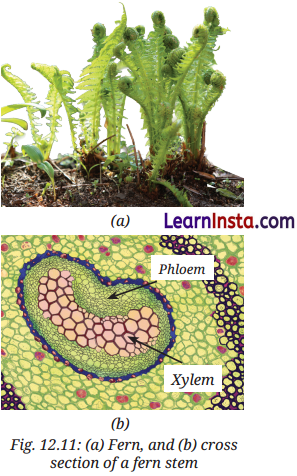
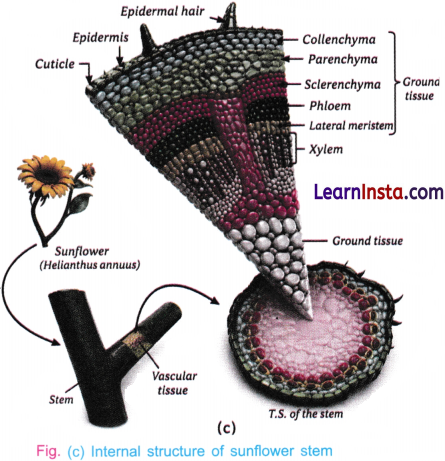
2. Compare the cross section of the stem of a fern, a pteridophytic plant (Fig.) with a cross section of the sunflower stem you studied in Chapter 3.
3. What difference do you observe in the vascular tissue of the fern stem and of the stem of higher plants? Write your observations. Share and discuss them in class.
Answer:
Observations:
- The cross section of a fern stem shows vascular bundles (xylem and phloem) that may be scattered or arranged in a ring, depending on the species.
- In a sunflower stem (a higher plant), the vascular bundles are arranged in an organised ring with more developed xylem and phloem.
Both plants have vascular tissues, but the arrangement and complexity are greater in angiosperms like sunflower.
Activity 12.8:
Let us discuss (Leaf Shapes of Monocots and Dicots) (NCERT Textbook Page No. 239)
Collect different leaves from your surroundings, and observe their shape and venation. Group them as monocots or dicots. Discuss how their structures help them adapt in different conditions to survive.
Answer:
Different leaves are collected and their venation observed:
- Monocots: parallel venation (e.g., grass, wheat, maize).
- Dicots: reticulate (net-like) venation (e.g., mango, Hibiscus, peepal).
These structural differences help plants adapt to different conditions.
For example, parallel venation in grass helps it grow from the base, while reticulate venation gives strong support to broad leaves in trees.
Activity 12.9:
Let us study (Plant Groups, Advantages and Challenges) (NCERT Textbook Page No. 239)
- Carefully study the salient features of each plant group.
- Analyse the salient features, and write the advantages for survival of the group and the exceptions or challenges faced in the given columns.
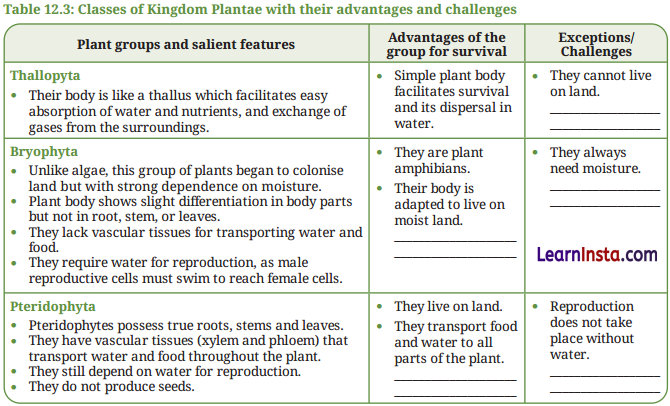
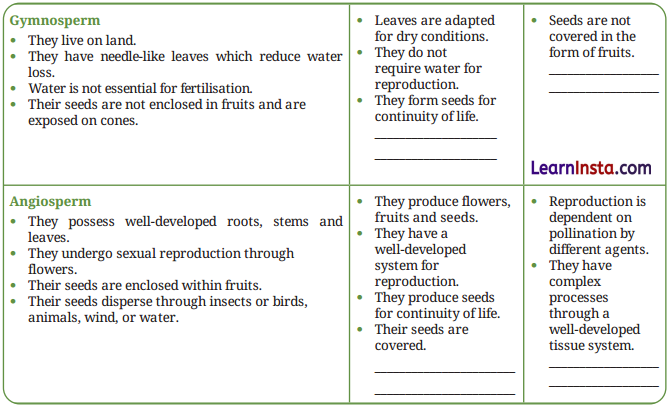
Answer:
| Plant Group | Salient Features | Advantages for Survival | Challenges |
| Thallopyta | Thallus body; absorbs water and nutrients directly | Simple body helps survival and dispersal in water | Cannot live on land |
| Bryophyta | Slight body differentiation; no true roots, stems, or vascular tissue; needs water for reproduction | Plant ‘amphibians’; adapted to moist land | Always need moisture |
| Pteridophyta | True roots, stems, leaves; vascular tissues; no seeds; need water for reproduction | Live on land; transport food and water | Reproduction depends on water |
| Gymnosperm | Needle-like leaves; seeds on cones; no water needed for fertilisation | Adapted to dry conditions; produce seeds | Seeds not enclosed in fruits |
| Angiosperm | True roots, stems, leaves; flowers and fruits; seeds enclosed in fruits | Produce flowers, fruits, seeds; efficient reproduction | Reproduction depends on pollinators |