Get the simplified Class 8 Maths Extra Questions Chapter 5 Number Play Class 8 Extra Questions and Answers with complete explanation.
Class 8 Number Play Extra Questions
Class 8 Maths Chapter 5 Number Play Extra Questions
Class 8 Maths Chapter 5 Extra Questions – Number Play Extra Questions Class 8
Very Short Answer Type Questions
Question 1.
Write three consecutive numbers whose sum is 12.
Answer:
Let three consecutive numbers be x, x + 1 and x + 2.
According to the question,
x + x + 1 + x + 2 = 12
⇒ 3x + 3 = 12
⇒ 3x = 9
x = 3
Number are 3, 3 + 1 and 3 + 2 i.e. 3, 4 and 5.
Question 2.
If 325a is divisible by 3, then find the minimum value of a.
Answer:
We know that, a number is divisible by 3, if the sum of its digits is divisible by 3.
∴ Sum of digits of 325a = 3 + 2 + 5 + a
= 10 + a, which is divisible by 3.
So, a can be equal to 2, 5, 8.
∴ The minimum value of a is 2.
Question 3.
A 3-digit number42xis divisible by 9. Find the value of x.
Answer:
Since, 42x is divisible by 9.
Then, the sum of its digits, i.e. 4 + 2 + x must be divisible by 9.
or 6 + x is divisible by 9. or 6 + x = 9 or 18
If6 + x = 9 ⇒ x = 9 – 6 = 3
If 6 + x = 18 ⇒ x = 18 – 6 = 12.
This is a 2-digit number, which is impossible.
Hence, the value of x is 3.
Question 4.
Check the divisibility of 1052896 by 9.
Answer:
To check the divisibility of 1052896,
1 + 0 + 5 + 2 + 8 + 9 + 6 = 31
Since, 31 is not divisible by 9.
Hence, this number is not divisible by 9.

Question 5.
A number is divisible by 20. By what other number will that number be divisible?
Answer:
Factors of 20 = 1, 2, 4, 5, 10, 20
The given number will be divisible by 1, 2, 4, 5, 10.
Question 6.
When N + 2 leaves a remainder 1, what will be the one’s digit of N?
Answer:
When N + 2 leaves a remainder 1, the one’s digit of the number will be an odd number, i.e. 1, 3, 5, 7 or 9.
Question 7.
Find the digital root of 7694.
Answer:
We have, 7694
Sum of digit of 7694 = 7 + 6 + 9 + 4 = 26
and sum of digits of 26 = 2 + 6 = 8
∴ Digital root of 7694 = 8
Question 8.
Find the values of A and B in the following addition.

Answer:
It is given that
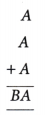
We observe first column, i.e.
A + A + A = A
It is possible for A = 5.
5 + 5 + 5 = 15
Hence, 5 = 1
Now, this number puzzle can be solved as

Hence, A = 5 and 5 = 1.
Short Answer Type Questions
Question 1.
Which of the following expressions is/are even?
(i) 497 + 364
Answer:
We have, 497 + 364
Since, 497 is an odd number and 364 is an even number.
So, 497 + 364 is odd. [∵ odd + even = odd]
(ii) 1229 – 871
Answer:
We have, 1229 – 871
Since, both 1229 and 871 are odd numbers.
So, 1229 – 871 is even. [∵ odd – odd = even]
Question 2.
Check the divisibility of the following numbers by 10.
(i) 990
Answer:
We have, 990
This number is divisible by 10 because its units place is equal to zero.
(ii) 1043
Answer:
We have, 1043
This number is not divisible by 10 because its units place is not equal to zero.
Question 3.
If 21y5 is a multiple of 9, where y is a digit, what is the value of y?
Answer:
Given, 21y5 is a multiple of 9, i.e. 21y5 is divisible by 9.
We know that, a number is divisible by 9, if sum of its digits is divisible by 9.
So, sum of digits of 21y5 = 2 + 1 + y + 5 = 8 + y
Therefore, (8 + y) should be 0, 9, 18, 27, …, etc.
Since, x is a digit.
8 + y = 9
⇒ y = 9 – 8
⇒ y = 1
Hence, the value of y is 1.
Question 4.
Suppose that the division N ÷ 5 leaves a remainder of 4 and the division N ÷ 2 leaves a remainder of 1. What must be the one’s digit of N?
Answer:
Here, N ÷ 5 leaves a remainder 4. So, one’s digit of N should be 4 or 9.
Again, N ÷ 2 leaves a remainder 1.
So, one’s digit of N is odd, i.e. one’s digit is one of these 1, 3, 5, 7 or 9.
∵ 9 is a common one’s digit in both the cases. Therefore, one’s digit of N must be 9.
Question 5.
Find the values of A, Band C in the following addition.

Answer:
We have

Here, we have three letters A 5 and C whose values are to be found.
Studying the addition in the one’s column, we have A + 8
and we get 3 from this, i.e. a number whose one’s digit is 3, for this A has to be 5.
∵ A + 8 = 5 + 8 = 13
Now, for the addition in ten’s column, we have 1 + 4 + 9 = CB ⇒ 14 = C5
Here, B = 4 and C = 1
Therefore, the puzzle is solved as shown below

Hence, A = 5, B = 4 and C = 1.
Question 6.
Find the values of A and B in the following addition.

Answer:
We have,

Here, we have two letters A and 6 whose values are to be found.
Studying the addition in one’s column, we have 1 + 5 and we get 0 from this i.e. a number whose one’s digit is 0.
So, 5 must be 9. Then, for addition of ten’s column, we have 1 + A + 1 = 9
Then, A must be 7 and then the puzzle is solved as shown below.

Hence, A = 7 and B = 9.
Long Answer Type Questions
Question 1.
Using divisibility tests, determine which of the following numbers are divisible by 6?
(i) 297144
(ii) 1258
(iii) 4335
(iv) 61233
Answer:
(i) We have, 297144
(a) Divisibility by 2
∵ Unit digit of number = 4, so 297144 is divisible by 2.
(b) Divisibility by 3
Sum of digits of given number = 2+ 9 + 7 + 1+ 4 + 4 = 27
∵ 27 is divisible by 3, so 297144 is also divisible by 3.
Now, we see that 297144 is divisible by 2 and 3 both. Hence, it is divisible by 6.
(ii) We have, 1258
(a) Divisibility by 2
∵ Unit digit of number = 8, so 1258 is divisible by 2.
(b) Divisibility by 3
Sum of digits of given number =1 + 2 + 5 + 8=16
∵ 16 is not divisible by 3, so 1258 is not divisible by 3.
Now, we see that 1258 is divisible by 2 but not divisible by 3.
Hence, it is not divisible by 6.
(iii) Do same as above.
4335 is not divisible by 6.
(iv) Do same as above.
61233 is not divisible by 6.
Question 2.
Write a digit in the blank space of each of the following numbers, so that the number formed is divisible by 11.
(i) 92 _______ 389
(ii) 8 _______ 9484
Answer:
(a) Let the required unknown digit be x.
Then, the number becomes
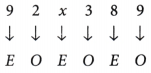
where, O = Odd and E = Even.
Sum of digits at odd places from right to left
= 9 + 3 + 2 = 14
Sum of digits at even places from right to left = 8 + x + 9 = 17 + x
∵ Number is divisible by 11.
Difference of digits will be 0 or 11.
⇒ (17 + x) – 14 = 0 or 11
⇒ 17 + x – 14 = 0 or 11
⇒ x + 3 = 0 or 11
Taking difference 0, x + 3 = 0
⇒ x = 0 – 3 = -3 [not possible]
Taking difference 11, x + 3= 11
⇒ x = 11 – 3 = 8
So, required digit to write in the blank space is 8.
(b) Let the required unknown digit be x.
Then, the number becomes
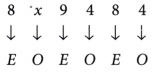
Sum of digits at odd places from right to left = 4 + 4 + x = 8 + x
Sum of digits at even places from right to left = 8 + 9 + 8 = 25
∵ Number is divisible by 11.
Difference of digits will be 0 or 11.
⇒ 25 – (8 + x) = 0 or 11
⇒ 25 – 8 – x = 0 or 11
⇒ 17 – x = 0 or 11
Taking difference 0,17 – x = 0
⇒ x = 17 + 0
⇒ x = 17 [but 17 is not a single digit number, so it is not possible]
Taking difference 11, 17 – x = 11
⇒ x= 17 – 11= 6
So, required digit to write in the blank space is 6.
Question 3.
If 31z5 is a multiple of 3, where z is a digit, what might be the values of z?
Answer:
Given, 31z5 is a multiple of 3, i.e. 31z5 is a divisible by 3.
We know that a number is divisible by 3, if the sum of its digits is divisible by 3.
So, sum of digits of 31z5 = 3 + 1 + z + 5 = 9 + z, which should be a multiple of 3.
Therefore, 9 + z should be 0, 3, 6, 9, 12, 15, 18,…, etc., but z is a digit.
So, 9 + z should be 9, 12, 15 or 18.
Now, 9 + z = 9
⇒ z = 9 – 9
⇒ z = 0
9 + z = 12
⇒ z = 12 – 9
⇒ z = 3
9 + z = 15
⇒ z = 15 – 9
⇒ z = 6 or 9 + z = 18
⇒ z = 18 – 9
⇒ z = 9
Hence, the values of z might be 0, 3, 6, 9.
Question 4.
Find the values of A and B in the following addition.

Answer:
We have,

Here, we have two letters A and B whose values are to be found.
Studying the addition in one’s column, we have B + 7 and we get A from this, i.e. a number whose one’s digit is A.
Also, from addition in ten’s columns, we have A + 3 and we get 6 from this. Therefore, A must be 0, 1, 2 and 3.
If A = 0 then puzzle becomes

It is not possible because first number AB becomes B i.e. one digit number.
If A = 1 then puzzle becomes

Then, B + 7 gives 1, so B must be 4 and sum in ten’s column is 1 + 1 + 3 = 5 ≠ 6 , so it is not possible.
If A = 2 then puzzle becomes

Then, B + 7 gives 2, so B must be 5 and sum in ten’s column is 1 + 2 + 3 = 6.
So, it is correct.
Therefore, the puzzle is solved as shown below

Hence, A = 2 and B = 5
Skill Based Questions
Question 1.
Place or ‘x’ in the appropriate spaces according to the divisibility of the respective numbers.
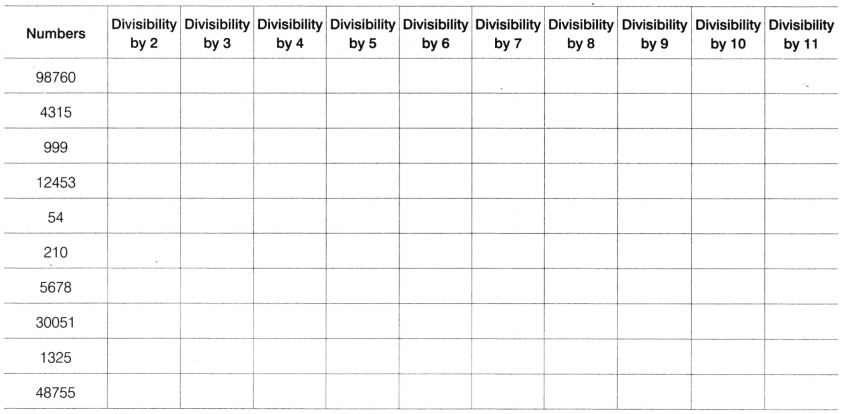
Answer:
Do yourself
Question 2.
A five-digit number is given as below.
7x4y2
(i) It is known that this number is divisible by 4.
Then, what are the possible values of y?
(ii) Also, it is known that this number is divisible by 9.
Then, what are the possible values of x in accordance with values of y?
(iii) Write the possible five-digit numbers.
Answer:
(i) 1, 3, 5, 7, 9
(ii) The possible values for (x, y) are (4, 1), (2, 3), (0, 5), (9, 5), (7, 7), (5, 9).
(iii) 74412, 72432, 70452, 79452, 77472, 75492
Case Study Based Question
Question 1.
A teacher writes a 5-digit number A69BCon the board and says it is divisible by 3.
Based on the above information, answer the following the questions.
(i) If C = 2A and C = 8, then find the possible values of B.
Answer:
Given, 5-digit number is A69BC
∵ C = 8
A = \(\frac{8}{2}\) = 4
∴ A69BC = 469B8
Since, 469B8 is divisible by 3.
∴ Sum of its digits is divisible by 3.
⇒ 4 + 6+ 9+ B + 8 is divisible by 3.
⇒ 27 + B is divisible by 3.
∴ So, B can be equal to 0, 3, 6, 9.
(ii) If C = 8 and B = 3, then find the possible values of A.
Answer:
+C = 8 and B = 3
∴ A69BC = 46938
Since, A6938 is divisible by 3.
∴ Sum of its digits is divisible by 3.
⇒ A + 6 + 9 + 3 + 8 is divisible by 3.
⇒ A + 26 is divisible by 3.
So, A can be equal to 1,4, 7.
(iii) If A = 4 and B = 3, then find the possible values of C.
Answer:
+A = 4 and B = 3
∴ A69BC = 4693C
Since, 4693C is divisible by 3.
∴ Sum of its digits is divisible by 3.
⇒ 4 + 6 + 9 + 3 + C is divisible by 3.
⇒ 22 + C is divisible by 3
So, C can be equal to 2, 5, 8.