Class 6 Science Chapter 11 Notes Nature’s Treasures
→ Air is one of the most important resources which are necessary for all living organisms. We can survive without food or water for a few days, but we cannot survive without oxygen for even a few minutes.
→ The main components of air are nitrogen (78%), oxygen (21%), argon (0.93%) and carbon dioxide (0.03 to 0.04%). Air also contains water vapour, dust particles and smoke particles which have negligible percentage in air.
→ Moving air is called wind. Sometimes it blows fast, for example, during a storm, and sometimes it blows gently as a breeze.
→ Wind is used to rotate windmills. Windmills are used for various purposes like pumping ground water, producing electricity or helping people sail boat.
→ Water is the most common and important substance for survival of life after air. It is used in our daily activities such as bathing, washing, drinking and for irrigation.

→ Water covers about two-thirds of the Earth’s surface. Most of the water is found in oceans and seas. However, this water is salty which is not fit for domestic, agricultural and industrial use. We get freshwater from ponds, rivers, lakes and wells. It is also present in the form of snow, rivers or lakes on the surface of the Earth, and underground.
→ Enough water is available on the Earth but the water available for use is very limited and is decreasing with over usage. On the other hand, due to increase in human population, demand of water usable for drinking, preparation of food and also for industries, is increasing.

→ We can conserve water by adopting different practices. Rainwater harvesting also helps in conserving water. In this process, rainwater is collected and stored for later use.
→ A large area chiefly dominated by trees, woody shrubs and herbs that provide shelter, breeding place and food to a large number of animals is known as forest. The quality and quantity of plants in a forest varies significantly due to various climatic conditions.
→ A forest is a renewable natural resource, if not disturbed by human activities such as deforestation or killing of wildlife.
→ Forests are a natural home for many wild animals, including birds and insects. Forests provide food and shelter to them. Over the years, the forest cover has been decreasing, mainly due to human activities like large scale cutting of trees.
→ It takes many years to grow a new forest or restore lost forests. We must preserve and use forests responsibly so that they get enough time to regenerate.
→ Van Mahotsav is a forest festival during which we plant new plants and trees. This festival is celebrated across the country during the month of July.
→ Sun is the main source of energy. We use heat and light from the Sun for various purposes. The solar panels capture the Sun’s energy and produce electricity. We can also use sun’s energy directly for cooking food in a solar cooker or for heating water in a solar water heater. Sunlight also helps plants prepare food.
→ Soil is a precious treasure which is formed by disintegration of rocks. The soil samples collected from different places may be of different colours because they may contain different materials.
→ There are many things in the soil such as sand, insects and worms. Many small organisms that we cannot see with our naked eyes can also be present in the soil. Plants and animals also become part of the soil as they decompose and decay.
→ There are different types of soils. Some are good for growing certain types of plants while some are good for making bricks for buildings.
→ Rocks are used for various purposes such as for constructing houses, buildings, temples, roads, dams and table tops. Some rocks, such as slate are used for roofing and laterite can be used as a building material, like bricks. Granite, sandstone and marble are some other important types of rocks.
→ Rocks are sources of important metals, such as aluminium, gold, copper and iron. Rocks are made up of minerals. These minerals are used in the manufacturing of airplanes, cars, jewellery, cosmetics, and electrical and electronic equipment. Petroleum along with natural gas and coal are commonly called fossil fuels.
→ They are formed from the remains of microorganisms and plants that got buried deep inside the earth, and were converted to petroleum, natural gas and coal. It takes millions of years for these fuels to form. The resources provided by nature or obtained from the nature are called natural resources. For example: air, water, soil and sunlight, etc.
→ We use natural resources to make many useful things for our convenience. For example, electric bulbs, furniture, solar panels, bicycles, etc., make our lives comfortable. All such resources created by human beings are called human-made resources.
→ Some resources get renewed, replenished or restored within a reasonable period of time. They are called renewable resources. Air, water and forest are some of the examples of renewable natural resources.
→ There are some resources such as fossil fuels that take millions of years to form. They are found in limited quantities and once used, they get exhausted. They are not produced or replenished within a reasonable period of time. These resources are called non-renewable resources. Rocks, minerals, soil, coal, petroleum and natural gas are examples of non-renewable natural resources.
→ We must conserve our natural resources and use them responsibly without wasting them.
→ Air : Air is a mixture of several gases.
→ Petroleum : It is a dark coloured, thick crude oil found deep below the ground in certain areas.
→ Classify : Grouping
→ Coal : Coal is a hard, black combustible mineral that consist mainly of carbon.
→ Renewable-resources : Resources that get renewed, replenished or restored by the natural processes within a reasonable period are called renewable resources.
→ Experience : Knowledge or skill acquired from seeing and doing things.
→ Forests : A forest is a large area of land covered mainly with trees and other plants.
→ Resources : Supplies of raw materials, etc which bring a country, person, wealth.
→ Explore : Travel into or through in order to learn about it.
→ Fossil fuels : The natural fuels formed from the remains of living organism buried under the earth long long ago are called fossil fuels.
→ Rocks : Part of the earth’s crust.
→ Investigate : To inquire
→ Human- made resources : Resources created by human beings to meet their needs are called human made resources.
→ Soil : The uppermost layer of the earth’s crust (in which plant grow) is called soil.
→ Observe : To see or notice
→ Natural Gas : It consists mainly of methane with small quantities of etharie and propane.
→ Sun : It is the star around which the earth and other planets revolve.
→ Survey : General view
→ Natural Resources : Resources provided by nature are called natural resources.
→ Water : A liquid without colour, smell or taste that falls as rain, is in lakes, rivers and seas, and is widely used for drinking washing etc
→ Non-renewable : Resources that are in limited quantities and do not get resources replenished within a reasonable period are called non
renewable resources.
→ Rain water : The process of collecting rainwater from roofs and street harvesting corners and storing it for later use is called rain water harvesting.
→ Resources required for our survival are provided by nature.
→ Resources provided by nature are called natural resources.
→ Some important natural resources are water, energy from the sun, forests, rocks, minerals and fossil fuels.
→ Resources created by human beings to meet their needs are called human- made resources.
→ Natural resources can be classified as renewable resources and non-renewable resources.
→ Resources that get renewed, replenished or restored by natural processes within a reasonable period are called renewable resources.
→ Resources that are in limited quantities and do not get replenished within a reasonable period are called non-renewable resources.
→ All living beings, including humans depend on natural resources for their survival, so we should use them judiciously.
→ Fossil fuels : The natural fuels formed from the remains of living organisms buried under the earth long long ago are called fossil fuels.
→ Soil : Soil is a dark brown (or black) solid material which is a mixture of rock particles of various sizes and decayed plants and animals matter is called humus.
Introduction
We use water for drinking and growing vegetables. All the living things ( plants and animals) need water to live. If water is not available to plants and animals, they will ultimately die. Without water, there would be no living things on the earth. We need these treasures for our survival and for making our lives more comfortable. Without these treasures of nature, any form of life on earth is not possible. We all are a part of nature.
The which surrounds the earth is a mixture of gases. Air contains nitrogen, oxygen, carbon dioxide and other gases in small quanfities. Fig.2 gives the composition of air in percentage. In Fig.2 there are 100 squares. Out of 100 squares 78 occupied by nitrogen, 21 are occupied by Oxygen and 1 by
argon, carbon dioxide and other gases.

We notice the presence of air when the leaves of a tree rustle, the clothes hanging on a clothes line sway, or the pages of an open book begin to flutter once a fan is switched or. Moving air is called wind. Sometimes it blows fast, for example, during a storm, and sometimes it blows gently as a breeze.
We have seen many little children playing with ‘Phirki’ (paper pin wheel). When a child holds the stick of its Phirki in his hand, stands in an open area and adjust the direction of Phirki blade, the phi rki starts rotating. It is the moving air or blow air which makes a Phirki rotate.
→ Windmill : Wind rotates the wings of a windmill. Windmills can be used to run flour millls to pull up water from a well, or to generate electricity.
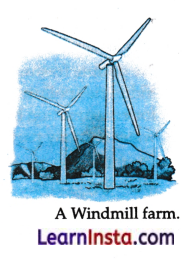
In our country there are many windmill farms. A windmill farm is an area that has a large number of windmills which use the energy of the winds to generate electricity. Muppandal wind farms in Tamil Nadu, Jaisalmer wind park in Rajasthn and Brahmanvel wind farm in Maharashtra are some of the leading windmill farms in our country.
→ Water : We need water for many daily activities such as drinking, cooking, bathing, washing and cleaning. It is also used for growing crops and for industrial purposes. The force of flowing water is used to operate turbines that generate electricity in hydroelectric power stations. Our country has many hydroelectric power stations installed on dams. Water covers about two-thirds of the earth’s surface.
Most of the water is found in oceans and seas. However, this water is saline or salty. This saline water is not fit for domestic, agricultural and industrial use. For all these activities, we need fresh water, which is present in the form of ice sheets or snow. Fresh water in ice sheets and snow, or underground water is difficult to access. A very small fraction of the freshwater present in ponds and well is easily accessible. Water is precious.
→ Water harvesting: It is one of the methods for conserving water. Recharging of groundwater by making the water to percolate into the soil is called wafer harvesting.
→ Roof-top Rainwater Harvesting : In this method, the rainwakir from the roof-top is collected in a storage tank with the help of pipes. Here it is fiLtered and then sent into a pit. The water in the pit seeps slowly into the ground to recharge the groundwater.

→ Stepwells : Step wells commonly known as Bawadi in Rajasthan and vav in Gujarat are built for water harvesting. These step wells have a unique system of water harvesting. They store not only rainwater but also water seeping from nearby lakes aid rivers. The walls of the trenches (long deep holes dug in the ground) are lined with the blocks of stone that allow seepage of water.

Energy From The Sun
Sun is the main source of energy on earth. We use heat and light from the sun for the various purposes. Sunlight helps plant prepare food. The sun also provides all the living beings on Earth with heat and light. It is their main source of energy. The solar panels capture the sun’s energy and produce electricity. In the solar cells, the solar panel convert solar energy into electricity, which is stored in storage battery.

Energy from the sun can also be directly used for cooking in the solar cooker or for heating in a solar water heater. The sun is the main source of energy on the earth. Plants get energy from the sun and produce food. Animals eat plants and grow. We get food from both plants and animals. This cycle on Earth is possible due to Sun. Hence, we all are dependent on the sun as the main source of energy.
Forests
Forest is a large area of land covered thickly with different kinds of trees shrubs, herb, grasses, creepers and climbers. Forests are a natural home for many wild animals including birds and and insects. Forests provide food and shelter to them. In nature, every animal depends on other life forms for survival. Forests play a very important role in maintaining the environmental balance.

The diversity of life forms ensures food for every living being. However, over the years the forest cover has been decreasing mainly due to human activities like large scale cutting of trees. It takes many years to grow a new forest or restore lost forests. Hence, we must preserve forests, so that they get enough time to regenerate.
→ Van Mahotsav : It is a week long event celebrated during the month of July. It is a forest festival during which new plants and trees are planted. The aim of the event is to increase the green cover.
→ Chipko Movement: Chipko Movement (Hug the trees Movement) was a movement started by women of Reni village in Garhwal, who hugged the tree preventing the contractors from cutting the trees.

It started in the early 1970’s in Uttarakhand. This movement quickly spread to other parts of the country and forced the government to re-think their priorities in the use of forest produce. Consequently, the local people were benefited. The roots of plants hold on to the soil and prevent it from being washed away. The leaves that fall from the tree decay and enrich the soil with nutrients. This soil is used by new plants and trees to grow. There is an example of recycling in nature.
How soil is formed?
Soil is formed from rocks by the process of weathering. The process of huge rocks into small rock particles by the action of sun’s heat, wind, rain, flowing water and climatic conditions is called Weathering.
In weathering rocks are broken down very slowly to form tiny rock particles. These tiny rock particles then mix up with humus to form fertile soil. The nature of any soil depends on the rocks from which it has been formed and the type of vegetation that grows on it.
Rocks are used in the construction of houses, buildings, temples, roads, dams and table-tops. Some rocks like slate are used for roofing and laterite can be used as a building material like bricks. Some of the important rocks are granite, sandstone and marble. Human beings have been using rocks to make tools have been using rocks to make tools such as hand axes and arrow heads, since thousand of years.

What are rocks made of?
Rocks are made up of minerals and important metals, such as aluminum, copper, iron and gold. The natural materials in which the metals or other
compounds are found in earth are called minerals. Minerals are used in manufacturing of airplanes, cars, jewellery, cosmetics, and electrical and electronic equipment. The basic mobile phones that we use contain about a dozen minerals like gold, silver, copper, cobalt, etc.

Fossil Fuel
The natural fuels formed from the remains of living organisms burned under earth long long ago, are called fassiifrels. Coal, petroleum and natural gas are fossil fuels. Coal, petroleum and natural gas are called fossil fuels because they are formed by the decomposition of the remains of pre-historic plants and animals (fossils) hurried under the earth, long long ago.
Natural Resources : Renewable And Non-Renewable
Resources which get renewed, replenished or restored within a reasonable period of time are called renewable resources. Air, water and forest are some of the examples of renewable natural resources. Nature renews them. We should use our natural resources judiciously.
We also use natural resources to make many useful things for our convenience. For example, electric bulbs, furniture, solar panels, bicycles, etc., make our lives comfortable. All such resources created by human beings are called human-made resources.
On the other hand, fossil fuels take million of years to form. They are found in limited quantities and once use, they get exhausted. They are not produced /replenished within a reasonable period of time. The sources are called non-renewable resources. Examples of non-renewable natural resources are minerals soil, rocks petroleum and natural gas.
Resources We Use
When we use fossil fuels in our vehicles smoke is generated. Now there are vehicles which cause less pollution. Electric vehicles do not release any smoke. People are making an effort to create alternatives.