Students can use Our Wondrous World Class 4 Solutions Chapter 3 Nature Trai Class 4 Questions and Answers as a quick reference guide.
Class 4 EVS Chapter 3 Nature Trai Question Answer
Nature Trai Class 4 EVS Question Answer
Our Wondrous World Class 4 EVS Chapter 3 Question Answer – Class 4 EVS Nature Trai Question Answer
Write (Page 37)
Question 1.
Can you think of rules that should be followed while you are in a zoo or a forest?
For example,
Answer:
- We should not feed birds.
- Do not tease or disturb animals.
- Do not damage plants or trees.
- Do not litter or throw garbage.
- Do not bring polythene bags with you.
- Do not bring pets with you.
- Do not damage zoo property.

Now, look at the safety rules given below and match them with your list. Have you missed out any of the rules given?
DOs and DON’Ts
1. Please be careful in a new place.
2. Please do not tease animals.
3. Please do not feed animals.
4. Please do not damage trees, and flowers.
5. Please do not bring pets, firearms, or any kind of weapons.
6. Please do not bring polythene bags.
7. Please do not damage public utilities.
8. Please do not throw any garbage in the forest.
Answer:
Yes, I missed item no. 1 Please be careful in a new place.
Discuss (Page 37)
Why are these rules important to be followed?
Answer:
These rules are important to:
- protect wildlife by preventing harm or disturbance to animals and their habitats.
- ensure visitor safety by avoiding dangerous interactions with animals or unsafe items.
- preserve the environment by reducing pollution (e.g., no polythene bags or garbage) and protecting plants and public utilities.
- maintain the natural balance of the ecosystem for future generations.
Write (Page 40)
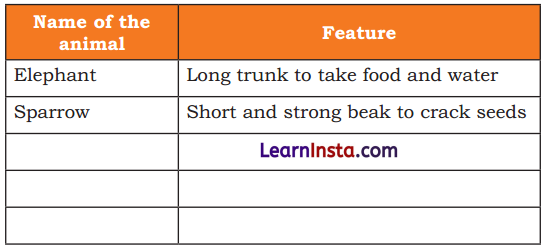
Name some animals including the birds that you have seen. Write any one feature of each of them.
Answer:
| Name of the Animal | Feature |
| Elephant | Long trunk to take food and water |
| Sparrow | Short and strong beak to crack seeds |
| Tiger | Sharp claws for hunting |
| Peacock | Colourful tail feathers for display |
| Hornbill | Curved beak with a horn-like structure |
Write (Page 40)
Compare its (Indian Giant Squirrel) features with the squirrels you see in your area.
Answer:
- Indian Giant Squirrel : Big body, red-coloured, found in Pachmarhi and other forest areas, has a bushy tail and strong limbs for climbing trees.
- Common Squirrel (e.g., in urban or local areas):
Smaller, usually grey, or brown with white stripes, bushy tail, agile, and quick climbers, eats nuts, seeds, and fruits. - Comparison: Size and Colour: Indian Giant Squirrel is larger and red-coloured, while common squirrels are smaller and grey/brown in colour with white stripes.
Write (Page 44)
Name the birds shown below.

Answer:

Activity 1 (Page 39)
Animals in the Forest
- Look closely at the picture (on pages 38-39 of the NCERT textbook) and identify the animals. You may take help from your teacher.
- Divide them into two categories:
Answer:
1. Animals on Land: Bisons, monkeys, deer, nilgai (blue bull)
2. Birds in the sky: Sparrows, parrots, eagles, and blue jay
Activity 2 (Page 43)
Question 1.
Look at the footprints and guess the name of the animals that you think must have come to the pond to drink water.

Answer:

Question 2.
Observe and draw the footprint of any animal in the space given here.

Answer:
Students Activity. Students to do it themselves.
Activity 3 (Page 45)
Take different food items like grains, berries, fruits, nuts, etc., in a plate. Try to pick these food items using a spoon, a toothpick or a pair of sticks. Fill the table below with appropriate tool(s) for picking each of these food items.

Answer:
| Food Item | Appropriate Tool(s) |
| Grains | Spoon |
| Berries | tongs or hands |
| Nuts | Nutcracker or hands |
| Pieces of fruits | Fork or toothpick |
Activity 4 (Pages 47-48)
1. Bird Diary
(a) Go near a tree.
(b) Close your eyes and listen to the sounds of different birds.
(c) Now open your eyes and focus on one bird at a time.
(d) Observe how it moves, what it eats, and where it sits.
(e) Write your observations in a Bird Diary!
For each bird, note the following:


Answer:
Name: Shreesh Jain
Date: 3 September, 2025
My Bird Diary
The first bird I saw after I opened my eyes was a crow.
It’s Appearance:
- Head Colour: Black.
- Back Colour: Black with greyish colour on the neck and shoulders.
- Wings Colours: Black, glossy, with a shine in sunlight.
- Beak Shape: Strong, conical, and curved, black in colour.
- Throat Colour: Black with a greyish collar around the neck
- Colour of Legs: Black, sturdy, and adapted for hopping and perching.
Interesting Facts:
- Crows are highly intelligent and can use tools to recognise human faces.
- They have a great memory. They remember people who are kind or mean to them.
- They are excellent communicators and have a wide range of calls and can warn other crows of danger with specific sounds.
Question 2.
List the animals which live in and around water bodies. Fill in the table given below.

Answer:
| Name of the Animal | Movements |
| Fish | Swims |
| Crab | Walks (sideways) |
| Frog | Jumps and swims |
| Otter | Swims |
| Duck | Walks on land, swims in water and flies |
| Hippopotamus | Walks underwater and swims |
Activity 5 (Pages 50-51)
Question 1.
During the visit to the nature trail, students collected leaves from different plants. Help them identify the plants based on the pictures of the leaves given below.

Answer:

Question 2.
Observe the leaves of different plants in your neighbourhood and fill the table.

Answer:

Write (Page 49)
Question 1.
What are the insects that you find at your home and in your surroundings?
Answer:
The insects that I find in my home are: houseflies, mosquitoes, cockroaches, spiders, and ants.
Question 2.
Name the insects shown below

Answer:
- Butterfly
- Cockroach
- Beetle
- Dragonfly
- Ant
- Praying Mantises
- Grasshopper
Let us Reflect (Pages 55-56)
Question 1.
Which animal would you love to be? What special abilities would it give you?
Answer:
Animal: Eagle
Special Abilities: Sharp eyesight to see far distances, strong wings for flying, and powerful talons for catching prey.
Question 2.
How do you think different plants and animals are dependent on each other?
Answer:
- Plants provide food (fruits, leaves) and oxygen for animals.
- Animals help plants by pollinating (e.g., bees) or dispersing seeds (e.g., birds).
- Predators (e.g., tigers) control herbivore populations (e.g., deer), preventing overgrazing.
- Decomposers (e.g., insects) break down dead matter, enriching soil for plants.
Question 3.
What is the role of a nature scientist?
Answer:
A nature scientist (like Abha Didi) studies plants and animals, their behaviours, habitats, and interactions. They help conserve ecosystems, educate others, and ensure the protection of biodiversity.
Question 4.
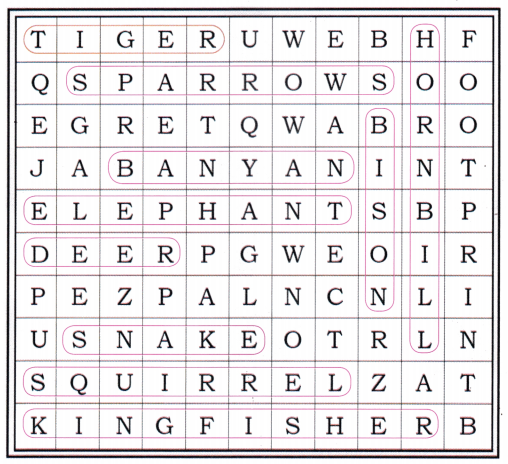
Solve the puzzle.
Find the treasures of the forest.

Answer:
Question 5.
Take on the challenge
Plan a nature walk with your family or friends in a nearby park. To prepare yourself as a guide, identify few plants and animals, and study their features and interesting facts which you can explain during the walk.
Answer:
Students to do themselves.
Question 6.
Do an activity
Role-play: Create a scene of a forest in your classroom where students can perform roles of plants and animals, and of visitors. While enacting the play, focus on our role to protect animals and plants.
Answer:
Students to do themselves.
Question 7.
Let us make a paper turtle! Try using an old newspaper or used paper.

Answer:
Students to do themselves.
Question 8.
Find out Write the name of your state animal, bird, and plant.
Answer:
- State, e.g., Madhya Pradesh
- State Animal: Barasingha (Swamp Deer)
- State Bird: Indian Paradise Flycatcher
- State Plant/Tree: Banyan
Note: You should replace this with the specific state you are in.
For example:
Karnataka: Indian Elephant, Indian Roller, Sandalwood.
Kerala: Indian Elephant, Great Hornbill, Coconut Tree.