These Class 6 Science Curiosity Worksheet and Class 6 Science Chapter 9 Methods of Separation in Everyday Life Worksheet with Answers are excellent for board exam practice.
Class 6 Science Chapter 9 Methods of Separation in Everyday Life Worksheet
Class 6 Methods of Separation in Everyday Life Worksheet
Worksheet On Methods of Separation in Everyday Life Class 6 – Methods of Separation in Everyday Life Worksheet Class 6
A. Objective Type Questions
Multiple Choice Questions
Question 1.
The process used to separate slightly larger particles from a mixture by the hand is called
(a) evaporation
(b) winnowing
(c) sieving
(d) handpicking
Answer:
(d) handpicking
Question 2.
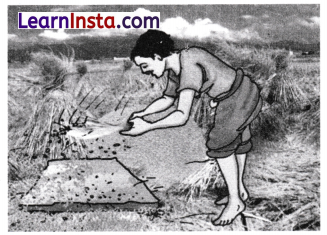
Observe the image given below and suggest the method of separation.
(a) Filtration
(b) Threshing
(c) Winnowing
(d) Sieving
Answer:
(b) Threshing

Question 3.
The method that allows the separation of lighter husk from the heavier grains by blowing air is known as
(a) sieving
(b) condensation
(c) sedimentation
(d) winnowing
Answer:
(d) winnowing
Question 4.
Four mixtures are given below.
(i) Kidney beans and chick peas
(ii) Pulses and rice
(iii) Straw and corn
(iv) Rice grains and chaff
Which of these can be separated by the method of winnowing?
(a) (i) and (ii)
(b) (ii) and (iii)
(c) (i) and (iii)
(d) (iii) and (iv)
Answer:
(d) (iii) and (iv)
Question 5.
The process of fine particles being separated from bigger particles by using a sieve is called
(a) threshing
(b) filtration
(c) sieving
(d) evaporation
Answer:
(c) sieving
Question 6.
Salt is obtained from seawater by the process of
(a) evaporation
(b) filtration
(c) threshing
(d) winnowing
Answer:
(a) evaporation
Question 7.
Impurities settled at the bottom when muddy water was kept overnight in a bucket. The clear water was then poured off the top. The process of separation used in this example is called
(a) sieving
(b) evaporation
(c) sedimentation
(d) filtration
Answer:
(c) sedimentation
Question 8.
In a mixture of sand and water, heavier sand particles settle down at the bottom and the water can be separated by
(a) churning
(b) sedimentation
(c) solution
(d) decantation
Answer:
(d) decantation
Question 9.
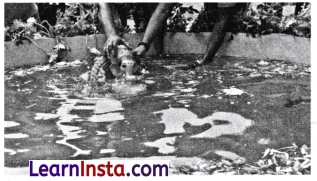
Now-a-days, Ganpati visarjan is performed in artificial ponds to control pollution of natural water reservoirs. Which of the following would be the most appropriate method?
(a) Sedimentation & Filtration
(b) Filtration & Evaporation
(c) Sedimentation & Evaporation
(d) Decantation & Condensation
Answer:
(a) Sedimentation & Filtration
Question 10.
More of a substance can be dissolved in a solution on
(a) heating
(b) cooling
(c) melting
(d) None of these
Answer:
(a) heating
Question 11.
Mark the incorrect statement regarding decantation process.
(a) This method is used for separating mixture of immiscible liquids like alcohol in water
(b) The solid layer formation at the bottom of the vessel is known as sediment
(c) This process can be used to separate mud from muddy water
(d) It is a process of separating the top layer of liquid after sedimentation
Answer:
(a) This method is used for separating mixture of immiscible liquids like alcohol in water
Question 12.
Filtration can be used to separate components of a mixture of an insoluble
(a) solid and a liquid
(b) wheat and rice
(c) salt and sugar
(d) None of these
Answer:
(a) solid and a liquid
Question 13.
When milk cooled after boiling, is poured onto a piece of cloth, the cream (malai) is left behind on it. This process of separating cream from milk is an example of
(a) winnowing
(b) evaporation
(c) filtration
(d) threshing
Answer:
(c) filtration
Question 14.
Reena’s grandmother is suffering from diabetes. Her doctor advised her to take ‘Lassi’ with less fat content. Which of the following method would be most appropriate to prepare it?
(a) Filtration
(b) Decantation
(c) Churning
(d) Winnowing
Answer:
(c) Churning
Question 15.
In many industries, the waste material often contains scrap iron. Which of the following methods can be used to separate this iron from the heap of waste materials using magnets?
(a) Filtration
(b) Magnetic separation
(c) Evaporation
(d) Decantation
Answer:
(b) Magnetic separation
Fill in the Blanks
Fill in the blanks by choosing the appropriate words.
Question 1.
Separation of components is done to obtain a ____ substance, (pure/ impure)
Answer:
pure
Question 2.
You can separate a mixture of dry kidney beans (rajma) & dry lentils by ____ (handpicking/decantation)
Answer:
handpicking
Question 3.
Fine sand can be separated from coarse gravels by (sieving/ winnowing)
Answer:
winnowing
Question 4.
____ is used to separate husk from wheat. (Winnowing/ Magnet)
Answer:
Winnowing
Question 5.
Salt is obtained from seawater by the process of ___. (evaporation/ condensation)
Answer:
evaporation
Question 6.
A mixture of mustard oil and lemon water can be separated by ____. (decantation/ evaporation)
Answer:
decantation
Question 7.
____ is usually essential for the filtration. (Pore size/Apparatus size)
Answer:
Pore size
Question 8.
Using a ___ we can separate tea leaves from the liquid, (strainer/ flask)
Answer:
strainer
Question 9.
Butter is separated from buttermilk by the process of ____. (churning/ winnowing)
Answer:
churning
True/False
State whether the given statements are true or false.
Question 1.
Flour mixed with wheat grains can be separated using sieving.
Answer:
True
Question 2.
Winnowing is generally done with the help of water.
Answer:
False. Winnowing is generally done by the help of wind or blowing air.
Question 3.
A mixture of sand and water be separated using decantation.
Answer:
True
Question 4.
A mixture of milk and water can be separated by decantation.
Answer:
False. A mixture of milk and water cannot be separated by decantation.
Question 5.
Rock salt is an impure substance.
Answer:
True
Question 6.
A mixture of oil and water can be separated by filtration.
Answer:
False. A mixture of oil and water can be separated by decantation.
Question 7.
Filtration is used to separate salt and water.
Answer:
False. Evaporation is used to separate salt and water.
Question 8.
Separating funnel is used for the separation of two miscible liquids.
Answer:
False, separating funnel is used for the separation of two immiscible liquids.
Question 9.
A mixture of iron filings and rice flour can be separated by magnet.
Answer:
True.
Question 10.
The process used to separate cream from curd is called magnetic separation.
Answer:
False. The process used to separate cream from curd is called churning.
Match the Following
Question 1.
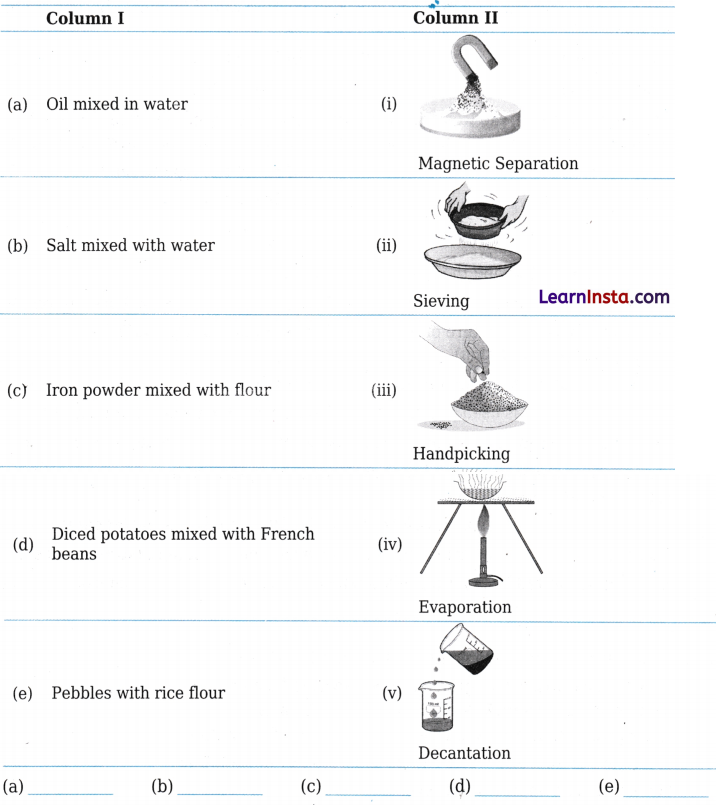
Match the statements in Column I with the terms given in Column II.
Answer:
(a)-(v):
(b)-(iv);
(c)-(i);
(d)-(iii);
(e)-(ii)
Question 2.
Match Column I with Column II.
| Column I (Terms) |
Column II (Definition) |
| (a) Mixture | (i) Substances which contains only one type of components. |
| (b) Chaff | (ii) Two or more substances are mixed. |
| (c) Pure Substances | (iii) The process of separating grains from stalks of harvested crops. |
| (d) Threshing | (iv) The process of settle down of insoluble heavier solid particles at the bottom of the vessel. |
| (e) Sedimentation | (v) The thin, scaly layer which covers the grains attached to the stalks. |
(a) _____
(b) _____
(c) _____
(d) _____
(e) _____
Answer:
(a)-(ii);
(b)-(v):
(c)-(i);
(d)-(iii):
(e)-(iv)
Assertion-Reason Questions
In the following questions, two statements are given- one is labelled as Assertion (A) and the other is labelled as Reason (R). Read the statements carefully and choose the correct alternative (a), (b), (c) and (d) as given below.
(a) Both A and R are true and R is the correct explanation of A.
(b) Both A and R are true, but R is not the correct explanation of A.
(c) A is true, but R is false.
(d) A is false, but R is true.
Question 1.
Assertion (A) Separation of stones from rice is one of the separation methods.
Reason (R) The above separation method is handpicking method of separation.
Answer:
(a) Both A and R are true and R is the correct explanation of A.
Question 2.
Assertion (A) The separation of heavier and lighter components of a mixture can be done by wind or by blowing air.
Reason (R) The process which is used to separate grain from stalks are known as winnowing.
Answer:
(c) A is true, but R is false. R can be Corrected as
The process of separating grains from stalks is known as threshing.
Question 3.
Assertion (A) Evaporation can be used to separate a solid dissolved in a liquid.
Reason (R) Evaporation is the process in which liquid gets converted into its vapour.
Answer:
(a) Both A and R are true and R is the correct explanation of A.
Question 4.
Assertion (A) When the heavier component in a mix settles after water is added to it the process is called sedimentation.
Reason (R) When the water along with the dust is removed the process called decantation.
Answer:
(c) A is true, but R is false. R can be corrected as
In the process of decantation, water is separated from the dust particles present in it.
Question 5.
Assertion (A) Decantation method cannot be used for separating mixture of miscible liquids.
Reason (R) The mixture do not form two separate layers to be separated.
Answer:
(a) Both A and R are true and R is the correct explanation of A.
Case Based Questions
Question 1.
Raman collected samples of vinegar, lemon juice, mustard oil or coconut oil, kerosene or any other liquid. Took a glass tumbler. Filled it up to half with water. Added a few spoonfuls of one liquid to this and stirred it well. Let it stand for five minutes. Observed whether the liquid mixes with water. Repeated the same with other liquids, as vinegar, lemon juice, coconut oil, kerosene, etc. many different liquids as are available to him.
(i) The liquid that floats on water is
(a) milk
(b) coconut oil
(c) alcohol
(d) All of these
Answer:
(b) coconut oil
(ii) The liquids that do not dissolve in water are called ____ liquids.
(a) soluble
(b) insoluble
(c) miscible
(d) immiscible
Answer:
(d) immiscible
(iii) ___ is a universal solvent.
(a) Milk
(b) Water
(c) Oil
(d) None of these
Answer:
(b) Water
(iv) Objects that float on water are ___ than water.
(a) heavier
(b) lighter
(c) soluble
(d) insoluble
Answer:
(b) lighter
Question 2.
Many substances dissolve in water and form a solution. These substances are soluble in water. Shravan was instructed to do as follows:
I. Mix two teaspoons of solid salt with some liquid water in a beaker.
II. Stir it well. When he stirred it, he discovered that all of the salt had vanished, leaving only liquid in the beaker.
III. He was again asked to add few more teaspoons of salt in the same mixture and stir. He could see some salt undissolved.
IV. Heat the mixture formed in step III.
V. Cool the mixture formed in step IV.
(i) The liquid contained in the beaker at the end of procedure in step I is
(a) water
(b) solute
(c) solvent
(d) solution
Answer:
(d) solution
(ii) Which of the following method will be most effective in extracting salt from the mixture prepared in step I?
(a) Evaporation
(b) Filtration
(c) Churning
(d) Sedimentation
Answer:
(a) Evaporation
(iii) Select one another example which can be separated by the above given separation technique.
(a) Butter from butter milk
(b) Sugar from sugar-water solution
(c) Grains from their husks
(d) Iron from sulphur powder
Answer:
(b) Sugar from sugar-water solution
(iv) Which of the following statements are correct?
(a) In everyday life, evaporation is commonly used to obtain salt from sea water
(b) The rate of evaporation decreases with rise in temperature
(c) Evaporation process is slower when the mixture is heated
(d) For the separation of mixture, the sea water is stored above shallow pits
Answer:
(a) In everyday life, evaporation is commonly used to obtain salt from sea water
B. Subjective Type Questions
Define the following terms
Question 1.
Mixture
Question 2.
Winnowing
Question 3.
Churning
Question 4.
Filtration
Question 5.
Evaporation
Question 6.
Sedimentation
Question 7.
Magnetic separation
Very Short Answer Type Questions
Question 1.
Name the process used to separate heavier and lighter components of a mixture.
Question 2.
Can the above stated method be used if both the components have same weight?
Question 3.
What are the main reasons for separation of components of a mixture?
Question 4.
Give one example of sieving used in kitchen in daily life.
Question 5.
Malli, Valli and Ravi have to dissolve maximum amount of sugar in the same amount of milk so as to win in a game. Ravi took hot boiling milk while Malli took ice cold milk. Valli managed to get milk at room temperature. What do you think who would win the game and why?
Question 6.
Write opposite process of evaporation.
Question 7.
Name the method used to separate a mixture of two insoluble liquids.
Question 8.
How can you obtain pure water?
Question 9.
Which method is used to separate tea leaves from tea?
Question 10.
Can mixture of salt and sugar be separated by filtration?
Question 11.
What is strainer?
Question 12.
Name two materials that are used as filters.
Short Answer Type Questions
Question 1.
Write down the components of the following mixtures.
(a) air,
(b) soil
Question 2.
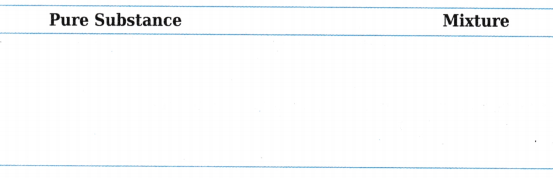
Distinguish between the following:
(a) Pure substances and Mixture
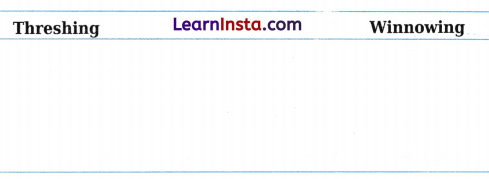
(b) Threshing and Winnowing
Question 3.
Is it possible to separate sugar mixed with wheat flour? If yes, how will you do it?
Question 4.
What do you mean by threshing? Where is it used?
Question 5.
How will you separate iodine from washing soda?
Question 6.
Write various methods of separation of components from their mixture.
Question 7.
How will you separate oil and water from their mixture?
Question 8.
How will you separate sand and water from their mixture?
Question 9.
How would you obtain clear water from a sample of muddy water?
Question 10.
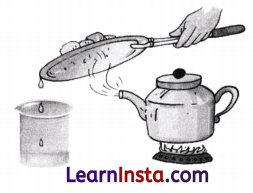
The following figure indicates two processes. Identify and write their names.
Question 11.
In Sharbat, what should be mixed first, ice cubes or sugar and why?
Question 12.
What is the principle of filtration and magnetic separation method?
Question 13.
A mixture of iron nails, salt, oil and water is provided to you. Give stepwise method to separate each component from this mixture.
A mixture of iron nails, salt, oil and water can be separated by the following steps:
- Iron nails can be handpicked or removed by a ____ by attracting them.
- Oil can be removed by ____ method or by using a ___.
- By _____ method, evaporate the salt and water solution. Hence, water can be converted back into ____ leaving behind the salt at the bottom.
Long Answer Type Questions
Question 1.
Observe the figure and answer the following question.
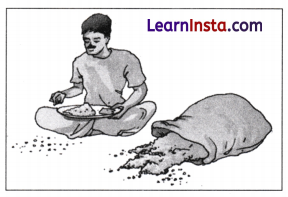
(i) What does the figure show?
(ii) Name two mixtures which are separated by this method.
Question 2.
If you are given two transparent clear liquids, without tasting, how would you determine which is distilled water and which is a solution of salt water?
Question 3.
John was feeling thirsty but there was only a pot of water at home which was muddy and unfit for drinking. How do you think Jacob would have made this water fit for drinking if the following materials were available to him ? Alum, tub, muslin cloth, gas stove, thread, pan and lid.
Question 4.
Both Malli and Valli were asked to make salt solution. Malli was given a teaspoonful of salt and half a glass of water, whereas Valli was given twenty teaspoonful of salt and half a glass of water.
(a) How would they make salt solutions?
(b) Who would be able to prepare saturated solution?
Question 5.
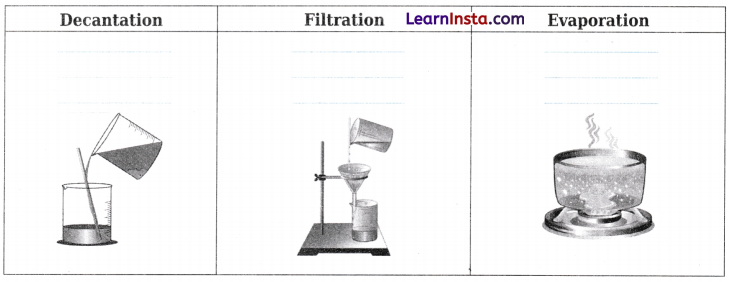
You are provided with a mixture of salt, sand, oil and water. Write the steps involved for the separation of salt, sand and oil from the mixture by giving an activity along with the
diagram.
Question 6.
We are proud of our Indian heritage. Under supervision of your elders, try to prepare some herbal remedies using various parts of plants. For example-tulsi kadha. Which methods of separation will you use while preparing herbal kadha?
Question 7.
A bowl of milk in your home has gone sour. Discuss with your parents how you can use it in another way. Also, which method of separation will you use in the process?
Skill Based Activities
Question 1.
Unscramble the jumbled words.
(a) NUEDNACIAO ________
(b) GCRNHIUN ________
(c) NIATOFRTLI ________
(d) ADSUAERU ________
(e) GEHSTRIHN ________
(f) IATMIESDNETNO ________
(g) MPIITERSJU ________
(h) MTURXIE ________
Question 2.
Complete the crossword with the help of clues provided.
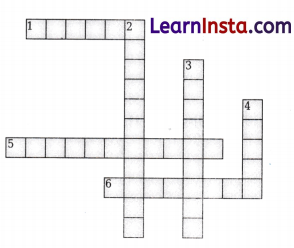
Across
1. Substance present in lesser amount in solution.
5. Transfer of clear liquid to another container.
6. Another word for soluble liquid
Down
2. Salt is obtained by using this method of separation.
3. Blowing wind assist this method.
4. Used to separate different sized particles.
Question 3.
We know that water is purified before it is supplied to our houses. Then why do we have water filters in our houses? What purpose does they serve? Find out.
Answer:
Question 4.
You might have seen your mother separating small stones from rice grains and pulses before cooking. These stones are an undesired components of the grains and harmful if consumed. Addition of undesired and harmful substances to food item is called adulteration. Visit a nearby grocery shop and see if you find any adulterated food items there. If yes, then bring this to the notice of shopkeeper. Find out what health issues can arise if we consume adulterated food. Spread awareness about this in your family, neighbourhood and friends.
Question 5.
During the process of filtration, should we use more number of filters with progressively smaller pore size or use one filter with small mesh size? Explain the reasons for your answer.
Question 6.
With the help of google explore the dairies of England and write a report on the processes used there to separate cream from milk.
Question 7.
Salt is obtained from sea water by the process of evaporation. In 1930, Gandhi ji led a very famous march known as Dandi March. Find out more about it and how it is related to salt.
Question 8.
Observe the following diagram and answer the questions given below:
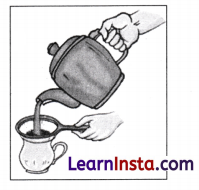
(i) Suggest a caption/title to the process shown in figure.
(ii) What method is used in this process?
Question 9.
The following diagram shows the method used in taking out butter from milk and curd. Answer the questions after observing the diagram carefully.
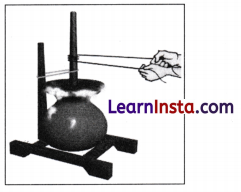
- What is the name of this process?
- Explain the process/ principle.
Question 10.
Observe the figure given below. Write what process of separation of substances indicates.
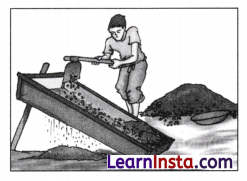
Question 11.
In the diagram given below is a part of the process adopted to obtain common salt from sea water. Observe it and answer the following questions.
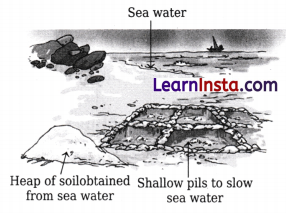
- Name the process of obtaining salt (solid) from the sea water as shown in the figure.
- Define the process involved in obtaining salt from sea water at the first stage.