Experts have designed these Class 9 Science Notes and Exploration Chapter 6 How Forces Affect Motion Class 9 Notes for effective learning.
Class 9 Science Chapter 6 How Forces Affect Motion Notes
Class 9 Science Exploration Chapter 6 Notes
Class 9 Science Chapter 6 Notes – Class 9 How Forces Affect Motion Notes
→ Acceleration due to gravity (g): The acceleration of a freely falling object near the Earth’s surface, approximately 9.8 m/s2 (or 10 m/s2 for quick calculations).
→ Balanced Forces: Two or more forces acting on an object that are equal in magnitude but opposite in direction, resulting in zero net force. The object’s state of motion does not change.
→ External Forces: Forces acting on a system from outside. These determine the acceleration of the system as a whole.
→ Force: A push or pull exerted by one object on another. It has both magnitude and direction (vector quantity). SI unit is newton (N).
→ Friction: A contact force that acts between two surfaces in contact, opposing relative motion between them. It always acts in a direction opposite to motion.

→ Inertia: The natural tendency of an object to resist any change in its state of rest or state of uniform motion. Greater mass means greater inertia.
→ Internal Forces: Forces that act between parts within a system. They do not affect the acceleration of the system as a whole.
→ Mass: The amount of matter in an object. It is a measure of inertia. SI unit is kilogram (kg).
→ Net Force: The single resultant force that has the same effect on an object as all the individual forces acting on it combined. Also called resultant force.
→ Newton (N): The SI unit of force. 1 N is the force that gives a mass of 1 kg an acceleration of 1 m/s2.
→ Newton’s First Law: An object at rest stays at rest and an object in motion stays in motion at constant velocity unless acted upon by a net force. Also called the Law of Inertia.
→ Newton’s Second Law: The acceleration of an object is directly proportional to the net force acting on it and inversely proportional to its mass. F = ma.
→ Newton’s Third Law: For every action force, there is an equal and opposite reaction force. These forces act on two different objects.
→ Spring Balance: An instrument used to measure force. It works by measuring the extension of a spring when a force is applied.
→ Unbalanced Forces: Forces acting on an object where the net force is not zero. The object accelerates in the direction of the net force.
→ Weight: The gravitational force exerted by the Earth on an object. Weight = mg. It is measured in newtons.
The Concept of Force
A force is a push or a pull that one object exerts on another. Force can make a resting object move, change the speed of a moving object, change the direction of a moving object, or even change the shape of an object.
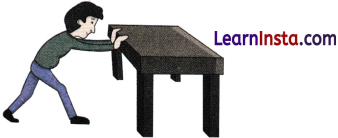
Force is a vector quantity, which means it has both magnitude (strength) and direction. Both must be specified to describe a force completely. The SI unit of force is newton (written with a small letter ‘n’), and its symbol is the capital letter N.
One newton (1 N) is defined as the force that produces an acceleration of 1 m/s2 on an object of mass 1 kg. The magnitude of a force tells us how strong it is, while the direction tells us which way it acts.
→ Measuring the Magnitude of a Force: The magnitude of a force can be measured using a spring balance. When you pull on the free end of a spring balance, it measures the force with which you pull on the spring inside it. This instrument can measure not just weight but any force in general.
→ Balanced and Unbalanced Forces:
- In real life, more than one force usually acts on an object at the same time. The overall effect of all these forces together is what matters for the motion of the object.
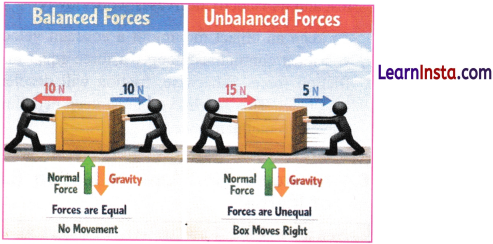
- When two forces of equal magnitude act on an object in opposite directions, they equalise each other out. These are called balanced forces. A balanced force produces no change in the state of motion of an object. The object either remains at rest or continues moving with the same velocity.
- When the forces acting on an object are not equal in magnitude or direction, a net force (also called resultant force) acts on the object. This net force causes the object to accelerate or change its state of motion. These are called unbalanced forces.
- When two forces act in the same direction on an object, the net force is the sum of the two forces and acts in the same direction as both forces.
- When two forces act in opposite directions, the net force equals the difference between the larger and smaller force and acts in the direction of the larger force.
The Force of Friction: Often Overlooked but Always Present
Friction is a force that always acts between two surfaces that are in contact and tends to oppose the relative motion between them. When we push an object on a surface, friction acts in the direction opposite to the motion.
An object will start moving only when the applied force becomes greater than the maximum friction force. Once moving, if we stop applying force, friction gradually slows the object down and brings it to rest.
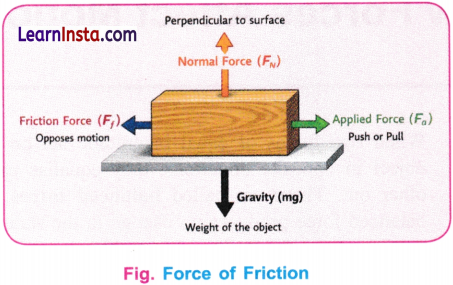
The magnitude of the force of friction depends on the nature of the surfaces in contact. A rougher surface produces more friction, while a smoother surface produces less. When friction is smaller, an object travels a larger distance before coming to rest and its velocity decreases more slowly.
To keep an object moving at a constant velocity, you must continuously apply a force equal to the friction force. Otherwise, friction will decelerate the object. This is why you must keep pedalling a bicycle to maintain speed.
Newton’s First Law of Motion (Law of Inertia)
Newton’s First Law states: An object at rest remains at rest, and an object in motion continues to move with a constant velocity, unless a net force acts upon it.
This means that if the net force on an object is zero, the object cannot begin to move (if at rest) or change its velocity (if moving). In both cases, the acceleration of the object is zero.
The property of an object to resist any change in its state of rest or uniform motion is called inertia. Isaac Newton used the word ‘inertia’ to describe this tendency, and built his first law of motion around this idea.
Galileo Galilei, in the 17th century, was the first to argue through thought experiments that if all impediments to motion are removed, a moving body will continue to move indefinitely. Newton built upon this insight.
Key points about Newton’s First Law:
A resting object needs a net force to start moving. A moving object needs a net force to slow down, stop, or change direction. An object moving at constant velocity on a frictionless surface needs no force to keep moving.
Newton’s Second Law of Motion
Newton’s Second Law states: When a net force acts on an object, the object accelerates in the direction of the net force. The magnitude of acceleration is directly proportional to the magnitude of the net force and inversely proportional to the mass of the object.
Mathematically this is expressed as F = ma, where F is the net force (in newtons), m is the mass of the object (in kg), and a is the acceleration produced (in m/s2). This is one of the most important equations in science.
From this law, we understand that a larger force produces a larger acceleration for the same mass. For the same force, a larger mass produces a smaller acceleration. These two relationships together define how motion responds to force.
The gravitational force acting on an object is given by F = mg, where g is the acceleration due to gravity, approximately 9.8 m/s2 near the Earth’s surface (often approximated as 10 m/s2 for quick calculations).
Practical applications:
A cricket fielder pulls their hands backwards while catching a fast ball. This increases the time of deceleration, reducing the acceleration and thus the force experienced. Similarly, airbags in cars and landing mats in high jump events increase the stopping time to reduce the force on a person.
Newton’s Third Law of Motion
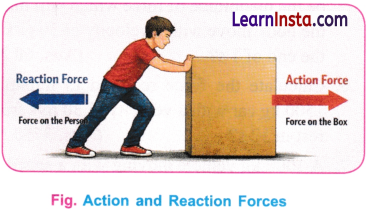
Newton’s Third Law states: Whenever one object exerts a force on a second object, the second object simultaneously exerts an equal and opposite force on the first object.
These paired forces are often called action and reaction forces. A critical point to remember is that action and reaction forces always act on two different objects. Since they act on different objects, they do not cancel each other out.
Examples in everyday life:
When we push the ground backwards with our feet while walking, the ground pushes we forward with friction. A canoeist pushes water backwards with a paddle and the water pushes the paddle and canoe forward with an equal force. A rocket expels gases downward and the gases push the rocket upward.
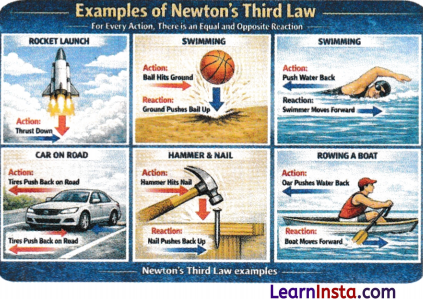
Newton’s Third Law applies to all types of forces, whether contact forces (like friction and muscular force) or non-contact forces (like gravitational and magnetic forces). Two magnets exert equal and opposite forces on each other. The Earth and a falling fruit exert equal and opposite gravitational forces on each other.
Forces Acting on a System of Objects
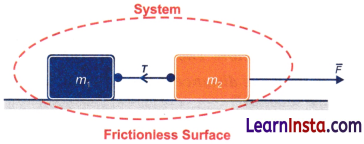
When two or more objects are connected together, we can treat them as a single system. The forces acting within the system (called internal forces, such as the tension in a connecting string between them) do not need to be considered when applying Newton’s Second Law to the system as a whole.
Only the forces acting from outside the system (called external forces) matter when finding the acceleration of the entire system. The acceleration of the system is calculated as: a = F / (m1 + m2), where F is the external force and m1 and m2 are the masses of the two objects.
This concept simplifies the analysis of complex connected systems and demonstrates the power of Newton’s laws in handling even complicated scenarios.
Solved Examples
Example 1.
A force of 10 N accelerates an object from 15 m/s to 25 m/s in 20 s. Calculate the mass of the object.
Solution:
Here, F = 10 N,
u = 15 ms-1,
v = 25 m s-1,
t = 20 s
Acceleration, a = \(\frac{v-u}{t}\)
= \(\frac{25-15}{20}\)
= \(\frac{1}{2}\) m s-2
Mass, m = \(\frac{F}{a}\)
= \(\frac{10}{1/2}\) = 20 kg
Example 2.
A cricket ball of mass 70 g moving with a velocity of 0.5 m/s is stopped by a player in 0.5 s. What is the force applied by the player to stop the ball?
Solution:
Here, m = 70 g = 0.070 kg,
u = 0.5 m/s,
v = 0,
t = 0.5 s
Force, F = (\(\frac{v-u}{t}\))
= 0.070 (\(\frac{0-0.5}{0.5}\))
= – 0.07 N
Negative sign shows the retarding nature of the force.
Example 3.
Calculate the force required to impart to a car a velocity of 30 m/s in 10 s. The mass of the car is 1500 kg.
Answer:
Here, u = 0,
v = 30 m/s,
t = 10 s
∴ a = \(\frac{v-u}{t}\) = 3 m/s2
Now, m = 1500 kg,
a = 3 m/s2
∴Required force, F = ma
= 1500 × 3 N = 4500 N.
Example 4.
A man pushes a box of mass 50 kg with a force of 80 N. What will be an acceleration of the box due to this force? What would be an acceleration if the mass is halved?
Solution:
In first case:
m = 50 kg,
F = 80 N
Acceleration, a = \(\frac{F}{m}\)
= \(\frac{80}{50}\) = 1.6 m/s2.
In second case:
m = 25 kg,
F = 80 N
Acceleration, a = \(\frac{F}{m}\)
= \(\frac{80}{25}\)
= 3.2 m/s2.
Example 5.
The velocity-time graph of a car is shown in Fig. below. The car weighs 1000 kg.
(a) What is the distance travelled by the car in the first two seconds?
(b) What is the braking force applied at the end of 5 s to bring the car to a stop within one second?
Solution:
(a) Distance travelled by the car in first 2 s = Area of ∆ ABM
= ½ AM × BM
= ½ × (2 – 0) × (15 – 0)= 15 m.
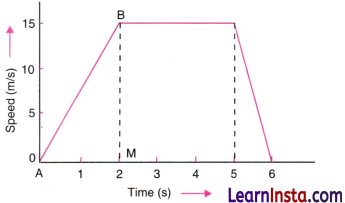
(b) It is clear from the graph that the velocity at the end of 5 s is 15 m/s.
So u = 15 m/s,
t = 1 s,
v = 0 v — u 0-15
∴ a = \(\frac{v-u}{t}\)
= \(\frac{0-15}{1}\)
= – 15 m/s2
Retardation = 15 m/s2
Braking force = ma
= 1000 × 15 N = 15000 N.
Example 6.
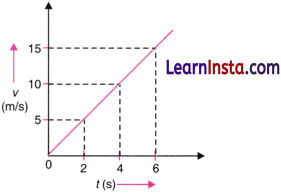
The motion of a body of mass 5 kg is shown in the v – t graph.
Find from graph:
(a) its acceleration,
(b) the force acting on the body, and
(c) the change in momentum of the body 2 seconds after start.
Solution:
(a) a = \(\frac{v_2-v_1}{t_2-t_1}\)
= \(\frac{15-0}{6-0}\) = 2.5 m s-2
(b) F = ma
= 5 × 2.5
= 12.5 N
(c) Change in momentum 2 seconds after start = m (v – u)
= 5 (5 – 0) = 25 kg ms-1.