These Class 7 Science Curiosity Worksheet and Class 7 Science Chapter 8 Measurement of Time and Motion Worksheet with Answers are excellent for board exam practice.
Class 7 Science Chapter 8 Measurement of Time and Motion Worksheet
Class 7 Measurement of Time and Motion Worksheet
Worksheet On Measurement of Time and Motion Class 7 – Measurement of Time and Motion Worksheet Class 7
A. Multiple-Choice Questions
Question 1.
The relation between speed and distance is
(a) Distance = \(\frac{Speed}{Time}\)
(b) Distance = Speed × Time
(c) Distance = \(\frac{Time}{Speed}\)
(d) None of these
Question 2.
Which of the given factors do NOT affect the period of a simple pendulum?
I. Length of pendulum
II. Mass of bob
III. Location on the Earth
IV. Material of the bob
(a) I and II
(b) II and IV
(c) I and III
(d) II, III, and IV

Question 3.
A cyclist travels 40 km in 2 hours and then 20 km in 1 hour. What is the average speed of the cyclist for the whole journey?
(a) 15 km/h
(b) 10 km/h
(c) 25 km/h
(d) 20 km/h
Question 4.
The question consists of an Assertion (A) and a Reason (R). Read the Assertion and Reason and choose the appropriate answer.
Assertion (A): The time period of a simple pendulum depends on the length of the thread.
Reason (R): The time period of a simple pendulum increases with the increase in the mass of the bob.
(a) Both A and R are true, and R is the correct explanation of A.
(b) Both A and R are true, but R is not the correct explanation of A.
(c) A is true but R is false.
(d) A is false, but R is true.
Question 5.
The question consists of an Assertion (A) and a Reason (R). Read the Assertion and Reason and choose the appropriate answer.
Assertion (A): A car that covers 120 km in 2 hours is slower than a bike that covers 100 km in 1 hour.
Reason (R): An object covering more distance in less time is said to be faster.
(a) Both A and R are true, and R is the correct explanation of A.
(b) Both A and R are true, and R is not the correct explanation of A.
(c) A is true but R is false.
(d) A is false, but R is true.
B. State True (T) or False (F).
1. The SI unit of speed is km/h.
2. Electrocardiogram (ECG) machines measure variations in heartbeats in milliseconds to detect health issues.
3. Quartz clocks are known to be the most accurate clocks.
4. The motion of the bob of a simple pendulum is circular.
5. The time unit measured by Ghatika-yantra was called ghatika or ghati.
C. Fill in the blanks.
1. The larger units of time are ______________ and ______________
2. ______________ is used to measure distance travelled by a vehicle.
3. Motion of a simple pendulum is ______________ in nature.
4. ______________ is the distance covered by an object in unit time.
5. In a ______________ linear motion, speed of an object moving along a straight line is changing.
D. Assign one word to the following terms.
1. The world’s largest stone sundial. ______________
2. The person who invented the pendulum clock. ______________
3. The time taken by the pendulum to complete one oscillation. ______________
4. The unit in which an odometer measures the distance of a vehicle. ______________
5. The type of motion in which an object moves along a straight line with constant speed. ______________
E. Match the Columns.
Question 1.
Match the pictures given in Column I with their correct descriptions given in Column II.

Question 2.
Match the descriptions given in Column I with the correct jumbled words given in Column II.
| Column I | Column II |
| (i) An instrument used to measure the vehicle’s speed. | (a) S O T L C I L A I N O |
| (ii) Indian time unit measured using a sinking bowl water clock. | (b) C H W A T T O P S |
| (iii) The to-and-fro motion of an object from its mean position. | (c) U M P L N E U D |
| (iv) A metallic ball suspended from a rigid support by a long thread. | (d) E T P S R E D E O M E |
| (v) A tool used to measure the time of oscillations. |
(e) A T H K I A G |
Wonder Why?
A. Different students travelled from their homes to school. The teacher gave them an activity to calculate their speed based on the distance travelled and the time taken. Observe the measurements given in the table and answer the following questions.

Question 1.
What is Aditi’s speed while cycling to school?
_________________________________________________________
_________________________________________________________
Question 2.
Which student had the highest speed and who had the and slowest speed?
_________________________________________________________
_________________________________________________________
Question 3.
How much faster is Arjun compared to Rohan?
_________________________________________________________
_________________________________________________________
Question 4.
Next time, if Rohan and Aditi travel the same distance, but Aditi takes an hour extra, who will be faster and by how much?
_________________________________________________________
_________________________________________________________
B. Read the paragraph and answer the following questions.
Long ago, people used natural events like the rising and setting of the Sun to measure time. As societies advanced, they began to use sundials and water clocks. These were among the earliest instruments for measuring time during the day and night.
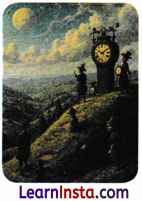
In today’s world, digital and quartz clocks are used almost everywhere— from homes to offices and schools. These clocks can measure time precisely in hours, minutes, and seconds. Learning how to measure time helps us stay organised and plan our day better.
Question 1.
How did people in ancient times measure time?
_________________________________________________________
_________________________________________________________
Question 2.
Which types of clocks are most commonly used today?
_________________________________________________________
_________________________________________________________
Question 3.
Why is measuring time with a modern clock accurate?
_________________________________________________________
_________________________________________________________
C. Observe the motion of different movements around you. Identify whether the motion is uniform linear or non-uniform linear, and give a reason for your answer. One example has been done for you.

Learn By Doing
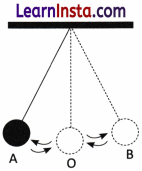
A. Attach a small bob (like a metal ball) to a long thread and hang it from a strong support. Pull the bob slightly to one side and release it. Use a stopwatch to measure how long it takes to complete 5 swings (oscillations). Repeat this activity 3-4 times to get accurate results. Calculate the time period, and write your observation in the given table:

B. Walk a fixed distance, such as 600 metres, and use a stopwatch to record the time it takes you to complete it. Once you have the time, divide the distance by the time to calculate your speed. Repeat this activity with a few of your friends, asking each one to walk the same distance. What do you observe from this activity? Will their speeds be the same or different?
_________________________________________________________
_________________________________________________________
_________________________________________________________
_________________________________________________________
Explore With Curiosity
A. Measure how much time it takes to cover a distance of 1.5 km using different movements like walking, cycling, and running. Record the time taken by each person and calculate their average speed.

B. Complete the conversation between Aryan and Sanya based on their observations.
Aryan and Sanya were discussing how people measured time in the past and how it is done today. They had seen a sundial in a museum and also learned about atomic clocks in their classroom.
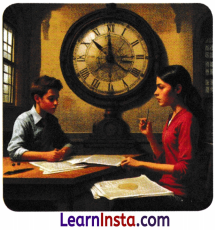
Aryan: Did you see that sundial in the museum? It shows time using shadows!
Sanya: _________________________________________________________
_________________________________________________________
Aryan: People must have depended on sunlight to know the time. But what did they do at night?
Sanya: _________________________________________________________
_________________________________________________________
Aryan: Today’s clocks are so accurate. I read that atomic clocks lose only one second in millions of years!
Sanya: _________________________________________________________
_________________________________________________________
Aryan: So, from sundials to smartwatches, the way we measure time has changed a lot, hasn’t it?
Sanya: _________________________________________________________
_________________________________________________________
C. Read the following paragraph and choose the correct word. Rewrite the paragraph in the space provided.
Riya was experimenting with a simple pendulum in her school lab. She tied a metal ball/rubber ball to a string and fixed it to a stand. She pulled the ball slightly to one side and released it. The ball started oscillating/rotating to and fro. This motion was called oscillatory motion/circular motion. Riya used a stopwatch/thermometer to measure how long it took to complete 10 oscillations. She noted the time and then calculated the distance/time period. Next, she changed the length/colour of the string and observed that the time period/weight changed. She also tried using heavier and lighter balls, but found that the time period remained the same/different. From this, Riya concluded that the time period of a pendulum depends on the length/weight of the bob.
_________________________________________________________
_________________________________________________________
_________________________________________________________
_________________________________________________________
_________________________________________________________
_________________________________________________________
_________________________________________________________
Word Puzzle
Complete the crossword with the help of the given clues.
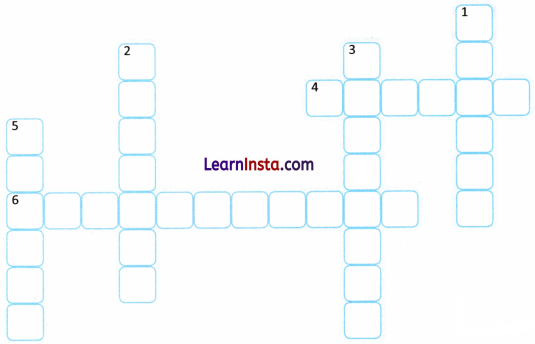
Across
4. SI unit of time
6. The complete to-and-fro movement of the pendulum from its mean position and back
Down
1. The motion of an object moves along a straight line
2. An instrument used to measure time by changing the position of the shadow
3. Motion of a simple pendulum
5. Modern most precise modern clock
Activities
A. Explore the Indian Railways timetable to identify trains (Passenger, Express, Superfast, Shatabdi, and Rajdhani) departing from New Delhi Railway Station. Determine their next stations, calculate the distance and time taken between stations, and compute the average speed of the trains. Identify which train has the highest average speed.
B. Go to a playground with swings and use a stopwatch to measure the time taken for the swing to complete 10 oscillations. Try swings of different lengths and observe how the time period changes with the length of the swing. Also, let children of different weights try the swing and see if their weight affects the time it takes to complete one swing.