Each of our Ganita Prakash Class 6 Worksheet and Class 6 Maths Chapter 2 Lines and Angles Worksheet with Answers Pdf focuses on conceptual clarity.
Class 6 Maths Chapter 2 Lines and Angles Worksheet with Answers Pdf
Lines and Angles Class 6 Maths Worksheet
Class 6 Maths Chapter 2 Worksheet with Answers – Class 6 Lines and Angles Worksheet
Choose the correct option.
Question 1.
In the following figure, the number of line segments is

(a) 4
(b) 8
(c) 6
(d) 10
Answer:
(d) 10
Question 2.
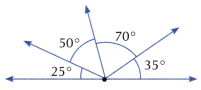
In the given figure, the number of obtuse angles is/are
(a) 2
(b) 3
(c) 4
(d) 5
Answer:
(c) 4
Question 3.
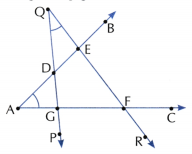
The number of marked common points in the given two angles of the given figure is
(a) 1
(b) 2
(c) 3
(d) 4
Answer:
(d) 4
Question 4.
The measure of a complete angle is
(a) 90°
(b) 180°
(c) 270°
(d) 360°
Answer:
(d) 360°
Question 5.
A wheel has 48 spokes. What is the degree measure of the angle between two spokes next to each other?
(a) 15°
(b) 22°
(c) 7\(\frac{1}{2}\)°
(d) 10°
Answer:
(c) 7\(\frac{1}{2}\)°

Assertion (A) & Reason (R) Questions.
Directions.: In the following questions, a statement of Assertion (A) is followed by a statement of Reason (R). Choose the correct option as:
(a) Both Assertion (A) and Reason (R) are true and Reason (R) is the correct explanation of Assertion (A).
(b) Both Assertion (A) and Reason (R) are true but Reason (R) is not the correct explanation of Assertion (A).
(c) Assertion (A) is true but Reason (R) is false.
(d) Assertion (A) is false but Reason (R) is true.
Question 1.
Assertion. (A): The Sharper the tip, the thinner will be the dot.
Reason (R): A point determines a location.
Answer:
(b) Both Assertion (A) and Reason (R) are true but Reason (R) is not the correct explanation of Assertion (A).
Question 2.
Assertion (A): In the given figure, p, q, a, aad m are the Lines passing through a point 0.
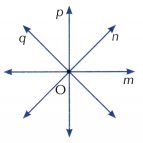
Reason (R): An infinite number of lines can be drawn through a single point.
Answer:
(a) Both Assertion (A) and Reason (R) are true and Reason (R) is the correct explanation of Assertion (A).
Question 3.
Assertion (A): When the hand of a clock moves from one position to another, it turns through an angle.
Reason (R): The angle for one revolution is a complete angle.
Answer:
(b) Both Assertion (A) and Reason (R) are true but Reason (R) is not the correct explanation of Assertion (A).
Question 4.
Assertion (A): If an angle formed where two line segments meet goes beyond a right angle, it is an obtuse angle.
Reason (R): An obtuse angle has a measurement greater than 90° but less than 180°.
Answer:
(a) Both Assertion (A) and Reason (R) are true and Reason (R) is the correct explanation of Assertion (A).
Question 5.
Assertion (A): Angles of measures 180° and 360° are reflex angles.
Reason (R): An angle whose measure is greater than 180° but less than 360° is called a reflex angle.
Answer:
(d) Assertion (A) is false but Reason (R) is true.
B. Fill in the blanks.
1. The number of right angles in a straight angle is ___________________ and in a complete angle is ___________________
Answer:
two, four
2. Two lines that meet at right angles are called ___________________ lines.
Answer:
perpendicular
3. A straight angle is ___________________ of a full turn.
Answer:
half
4. A tool that is used to measure the magnitude of an angle is called a ___________________
Answer:
Protractor
5. ___________________ is the unit of measuring an angle.
Answer:
Degree
C. True and False.
1. If the arms of an angle on the paper are increased, the angle increases.
Answer:
False
2. Many lines can pass through two given points.
Answer:
False
3. An angle of 0° is an acute angle.
Answer:
False
4. Measures of the two angles between the hour and minute hands of a clock at 9 O’clock are 270°and 90°
Answer:
True
5. The line that bisects a given angle is called the perpendicular of the angle
Answer:
False
6. While measuring an angle, the centre of the protractor is always on the vertex of the angle.
Answer:
True
D. Solve the following
Question 1.
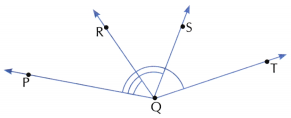
Find the degree measures of all the angle formed in the given figure using protractor.
_________________________________
_________________________________
Question 2.
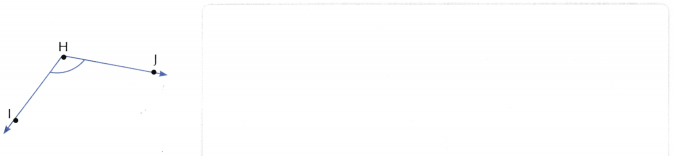
Draw an angle whose degree measure is the same as the angle given in the adjacent figure.
Question 3.
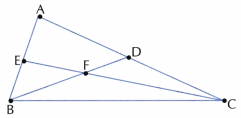
Write down all the angles that are less than the 180° in the given figure.
_________________________________
_________________________________
Answer:
∠BAC, ∠BEC, ∠AEC, ∠ABD, ∠ABC, ∠DBC, ∠EFD, ∠EFB, ∠DFC, ∠BFC, ∠DCE, ∠BCE, ∠ADB, ∠CDB.
Question 4.
In the adjoining figure,
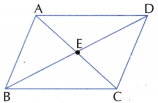
(a) name any four angles that appear to be acute.
(b) name any two angles that appear to be obtuse.
(a) _________________________________
(b) _________________________________
Answer:
(a) ∠BAC, ∠CAD, ∠BDC, ∠DCA
(b) ∠AED, ∠BEC
Question 5.
Draw two acute angles and one obtuse angle without using a protractor. Estimate the measures of the angles. Measure them with the help of a protractor and see how much accurate is your estimate.
Question 6.
Can we have two obtuse angles whose sum is
(a) a reflex angle? Why or why not?
_________________________________
Answer:
Yes
(b) a complete angle? Why or why not?
_________________________________
Answer:
No
Question 7.
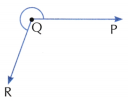
How will you measure the given angle by using protractor. Write the steps in your word. Also, write its measure.
_________________________________
_________________________________
_________________________________
Question 8.
Using a protractor draw an angle of measure 262°. Also, write its steps of construction in your word.
_________________________________
_________________________________
_________________________________
Rohan, and Seema are the students of class 6. Today their maths teacher is about to teach ‘Geometry’.
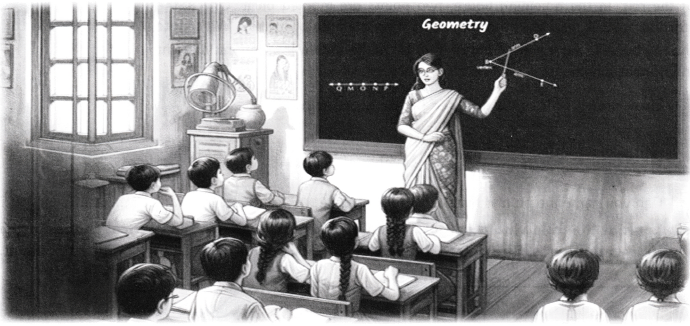
Teacker: Geometry has great importance in our life.
Rohan: Why is it so important?
Teacher: Without knowing geometry, we cannot imagine any form of art, measurement, architecture, engineering, cloth designing, etc. For example, while drawing a building construction plan, an architect uses his knowledge about the basic geometrical shapes such as points, lines, angles, etc. These are the basic ideas of geometry, which are the foundation stone of any geometrical concept, and will help us to understand more advanced topics in geometry at a later stage.
Seema: Could you please tell us about these basic geometrical shapes?
Teacher: Yes, I teach you the basic geometrical shapes.
Points: A tiny dot made by a sharp pencil or the tip of a compass on a plain B paper is called a point. It determines a precise location, but it has no length, breadth, or height.
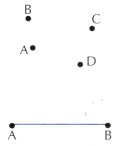
Line segment: The shortest distance between two points is called a line segment. In the adjoining figure, the straight line AB represents a line segment.
It is denoted by either \(\overline{\mathrm{AB}}\) or \(\overline{\mathrm{BA}}\), and the points A and B are called the end A points of the line segment \(\overline{\mathrm{AB}}\) or \(\overline{\mathrm{BA}}\).

Line: A line segment that extends endlessly on both sides (directions) is called a line. A line passing through two points, A and B, is written as AB. It can extend forever in both directions. Sometimes a line is denoted by a letter l or m.
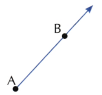
Ray: A ray is a portion of a line that starts from one point and extends infinitely in another direction.
The point from where a ray starts is called the starting point or initial point of the ray. In the adjoining figure, two points are marked on it. One is the starting point A, and the other is a point B on the path of the ray. We denote the ray by \(\overline{\mathrm{AB}}\). An infinite number of rays can be drawn from an initial point in different directions.
Question 1.
How many points do you see In the given figure?
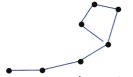
Number of points =
Can you name the points? Name them ___________________
Answer:
Number of points = 7, yes , i.e., A, B, C, D, E, F, G
Question 2.
Look at the following diagrams. Can you Identify the basic geometrical shapes In the following figures, like points, line segments, lines, and rays? Identify and write them.
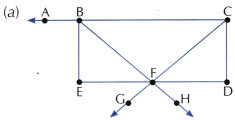
Points: ___________________
Line segments: ___________________
Lines: ___________________
Rays: ___________________
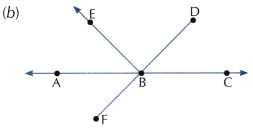
Points: ___________________
Line segments: ___________________
Lines: ___________________
Rays: ___________________
Answer:
(a) Points: A, B, C, D, E, F, G, H
Line segments: AB,BC,CD,DF,FE,EB,BF,FC,FG,FH
Line: 0
Rays: BA, CA, BH, CG, FG, FH
(b) Points: A, B, C, D, E, F
Line segments: AB,BC, AC,BE,BD,BF,FD
Line: AC
Rays:. BE, BA, BC
Question 3.
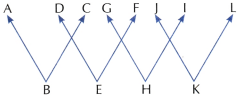
Write the name of the rays In the following diagram.
_________________________________
Answer:
BA, BC, ED, EF, HG, HI, KJ, KL
Question 4.
How many lines can be drawn passing through three points which are not In a straight line? (Using all the three points)
_________________________________
Answer:
None
Question 5.
Draw the following types of lines and write their proper geometrical notations.
(a) A line segment PQ
(b) A ray XY
(C) A line I
Question 6.
(a) Anuj marked a point ‘O’ on a piece of paper, and he wants to draw lines that will pass through the point ‘O’. How many lines can he draw that pass through the point ‘O’? Also, draw them.
_________________________________
Answer:
Infinite
(b) Again, he draws one more point, ‘P’ on the same paper, and now he wants to draw lines that will pass through both points, i.e., ‘O’ and ‘P’. How many lines can he draw that pass through the points O and P? Also, draw.
_________________________________
Answer:
One
Question 7.
Observe the adjoining figure and name the following.
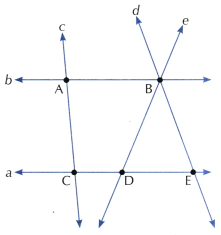
(a) line c in two other ways.
(b) line e in two other ways.
(c) Three line segment on line a.
(d) Two rays on line b.
(e) Four rays on line a.
Answer:
(a) \(\overleftrightarrow{\mathrm{AC}}, \overleftrightarrow{\mathrm{CA}}\)
(b) \(\overrightarrow{\mathrm{BD}}, \overrightarrow{\mathrm{DB}}\)
(c) \(\overline{\mathrm{CD}}, \overline{\mathrm{CE}}, \overline{\mathrm{DE}}\)
(d) \(\overrightarrow{\mathrm{BA}}, \overrightarrow{\mathrm{AB}}\)
(e) \(\overrightarrow{\mathrm{DC}}, \overrightarrow{\mathrm{EC}}, \overrightarrow{\mathrm{DE}}, \overrightarrow{\mathrm{CE}}\)
Question 8.
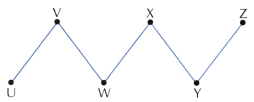
Name the line segments in the given figure.
Which of the six marked points lies on exactly one of the line segments?
Which are on two of the line segments?
Answer:
Line segment: UV, VW, WX, XY, YZ; U, Z, V, W, X,Y
ANGLES
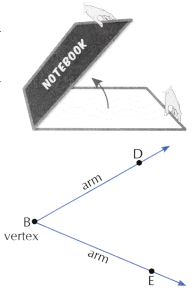
Teacher: Do you notice the formation of any geometric shapes when you open the cover of your books or notebooks?
Student: Yes, it is a shape formed by the two straight edges that joined at a point.
Teacher: Yes, it is an angle.
An angle is formed when two rays meet at a common end point.
An angle has two arms and a common starting point called a vertex or corner.
Here is an angle formed by rays BD and BE, where B is the common starting point. The point B is called the vertex of the angle, and the rays BD and BE are called the arms of the angle.
Question 9.
Look around you and identify the objects that form angles, draw angles on them by marking out rays and vertices.
Question 10.
Draw and label an angle with arms PQ and QR.
Question 11.
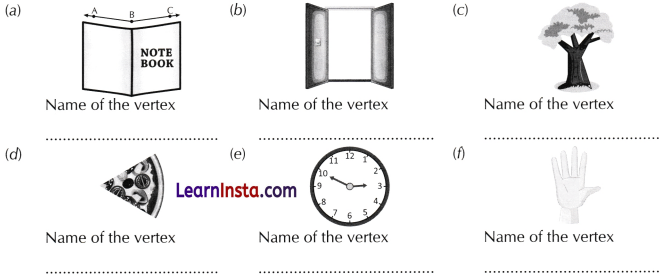
Can you find the angles In the given pictures? Draw the rays forming any of the angles and. name the vertex of the angle. One has been done for you.
Question 12.
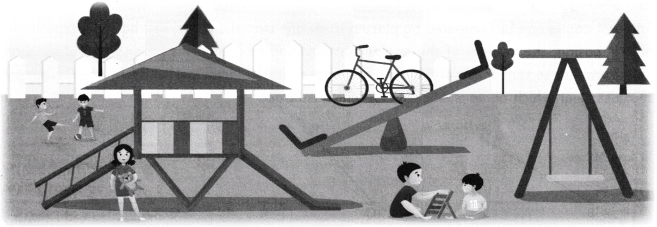
Observe the given picture and draw the rays forming any of the angles and name the rays and vertex of the angle. Also write them.
_________________________________
_________________________________
Question 13.
Name the angles marked in the given figure.
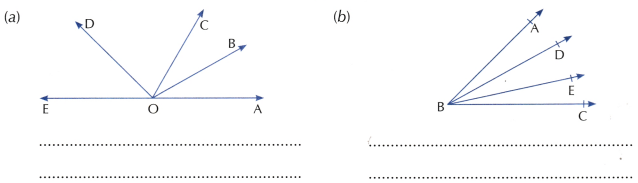
(c) Are the vertices of all angles same in the above diagrams? Why? Give reason.
_________________________________
_________________________________
Answer:
(a) ∠EOD, ∠EOC, ∠EOB, ∠EOA, ∠DOC, ∠DOB, ∠DOA, ∠COB, ∠COA, ∠BOA.
(b) ∠ABD, ∠ABE, ∠ABC, ∠DBE, ∠DBC, ∠EBC.
(c) Yes
Question 14.
In the adjoining figure, name the/oliowing angles using three letters:
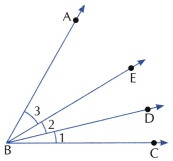
(a) ∠1 = _________________________________
(b) ∠2 = _________________________________
(c) ∠3 = _________________________________
(d) ∠1 + ∠2 = _________________________________
(e) ∠2 + ∠3 = = _________________________________
(f) ∠1 + ∠2 + ∠3 = _________________________________
(g) ∠CBA – ∠1 = _________________________________
Answer:
(a) ∠DBC
(b) ∠EBD
(c) ∠ABE
(d) ∠EBC
(e) ∠ABD
(f) ∠ABC
(g) ∠ABD
Comparing Angles
Any two angles can be compared by placing them one over the other, i.e., by superimposition. While superimposing, the vertices of the angles must overlap as it involves placing one angle directly on top of another so that their vertices and one of the arms coincide perfectly. After superimposition, it becomes clear which angle is smaller and which is larger.

The picture given above shows the two angles ∠ABC and ∠PQR superimposed. It is clear that ∠PQR is larger than ∠ABC.
If the corners or vertices of both of the angles match and both the arms overlap with each other, then we can say that the angles are equal in size.
In the figure given below, ∠AOB and ∠XOY are equal as arms OA, OX and OB, OY and vertices 0 are overlapping each other.

So, ∠ABC equals to ∠XOY.
Or we can say that it is formed by half of the half-turn.
Question 16.
Since a right angle Is half of a half-turn. So, how many right angles are there In a full (complete) turn? Give reason In your own words.
_________________________________
_________________________________
Answer:
4 Right angles
Question 17.
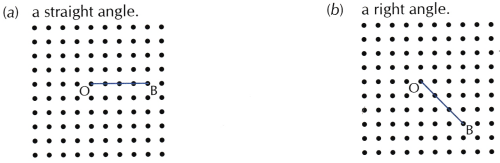
Join O to other grid points In the figures given below by a straight line to get:
Classification of the angles
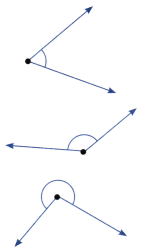
1. Angles that are less than a right angle, or in other words, less than a quarter turn, are called acute angles.
2. Angles that are greater than a right angle but less than a straight angle, or the turning of arm is more than a quarter turn and less than a half turn, are called obtuse angles.
3. Angles that are greater than a straight angle or less than a full turn are called reflex angles.
Question 18.
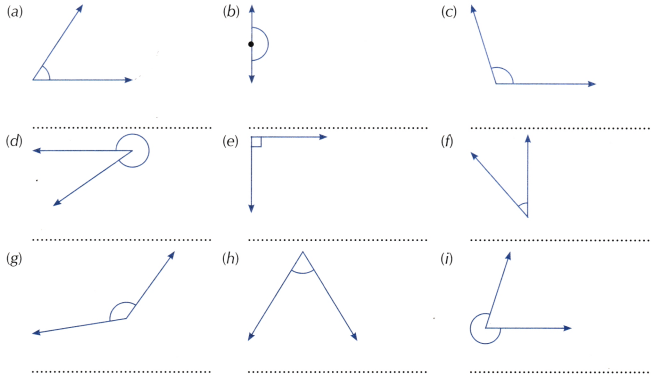
Identify each angle as acute, obtuse, right, straight, or reflex angle.
Answer:
(a) Acute angle
(b) Straight angle
(c) Obtuse angle
(d) Reflex angle
(e) Right angle
(f) Acute angle
(g) Obtuse angle
(h) Acute angle
(i) Reflex angle
Question 19.
Join O to other grid points in the figure by a straight line to get:
Question 20.
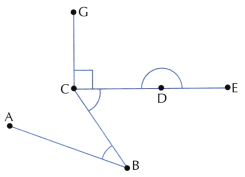
Identify the acute, obtuse, straight, or right angle in the following figure. Write their names.
_________________________________
_________________________________
_________________________________
Answer:
Acute angles: ∠ABC, ∠BCE
Obtuse angles: ∠GCB
Right angles: ∠GCE
Straight angles: ∠CDE
Think and Answer
Identify the acute, obtuse, or right angle formed in the letters of the word ‘ANGLE’. Also, draw them along the lines of the letters. Count them.

How many acute, obtuse, and right angles are there respectively?
Acute angles = ___________________
Obtuse angles = ___________________
Right angles = ___________________
Answer:
5, 2, 6
Question 21.
Write your name using straight lines only. Identify the acute, obtuse, or right angle formed in the letters of your name. Also, draw them along the lines of the letters. Count them.
Acute angles = ___________________
Obtuse angles = ___________________
Right angles = ___________________
Question 22.
Make a few acute angles and a few obtuse angles. Draw them in different orientations.
Think and Answer
If the sum of two angles is equal to an obtuse angle, then which of the following is not possible?
(a) One obtuse angle and one acute angle.
(b) One right angle and one acute angle.
(c) Two acute angles.
(d) Two right angles.
Answer:
(d) Two right angles.
MEASURING ANGLES
Sumit: Hey! Have you ever noticed the chakra in our national flag?
Slya: Yes, it is called the Ashoka chakra, and it is circular in shape. Do you know? It has 24 spokes, which divides it into 24 equal divisions.
Irjan: Do you know the angle between two consecutive spokes is 15 degrees?
Gurmeet: Degree? What is it?
Sumit: It is the unit used to measure an angle.
The angle at the centre of a circle is divided into 360 equal parts. The angle measure of each of these unit parts is 1 degree, which is written as 1°.
This unit part is used to measure any angle: the measure of an angle is the number of 1° unit parts it contains, inside it.
For example: In the following figure, the angle contains 30 units of 1° angle, so we can say that its angle measure is 30°.
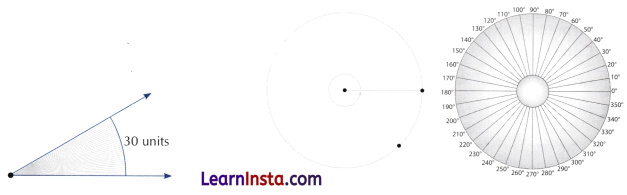
We measure the angles by using a protractor. It is a geometrical instrument in a semi-circular shape which is divided into 180 equal parts of 1°.
Question 23.
Write the magnitude of the following angles.
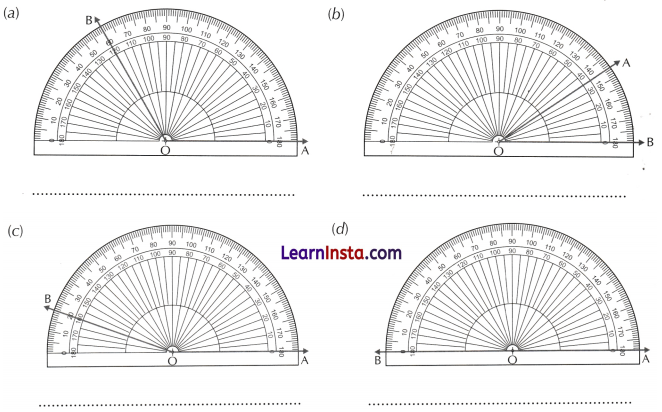
Answer:
(a) 120°
(b) 35°
(c) 160°
(d) 180°
Question 24.
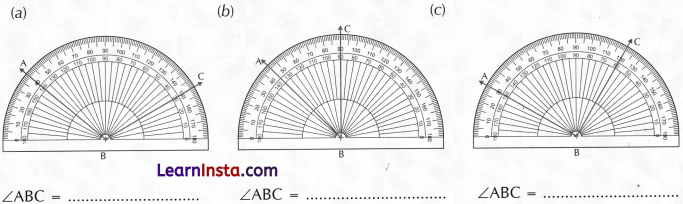
Measure the following angles using a protractor and write their magnitudes.

Think and Answer
What are the measures of the following angles? Write them.
Answer:
(a) 110°
(b) 45°
(c) 90°
Angles In a Clock
The hands of a clock make different angles at different times. The hour hand of a 12-hour clock moves 360° in 12 hours or \(\frac{360^{\circ}}{12}\) = 30° in 1 hour. The minute hand moves 360° in 60 minutes or \(\frac{360^{\circ}}{60}\) = 6° in one minute.
Question 25.
Find the angles formed between the hour and the minute hands in the following clocks.
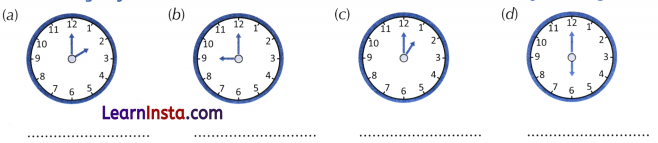
Answer:
(a) 60°
(b) 270°
(c) 30°
(d) 180°
Question 26.
What angles are formed bg tke hands oj the clock at:
(a) 4 O’clock
(b) 9 O’clock
(c) 11 O’clock
(d) 12 O’clock
Answer:
(a) 120°
(b) 270°
(c) 330°
(d) 0° or 360°
Question 27.
What angle will be made when the hands of the clock l.e.,
(a) the hour hand is at 2 and the minute hand
(b) the hour hand is at 7 and the minute hand is is at 10. at 4.
Answer:
(a) 240°
(b) 270°
DRAWING ANGLES
Question 28.
Draw angles of the following measures using a protractor.
(a) ∠ABC = 35°
(b) ∠DEF = 72°
(c) ∠PQR = 127°
(d) ∠ABC = 275°
Question 29.
Draw the Letter ‘K’ such. that the three angles formed are 30°, 120°, and 30° respectively.

Fun Time
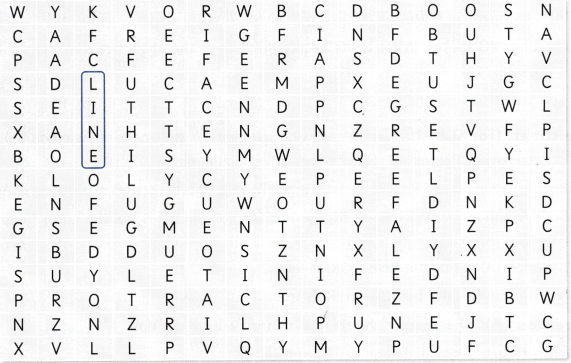
There are a few words related to the chapter Lines and Angles’ are hidden in this word search puzzle. Find as many words as you cart. One has been found for you.