Students rely on Class 8 Science Extra Questions and Class 8th Curiosity Chapter 10 Light: Mirrors and Lenses Extra Question Answer to improve their grades.
Class 8 Science Chapter 10 Light: Mirrors and Lenses Extra Questions
Class 8 Science Chapter 10 Extra Questions on Light: Mirrors and Lenses
Light: Mirrors and Lenses Class 8 Very Short Question Answer
Question 1.
What is the perpendicular drawn to the reflecting surface at the point of incidence called?
Answer:
Normal.
Question 2.
Which lens is thicker at the center than edges?
Answer:
Convex lens.
Question 3.
What is spherical mirror?
Answer:
A type of mirror whose reflecting surfaces are spherical.

Question 4.
What is the angle between the incident ray and the normal?
Answer:
Angle of incidence.
Question 5.
Which type of lens is present in the human eye?
Answer:
Convex lens.
Question 6.
What kind of image is seen on the outer surface of a steel spoon?
Answer:
Erect and diminished.
Question 7.
What kind of image does a concave lens form of a distant object?
Answer:
Erect and diminished
Question 8.
Name some applications of lenses.
Answer:
Lenses are used in eyeglasses, smartphones, cameras, telescopes, and microscopes.
Question 9.
What is the reflecting surface of a concave mirror like?
Answer:
It is curved inward like the inside of a spoon.
Question 10.
What happens to the size of image as you move closer to a concave mirror?
Answer:
Image becomes larger and erect.
Question 11.
What is a lens?
Answer:
A lens is a piece of transparent material, usually made of glass or plastic, which has curved surfaces.
Question 12.
Which type of lens converges the multiple light rays at a point?
Answer:
Convex lens.
Light: Mirrors and Lenses Class 8 Short Question Answer
Question 1.
The side mirror of a scooter got broken. The mechanic replaced it with a plane mirror. Mention any inconvenience that the driver of the scooter will face while using it.(NCERT Exemplar)
Answer:
Convex mirror produces image of smaller size and hence they can cover the objects spread over a large area. If the driver replaces side mirror with plane mirror, he will face the inconvenience of a narrower field of view, making it harder to see traffic behind. Plane mirrors reflect images of the same size and distance, so they show less area. This can make lane changing or turning unsafe, as the driver may miss vehicles in the blind spots.
Question 2.
State the two laws of reflection.
Answer:
The two laws of reflection are:
- The angle of incidence is equal to the angle of reflection.
- The incident ray, the normal, and the reflected ray all lie in the same plane.
Question 3.
A shopkeeper wanted to fix a mirror which will give a maximum view of his shop. What type of mirror should he use? Give reason. (NCERT Exemplar)
Answer:
He should use convex mirror because it forms images of smaller size and hence the shopkeeper would be able to view a larger area.
Question 4.
What happens when sunlight falls on a concave mirror?
Answer:
When sunlight falls on a concave mirror, it gets reflected and converged to a single point, producing a bright spot. This concentrated light can become hot enough to burn paper or produce smoke.
Question 5.
How can you identify a concave mirror by looking at your face in it?
Answer:
At very close distance, your image appears upright and enlarged but when you move away from the mirror and stand at a distance, it becomes inverted and keeps getting smaller as you move away from the mirror.
Question 6.
Draw figure showing the position of the plane mirror. Also label the angle of incidence and angle of reflection on it. (NCERT Exemplar)
Answer:
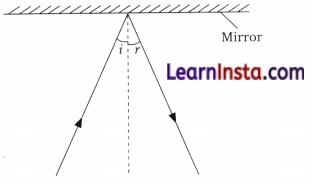
Question 7.
Write down the applications of concave mirrors.
Answer:
Concave mirror is used in the reflectors of torches, headlights of cars and scooters. Even a dental mirror used by a dentist for inspecting teeth is a concave mirror which provides an enlarged view of teeth when held close to the teeth inside the mouth.
Light: Mirrors and Lenses Class 8 Long Question Answer
Question 1.
You are given three mirrors of different types. How will you identify each one of them? (NCERT Exemplar)
Answer:
The three different types of mirrors – plane, concave, and convex can be distinguished by observing the size, orientation and behaviour of your image at different distances. Image formed by plane mirror is erect and is of the same size as the object. Image formed by concave mirror is real, inverted and larger. Image formed by convex mirror is smaller, erect and virtual.
Question 2.
What do you mean by lenses? Also, write about the different types of lenses along with a diagram.
Answer:
A lens is a piece of transparent material, usually made of glass or plastic, which has curved surfaces.
There are two types of lenses: convex and concave lenses:
(i) Convex lens: A convex lens is thicker at the middle than at the edges. It converges the light rays falling on it to a point. It is also known as a converging lens. When an object is placed close to a convex lens, it appears erect and magnified. As the object is moved farther away from the lens, the image becomes inverted. Initially, the image is larger in size, but as the distance increases further, the image becomes smaller and diminished.

(ii) Concave lens: A concave lens is thicker at the edges than at the middle. It diverges the light rays falling on it. It is also known as a diverging lens. An object placed in front of a concave lens always appears erect and smaller in size when viewed through the lens. The size of the image decreases further as the object is moved farther away from the lens.

Question 3.
What is reflection of light? State the laws of reflection. Explain by giving diagram.
Answer:
Reflection is a phenomenon in which a beam of light falls on some surface and returns back in different directions. It may be regular or irregular.
Following are the laws of reflection:
(i) When a ray of light falls on a reflecting surface it is reflected back in such a way that the angle of incidence is equal to the angle of reflection, i.e. ∠i=∠r
(ii) The incident ray, the normal and the reflected ray, all lie in the same plane.
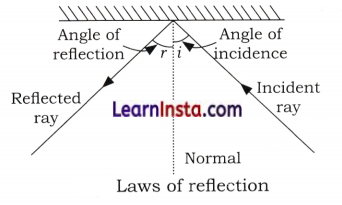
Light: Mirrors and Lenses Class 8 Skill-Based Questions
Question 1.
Draw a diagram to show the reflection of light and answer the following questions.
(i) What is angle of reflection (r) ?
(ii) What is angle of incidence (i)?
(iii) What is the relation between angle of incidence and angle of reflection (∠r) ?
Answer:
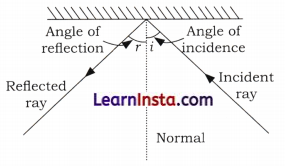
(i) The angle between the normal and reflected ray is called the angle of reflection (∠r )
(ii) The angle between normal and incident ray is called the angle of incidence (∠ i)
(iii) Angle of incidence = Angle of reflection or
Or ∠ i = ∠ r
Question 2.
Observe the figure given as figures A and B carefully.

The given figures show the path of light through lenses of two different types, represented by rectangular boxes A and B. What is the nature of lenses A and B ? (NCERT Exemplar)
Answer:
A – Convex lens.
B – Concave lens.
Question 3.
There is a mistake in each of the following ray diagrams given as Fig. a, b, and c. Make the necessary correction(s). (NCERT Exemplar)

Answer:
According to the laws of reflection, angle of incidence is always equal to the angle of reflection. And the normal line is at 90° to the plane. In all of these cases after correction the figure should be as follows:

Question 4.
Draw the multiple light rays when passing through a thin glass plate, convex lens, concave lens.
Answer:
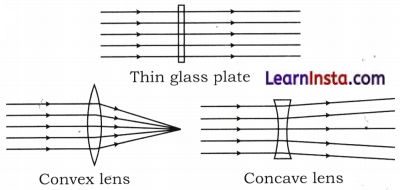
Light: Mirrors and Lenses Class 8 Quiz Questions
Question 1.
What would happen if we incident the light along the normal?
Answer:
Light will be reflected back along the normal.
Question 2.
Which part of the mirror reflects light?
Answer:
Surface
Question 3.
Name the lens which is thicker at the middle.
Answer:
Convex lens
Question 4.
How many types of spherical mirrors are there? Name them.
Answer:
Two types:
(i) Concave mirror
(ii) Convex mirror
Question 5.
Which lens is also known as diverging lens?
Answer:
Concave lens
Question 6.
When an object is placed behind a concave lens and seen through the lens what type of image is formed?
Answer:
Erect and diminished image is formed
Question 7.
Why do dentists use the concave mirror during the teeth check up?
Answer:
Erect and diminished image is formed
Question 8.
What is the ray of light called that strikes the surface of a mirror?
Answer:
Incident ray
Question 9.
Is a concave mirror used as a surveillance mirror in malls?
Answer:
No
Question 10.
What are the devices called that use mirrors and lenses to focus sunlight into a small area
Answer:
Solar concentrators
Light: Mirrors and Lenses Class 8 Case Based Questions
Shilu visited a science centre and observed her reflection in different curved mirrors. In one mirror, her face appeared larger, in another, it appeared upside down and in the third, it appeared smaller. A guide explained that she was looking into spherical mirrors, both concave and convex.
I. What type of mirror made Shilu’s face appear larger?
II. What kind of mirror made her image appear smaller?
III. What does an inverted image indicate about the mirror?
OR
Are spherical mirrors the same as plane mirrors?
Answer:
I. Concave mirror
II. Convex mirror
III. The mirror is concave and the object is not placed close to the mirror that’s why it forms an inverted image.
OR
No, spherical mirrors are curved (either concave or convex), while plane mirrors are flat. Spherical mirrors can form magnified, diminished, real, images depending on the object’s position. Plane mirrors always form erect and same-size images.
Light: Mirrors and Lenses Extra Questions for Practice
Multiple Choice Questions
Question 1.
Which of the following surfaces always reflects a diminished, erect image?
(a) Concave mirror
(b) Plane mirror
(c) Convex mirror
(d) Concave lens
Question 2.
What does a convex lens do to light rays?
(a) It makes light rays spread out.
(b) It bends light rays inward to meet at a point.
(c) It allows light rays to pass without bending.
(d) It reflects light like a mirror.
Question 3.
Which type of mirror provides a wide field of view and is commonly used in security and surveillance systems?
(a) Concave mirror
(b) Convex mirror
(c) Plane mirror
(d) None of these
Question 4.
Read the given statements and select the correct option.
Assertion (A): A real image can be obtained on a screen.
Reason (R): Real images are always upright,
(a) Both A and R are true and R is the correct explanation of A.
(b) Both A and R are true but R is not the correct explanation of A
(c) A is true but R is false.
(d) A is false but R is true.
Question 5.
Match the items in column I with those in column II.
Column I — Column II
(i) Concave mirror — (p) Focuses sunlight to produce very high heat
(ii) Convex mirror — (q) Converging lens
(iii) Convex lens — (r) Diverging lens
(iv) Concave lens — (s) Torch reflector
(v) Solar concentrators — (t) Rear-view mirror
(a) (i)-(s),(ii)-(t),(iii)-(q),(iv)-(r),(v)-(p)
(b) (i)-(p), (ii)-(r), (iii)-(q), (ii)-(s), (v)-(t)
(c) (i)-(t),(i)-(q),(iii)-(r),(iv)-(p),(i)-(s)
(d) (i) – (q), (ii) – (p), (iii) – (s), (iv) – (t), (iv) – (r)
Very Short Answer Type Questions
Question 1.
What is the nature of image formed by a concave mirror when the object is far away?
Question 2.
Which mirror is used by shopkeepers to monitor theft?
Question 3.
What kind of mirror is used in headlights of vehicles?
Question 4.
Define the term reflected ray.
Question 5.
Name the mirror that converges light rays.
Short Answer Type-I Questions
Question 1.
State two characteristics of the image formed by a convex mirror.
Question 2.
What is meant by lateral inversion?
Question 3.
Why cannot a concave lens burn paper like a convex lens?
Question 4.
Mention two differences between concave and convex lenses.
Question 5.
Why does a convex mirror provide a wider field of view compared to a plane mirror?
Short Answer Type-II Questions
Question 1.
Describe any two examples how concave mirrors are used in the medical field.
Question 2.
How can you differentiate between concave and convex lenses using an object?
Question 3.
What is the shape of the surface of water drop? Explain giving example.
Question 4.
Write down the function of solar concentrators.
Question 5.
What are spherical mirrors? Also write down about the concave and convex mirrors.
Long Answer Type Questions
Question 1.
Draw and explain how incident and reflected rays behave according to the laws of reflection.
Question 2.
Describe how a convex lens can focus sunlight to burn a paper, and explain the science behind it.
Question 3.
Compare and contrast the behavior of light rays when they interact with different types of mirrors and lenses. Support your answer with suitable ray diagrams.
Suggested Projects And Activities
Question 1.
Visit a nearby hospital. You can also visit the clinic of an ENT specialist, or a dentist. Request the doctor to show you the mirrors used for examining ear, nose, throat and teeth. Recognise the kind of mirror used in these instruments and write them in your notebook. Discuss them with your classmates.
Question 2.
Visit a laughing gallery in a science centre or a science park or a village mela. You will find some large mirrors there. You can see your distorted and funny images in these mirrors. Try to find out the kind of mirrors used there.