Each of our Ganita Prakash Class 6 Worksheet and Class 6 Maths Chapter 3 Number Play Worksheet with Answers Pdf focuses on conceptual clarity.
Class 6 Maths Chapter 3 Number Play Worksheet with Answers Pdf
Number Play Class 6 Maths Worksheet
Class 6 Maths Chapter 3 Worksheet with Answers – Class 6 Number Play Worksheet
Choose the correct option.
Question 1.
Which one is the greatest among the following numbers?

(a) 45174
(b) 45871
(c) 45781
(d) 46871
Answer:
(d) 46871
Question 2.
Which one is the smallest among the following numbers?

(a) 34787
(b) 37847
(c) 38747
(d) 34877
Answer:
(a) 34787
Question 3.
In the following number grid, the supercell(s) is/are

(a) 8628, 7880, 8050
(b) 8628, 7880
(c) 7880, 8050
(d) 4935, 3708, 5538
Answer:
(a) 8628, 7880, 8050

Question 4.
How mang numbers have two digits from numbers 1 to 100?
(a) 89
(b) 91
(c) 90
(d) 99
Answer:
(c) 90
Question 5.
Among the given numbers the 2-digit palindromic number is
(a) 89
(b) 91
(c) 90
(d) 99
Answer:
(d) 99
Question 6.
Which one of the following is the Kaprekar Constant?
(a) 6471
(b) 6417
(c) 6174
(d) 6714
Answer:
(c) 6174
Question 7.
The sum of the greatest 5-digit number and the smallest 4-digit number is a
(a) 5-digit number
(b) 6-digit number
(c) 4-digit number
(d) 7-digit number
Answer:
(b) 6-digit number
Question 8.
Which of the following number sequence show the Collatz Conjecture?
(a) 44 → 22 → 11 → 10 → 5 → 1 6 → 8 → 4 → 2 → 1
(b) 13 → 40 → 20 → 10 → 5 → 16 → 8 → 4 → 2 → 1
(c) 10 → 31 → 94 → 48 → 24 → 12 → 6 → 3 → 10 → 5 → 16 → 8 → 4 → 2 → 1
(d) 20 → 10 → 5 → 2 → 1
Answer:
(b) 13 → 40 → 20 → 10 → 5 → 16 → 8 → 4 → 2 → 1
Assertion (A) & Reason (R) Questions.
Directions.: In the jollowing questions, a statement of Assertion (A) is followed by a statement of Reason (R). Choose the correct option as:
(a) Both Assertion (A) and Reason (R) are true and Reason (R) is the correct explanation of Assertion (A).
(b) Both Assertion (A) and Reason (R) are true but Reason (R) is not the correct explanation of Assertion (A).
(c) Assertion (A) is true but Reason (R) is false.
(d) Assertion (A) is false but Reason (R) is true.
Question 1.
Assertion (A): 64 + 46 = 110 → 110 + 011 = 121 a palindromic number.
Reason (R): A number that reads the same from left to right and from right to left is called a palindromic number.
Answer:
(b) Both Assertion (A) and Reason (R) are true but Reason (R) is not the correct explanation of Assertion (A).
Question 2.
Assertion (A): In the given number grid, the coloured cells represent supercells.

Reason (R): A cell becomes a supercell if the number in it is greater than all the numbers in its neighbouring cells.
Answer:
(a) Both Assertion (A) and Reason (R) are true and Reason (R) is the correct explanation of Assertion (A).
B. Fill In the blanks.
1. 5-digit number + 4-digit number gives a ____________ or ____________ numbers.
2. 73400 = 2 × 30000 + 3 × 1500 + 200 + 8 × ____________ + ____________ × 100
3. A 5-digit palindromic number using the digits 1, 2, and 3 is ____________
4. There are total ____________ 6-digit numbers in all.
5. By adding 1 to the greatest ____________ digit number, we get smallest 6-digit number.

Answer:
1. 5-digit, 6-digit
2. 1000, 7 (Answer may vary)
3. 12321 (Answer may vary)
4. 900,000
5. 5
C. Match the following.
Question 1.
| Column A | Column B |
| 1. 7 × 100000 + 3 × 10000 + 2 × 1000 + 2 × 100 + 3 × 10 + 4 | (a) Predecessor of 100000 |
| 2. A five-digit number greater than 99998 | (b) 24000 |
| 3. Kaprekar Constant | (c) 7641 |
| 4. An average person takes breaths in a day. | (d) 732234 |
| 5. The greatest 4-digit number formed with 1, 4, 7 and 6 | (e) 6174 |
Answer:
| Column A | Column B |
| 1. 7 × 100000 + 3 × 10000 + 2 × 1000 + 2 × 100 + 3 × 10 + 4 | (d) 732234 |
| 2. A five-digit number greater than 99998 | (a) Predecessor of 100000 |
| 3. Kaprekar Constant | (e) 6174 |
| 4. An average person takes breaths in a day. | (b) 24000 |
| 5. The greatest 4-digit number formed with 1, 4, 7 and 6 | (c) 7641 |
D. Answer the following.
Question 1.
Write any six numbers in the table such that the second smallest number becomes a supercell.

Answer:

Question 2.
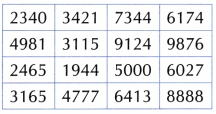
In the given number grid colour the supercells.
Question 3.
Take a number, 3444. Can you make a Kaprekar Constant for 4 digits? If yes, can you make the Kaprekar constant with the number 2222? If not, find out the reason why it fails.
Answer:
No
Question 4.
Write one 5-digit number and two 3-digit numbers such that their sum is 23,67°).
Answer:
22,450 + 614 + 615 (Answer may vary)
Question 5.
Make Collatz sequences for the following numbers.
(a) 32
(b) 45
(c) 50
Answer:
(a) 32,16, 8, 4, 2,1
(b) 45,136, 68, 34, 17, 52, 26, 13, 40, 20, 10, 5, 16, 8, 4, 2, 1.
(c) 50, 25, 76, 38, 19,58, 29, 88, 44, 22, 11, 34, 17, 52, 26, 13, 40, 20, 10, 5, 16, 8, 4, 2, 1.
Question 6.
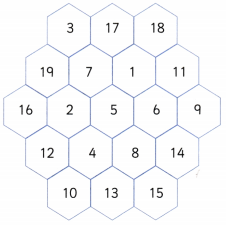
Here is a magical hexagon whose magical constant is 38. Colour the supercells such that the numbers in any adjacent cells (vertical or slant) are less than the number in the supercell.
Raman, Karan, Neha, and Riya are cousins. They went to the park with their other friends of the society in the evening.
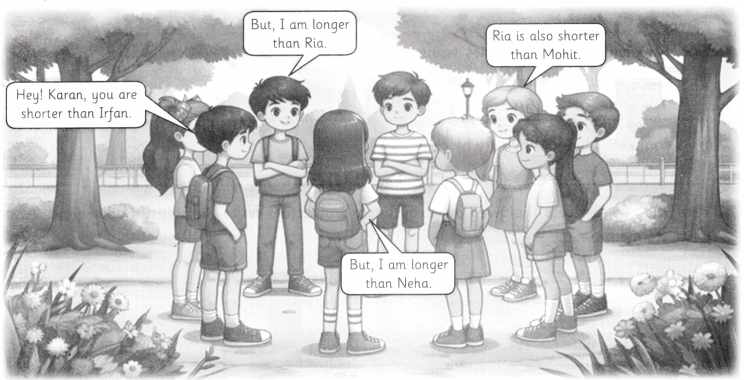
Karart’s father is watching the kids. He interrupted and told them “Let’s play a game”.
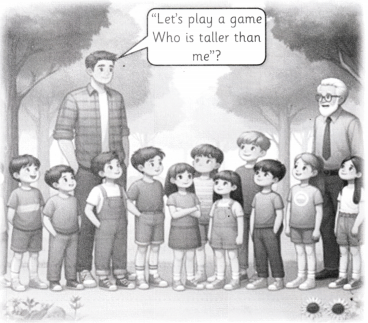
In the game, each child will say the number of taller neighbours they have.
He instructs them to stand in a row randomly, and then each child will say a number 0, 1, or 2, depending upon taller neighbours they have.
A child says ‘1 ’ if there is only one taller child standing next to them.
A child says ‘2’ if both the children standing next to them are taller.
A child says ‘0’ if neither of the children standing next to them is taller.
Question 1.
As per the instructions given by the Karans father, write the numbers 0, 1, or 2 in the bubbles.
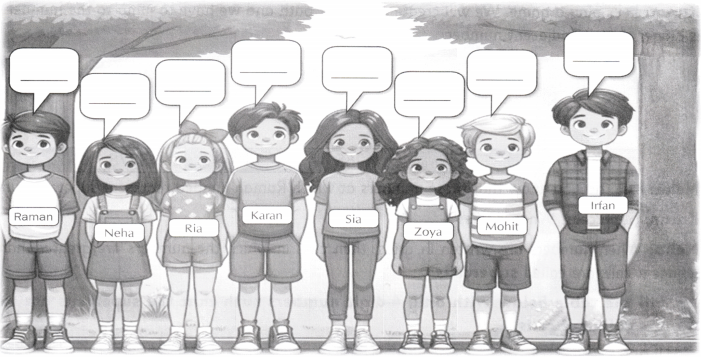
Answer:

Question 2.
In the above picture, if each number is read together, then what number will you get? Write it. Also, write in word?
Answer:
02101210
Question 3.
How do you rearrange the children to get number 1,11,11,111? Write the names of tke kids in that order.
Answer:
Zoya, Neha, Ria, Mohit, Raman, Sia, Karan, Irfan.
Question 4.
Is the number obtained in Q.2 smallest 8-digit number? IJ not, then justijy your reason. Also, write tke smallest 8-digit number in numerals and in words.
Answer:
No; 1,00,00,000, One crore 99999999;
Question 5.
Write the greatest 8-digit number in numerals and also in words. How will you get it by the greatest 7-digit number? Explain.
Answer:
Nine crore ninety-nine lakh ninety-nine thousand nine hundred ninety- nine.
Question 6.
Rearrange the children by writing their names to get tke number sequence 1,0, 2, 0, 2, 0
Answer:
Ria, Sia, Mohit, Karan, Neha, Raman, Zoya, Irfan.
Supercells
Karan: Let’s play a game. We will create a number path and we have to jump to the number which is bigger than its adjacent number.

Neha: Hey, do you know that these numbers at which Raman jumped represent supercell numbers? Karan: Supercells. What is this?
Neha: When numbers are written in grids, then cells in which the numbers are greater than their adjacent cells are called supercells.
Question 7.
Fill the table below with only 4-digit numbers such that the supercells are exactly the coloured cells.

Answer:

Question 8.
Colour the supercells in the following number grids.

Question 9.
Colour the supercells in the following given grids.

Question 10.
Complete the table with 5-digit numbers whose digits are 1, 0, 6, 3, and 9 in some order. Only a coloured cell should have a number greater than all its neighbours.

After completing the table, (a) encircle the biggest number, (b) tick the smallest even number, and (c) cross out the smallest number greater than 50,000 in the table.
Answer:
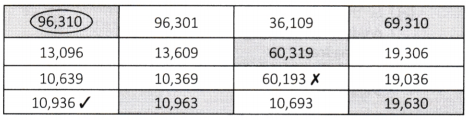
Question 11.
Take a number 8739. How many possible 4-digit numbers can you make by shifting the digits in it? Write these numbers in a tabular form. Colour the supercells in it.

Can you identify the smallest and the greatest numbers among the given numbers?
Write them.
Smallest number: ____________ Greatest number: ____________
Answer:
21;
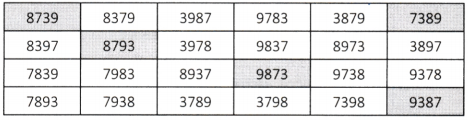
3789, 9873
Question 12.
Fill in the table below to get as many supercells as possible. Use numbers between 1001 and 2000 without repetitions.

Answer:

Question 13.
Colour the supercells of the following 4 by 4 magic square whose magical sum is 34.
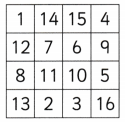
Question 14.
Compare the numbers given in the grid by colouring the supercell. Find which number is the greatest and which one is the smallest. Rearrange the number in ascending order.

Ascending order: ____________
Answer:
3897; 3107

PATTERNS OF NUMBERS ON THE NUMBER LINE
A number line is a straight line on which numbers are marked at equal distances.

The number from left to right is greater than the previous number, and the number on the right of the other number is always greater than the number on the left of the number line.
Question 15.
Represent the numbers 180, 200, 230, 270, and 300 on the number line.

Answer:

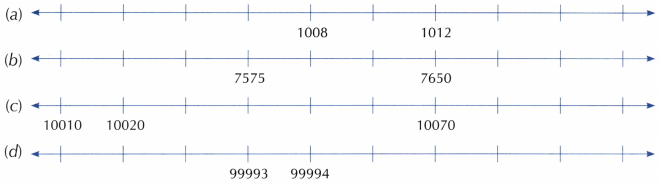
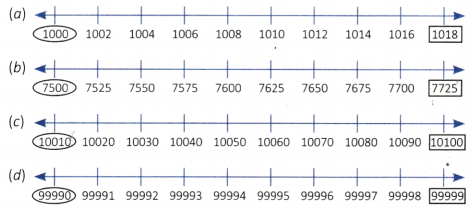
Question 16.
Identify the numbers marked on the number lines given below and label the remaining positions. Also, put a circle around the smallest number and a box around the largest number In each of the number lines below.
Answer:
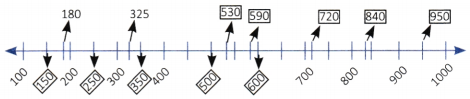
Question 17.
Observe the following number lines. And mark the following numbers: 250, 720, 500, 600, 950, 590, 150, 350, 530, and 840 on It.

Answer:
PLAYING WITH DIGITS
We are writing any number with digits 0, 1, 2, 3, 4 and so on.
Question 18.
Find out from 1 to 99999, know many:
(a) 1-digit numbers: ____________
(b) 2-digit numbers: ____________
(c) 3-digit numbers: ____________
(d) 4-digit numbers: ____________
(e) 5-digit numbers: ____________
Answer:
(a) 9
(b) 90
(c) 900
(d) 9,000
(e) 90,000
DIGIT SUMS OF NUMBERS
Let us observe the following examples
7 + 9 = 16;
8 + 8 = 16;
9 + 7 = 16;
1 + 6 + 9 = 16;
1 + 7 + 8 = 16;
1 + 8 + 7 = 16;
1 + 9 + 6 = 16;
2 + 5 + 9 = 16, etc.
Clearly, on adding up the digits of certain numbers, the sum is same.
Can you find some more numbers whose sum of the digits is 16?
Question 19.
Write the 5 numbers whose sum of the digits Is 18. Also, find the smallest number and the greatest number among them.
Answer:
99, 945, 8433, 95121, 90018; smallest number = 99,
greatest number = 95121
Think and Answer
Can you find the smallest and the greatest numbers whose sum oj the digits Is 12? Give reasons and find these if possible.
Answer:
Smallest number -39, greatest number is not possible.
Digit Detectives
Question 20.
Among the numbers 1-100, how many times will the digit ‘0’ occur?
Answer:
11
Question 21.
Among the numbers 1-200, how many times will the digit ‘9’ occur?
Answer:
40
Question 22.
Among the numbers 100-500, how many times will the digit ‘5’ occur?
Answer:
81
Think and Answer
How many 6-digit numbers are there in all?
Answer:
900,000
PRETTY PALINDROMIC PATTERNS
The numbers that read the same from left to right and from right to left are called palindromes or palindromic numbers
The numbers 121, 313, and 222 are some examples of palindromes using the digits 1, 2, and 3.
Question 23.
Write all possible 3-digit palindromes using the digits 1, 2, and 3.
Answer:
111, 121,131, 222, 212, 232, 313, 323, 333.
Question 24.
Write all possible 4-digit palindromes under 2000.
_____________________________________
_____________________________________
Reverse-and-add Palindromes
- Start with a 2-digit number.
- Add this number to its reverse.
- Stop if you get a palindrome; else repeat the steps of reversing the digits and adding till to get a palindrome.
For Example
(a) 37 + 73 = 110 → 110+ 011 = 121, a palindromic number.
(b) 67 + 76 = 143 → 143 + 341 = 484, a palindromic number.
Answer:
1001, 1111, 1221,1331, 1441,1551,1661,1771, 1881, 1991.
Question 25.
Use the reverse-and-add method to find the palindromic numbers for the following numbers:
(a) 48
(b) 78
(c) 85
(d) 95
Answer:
(a) 363
(b) 4884
(c) 484
(d) 1111
THE MAGIC NUMBER OF KAPREKAR
Let us take any 4-digit number, say 4286.
Make the largest number Jrom the digits oj the number.
Call it A.
A = 8642
Make the smallest number Jrom these digits. Call it B.
B = 2468
Subtract B from A. Call it C.
C = A – B = 8642 – 2468 = 6174
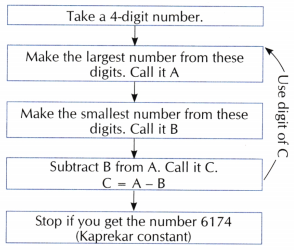
The number ‘6174’ is called the ‘Kaprekar constant’.
Sometimes we repeat the entire process many times to get the ‘Kaprekar constant’, i.e., 6174. In such cases, we consider C as A in each time.
Let us take another 4-digit number 6538 to Jind the ‘Kaprekar constant’.

The Kaprekar constant
Here, the number 6538 takes 8 rounds to reach the ‘Kaprekar constant’.
Take any 4-digit number and find the ‘Kaprekar constant’ by following the above procedure.
Think and Answer
How many rounds does your year oj birth take to reach the Kaprekar constant?
CLOCK AND CALENDAR NUMBERS
Question 26.
Find out all possible times on a 12-hour clock of each of them in the form of palindromic numbers, as: 10:01, 3:13, 9:29, etc.
Question 27.
Supriya has her birthday on 12/02/2021 where the digits read the same from left to right and from right to left. Find all possible dates of this form from the past.
Question 28.
The time now is 11:11. How many minutes go until the clock shows the next palindromic time? What about the one after that?
Answer:
70 min, 40 min
MENTAL MATH
Supriya’s mother went to the market to buy some groceries. The grocer gives her the bill, and the total amount of the bill is ₹ 2950.
Mother: Supriya, pay the bill amount in cash.
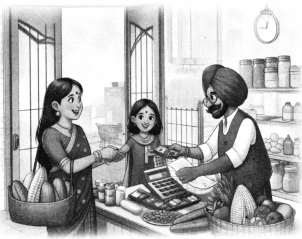
Supriya took out 3 notes of ₹500, 5 notes of ₹200, 4 notes of ₹ 100, and 1 note of ₹ 50 from the mother’s purse. So, the total bill amount can be shown as: ₹ 2950 = ₹ 500 × 3 + ₹ 200 × 5 + ₹ 100 × 4 + ₹ 50 × 1
Mother: You should give 6 notes of ₹ 500 to get back the balance.
In this case, the seller would return a ₹ 50 note to her.
So, the amount can be shown as: ₹ 2950 = ₹ 500 x 6 – ₹ 50
Now, observe the numbers written.
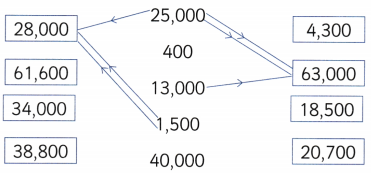
Numbers in the middle column are added in different ways to get the numbers on the sides (1500 + 1500 + 25000 = 28000 or 2 × 1500 + 25000 – 28000).
The numbers in the middle can be used as many times as needed to get the desired sum.
Draw arrows from the middle to the numbers on the sides to obtain the desired sums.
Question 29.
Get the following a numbers by using the numbers given in the boxes by using both addition aad multlplicatioa.

(a) 27700
_____________________________________
_____________________________________
(b) 65800
_____________________________________
_____________________________________
(c) 71100
_____________________________________
_____________________________________
Answer:
(a) 24000 + 1500 + 1000 + 500 × 2 + 200
(b) 2 × 24000 + 3 × 5000 + 2 × 1000 + 4 × 200
(c) 10 × 5000 + 10 × 1000 + 5 × 2000 + 500 + 600 (Answer may vary)
Digit aad Operations
Let us explore the number of digits in the result when we add or subtract the numbers up to 5 digits.
- The sum of two 1-digit numbers is a 1-digit or a 2-digit number. But the difference between two 1- digit numbers is always a 1-digit number.
- The sum of two 2-digit numbers is a 2-digit or a 3-digit number. But the difference between two 2- digit numbers is a 1-digit or a 2-digit number.
- The sum of two 3-digit numbers is a 3-digit or a 4-digit number. But the difference between two 3- digit numbers is a 1-digit, 2-digit, or 3-digit number.
- The sum of two 4-digit or 5-digit number. The difference between two 4-digit numbers is a 1-digit, 2-digit, 3-digit, or 4-digit numbers.
- The sum of two 5-digit numbers is a 5-digit or 6-digit number. But the difference between two 5-digit numbers is a 1-digit, 2-digit, 3-digit, 4-digit, or a 5-digit number.
Question 30.
Write an example for each of the below cases whenever possible.
(a) 4-digit number + 4-digit number = sum greater 10,000
(b) 5-digit number + 4-digit number = a 6-digit number
(c) 5-digit number + 5-digit number = a 5-digit number greater than 60,000
(d) 5-digit number – 5-digit number = a 3-digit number less than 400
(e) 5-digit number – 5-digit number = a 4-digit number equal to 2500
Answer:
(a) 8576 + 9120 = 17696
(b) 52,360 + 8470 = 60,830
(c) 50,000 + 20,000 = 70,000
(d) 54,000 – 53,736 = 264
(e) 42,386 – 39,886 = 2500 (Answers may vary)
PLAYING WITH NUMBER PATTERNS
Question 31.
Given below are some numbers arranged In some patterns. Find out the sum of the numbers in each of the below figures.

Answer:
(a) 78
(b) 84
AN UNSOLVED MYSTERY – THE COLLATZ CONJECTURE
In 1937, the German mathematician Lothar Collatz conjectured that the sequence will always reach 1, regardless of the whole number you start with.
Look at the sequences below—the same rule is applied in all the sequences:
(a) 22, 11, 34, 1 7, 52, 26, 1 3, 40, 20, 10, 5, 1 6, 8, 4, 2, 1
(b) 1 7, 52, 26, 13, 40, 20, 10, 5, 16, 8, 4, 2, 1
(c) 21, 64, 32, 16, 8, 4, 2, 1
In all four sequences above eventually reached the number 1.
The rule that the conjecture follows is:
Start with any number; if the number is even, take half of it; if the number is odd, multiply it by 3 and add 1; and repeat the process till reaches the number 1.
Question 32.
Make four Collatz sequences, starting with any even and odd numbers:
(a) _____________________________________
(b) _____________________________________
(c) _____________________________________
(d) _____________________________________
Answer:
(a) 48, 24, 12, 6, 3,10, 5,16, 8, 4, 2,1.
(fa) 19, 58, 29, 88, 44, 22,11, 34,17,52, 26,13, 40, 20,10, 5,16, 8, 4, 2,1.
(c) 7, 22, 11, 34, 17, 52, 26,13, 40, 20,10, 5,16, 8, 4, 2, 1.
(fa) 304,152, 76, 38,19, 58, 29, 88, 44, 22, 11, 34, 17, 52, 26, 13, 40, 20, 10,5,16,8,4,2,1. (Answers may vary)
SIMPLE ESTIMATION
Rachit is going on a vacation with his family on a hill station. On the way, they are stuck in a traffic jam.
Rachit: There are many vehicles on the roads.
Rachit’s Jather: Yes, around 5000 vehicles are in this traffic jam.
Rachit: Why did you tell around 5000 vehicles?

Father: Because this is not an exact count of vehicles. It may be more or less.
Mother: It is called an estimation. It means we only take the nearest value for the exact value.
The word nearly, about, approximately, etc. denote the number not exactly, but a little more or less. This value is called the estimated value.
Question 33.
Estimate the following by using the words ‘nearly’, ‘about’, and ‘approximate’.
(a) Number of people living in your area = _____________________________________
(b) Number of students in your school who come to school by school bus = _____________________________________
(c) The height of the tallest student of your school = _____________________________________
(d) Number of grains in 1 kg rice = _____________________________________
(e) Distance between your school and house = _____________________________________
(f) Number of times you blink your eyes = _____________________________________
Question 34.
How much time will you take to solve a Maths problem? Tick (✓) the nearly estimated time.
(a) 3 seconds
(b) 2 minutes
(c) 3 hours
(d) 1 day
Question 35.
Have you ever visited your nearby railway station? Based on your observation estimate the answer of the following questions by choosing the nearly estimated number.

(a) Number of people in the railway station.
(i) 100
(ii) 1000
(iii) 10,000
(iv) 1,00,000
Answer:
(iii) 10,000
(b) Number of people on a platform.
(i) 10
(ii) 500
(iii) 1000
(iv) 5000
Answer:
(ii) 500
(c) Number of passengers travelling in a train.
(i) 200
(ii) 2500
(iii) 10000
(iv) 25000
Answer:
(ii) 2500
Think and Answer
A man has been working in a factory for 10 years. He says that he has spent around 25000 hours in the factory till date. Do you agree with the man? Why or why not?