Students often revise Class 6 SST Extra Questions and Class 6th SST Chapter 3 Landforms and Life Important Extra Question Answer before their exams for better preparation.
Landforms and Life Class 6th Extra Question Answer
Class 6 Social Science SST Chapter 3 Landforms and Life Class 6 Extra Questions and Answers
Landforms and Life Class 6 Extra Questions Very Short Answer Type
Question 1.
What is a landform?
Answer:
A physical feature on the surface of our planet Earth.
Question 2.
Name two peaks in the Himalayan range.
Answer:
Mount Everest and Kanchenjunga.
Question 3.
What is terrage farming?
Answer:
Cultivation on slopes by cutting steps into the slope.

Question 4.
What is the largest plateau in the world?
Answer:
The Tibetan Plateau.
Question 5.
Which river is mentioned in Kālidāsa’s verses?
Answer:
Ganga.
Question 6.
Name some mountain animals.
Answer:
Leopard, Black bear, Grey fox, Golden Eagle* Mountain hare and Peregrine falcon Himalayan tahr.
Question 7.
Name some common conifer trees.
Answer:
Conifer trees such as pines fire are common.
Question 8.
Define hills.
Answer:
Highlands with a lower heieht, less steep slopes and rounded tops are called hills.
Question 9.
Name different types of landforms.
Answer:
They can broadly be divided into three categories – mountains, plateaus and plains.
Question 10.
What is a landform?
Answer:
A landform is a physical feature on the surface of our planet Earth.
Question 11.
What is an altitude?
Answer:
The height of an object above sea level is called altitude.
Question 12.
Define Terrain.
Answer:
A piece or stretch of land, from the point of view of its physical features.
Question 13.
Name any two women mountain climbers.
Answer:
Bachendri Pal, Arunima Sinha
Question 14.
What is a sea level?
Answer:
The average level of the surface of the oceans, also called ‘mean sea level’.
Landforms and Life Class 6 Extra Questions Short Answer Type
Question 1.
Define a plateau.
Answer:
A plateau is a landform that rises up from the surrounding land and has a more or less flat surface, often with steep slopes.
Question 2.
Explain the significance of the Ganga plain.
Answer:
The Ganga plain is fertile and supports agriculture, making it a major region for food crops. It also has a high population density and cultural significarice.
Question 3.
Describe the features of conifer trees found in montane forests.
Answer:
Conifer trees are tall, cone-shaped, with thin, pointed leaves. They are common in montane forests.
Question 4.
How have humans adapted to living in mountains?
Answer:
Humans have adapted through activities like terrace farming, herding, tourism, and by practicing traditional cultures.
Question 5.
What are floodplains and why are they important?
Answer:
Floodplains are flat lands formed by river sediments, making the soil fertile and ideal for agriculture.
Question 6.
What is terrace farming?
Answer:
Cultivation is practised on the slopes by cutting steps into the slope. This is called terrace farming. In many mountainous regions of the world, herding is the preferred occupation over agriculture.
Question 7.
Define Avalanche.
Answer:
The sudden fall of snow, ice or rocks from a mountainside; often occurs when the snow starts melting.
Question 8.
Name two plateaus.
Answer:
Two examples of plateaus are the Tibetan Plateau, the largest and highest plateau in the world and the Deccan Plateau.
Question 9.
Why plateaus are called store house of minerals?
Answer:
Plateaus are rich in mineral deposits; they have been called ‘storehouses of minerals. As a result, mining is a major activity on plateaus, where many of the world’s largest mines are found.
Question 10.
What are Plains?
Answer:
Plains are landforms that have an extensive flat or gently undulating surface. They do not have any large hills or deep valleys. They are genera y no more than 300 metres above sea level.
Question 11.
Why the mountains attract many tourists?
Answer:
The crisp mountain air and scenic beauty attract many tourists. Some tourists also go to the mountains for Sports such as skiing, hiking, mountaineering and paragliding
Landforms and Life Class 6 Extra Questions Long Answer Type
Question 1.
Discuss the economic activities associated with the three major landforms.
Answer:
Mountains support activities like terrace farming, herding, tourism, and mining. Plateaus are known for mining due to rich mineral deposits, and some support agriculture where the soil is fertile. Plains are ideal for agriculture due to fertile soil from river sediments, and they also support fishing and various economic activities related to river navigation.
Question 2.
Explain how landforms influence human activities and settlement patterns.
Answer:
Landforms shape human activities and settlements by providing resources and presenting challenges. Mountains offer minerals and tourism opportunities but limit large-scale agriculture. Plateaus also offer minerals and limited agriculture. Plains, with their fertile soils, support dense populations and extensive farming. The availability of resources like water and minerals influences where and how people live and work.
Question 3.
Describe the cultural significance of mountains in different parts of the world.
Answer:
Mountains hold cultural significance as saered places, sources of myths and legends, and locations for pilgrimages. Examples include Mount Everest (Chomolungma and Sagarmatha), Moant Kailash, and other revered peaks. This reverence influences cultural practices, traditions, and religious activities.
Question 4.
How do the physical characteristics of landforms affect their ecosystems and biodiversity?
Answer:
The physical characteristics, such as altitude, slope, and climate, create diverse ecosystems. Mountains have montane forests and unique fauna like snow leopards. Plateaus have rocky soils and diverse vegetation depending on their formation. Plains, with their fertile soil, support a variety of flora and fauna. Each landform hosts unique ecosystems shaped by its physical environment.
Question 5.
Discuss the role of rivers in shaping landforms and supporting human activities.
Answer:
Rivers shape landforms through erosion and deposition, creating features like valleys, floodplains, and deltas. They provide water for agriculture, support fishing, and enable transportation and trade. Rivers also hold cultural significance and influence settlement patterns by providing fertile land and resources.
Question 6.
Tourism, is often an important Source of Income for the people living in the mountains. Justify the Statement ?
Answer:
For those who live in the highlands, tourism frequently provides a significant source of revenue. Many people come here for the picturesque scenery and the clean mountain air. In addition, some visitors travel to the mountains to engage in activities like paragliding, mountaineering, skiing and hiking. People have been coming to these uplands for generations in order to make pilgrimages to sacred places. However, an overabundance of people can also strain the delicate alpine ecosystem; striking the correct balance is frequently challenging.
Question 7.
What do you understand by floodplains?
Answer:
One kind of plain created by rivers that start in mountain ranges and gather “sediments,” or small rocks, sand and silt particles, is a floodplain. The rivers carry these sediments all the way to the plains, where they deposit them, resulting in extremely rich soil. Because of this, these plains are perfect for raising a wide variety of crops, and agriculture is a significant industry in this landform. A wide range of plants and animals can be found in plains.
Question 8.
One of landform is the desert. Give some features of deserts.
Answer:
Generally speaking, deserts are thought to be vast, arid regions with minimal precipitation. They also have distinctive wildlife and plants. Certain deserts, such as the Thar Desert in the northwest of the Indian subcontinent and the Sahara Desert in Africa, are extremely hot. Some are chilly, such as Asia’s Gobi Desert. (A few specialists also refer to the continent of Antarctica as a desert.) Most deserts have been adapted to by humans, despite their severe living conditions. Folk songs and legends about the desert are part of rich cultural heritage of Indian people who live in or migrate through the Thar Desert.
Question 9.
Discuss about six mountains of the world.
Answer:
The two tallest peaks in the Himalayan range are Mount Everest, which is situated between Tibet (China) and Nepal, and Kanchenjunga, which is situated between Nepal and the Indian state of Sikkim. The tallest peak in the Andes is Mount Aconcagua, which is located in South America. Located in eastern Africa, Mount Kilimanjaro is a solitary peak that is not a part of any range. The tallest peak in the Alps is Mont Blanc, located in Western Europe. South India’s highest mountain Anamudi, sometimes called “Anai Peak because it is located in Kerala.
Landforms and Life Class 6 Source-based Questions
1. Read the following passage and answer the following questions:
The mountain terrain is usually rugged or rough, and has steep slopes. This means that regular farming can only be practised in some valleys. Cultivation is practised on the slopes by cutting steps into the slope. This is called terrace farming. In many mountainous regions of the world, herding is the preferred occupation over agriculture.
Tourism is often an important source of income for the people living in the mountains. The crisp mountain air and scenic beauty attract many tourists. Some tourists also go to the mountains for sports such as skiing, hiking, mountaineering and paragliding.
For any centuries, people have also travelled to these uplands for pilgrimages to holy sites. But an excessive inflow of visitors can also put the fragile mountain environment under pressure; it is often difficult to find the right balance.
Question i.
What is terrace farming, and why is it practised in mountainous regions?
Answer:
Terrace farming is the practice of cutting steps into the slopes of mountains to create flat areas for cultivation. It is practised in mountainous regions because the rugged terrain and steep slopes make regular farming difficult, so creating flat surfaces allows for better use of the land for agriculture.
Question ii.
Why is herding often preferred over agriculture in many mountainous regions?
Answer:
Herding is often preferred over agriculture in many mountainous regions because the rough and steep terrain is not suitable for regular farming. Herding livestock can be more feasible in such environments where large flat areas for crops are limited.
Question iii.
What are some activities that attract tourists to mountainous regions, and what is a potential negative impact of excessive tourism?
Answer:
Activities that attract tourists to mountainous regions include skiing, hiking, mountaineering, and paragliding. A potential negative impact of excessive tourism is that it can put pressure on the fragile mountain environment, making it difficult to maintain the balance between tourism and environmental conservation.
Landforms and Life Class 6 Picture-based Questions
1. Observe the below picture and answer the following questions:
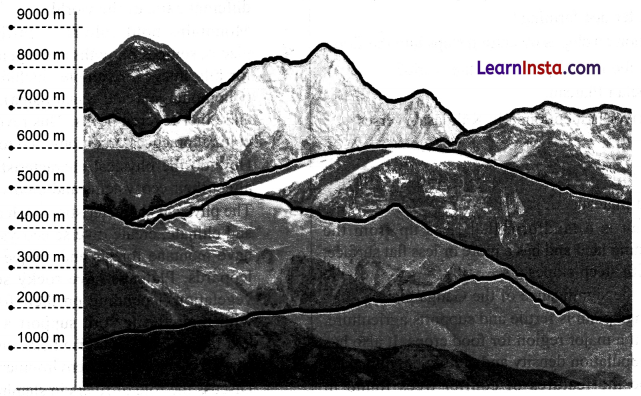
Question i.
Which two peaks are the highest in the Himalayan range, and where are they located?
Answer:
The two highest peaks of the Himalayan range are Mount Everest, located between Tibet (China) and Nepal, and Kanchenjunga, located between Nepal and the Indian state of Sikkim.
Question ii.
What is the highest peak of the Andes mountain range in South America?
Answer:
The highest peak of the Andes mountain range in South America is Mount Aconcagua.
Question III.
Name the highest mountain in South India and its other known name.
Answer:
The highest mountain in South India is Anamudi, also known as ‘Anai Peak’. It is located in Kerala.