Hamara Bharat Incredible India Class 6 Questions and Answers
Hamara Bharat Incredible India Question Answer Class 6 English Poorvi Chapter 13
Let us discuss (Page 132)
Question 1.
What has Bharat always been known for?
Answer:
Bharat has always been known as a land of wise and brave people.
Question 2.
What is attractive about Bharat?
Answer:
Bharat’s rich and diverse culture is always attractive for outsiders.

Question 3.
What is special about the fact that the people live here in unison?
Answer:
The people of Bharat live in unison, presenting to the world ‘unity in diversity’.
Question 4.
What geographical features does the passage mention?
Answer:
Bharat is a land rich with rivers, lakes, and high mountains. Its green forests are home to many plants, insects, birds, and animals.
Question 5.
What is the advice given to everyone?
Answer:
As its inhabitants, we need to continue working hard and make sure that our country prospers.
Let us do these activities before we read (Page 132)
Complete these words with the correct vowels (A, E, I, O, U).
(a) We like to decorate our homes with our f __ l k ___ r t.
(b) Our c __ l t _ re consists of our ideas, customs, traditions, values, arts, and languages.
(c) All of us celebrate our f __ st ___ v __ l s together.
(d) We tell stories to our children to teach them about our c __ l t __ r e, h __ st __ ry, and l __ g __ n d s.
(e) We have our own l__ n g __ ag __ s to talk to each other.
Answer:
(a) folkart
(b) culture
(c) festivals
(d) culture, history and legends
(e) languages
Let us discuss (Page 133)
Question 1.
What is the Ek Bharat, Shreshtha Bharat programme all about?
Answer:
It is to know that we all belong to one nation and that is the bond we share. And our unity in diversity makes us the most wonderful country in the world.
Question 2.
Why is this programme being conducted?
Answer:
This programme is presented to show Bharat’s uniqueness and the unity in diversity of the country.
Let us discuss (Page 136)
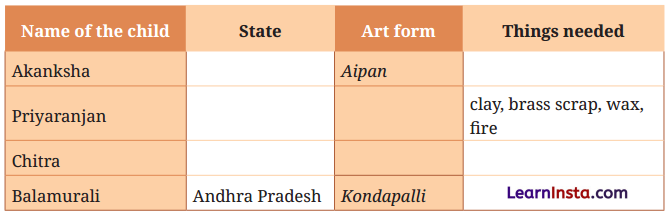
On the basis of what, the speakers said about the art forms, complete the table given below.
Answer:
| Name of child | State | Art form | Things needed |
| Akansha | Uttara khand | Aipan | white rice flour, geru |
| Priyaranjan | Odisha | Dhokra metal craft | day, brass scrap, wax, fire |
| Chitra | Kerala | “Coconut shell craft | sandpaper or a machine, wood polish |
| Balamurali | Andhra Pradesh | Kondapalli | soft wood, makku—a paste of tamarind seed powder and sawdust, oil and watercolours or vegetable dyes and enamel paints |
Let us think and reflect (Page.136)
Question 1.
Fill in the blanks to complete the following sentences.
(a) The designs for Aipan are taken from ___ and ____.
(b) Dhokra metal craft is very old because it is ___ old.
(c) A base is needed for coconut shell craft to make it ___.
(d) Soft wood, ___ and colours are used to make Kondapalli toys.
Answer:
(a) cultural traditions, and observations of nature
(b) 4000-year
(c) stable
(d) makku
Question 2.
Why does Akanksha’s family make Aipan?
Answer:
Aipan is a folk art of Uttarakhand which is drawn on family functions and festivals.
Question 3.
In Dhokra, why does wax come out of the small openings?
Answer:
The wax comes out of small opening because it is put in the fire.
Question 4.
What is common in the toys made in Balamurali’s village and coconut shell craft in Kerala?
Answer:
Both are biodegradable crafts.
Let us learn (Page 137)
Question 1.
Priyaranjan, Chitra and Balamurali share how art works of their states are made. They use some words to show the order of making it. Those words are given in the box below.

Now, use some of these words to complete the paragraph given below. Use one word only once.
How I Get Ready for School
(i) ___ I get up and go to take a shower, (ii) ___, I wear my school dress, (iii) ____, I eat my food. (iv) ___, I wear my shoes, (v) ____, I pick up my bag and go out of my home.
Answer:
(i) first
(ii) then
(iii) after that
(iv) next
(v) finally
Question 2.
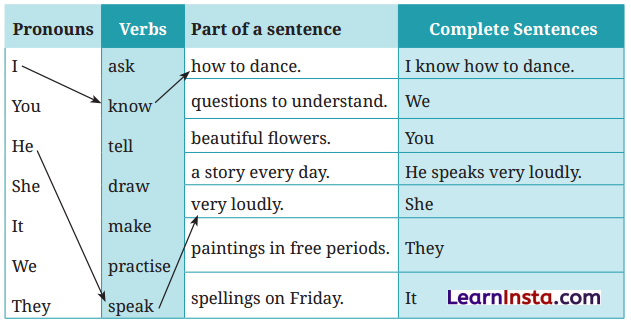
The children from different states each speak about one art form from their state. When they speak, they use the first form of the verb. It shows something that happens regularly. It is called the present tense. With he, she and it, -s/-es is used with the verb to show the present tense. Make five sentences with the help of the words given in the table below. Use -s/-es wherever necessary. Two examples are given.
Answer:
1. You make beautiful flowers.
2. It tells a story every day.
3. She asks questions to understand.
4. We draw paintings in free periods.
5. They practise spellings on Friday.
Let us listen. (Page 133)
Question 1.
Listen to the description of gakkad bharta and complete the notes given below. (refer to page 162 for transcript)
Gakkad Bharta
(a) Name of the speaker : …………
(b) The town of the speaker : ……….
(c) The state he belongs to : ……….
(d) The name of the food item : ……….
(e) Vegetables roasted for bharta : ………..
Answer:
(a) Sushil
(b) Jabalpur
(c) Madhya Pradesh
(d) Gakkad bharta
(e) brinjals and tomatoes
Question 2.
Now, listen to the description again and complete the flowchart on how to make gakkad bharta.
1. To make gakkad, make balls of _____ dough and them on high heat.
2. To make bharta, ___ brinjal and tomatoes and garnish with ____ onions, coriander, green chillies and salt.
3. To serve, crumble the gakkad, put some on it and add one spoon of ghee.
Answer:
1. Wheat, roast
2. Roast, chopped
3. Bharta
Let us Speak (Page 133)
Question 1.
Speak about a local art form of your region. It can be any one out of painting, rangoli, metal craft, embroidery, music, dance or drama.
Remember to include:
- the name of the art form
- what things do they need for it
- how do they make/present it
Question 2.
You may use the words given below when you speak.
- I know about the art form called ….
- They need ……
- To make it, first… after that… next… then … at last .. .
Answer:
Do it yourself.
Let us write (Page 139)
Question.
You heard children from different states speak about the art forms from their state. Discuss in pairs which art form you liked the most.
Now, write a paragraph with five sentences giving your reasons for liking it.
Answer:
Coconut shells can be used to make home decor, and jewellery, that is not only eco-friendly but also durable despite being lightweight. Coconut shell, which was primarily considered’ waste can be used as a raw product and by-product for creating handicrafts for decorative and utility purposes. As this eco-friendly material are not hard & durable, so they don’t contribute to the clogging of drains or the breeding of mosquitoes.
It’s amazing how a fruit that is so easily found and used for Hindu rituals can be used for great art & crafts and has the potential to provide food to many poor farmer households.
Eco-friendly & sustainable products are highly demanded in a world where words like global warming & pollution have associated so much so in our daily life that we have even stopped bothering.
(Answer may vary)
Let us explore (Page 139)
Question 1.
Madhubani painting is a traditional art form from Bihar. The artists use natural colours to make them on the walls of their houses. You can also make and use natural colours as given below.
- yellow from haldi
- green from leaves
- red from red flowers/geru/sindoor
- orange from flowers
- blue from neel/indigo powder.
Given below is a Madhubani painting. Colour it with natural colours or any other colour.
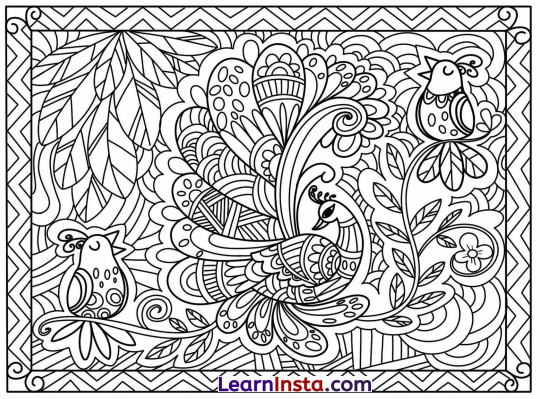
Answer:
Do it yourself.
Question 2.
Ek Bharat, Shreshtha Bharat Programme
Bharat has diverse languages, cuisines, music, dance, theatre, movies and films, handicrafts, sports, literature, festivals, paintings, sculptures, etc. The Ek Bharat, Shreshtha Bharat programme aims to enhance interaction and promote mutual understanding between people of different states/UTs through the concept of state/UT pairing.
This is to celebrate the unity in diversity and strengthen the emotional bonds between its citizens. The vision is to enable people to develop a sense of common identity by sharing best practices and experiences. The programme aims to contribute to nation building by highlighting the inter-connectedness between various cultures and traditions.