Students often prefer our concise Class 5 English Santoor Worksheet and Class 5 English Chapter 2 Gone with the Scooter Worksheet with Answers Pdf for quick practice.
Class 5 English Chapter 2 Gone with the Scooter Worksheet with Answers
Class 5 English Gone with the Scooter Worksheet
Class 5 English Chapter 2 Worksheet – Class 5 Gone with the Scooter Worksheet
Word Castle
- Dribble – To move a ball with small taps while playing hockey
- Rustling – A soft crackling sound
- Grab – To take something with a sudden movement
- Boast – To speak too proudly about oneself or something
- Unaware – Not knowing or realizing something
- Thud – A dull sound made when something falls
Let us Start
A. Answer the following questions.
Question 1.
Where was Gopi sitting in the summer afternoon?
___________________________________
Question 2.
What did Gopi at first think about hearing the rustling sound?
___________________________________
Question 3.
What was Gopi’s immediate reaction to the rustling sound?
___________________________________
Question 4.
Where did Gopi find the hockey ball?
___________________________________
Question 5.
Why did Gopi’s mother call him inside the house ?
___________________________________
Question 6.
“I can’t keep this ball for myself. I will ask around.” What character trait of Gopi is reflected in this line?
___________________________________
Question 7.
Why did Gopi go to the nearby playground in the evening?
___________________________________
Question 8.
Why was Gopi assured that the ball did not belong to Manoj?
___________________________________

Question 9.
“… Gopi said at the top of his voice, ‘Stop!'” What kind of emotion did Gopi have now?
___________________________________
Question 10.
Why did Manoj go to the goalpost?
___________________________________
Question 11.
How did the ball drop into the basket of a passing scooter?
___________________________________
Question 12.
Why did the scooterist not return the ball?
___________________________________
B. Think and discuss
Question 1.
How does Gopi demonstrate that he has an inquisitive piece of mind?
___________________________________
Question 2.
Imagine Gopi had kept the ball himself. What would have happened to the ball at last? What character trait of Gopi would have revealed by this act?
___________________________________
Question 3.
The text draws attention to the rules of road safety. Do you follow safety rules while going to school? Which safety rule do you always follow?
___________________________________
Word Power
A. You have read all the given words in the text. Do you know their meaning also? If you already know or guess their meaning, you can check in the given list.
Match the words with their meaning.
| 1. veranda | (a) the low sound that is made when something heavy falls |
| 2. thud | (b) the player who stands in front of the goal and tries to stop the other team from scoring |
| 3. perhaps | (c) a person who rides a scooter |
| 4. goalpost | (d) one of the two posts that form the sides of a goal. They are joined together by a bar |
| 5. goalkeeper | (e) a platform joined to the side of house |
| 6. scooterist | (f) possibly, maybe |
B. Formation of Nouns
The suffix “-ist” is used to form nouns that denote a person who practices, specializes in or is also associated with a particular field, belief or action.
For example:
Scooter + ¡st = scooterist, the person who rides a scooter
Science + ¡st = scientist, a person who knows science
Now, write the nouns from which the following words have been formed and write their meanings. One has been done as example.
| Nouns | Base word /nouns from which the word has been formed | Meaning |
| 1. Medalist | (a) Medal | (i) A person who has won a medal |
| 2. Artist | (b) | (ii) |
| 3. Guitarist | (c) | (iii) |
| 4. Capitalist | (d) | (iv) |
| 5. Motorist | (e) | (v) |
| 6. Biologist | (f) | (vi) |
| 7. Tourist | (g) | (vii) |
| 8. Socialist | (h) | (viii) |
Learn Grammar
Conjunctions
Conjunctions are words that connect other words, phrases, or clauses. They help create smoother, more complex sentences by showing relationships between different parts of a sentence. The main conjunctions are: and, or, but, because, if, although, since, when, both and, either or, neither….nor, not only but also
For examples:
1. The cat and the dog are sleeping.
2. Because it was raining, we stayed inside.
3. Both the cat and the dog like to play.
A. Complete the following story using the words given in the box.
| however, but, then, when, since, as, because |
Suddenly I arrived at the playground gate, (i) ____________ the traffic lights had turned red. I stayed at the place around five minutes. (ii) ____________, the traffic lights turned green and I drove my scooter at a fast speed (iii) ____________ I had to reach home within ten minutes. (iv) ____________, I was sure that Mini would be waiting for me at home (v) ____________ I had made a promise to her that I would take her to the mall today. Fortunately, I reached home within ten minutes but I didn’t find Mini at home. She had gone with her mother to a neighbour’s house, (vi) ____________ Sharmajee has purchased a house and stated living with his family, we have got a guardian, (vii) ____________ nobody is in the house, Sharmajee is there to help them. He is a unique person.
Adverbs
Adverbs are words that modify verbs, adjectives, other adverbs, or even entire sentences, providing additional information about how, when, where, to what extent, or under what conditions something is done or exists. They often answer questions like “how?”, “when?”, “where?”, and “to what extent?”.
For example, “The dog barked loudly.” Here the word ’loudly’ is an adverb which tells us how the dog barked.
Manner : How something is done (e.g., quickly, slowly, carefully).
Time : When something happens (e.g., now, later, yesterday).
Place : Where something takes place (e.g., here, there, upstairs).
Degree : To what extent something is done or exists (e.g., very, extremely, quite).
Frequency : How often something occurs (e.g., always, sometimes, never).
Certainty : To what degree something is believed to be true (e.g., definitely, probably, perhaps).
B. Fill in the blanks by choosing correct adverbs from the box.
| attentively, gracefully, heartily, quickly, brightly, clearly, effortlessly, beautifully, recklessly, softly |
1. She spoke ____________ to avoid waking the baby.
2. He typed ____________ to finish his report on time.
3. The athlete ran ____________ as if it was easy.
4. They danced ____________ to the music of the night.
5. She listened, ____________ to every word he said.
6. He drove ____________ endangering the lives of others.
7. The sun shone ____________ on the beach that day.
8. She laughed ____________ at his silly joke.
9. He spoke ____________ and confidently in front of the audience.
10. The flowers bloomed ____________ in the garden.
Let us Speak
A. The opening line of the story is given below. You all have to add a sentence to continue the story and arrive at a suitable ending.
Here is the story:
Teacher : Once upon a time, there was a tiger.
Student 1 : ___________________________________
Student 2 : ___________________________________
Student 3 : ___________________________________
Student 4 : ___________________________________
Student 5 : ___________________________________
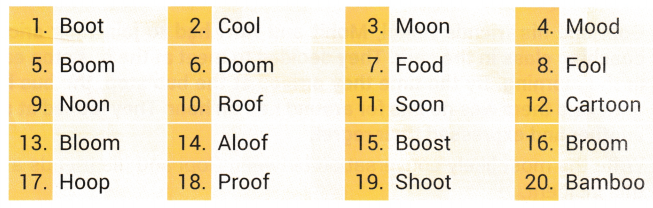
B. Say aloud the following words. Circle the words which have a long “o” sound.
Let us Listen
A. You have several mango trees in your garden. You are sitting in the veranda and reading a story. Suddenly you heard a thud and you became alert. You thought a ripe mango had fallen from the tree. You went into the garden but didn’t find the ripe mango. Then, you asked your mother to help you find the ripe mango. But your mother directed with a drawing.
Now, listen carefully to your mother. Follow her instructions and draw accordingly in the space given below.
(i) Draw a few big dry leaves at the centre with no gape between the leaves. Draw a ripe mango in the middle of the leaves.
(ii) Draw a few twigs fallen all around.
(iii) Colour the leaves yellow and brown. Colour the twigs brown.
(iv) Colour the ripe mango a little red and green.
(v) Now you have found the ripe mango.

Let us Write
A. Gopi and his friends Rahul, Mohit and Ravi had to join their cricket coaching class in the park. They decided to meet at the bus stop early in the morning. By the time they arrived at the bus stop, the bus had gone and there was no bus for around half an hour. They looked at one another and expressed their regret.
Write the most likely conversation between Gopi and his friends after this incident.
Gopi : ___________________________________
Rahul : ___________________________________
Mohit : ___________________________________
Ravi : ___________________________________
B. Make five words each starting with ‘class’ and ending with ‘room’, and use them in your own sentences.
Class _________________
_________________
_________________
_________________

_________________ room
_________________
_________________
_________________
_________________
C. Using the clues given below, write the words that have ‘ou’ in the middle.
| Clues | Word |
| 1. It represents a person, place, thing, or idea | |
| 2. High intensity or volume of sound | |
| 3. An injury on part of your body | |
| 4. It stops sunrays from reaching the earth | |
| 5. A building where we live in | |
| 6. Having the shape of a circle | |
| 7. A pointing device in a computer | |
| 8. A quantity of something | |
| 9. A landform that rises significantly above the surrounding area | |
| 10. It has a number in a bank to draw and deposit money |
Let us Practise
Word Game
Students sit in a circle as the teacher poses a question. They must respond one at a time around the circle, using only one word. You can note time to see how long it takes to make it all the way around. Nature of questions depends on your teacher choosing the subject as per his/ her choice.
Learn With Fun
A. Write a short biography about a famous footballer of your choice. You may use the following hints.
1. Name of the footballer.
_______________________________________
_______________________________________
2. Name of the coach who has trained him.
_______________________________________
_______________________________________
3. When and where he was born.
_______________________________________
_______________________________________
4. List one or two achievements.
_______________________________________
_______________________________________
5. Why this footballer is a source of inspiration for you.
_______________________________________
_______________________________________
B. Discuss a famous bailer who has made his name in the game of cricket.
_______________________________________
_______________________________________
_______________________________________
_______________________________________