Get the simplified Class 8 Maths Extra Questions Part 2 Chapter 1 Fractions in Disguise Class 8 Extra Questions and Answers with complete explanation.
Class 8 Fractions in Disguise Extra Questions
Class 8 Maths Chapter 1 Fractions in Disguise Extra Questions
Fractions in Disguise Extra Questions Class 8
Very Short Answer Type Questions
Question 1.
Express the following fractions as percentages.
(i) \(\frac{2}{5}\)
Answer:
We have, \(\frac{2}{5}=\frac{2}{5}\) × 100 = 40%
(ii) \(\frac{1}{2}\)
Answer:
We have, \(\frac{1}{2}=\frac{1}{2}\) × 100 = 50%
Question 2.
Find out 8% of 25 kg.
Answer:
Given, 8% of 25 kg
i.e. \(\frac{8}{100}\) × 25
= \(\frac{8 \times 25}{100}=\frac{8}{4}\) = 2 kg
Hence, 8 % of 25 kg is 2 kg.
Question 3.
Sachin and Sanjana are calculating 23% of 800. Find it.
Answer:
We have, 23% of 800
⇒ \(\frac{23}{100}\) × 800 = 23 × 8 = 184
Question 4.
Write following decimals as percentages.
(a) 6.1
Answer:
Given, 6.1
∴ 6.1 × 100% = \(\frac{61}{10}\) × 100%
= 61 × 10%
= 610%
(b) 0.064
Answer:
Given, 0.064
∴ 0.064 × 100% = \(\frac{64}{1000}\) × 100%
= \(\frac{64}{10}\) %
= 6.4%

Question 5.
Identify and write appropriate symbols ‘>’, ‘=’ in the boxes.
(i) 40% of 250 _______ 35% of 260
Answer:
We have, 40% of 250 = \(\frac{40}{100}\) × 250 = 100
and 35% of260 = \(\frac{35}{100}\) × 260 = 91
Since, 100 > 91
∴ 40% of 250 > 35% of 260
(ii) 30% of 180 _______ 25% of 400
Answer:
We have, 30% of 180 = \(\frac{30}{100}\) × 180 = 54
and 25% of 400 = \(\frac{25}{100}\) × 400 = 100
Since, 54 < 100
∴ 30% of 180 <25% of 400
Question 6.
Express 150% as a fraction in the lowest form.
Answer:
150% as a ratio in the lowest form is \(\frac{150}{100}=\frac{15}{10}=\frac{3}{2}\)
Question 7.
If \(\frac{7}{3}\)% of a number is 147 then find the number.
Answer:
∵ \(\frac{7}{3}\)% of the number = 147
⇒ \(\frac{7}{300}\) × Number = 147
∴ Number = 147 × \(\frac{300}{7}\) = 6300
Question 8.
Navin has a cell phone of fixed MP, ₹ 12000 and sold it for ₹ 8000. Find discount percent.
Answer:
Given, MP = ₹ 12000, SP = ₹ 8000
Discount = MP – SP = 12000 – 8000 = ₹ 4000
∴ Discount% = \(\frac{\text { Discount }}{\mathrm{MP}}\) × 100
= \(\frac{4000}{12000}\) × 100
= \(=\frac{100}{3}\) = 33\(=\frac{1}{3}\)%
Question 9.
By how much per cent 2800 is greater than 2400?
Answer:
Let 2800 be x% greater than 2400. Then
⇒ 2400 + 2400 × \(\frac{x}{100}\) = 2800
⇒ 2400 × \(\frac{x}{100}\) = 2800 – 2400 = 400
⇒ x = \(\frac{400 \times 100}{2400}=\frac{50}{3}\) %
So, 2800 is \(\frac{50}{3}\) % greater than 2400.
Question 10.
After increasing 15% of the price of an article, its price is ₹ 1725. Find the increased amount.
Answer:
Let the initial price of the article be ₹ x.
Then, x + 15% of x = 1725
⇒ x + \(\frac{15}{100}\) × x = 1725
⇒ \(\frac{100 x+15 x}{100}\) = 1725
⇒ 115 x = 1725 × 100
⇒ x = \(\frac{1725 \times 100}{115}\) = 1500
∴ Increased amount = ₹ (1725 – 1500) = ₹ 225
Question 11.
Ankit buys a memory card costing ₹ 550. If the rate of , sales tax is 5% then find the total amount payable by him.
Answer:
Total amount payable by Ankit = 550 + 5% of cost price
= 550 + \(\frac{5}{100}\) × 550
= 550 + \(\frac{5}{100}\)
= 550 + 27.5
= ₹ 577.5
Question 12.
Using the formula p(1 + r)t, calculate the compounded amount a for the following.
(i) p = ₹ 500,r = 12% and t = 2yr.
Answer:
∴ Amount = p(1 + r)t
A = 500 (1 + \(\frac{12}{100}\))2 [∵ t = 2 and r = \(\frac{12}{100}\)]
= 500\(\left(\frac{112}{100}\right)^2\)
= 500 × \(\frac{12544}{10000}\)
= ₹ 627.2
(ii) p = ₹ 1000, r = 10% and t = 2 yr.
Answer:
∵ Amount = p(1 + r)t
∴ A = 1000(1 + \(\frac{10}{100}\))2 [∵ t = 2 and r = \(\frac{12}{100}\)]
= 1000 × \(\left(\frac{110}{100}\right)^2\)
= 1000 × \(\frac{121}{100}\)
= ₹ 1210
Short Answer Type Questions
Question 1.
A student used the proportion \(\frac{n}{100}=\frac{5}{32}\) to find 5% of 32. What did the student do wrong?
Answer:
Given that student used proportion,
\(\frac{n}{100}=\frac{5}{32}\)
n = \(\frac{5 \times 100}{32}\)
While 5% of 32 = \(\frac{5}{100}\) × 32
So, the student did wrong in selection of formula.
Question 2.
Madhu’s room measures 6 m × 3 m. Her carpet cover is 8 m2. What percent of floor is covered by the carpet?
Answer:
Area of floor = (6 x 3) m2 = 18 m2
Area covered by carpet = 8 m2
When 18 m2 area will covered by carpet then floor will be covered = 100%
or when 1 m2 area covered by carpet then floor will be, covered \(\frac{100}{18}\)%
So, when 8 m2 area covered by carpet then floor will be covered = (\(\frac{100}{18}\) × 8)% = 44.44%
Question 3.
If marked price of an article is ₹ 800 and it is sold at ? 760 then find the discount rate.
Answer:
We have, marked price = ₹ 800 and selling price = ₹ 760
Discount = Marked price – Selling price
= 1800 – ₹ 760 = ₹ 40
Let the discount rate be x%.
Then, x% of marked price = 40
⇒ \(\frac{x}{100}\) × 800 = 40
⇒ x = \(\frac{40 \times 100}{800}\) = 5%
Question 4.
Ranjit works in a multinational company as a senior executive with annual package of 12 lakh. He pays incone tax regularly and donates 5% of his annual earning to an orphanage. What amount of money he donate.
Answer:
Total annual income = ₹ 1200000
5% of the total income = 1200000 × \(\frac{5}{100}\) = ₹ 60000
Thus, he donates ₹ 60000 to an orphanage.
Question 5.
A person sells a watch costing ₹ 75 0f or ₹ 840. Find his profit or loss percent.
Answer:
Cost price of watch = ₹ 750
Selling price = ₹ 840
∵ Profit = SP – CP = 840 – 750 = ₹ 90
Profit % = \(\frac{\text { Profit }}{\mathrm{CP}}\) × 100
= \(\frac{90}{750}\) × 100
= \(\frac{900}{75}\)
= 12%
Question 6.
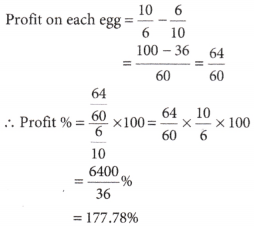
A shopkeeper purchased eggs at the rate of 10 for ₹ 6 and sells them at 6 for ₹ 10. Find his profit or loss percent.
Answer:
Cost price of one egg = ₹ \(\frac{6}{10}\)
Selling price of one egg = ₹ \(\frac{10}{6}\)
Question 7.
On what principal, the interest is ₹ 175 0f or 7 yr at 5% per annum simple interest?
Answer:
Let the principal be tx. Simple interest = ₹ 1750
Time period for principal (t) = 7 yr
Rate of Interest (r) = 5% per annum
∴ Simple Interest = prt
1750 = \(\frac{x \times 5 \times 7}{100}\)
175000 = 35x
x = \(\frac{175000}{35}\) = 5000
∴ Principal = ₹ 5000
Question 8.
₹ 5000 amounts to ₹ 6000 in 5 yr. What will ₹ 8000 amount be at the same rate of interest in 6 yr.
Answer:
Given, amount ₹ 5000 became ₹ 6000 in 5 yr.
So, principal = ₹ 5000, time period = 5 yr
Interest = ₹ 6000 – ₹ 5000 = ₹ 1000
Let rate of interest be r per annum (in decimal form).
SI = prt
⇒ 1000 = 5000 × r × 5
⇒ r = \(\frac{1000}{5000 \times 5}=\frac{1}{25}\)
So, SI for the amount ₹ 8000 will be at same rate for 6 yr.
SI = p × r × t = \(\frac{8000 \times 4 \times 6}{100}\)
= 80 × 4 × 6
= 80 × 24
= ₹ 1920
∴ 8000 amounts to 9920 in 6 yr.
Question 9.
In an examination, a student must get 40% marks to pass. A student gets 48 marks out of 200. Express his marks as a percentage. How many more marks should he have got to pass the examination?
Answer:
Given, pass percentage = 40%, total marks of examination = 200 and student got marks = 48
Passing marks = 40% of 200 40
= \(\frac{40}{100}\) × 200 = 40 × 2 = 80marks
Percentage of marks got by student = \(\frac{48}{200}\) × 100 = 24%
Hence, student needed atleast = 80 – 48
= 32 marks to pass the examination
Long Answer Type Questions
Question 1.
In Delhi University, in the year 2009-10, 49000 seats were available for admission to various courses at graduation level.
Out of these, 28200 seats were for the students of General category, while 7400 seats were reserved for SC and 3700 seats for ST.
Find the percentage of seats availale for
(i) students of General category.
(ii) students of SC and ST categories taken together.
[Competency Based Question]
Answer:
Given, total seats were available for admission = 49000
Seats for General category = 28200
Seats for SC category = 7400
Seats for ST category = 3700
(i) Percentage of General category seats = \(\frac{28200}{49000}\) × 100
= 57.55%
So, the percentage of seats available for students of General category is 57.55%.
(ii) Total students of SC and ST categories
= 7400 + 3700 = 11100
∴ Percentage of SC and ST categories seats
= \(\frac{111100}{49000}\) × 100
= 22.65%
So, the percentage of seats available for students of SC and ST categories taken together is 22.65%.
Question 2.
In 2007-08, the number of students appeared for Class X examination was 105332 and in 2008-09, the number was 116054. If 88151 students pass the examination in 2007-08 and 103804 students in 2008-09. What is the increase or decrease in pass% in Class X result?
Answer:
From the given information, we have
| Years | Number of students | |
| Appeared | Passed | |
| 2007-08 | 105332 | 88151 |
| 2008-09 | 116054 | 103804 |
Passing percentage of students of the Class X examination in year 2007-08
= \(\frac{\text { Number of students passed }}{\text { Number of students appeared }}\) × 100
= \(\frac{88151}{105332}\) × 100
= 83.69%
Passing percentage of students of the Class X
examination in year 2008-09 = \(\frac{103804}{116054}\) × 100
= 89.44 %
It is clear that in year 2008-09, passing percentage is increased by (89.44% – 83.69%) i.e. 5.75%.
Question 3.
Living on your own, Sanjay is looking for one bedroom apartment on rent. At Neelgiri apartments, rent for the first two months is 20% off. The one bedroom rate at Neelgiri is ₹ 6000 per month.
At Savana apartments, the first month is 50% off. The one bedroom rate at Savana apartments is ₹ 7000 per month. Which apartment will be cheaper for the first two months and by how much?
[Competency Based Question]
Answer:
At Neelgiri apartment,
First month rent off = 20% of 6000
= \(\frac{20}{100}\) × 6000 100
= ₹ 1200
First two months rent off = 2 × 1200 = ₹ 2400
So, rent after off = 12000 – 2400 = ₹ 9600
[for second month, total rent = 12000 but after 20% off, rent = 9600]
Now, at Savana apartment,
First month rent = 50% of 7000
= \(\frac{50}{100}\) × 7000 = ₹ 3500 100
Second month rent off = ₹ 7000
Total rent after off = 7000 + 3500 = ₹ 10500
Difference between rents of the two apartments for the
first two months = 10500 – 9600 = ₹ 900
So, Neelgiri apartments will be cheaper for the first two months by ₹ 900.
Question 4.
Rahim borrowed ₹ 1024000 from a bank for 2 yr. If the bank charges interest of 2.5% per annum, compounded annually. Then, what amount will he have to pay after the given time period?
Answer:
Given, principal (p) = ₹ 1024000
Rate of interest (r) = 25% and time (t) = 2 yr
∴ Amount = p(1 + r)t
= 1024000 × (1 + \(\frac{2.5}{100}\))2
[∵ r = \(\frac{2.5}{100}\), t = 2 and p = 1024000]
= 1024000 × \(\frac{1025}{1000} \times \frac{1025}{1000}\)
= ₹ 1075840
Hence, the amount Rehim will have to pay after the given time perod is ₹ 1075840
So, amount he have to pay is ₹ 1075840 and compound interest paid is ₹ (1075840 – 1024000) i.e. ₹ 51840.
Question 5.
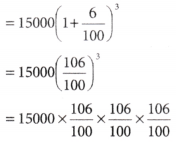
Asha has some money to spare. She wants to deposit ₹ 15000 for 3 yr in a bank to earn interest. She has two banks to choose from. Bank A gives an interest of 6% per annum compounded annually and Bank B gives 7% per annum simple interest.
Which bank is better choice for depositing ₹ 15000? Justify your choice. [Competency Based Question]
Answer:
Bank A gives compound interest on ₹ 15000
= ₹17865.24
Bank B gives simple interest on ₹ 15000
= \(\frac{15000 \times 7 \times 3}{100}\) = ₹ 3150
A = 1500 + 3150 = ₹ 18150
∴ So, Bank B is a better choice for depositing ₹ 15000.
Skill Based Questions
Question 1.
In a school of 600 students, 210 come by bus, 150 come by bicycle and the rest walk.
(a) What percentage of students come by bus?
Answer:
35%
(b) What percentage walk?
Answer:
40%
(c) If 20% of the students, who walk start coming by bus, how many students would then come by bus?
Answer:
258
Question 2.
A recipe for fruit salad for 5 people requires the following fruits in given proportion : Apples : 50%, Bananas : 30% and Grapes: 20%.
(a) If you want to make fruit salad for 10 people, what is the proportion of each of the above ingredients?
Answer:
Apples : 50%, Bananas : 30% and Grapes : 20%
(b) If the total weight of the ingredients is 1.5 kg, how much of each fruit is present?
Answer:
Apples = 750 g, Bananas = 450 g and Grapes = 300 g
Question 3.
Bus fare on a route was ₹ 20 in 2024. It was increased by 10% in 2025 and then again by 5% in 2026.
(a) What is the fare in 2025 ?
Answer:
₹ 22
(b) What is the fare in 2026 ?
Answer:
₹ 23.10
(c) What is the overall percentage increase from 2024 to 2026?
Answer:
15.5%
Question 4.
On a school excursion, 45% of students are from Grade 8 and the rest from Grade 9. Among Grade 8 students, 60% are girls.
(a) What percentage of all excursion students are Grade 8 girls?
Answer:
27%
(b) If there are 220 students in all, how many Grade 8 girls are there?
Answer:
59
Question 5.
A shopkeeper sets the marked price of a shirt at 40% above its cost price. Later, he offers a festival discount of 25% on the marked price.
(a) Does he make a profit or a loss compared to the cost price?
Answer:
Profit
(b) Find the net profit or loss percentage.
Answer:
5%
Question 6.
Mandvi and Aditya each invest ₹ 20000 in two different saving schemes for 3 yr. Mandvi invests her money at 10% per annum without compounding, while Aditya invests the same amount at 8% per annum, compounded annually. Then,
(a) find the interest earned by Mandvi?
Answer:
₹ 6000
(b) find the interest earned by Aditya?
Answer:
₹ 519424
(c) who gets more interest and by how much?
Answer:
Mandvi earns more interest by ₹ 805.76.
Case Study Based Questions
Question 1.
A private hospital has a bed capacity for 350 people. During COVID 19, 200 beds has reserved for COVID patients.
On the basis of the given information, answer the following questions.
(i) What is the ratio of reserved beds to the total number of beds?
Answer:
Here, the total capacity of hospital = 350 beds
Number of reserved beds = 200
Ratio of reserved beds to the total number of beds
= \(\frac{1}{2}\) or 4 : 7
(ii) What is the percentage of unreserved beds for the people?
Answer:
Total number of beds = 350
Number of reserved beds = 200
Number of unreserved beds = 350 – 200 = 150
Percentage of unreserved beds
= \(=\frac{\text { Unreserved beds }}{\text { Total number of beds }}\) × 100
= \(\frac{150}{350}\) × 100
= \(\frac{3}{7}\) × 100 = \(\frac{300}{7}\)
= 42.85%
(iii) If the cost of registration to reserve a bed is ₹ 250. A COVID patient found 20% discount on reservation fees. How many rupees did the patient pay?
[Competency Based Question]
Answer:
Cost of registration to reserve a bed = ₹ 250
Discount for COVID patients = 20%
Payable percentage of fees = 100% – 20% = 80%
Rupees paid by patient = 80% × 250
= 250 × \(\frac{80}{100}\)
= ₹ 200
Question 2.
A new movie was released on Friday, 150 seats were booked that day. The booking for the movie increased to 300 seats on Saturday. [Competency Based Question]
(i) What was the percent increase in the number of seats booked on Saturday?
Answer:
Number of seats booked on Friday = 150
Number of seats booked on Saturday = 300
Increased seats = 300 – 150 = 150
Percent increase in number of seats on Saturday
= \(\frac{150}{150}\) × 100 = 100%
(ii) The cost of a ticket for the show is ₹ 250. Ayush got a 20% discount on buying a ticket through online booking. How many rupees did Ayush pay for the ticket?
Answer:
The cost of a ticket = ₹ 250 Percentage of discount = 20%
Discount = 250 × 20%
⇒ \(\frac{250 \times 20}{100}\) = ₹ 50
Amount paid for a ticket = 250 – 50 = ₹ 200
Question 3.
Outside the cinema hall, Neeraj has a stall that sells a pack of popcorn for ₹ 200. The government charges 18% GST on selling of goods or services.
The price at which Neeraj sells popcorn includes GST.
[Competency Based Question]
(i) How much GST (in ₹) is charged on selling one pack of popcorn? (Give your answer correct up to one decimal place).
Answer:
Given,
Selling price of one pack popcorn (including GST)
= ₹ 200
Rate of GST =18%
Let the base price (price excluding GST) be x.
Selling price = x + 18% of × x + 0.18x = 200
⇒ 1.18x = 200
⇒ x = \(\frac{200}{1.18}\) = 169.4915
The GST charged on one pack of popcorn is given by GST = Selling price – Base price
= 200 – 169.4915
= 30.5085 ≈ 305
Hence, GST charged on one pack of popcorn is ₹ 30.5
(ii) The cost price of raw materials used by Neeraj for making one pack of popcorn is ₹ 20, the cost of packaging used to carry popcorn is ₹ 5 and the cost of preparation of popcorn ₹ 10 per pack. What is Neeraj’s profit percentage on selling popcorn?
Answer:
Given,
Cost of raw materials = ₹ 20
Cost of packaging = ₹ 5
Cost of preparation = ₹ 10
Cost price (CP) = 20+ 5 + 10 = ₹ 35
From Part (i), the selling price excluding GST is ₹ 169.4915.
Now, profit = Selling price – Cost price
= 169.4915 – 35
= 134.4915
∴ Profit % = \(\frac{\text { Profit }}{\text { Cost price }}\) × 100
= \(\left(\frac{134.4915}{35}\right)\) × 100
= 384.3%
Hence, the profit percentage of Neeraj is approximately 384.3%.