Family and Community Class 6 Question Answer Social Science Chapter 9
NCERT Class 6 Social Science SST Chapter 9 Family and Community Questions and Answers Solutions
Family and Community Class 6 Questions and Answers (In-Text)
The Big Questions (Page 137)
Question 1.
Why is the family unit important?
Answer:
The family unit is important as it plays a crucial role in the development of individuals and the well-being of society as a whole. Here are some reasons why families are important:
(a)Nurturing and Emotional Support.
(b)Socialization and Values
(c)Identity and Self-esteem
(d)Practical Support
(e)Community Building
(j) Resilience

Question 2.
What is a community and what is its role?
Answer:
A community is a group of people living in the same area or sharing common interests, values, and goals. Its role is to provide social support, foster a sense of belonging, facilitate cooperation and mutual aid, and create a network for sharing resources and information. Communities also play a vital role in shaping individual identities and promoting collective well-being and development.
Let’s Explore
Question 1.
What types of families do you see in your neighbourhood? List the type with the number of households for each type.
Answer:
In India, there are several types of families. Most common are joint families and nuclear families. In a joint family, many generations live together, including grandparents, parents, uncles, aunts, brothers, sisters, and cousins. On the other hand, a nuclear family includes just a couple and their children or sometimes one parent and children.
Question 2.
What types are more frequent? Why do you think this is so? (Page 138)
Answer:
(I) The frequency of family types can vary depending on the specific society or region.
A. Nuclear Family: This remains a common family structure in many societies specially in cities. India is witnessing a surge in the number of nuclear family. Nuclear family is a growing trend modern times.
B. Joint Family: In a joint family, extended generations reside together. Members are grandparents, parents, alongwith children and their grandchildren. In this kind of family, an individual learn more about their culture and ethnicity. Many families in villages and towns are Joint family.
Question 3.
As a class activity, compare with your classmates’ findings and discuss.
Answer:
Class activity
Question 4.
Make a list of all the members of your family you can think of, including a few distant relatives. List their terms in your mother tongue or regional language and try to find the equivalent in English. Two examples are below for Hindi: ,(Page 139)
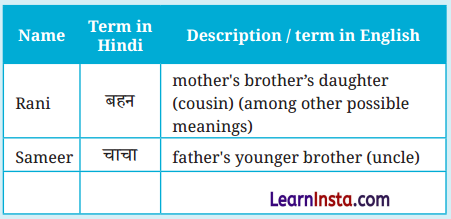
Answer:
Do it yourself
Question 5.
Notice how, quite often, a single word in your mother tongue or regional language requires several words in English to give a precise definition.
Answer:
In many Indian languages, a single term can describe complex family relationships. For example, ‘चाचा (Chacha) in Hindi means ‘father’s younger brother,’ while in English, it requires multiple words: ‘father’s younger brother’ (uncle). This highlights how a single word can convey detailed relationships more efficiently in regional languages.
Question 6.
Answer these questions and compare your answers with a few classmates: (Page 140)
Who in your family decides what is to be bought from the market?
Answer:
Father and mother
Who cooks food in your home?
Answer:
Mother
Who is the oldest person in your family?
Answer:
Grandmother
Who cleans the floor in your home?
Answer:
Maid
Who washes utensils in your house?
Answer:
Maid
Who helps you to do your homework?
Answer:
Mother and father
Question 7.
Draw a simple tree of this family of seven members. (Page 141)
Answer:
Do it yourself
Question 8.
Why do you think Shalini’s parents bought clothes for everyone?
Answer:
It is because Shalini’s uncle was having financial difficulties, so they were not able to buy new clothes for the festival. So Shalini’s parents bought clothes for everyone.
Question 9.
What would you have done if you were in Shalini’s place?
Answer:
I would have done the same what Shalini did as a – member of the family.
Question 1.
Create a story of a family somewhere in India, where we see some family values practised. Share it with your class either through writing or drawing.
Answer:
Story: “The Family’s Morning Prayer”
In a small town in northern India, the Sharma family started every day with a simple ritual. At dawn, before anyone went to work or school, they gathered in their courtyard around a small temple. The father, Ramesh, would light a diya (lamp) while the mother, Priya, sang a soft prayer. Their children, Meera and Arjun, sat quietly with folded hands, watching the flame flicker in the morning breeze.
This daily prayer wasn’t just about devotion; it was a moment of peace, a reminder to be grateful and kind. Afterward, Ramesh always reminded the children, “No matter where life takes you, always remember your roots and respect one another.” It was their way of keeping the family strong, through love, faith, and respect for their traditions.
Question 11.
Stage a small drama with all your classmates around two or three families. The play you write could include some challenging situations that the families faced, and show how they are resolved.
Answer:
Students do this activity themselves.
Question 12.
In the stories of Shalini and Tenzing, we see examples of joint families. What do you think are the aspects of modern living that make some couples opt for a nuclear family (i.e. living apart from older generations or other relatives)? What could be some advantages as well as disadvantages of the two kinds of families?
Answer:
The aspects of modern living that makes some couples opt for a nuclear family are as follows
- Nuclear family allows greater freedom and privacy.
- Nuclear family makes it easy to move to other places for work and study.
- Nuclear families put less financial, burden on the earning individual.
- It is easier to make decisions in a nuclear family without multiple opinions.
Advantages and disadvantages of a nuclear family are as follows
| Advantages | Disadvantages |
| More space and privacy | Feeling of isolation and loneliness. |
| Less financial burden on the family. | Fewer members means lesser help when needed. |
| Easier to move for work or education. | Children miss out on learning from grandparents . and other relatives. |
| More deeper bonding of parents with children. | If parent lose their job it is hard to manage the family. |
Advantages and disadvantages of joint family are as follows
| Advantages | Disadvantages |
| More members to take care of the children. | Less privacy and space. |
| Finance or the family may be divided between the members. | Supporting a large family is difficult financially. |
| All the members celebrate festivals together. | More conflicts because of multiple opinions. |
| More people to look after children if both of the parents work. | More household responsibilities on females. |
2. Privacy and Independence
Autonomy: Couples may prefer the freedom to make decisions without the influence of extended family members.
Personal Space: A nuclear family setup provides more privacy and space for individual family members.
3. Urbanization
Housing: Urban housing is often limited and expensive, making it difficult to accommodate extended families in the same household.
Lifestyle: Urban lifestyles tend to be faster-paced, with less time for large family interactions.
4. Child Rearing Preferences
Parenting Styles: Couples may wish to raise their children according to their own values and methods, which can sometimes differ from those of older generations.
Educational Opportunities: Proximity to better educational institutions in urban areas often necessitates a move away from extended family.
Question 13.
Make a list of all people outside your family that are supporting you through their work in one way or another. (Page 147)
Answer:
Do it yourself.
Question 14.
What types of communities are you part of ? (Page 148)
Answer:
Do it yourself.
Question 15.
Is there a club that you are a part of in school? How does it function?
Answer:
Do it yourself.
Passage-Based Questions (Page 146)
More than 20 years ago, in an area of Ahmedabad (Gujarat) a lot from them.”
Question 1.
Discuss this story in your class. What kind of attitude towards the community does it reveal?
Answer:
The story reveals the side of a sympathetic, caring and cooperating community, that takes pain to educate the underprivileged children of the society.
Question 2.
What values get reflected in Kamal Parmar’s initiative?
Answer:
Kamal Parmar’s presents an example of a good citizen of the country who wants to do something for the society by educating underprivileged children on the street. Some of the children had dropped out of school, while others had never been to school. By giving free tuition and free dinner to these children, he paved the way for others to emulate and serve the society.
Question 3.
Think about those underprivileged children. Do you think society has been unfair to them?
Answer:
It is the responsibility of the society to give free education to all the children below 14 years of age.
These underprivileged children are not able to get education because of proper guidance and economic support.
Question 4.
What should society do to make sure that all children get access to education?
Answer:
To ensure underprivileged children have access to education, society should implement comprehensive policies that provide free and compulsory education, increase funding for schools in disadvantaged areas, and offer financial assistance to families.
Building and maintaining schools with adequate facilities, training and recruiting qualified teachers, rand providing necessary learning materials are essential. Additionally, offering transportation, health, and nutrition programs can help remove barriers to attendance. Engaging communities and parents, promoting gender equality, and leveraging technology for digital access will further ensure that every child has the opportunity to receive a quality education.
Family and Community Question Answer (Exercise)
Question 1.
What are some of the rules you follow in your family and neighbourhood? Why are they important?
Answer:
Family rules include respecting privacy and sharing chores, while neighbourhood rules involve maintaining cleanliness and quiet hours. These rules are crucial for ensuring harmony, safety, and cooperation among family members and neighbours.
Question2.
Do you think some rules are unfair to a few people in the family or community? Why?
Answer:
Yes, some rules can be unfair to a few people.
It is because
- Rules might not consider everyone’s needs or situations.
- Some people might not have a say in making the rules.
- Rules can be too strict or controlling.
- Rules can be unfair to certain groups, like women or children.
- Rules can be outdated and not relevant anymore.
- Rules can be unclear or confusing.
- Rules can be made with biases or stereotypes.
Question 3.
Describe several situations that you have observed where community support makes a difference. You can draw or write about these.
Answer:
Here are some situations where community support makes a difference:
- Natural Disasters: After a hurricane, community members came together to provide food, shelter, and emotional support to affected families.
- Neighbourhood Watch: A community organised a Neighbourhood Watch program, reducing crime and increasing safety through collective vigilance.
- Fundraising for Medical Treatment: Community members raised funds for a neighbour’s medical treatment, showing financial and emotional support.
- Volunteer Cleanup Initiatives: Community volunteers cleaned up local parks and waterways, promoting environmental responsibility.
- Disability Support: Community members rallied around a family with a disabled child, providing resources and inclusivity.
- Food Banks and Pantries: Community-run food banks and pantries ensured no one went hungry, especially during economic downturns.
- Community Celebrations: Cultural events and festivals united the community, fostering connection and belonging.