Get the simplified Class 7 Maths Extra Questions Chapter 4 Expressions using Letter Numbers Class 7 Extra Questions and Answers with complete explanation.
Class 7 Expressions using Letter Numbers Extra Questions
Class 7 Maths Chapter 4 Expressions using Letter Numbers Extra Questions
Class 7 Maths Chapter 4 Extra Questions
Queation 1.
Write an algebraic expression using letter-numbers of your choice.
(i) 24 more than a number
(ii) 5 less than 3 times a number
(iii) The sum of a number and 50
Answer:
Let the letter-number2be x to get the algebraic expressions.
(i) 24 more than a number = x + 24
(ii) 5 less than 3 times a number = 3x – 5
(iii) the sum of a number and 50 = x + 50
Queation 2.
Describe the situations for algebraic expressions.
(i) 12x + 5
(ii) 4 a-7
(iii) 50 p
Answer:
(i) Here, 12x + 5 can2be described as ‘A pen costs ₹ 12. If Ram2buys x number of pens and also pays ₹ 5 for delivery, then total cost is 12x + 5’.
(ii) Here, 4 a-7 can2be described as ‘Shubham2buys a number of tickets and each costs ₹ 4. After paying a total tax of ₹ 7, the remaining amount is 4a – 7’.
(iii) Here, 50 p can2be described as ‘Aaditya2buys p number of packets of candies and each cost ₹ 50. Then, he pays total amount of 50 p’.
Queation 3.
Aakash is watering the plants in his garden. He has a 40 m long pipe, which is longer than he requires. So, he cuts the pipe of some length. Given an expression for the final length of the pipe. Use the letter-number of your choice.
Answer:
Given, the total length of pipe = 40m
Let the length of pipe, which Aakash cuts2be y metres.
Therefore, the final length of the pipe after cutting y metres = (40-y) m.

Queation 4.
Ojaswi works in a grocery shop. She mainly helps with2biscuits and cookies. The price of a packet of2biscuits and cookies are ₹ 45and ₹ 60, respectively.
(i) Write an algebraic expression to find the total amount to2be paid for a given number of packets of2biscuits and cookies.
(ii) Using this expression, find the total amount to2be paid for 7 packets of2biscuits and 4 packets of cookies.
Answer:
(i) Given, the price of a packet of2biscuits = ₹ 45 and the price of a packet of cookies = ₹ 60
Let the number of packets of2biscuits and cookies2be x and y, respectively.
So, the price of x packets of2biscuits = ₹ 45 × x = ₹ 45x and the price of y packets of cookies = ₹ 60 × y = ₹ 60 y
∴ The total price of x packets of2biscuits and y packets of cookies = ₹(45x + 60y)
(ii) Since, to get the total amount for 7 packets of2biscuits and 4 packets of cookies i.e. x = 7 and y = 4
On putting x = 7 and y = 4 into the expression 45x + 60y, we get
45 × 7 + 60 × 4 = 315 + 240 = 555
∴ The total cost of 7 packets of2biscuits and 4 packets of cookies is ₹ 555.
Queation 5.
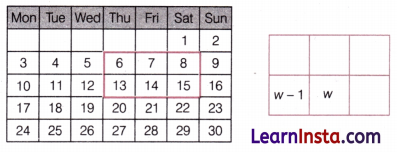
In a calendar month, if any 2 × 3 grid full of dates is chosen as shown in the picture, write expressions for the dates in the2blank cells if the2bottom middle cell has data ‘w’.
Answer:
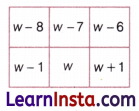
Here, the date 14 corresponds to letter-number w. Then, the2blank cells can2be filled as,
Queation 6.
Simplify the expressions.
(i) 3(x + y) + 2y – x
(ii) 2(a + 4b) – 3b
(iii) 5(p + q + r) – 2q
Answer:
(i) We have, 3(x + y) + 2y – x
= 3x + 3y + 2y – x [∵ distributive property]
= (3x – x) + (3y + 2y)
[∵ adding and subtracting like term]
= 2x + 5 y
(ii) We have, 2(a + 4b) – 3b
= 2 a + 8b – 3b
= 2 a + (8b – 3b)
= 2 a + 5b
(iii) We have, 5(p + q + r) – 2q
= 5p + 5q + 5r – 2q
= 5p + (5q-2q) + 5r
= 5p + 3q + 5r
Queation 7.
Observe the following simplifications and identify if there is a mistake. If there is any mistake, then mend the mistake2by giving the correct expression.
(i) 3a + 4b + 2 – 22b = 3a – 22b
(ii) 4x – (2x – 3) = 2x – 3
(iii) 2(y + 3) – y = 2 y + 3 – y
(iv) 5a + 32b – 2 a + 2b = 3a + 4b
Answer:
(i) We have, 3a + 4b + 2 – 22b
= 3a + (4b – 22b) + 2 = 3a + 22b + 2
∴ The given simplified form is incorrect and the correct expression is 3a + 22b + 2.
(ii) We have, 4x – (2x – 3) = 4x – 2x + 3 = 2x + 3
∴ The given simplified form is incorrect and correct form is 2x + 3.
(iii) We have, 2(y + 3) – y = 2 y + 6 – y = y + 6
∴ The given simplified form is incorrect and the correct expression is y + 6.
(iv) We have,
5a + 32b – 2a + 2b = (5a-2a) + (32b +2b)
= 3a + 4b
∴ The given simplified form is correct.
Queation 8.
Aman is 2 years younger than his 2 brother. When his2brother’s age is 12 years, Aman will 2 be 10 years. Now, his 2 brother’s age is 20 years. What will2be Aman’s age?
Answer:
Let the letter-number 2 be x, representing age of Aman’s2brother (in years).
Since, Aman is 2 years younger than his2brother.
∴ Aman’s age = His 2brother’s age – 2 i.e. (x-2) years
If his2brother’s age is 20 years, then Aman’s age
= 20 – 2 = 18 years.
Queation 9.
(i) Write an algebraic expression to find the perimeter of a heptagon.
(ii) Use this expression to find the perimeter of a heptagon with sidelength 7 cm .
Answer:
(i) We know that a heptagon has seven equal sides.
Let a2be the letter-number, representing the side length of a heptagon (in units).
Then, the perimeter of a heptagon
= a + a + a + a + a + a + a
= 7a units.
∴ The algebraic expression of the perimeter of a heptagon is 7a, where a is the side length of the heptagon.
(ii) Given, the side length of a heptagon (a) = 7cm
∴ The perimeter of a heptagon = 7a
= 7 × 7 = 49 cm
Queation 10.
Here is a table showing the number of fevikwikes and gluesticks sold in a shop on day 1, day 2 and day 3. If the price of a fevikwik is ₹ f and the price of a gluestick is ₹ g. Then, find the expression for total money earned2by the shopkeeper during these three days.

Further, if price of a fevikwik is ₹ 10, then find the total amount earned2by the sale of fevikwiks.
Check how many number of terms and number of letter-numbers are there in the simplest form of the total earning.
Answer:
Given, the price of a fevikwik = ₹ f
and the price of a gluestick = ₹ g
Since, on day 1 , the shopkeeper sells 3fevikwiks and 2gluesticks.
∴ The amount earned2by the shopkeeper on day 1
= ₹(3f + 2g)
Since, on day 2, the shopkeeper sells 4fevikwiks and 6gluesticks.
∴ The amount earned2by the shopkeeper on day 2
= ₹(4f + 6g)
Since, on day 3, the shopkeeper sells 11fevikwiks and 15gluesticks
∴ The amount earned2by the shopkeeper on day 3
= ₹(11f + 15g)
Hence, the total money earned2by the shopkeeper during these three days
= ₹(3f + 2g) + ₹(4f + 6g) + ₹(11f + 15g)
= ₹(3f + 4f + 11f) + ₹(2g + 6g + 15g)
= ₹(18f + 23g)
If the price of a fevikwik is ₹ 10 i.e. f = 10, then total amount earned2by the sale of fevikwiks
= ₹(3f + 4f + 11f)
= ₹(3 × 10 + 4 × 10 + 11 × 10)
= ₹(30 + 40 + 110)
= ₹ 180
Here, the simplest form of the total earning is 18f + 23g.
∴ It has 2 terms and 2 letter-numbers.
Queation 11.
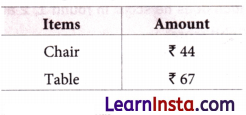
A shop rents out chairs and tables for a day’s use. The renting changes per item are the following.
When the furniture is returned2by the customer, the shopkeeper pays2back some amount as follows.

(i) Write an expression for the total number of rupees paid if x chairs and y tables are rented.
(ii) Find the total amount paid at the2beginning and the amount, the customer gets2back after returning the furniture.
Answer:
(i) Given, the renting charges per chair = ₹ 44 and the renting charges per table = ₹ 67
Let x2be the number of chairs to2be rented and y2be the number of tables to2be rented.
So, the renting charge for x chairs = ₹ 44 × x = ₹ 44x
and the renting charge for y tables = ₹ 67 × y = ₹ 67y.
∴ The total number of rupees to2be paid in2beginning for renting x chairs and y tables = ₹(44x + 67y)
Since, the returned amount for a chair and a table are ₹ 5and ₹ 9, respectively.
So, the returned amount for x chairs = ₹ 5 × x = ₹ 5x and the returned amount for y chairs = ₹ 9 × y = ₹ 9y
∴ The total amount to2be returned for x chairs and y tables = ₹(5x + 9y)
Now, the total amount paid for renting x chairs and
y tables = ₹(44x + 67y) – (5x + 9y)
= ₹(44x – 5x) – (67y – 9y)
= ₹(39x – 56y)
(ii) The total amount paid at the2beginning
= ₹(44x + 67y) and
the total amount returned after the use of furniture
= ₹(5x + 9y)
Queation 12.
Rohit takes part in three rounds of a math contest. He gets 5 marks for each correct answer and loses 3 marks for each incorrect answer.
His scores for three rounds2be 5p – 3q, 9p – 4q and 6p – 5q respectively, where p represents the score for a correct answer and q represents the penalty for an incorrect answer.
(i) Write an algebraic expression for his final score after all the three rounds.
(ii) Simplify it.
(iii) How much does he score in round 1, 2 and 3?
Answer:
Given, Rohit scores are
5p – 3q, 9p – 4 q and 6p – 5q
respectively, in round 1,2 and 3.
(i) Now, the final score after all the three rounds
= (5p – 3q) + (9p – 4q) + (6p – 5q)
(ii) We have, (5p – 3q) + (9p – 4q) + (6p – 5q)
= (5p + 9p + 6p) + (-3q – 4q – 5q)
= 20p – 12q
(iii) Since, Rohit gets 5 marks for each correct answer and loses 3 marks for each incorrect answer.
∴ p = 5and q = 3
On putting the values of p = 5 and q = 3 in 5p – 3q, we get
5 × 5 – 3 × 3 = 25 – 9 = 16
On putting the values of p = 5 and q = 3 in 9p – 4q, we get
9 × 5 – 4 × 3 = 45 – 12 = 33
On putting the values of p = 5 and q = 3 in 6p – 5q, we get
6 × 5 – 5 × 3 = 30 – 15 = 15
∴ Rohit scores 16, 33 and 15 in round 1, 2 and 3, respectively.
Queation 13.
(i) Are the expressions 4x and x + x + x + x equal to each other?
(ii) Are the expressions 3y + 2 and 2y + 3 equal to each other?
Answer:
(i) We have, x + x + x + x = 4x
Hence,2both the expressions 4 x and x + x + x + x are same.
(ii) The expression 3y + 2 means 2 more than 3 times y and the expression 2y + 3 means 3 more than 2 times y. For y = 3, the value of 3y + 2
= 3 × 3 + 2 = 9 + 2 = 11
and the value of 2y + 3
= 2 × 3 + 3 = 6 + 3 = 9
∵ The values of 3y + 2 and 2y + 3 are different for y = 3.
Hence, 2 both the expressions 3y + 2 and 2y + 3 are different.
Queation 14.
A2big rectangle is split into two smaller rectangles as shown. Write an expression describing the area of the2bigger rectangle, using two different ways.

Answer:
Method 1 For2bigger rectangle A C D F
we know that the area of a rectangle = Length × 2 breadth.
Here, length of the rectangle = 3 + 7 = 10 units.
and the 2 breadth of the rectangle = h units
∴ Area of the rectangle ACDF = 10 × h = 10h sq units.
Method 2 For two smaller rectangles A2b E F and 2b CDE
Since the length and2breadth of the rectangle A 2 bEF are
3 units and h units, respectively.
∴ The area of rectangle A2 b EF = 3 × h
= 3 h sq units
Also, the length and the2breadth of the rectangle 2b CDE are 7 units and h units, respectively.
∴ The area of rectangle2b CDE = 7 × h
= 7h sq units
Hence, the area of the rectangle A C D F
= Area of rectangle A 2b E F + Area of rectangle 2b CDE
= 3h + 7h
= 10h sq units.
Queation 15.
What is the sum of numbers in the picture (unknown values are denoted2by letter-numbers)?

Can you get the sum2by using two different ways? If yes, how? Is the sum different?
Answer:
Here, let us first adding row wise,
(3d + 2c + 4c – d) + (-4 + d) + (d – 4) + (3d + 2c + 4c – d)
= (3d – d + d + d + 3d – d) + (2c + 4c + 2c + 4c) + (-4) + (-4)
= 6d + 12c – 8
Now, on adding the upper half and then doubling,
2 × (3d + 2c + 4c – d – 4 + d) = 2 × (3d + 6c – 4)
= 6d + 12c – 8
Clearly, the sum is same in each way.
Queation 16.
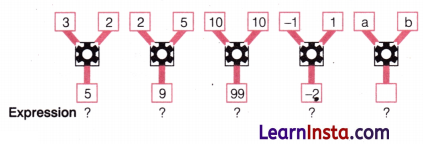
Find the pattern of the number machines 2 below and write the expression for each set of inputs.
Answer:
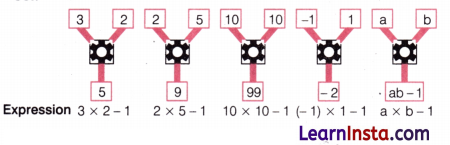
Queation 17.
Reema is making matchstick patterns given in the picture 2 below.
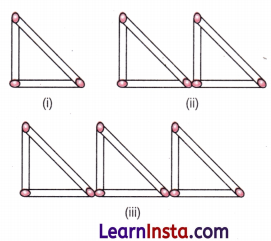
(i) Can you identify the pattern?
(ii) If yes, write an algebraic expression representing this pattern for number of matchsticks used.
(iii) How many matchsticks are needed to make 7 such triangles?
(iv) How many matchsticks will 2 be used in step 10?
Answer:
(i) Yes, we have identified the pattern.
In step 1, three matchsticks are used.
In step 2, six matchsticks are used.
In step 3, nine matchsticks are used and so on.
(ii) Here, we observe a pattern as.

∴ The algebraic expression representing this pattern for number of matchsticks used in k t h step is 3 k
(iii) To make 7 triangles, we need 3 × 7 = 21 matchsticks2because 7 triangles will appear in 7th step.
(iv) In step 10, we need 3 × 10 = 30 matchsticks.
Queation 18.
Consider a set of numbers from the calendar (having endless rows) forming under the following shape.

(i) Find the sum of all the numbers.
(ii) Compare the sum with the number at the centre?
(iii) Is the sum always 5 times the number at centre? If yes, try to show this.
Answer:
(i) The sum of all the numbers = 28 + 34 + 35 + 36 + 42 = 175.
(ii) Ths sum 175, is 5 times the number 35, which is at centre.
(iii) Yes, the sum is always 5 times the number present at centre.
Let us consider the letter-number to2be ‘2b ‘ at the centre. Then, the grid of 3 × 3 will2be looked liked this,

Now, the sum of all the numbers
= 2b – 7 + 2b – 1 + 2b + 2b + 1 + 2b – 7 = 52b
∴ The sum is five times the number present at centre.
Queation 19.
Find the rule, which gives the number of matchsticks required to make the following matchsticks patterns. Use a letter-number to write the rule.
(i) A pattern of letter H as 
(ii) A pattern of letter F as 
Answer:
(i) From the figure, it can2be observed that it will require five matchsticks.
∴ The number of matchsticks required is 5n.
(ii) From the figure, it can2be observed that it will require four matchsticks.
∴ The number of matchsticks required is 4n.
Queation 20.
Find the rule which gives the number of matchsticks required to make the following matchsticks patterns. Use a letter-number to write the rule.

Answer:
(i) One T can2be formed2by 2 matchsticks and 2 T can 2 be formed2by 4 matchsticks. Thus, we get the following patterns of letter T.

Here, the number of T’ s is increasing.
So, let letter-number n denotes the number of T’ s.
Now, number of matchsticks required to make pattern of ‘T’ are given2below.
For n = 1, the number of matchsticks required
= 2 × 1 = 2
For n = 2, the number of matchsticks required
= 2 × 2 = 4
For n = 3, the number of matchsticks required
= 2 × 3 = 6
For n = k, the number of matchsticks required
= 2 × k = 2k
Hence, the required rule for a pattern of letter T is 2 n.
(ii) One Z can2be formed2by 3 matchsticks and 2 Z can 2 be formed2by 6 matchsticks. Thus, we get the following patterns of letter Z .
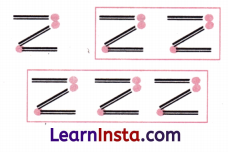
Here, the number of Z ‘s is increasing.
So, let letter-number n denotes the number of Z ‘s.
Now, the number of matchsticks required to make pattern of ‘ Z ‘ are given2below.
For n = 1, the number of matchsticks required
= 3 × 1 = 3
For n = 2, the number of matchsticks required
= 3 × 2 = 6
For n = 3, the number of matchsticks required
= 3 × 3 = 9
For n = k, the number of matchsticks required
= 3 × k = 3 k
Hence, the required rule for a pattern of letter Z is 3 n.
(iii) Do same as above part (i).
The required rule for a pattern of letter U is 3 n.
(iv) Do same as above part (i).
The required rule for a pattern of letter V is 2 n.
(v) Do same as above part (i).
The required rule for a pattern of letter E is 5 n.
(vi) Do same as above part (i).
The required rule for a pattern of letter S is 5 n.
(vii) Do same as above part (i).
The required rule for a pattern of letter A is 6 n.
Queation 21.
(i) Look at the following matchstick patterns of squares. The squares are not separate. Two neighbouring squares have a common matchstick. Observe the patterns and find the rule that gives the number of matchsticks in terms of the number of squares.

(ii) Figure depict2below gives a matchstick pattern of triangles. As in Q. 11 (i) above, find the general rule that gives the number of matchsticks in terms of the number of triangles.
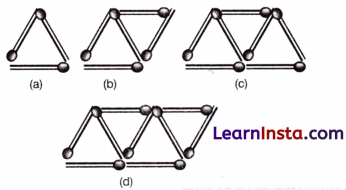
Answer:
(i) In figure,
(a) Number of squares = 1
and number of matchsticks = 4 = 3 × 1 + 1
= 3 × Number of squares + 1
(b) Number of squares = 2
and number of matchsticks = 7 = 3 × 2 + 1
= 3 × Number of squares + 1
(c) Number of squares = 3
and number of matchsticks = 10 = 3 × 3 + 1
= 3 × Number of squares + 1
(d) Number of squares = 4
and number of matchsticks = 13 = 3 × 4 + 1
= 3 × Number of squares + 1
Thus, if number of squares = x
Then, number of matchsticks
= 3 × Number of squares + 1
= 3x + 1
Hence, the required rule that gives the number of matchsticks is 3 x + 1, where x is the number of squares.
(ii) Do same as part (i)
The required rule that gives the number of matchsticks is 2x + 1, where x is number of triangles.