These Class 8 Science Curiosity Worksheet and Class 8 Science Chapter 1 Exploring the Investigative World of Science Worksheet with Answers are excellent for board exam practice.
Class 8 Science Chapter 1 Exploring the Investigative World of Science Worksheet
Class 8 Exploring the Investigative World of Science Worksheet
Worksheet On Exploring the Investigative World of Science Class 8 – Exploring the Investigative World of Science Worksheet Class 8
Let’s Begin
A. Multiple-Choice Questions
Question 1.
In science, an investigation means
(a) Only looking at something and asking simple questions
(b) Asking focused questions, doing experiments, and using observations to learn more
(c) Memorising facts without testing them
(d) Guessing answers without evidence.
Question 2.
What does the image of a root at the bottom of the left-hand pages in the NCERT science textbook symbolise?
(a) The importance of plant growth.
(b) The process of water absorption in plants.
(c) The need to study only about trees.
(d) A deep foundation of knowledge connected to environment, traditions, and heritage.
Question 3.
Which term is used for the bouncing back of light from a surface?
(a) Refraction
(b) Reflection
(c) Absorption
(d) Dispersion
Question 4.
This question consists of an Assertion (A) and a Reason (R). Read the Assertion and Reason and choose the appropriate answer.
Assertion (A): We see different phases of the Moon from Earth.
Reason (R): The phases occur due to the changing positions of the Moon, Earth, and Sun.
(a) Both A and R are true and R is the correct explanation of A.
(b) Both A and R are true but R is not the correct explanation of A.
(c) A is true but R is false.
(d) A is false but R is true.
Question 5.
This question consists of an Assertion (A) and a Reason (R). Read the Assertion and Reason and choose the appropriate answer.
Assertion (A): Living organisms do not depend on their environment.
Reason (R): Air, water, sunlight and other organisms form ecosystems that support life on Earth.
(a) Both A and R are true and R is the correct explanation of A.
(b) Both A and R are true but R is not the correct explanation of A.
(c) A is true but R is false.
(d) A is false but R is true.
B. State True (T) or False (F).
1. Only a polished surface can clearly reflect light.
2. Pure substances can be broken down into simpler substances.
3. A kite at the top right corner of the odd numbered pages in the NCERT science textbook symbolises curiosity taking flight to explore the unknown.
4. A greater pressure difference can cause stronger winds.
5. Chaitro is the month of March to April.

C. Fill in the blanks.
1. The ________ of electric current is used to run motors and operate machines.
2. _________ makes a car stop when the brakes are applie(d)
3. In __________, particles are tightly packed and cannot move.
4. The Earth’s atmosphere provides _____________, which we breathe.
5. Observing the Moon’s phases helped humans create the first __________
D. Assign one word to the following terms.
1. The effect of electric current that keep us warm. ______________
2. A combination of substances that can be separated by physical methods. ______________
3. A transparent curved surface that bends light. ______________
4. A substance that helps the body fight diseases by building immunity. ______________
5. Invisible rays from the Sun that can affect our skin. ______________
E. Match the pictures given in Column I with the correct descriptions given in Column II.
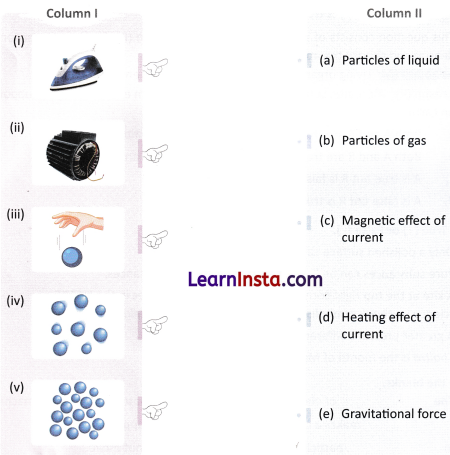
Wonder Why?
Read the paragraph and answer the following questions. Interpret/Analyse
Earth is at the perfect distance from the Sun where water exists as liquid, making it possible where water exists as liquid, making it possible for life to exist. Its atmosphere provides us with essential gases like oxygen and nitrogen gases. Oxygen is used for breathing, and nitrogen is used by plants for their growth. The atmosphere also protects us from harmful ultraviolet (UV) rays. Human activities can cause small changes in Earth’s temperature, which may disrupt climate patterns leading to dangerous consequences.
Question 1.
Why is Earth considered to be at the perfect distance from the Sun?
__________________________________________
__________________________________________
__________________________________________
2. How does Earth’s atmosphere protect us from harmful ultraviolet rays?
__________________________________________
__________________________________________
__________________________________________
3. Name the two gases needed by humans and plants to survive. Give reason.
__________________________________________
__________________________________________
__________________________________________
4. What can be the consequences of human activities?
__________________________________________
__________________________________________
__________________________________________
Learn By Doing
Observe and Answer
Question 1.
Identify the states of matter represented in each of the following figures based on the arrangement of particles.
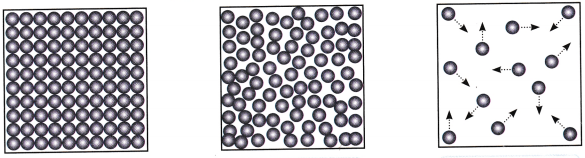
Question 2.
Which state of matter has slowest moving particles?
__________________________________________
__________________________________________
Question 3.
Give three examples of each state of matter.
__________________________________________
__________________________________________
Question 4.
State True (T) or False (F).
(i) The particles in solids are tightly packe(d) ______________
(ii) Particles in liquid do not change their shape easily. ______________
(iii) Particles in gases can be compressed easily. ______________
Explore With Curiosity
Observe the image and Answer the following questions.
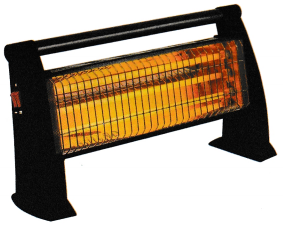
Question 1.
Which effect of electric current is shown in this picture? Explain.
__________________________________________
__________________________________________
Question 2.
Name four other devices that work on this principle.
__________________________________________
__________________________________________
Question 3.
Mention any two advantages and disadvantages of this effect.
__________________________________________
__________________________________________
Word Puzzle
Complete the crossword with the help of the given clues.
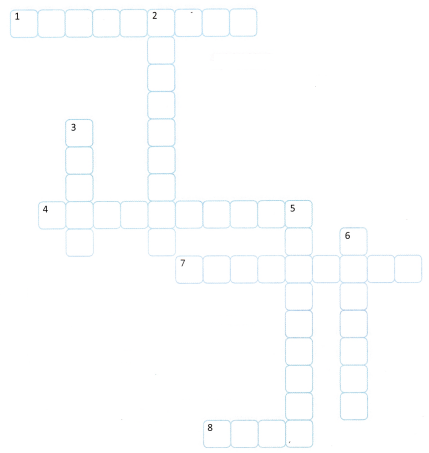
ACROSS
1. Community of living and non-living things interacting with each other
4. Layer of gases surrounding the Earth
7. Strong desire to learn or discover something new
8. Reflect sunlight and has no light of its own
DOWN
2. Person who studies and experiments to learn about nature
3. Planet at perfect distance from Sun with liquid water
5. Slow change in living things over generations
6. Shrinking bright part of the Moon
Suggested Activities
Make some dough using flour and water and knead it well. Roll small balls of dough into different thickness—thin, medium, and thick. Heat some oil in a pan. Carefully drop each rolled dough into the hot oil in different ways—straight down or at an angle. Make a table to record whether each puri puffs up or not and also note the time it takes. Try using fresh dough and stored dough, and write the difference.