Students can use Exploration Class 9 Science Solutions Chapter 5 Exploring Mixtures and their Separation Question Answer NCERT Solutions as a quick reference guide.
Class 9 Science Exploration Chapter 5 Question Answer
Class 9 Science Ch 5 Exploring Mixtures and their Separation Question Answer
Exploring Mixtures and their Separation Class 9 Questions and Answers (Exercise)
Revise, Reflect, Refine (NCERT Textbook Page No. 68 – 70)
Question 1.
Which of the following mixtures are correctly classified as homogeneous (Hm) and heterogeneous (Ht)? Choose the correct option.
(i) Air – Hm, Milk – Ht, Sugar solution-Hm, Smoke – Hm
(ii) Brass – Ht, Fog-Ht, Vinegar-Ht, Muddy water – Hm
(iii) Copper sulfate solution -Hm, Salt solution – Hm, Milk – Hm, Bronze – Hm
(iv) Muddy water – Ht, Milk – Ht, Blood – Ht, Brass – Hm
Answer:
(iv) Homogeneous mixture (Hm): Uniform composition throughout.
Heterogeneous mixture (Ht): Non-uniform composition, particles visible or separable.
Now let’s check each options:
(i) Incorrect: Smoke is a heterogeneous mixture (colloid), not homogeneous.
(ii) Incorrect: Brass → Homogeneous Vinegar → Homogeneous Muddy water → Heterogeneous
(iii) Incorrect: Milk is a heterogeneous mixture (colloid); others are correct.
(iv) Correct: Muddy water – Ht, Milk – Ht, Blood – Ht, Brass – Hm

Question 2.
Choose the correct options, and explain the reason for the correct and incorrect options.
Which among the following mixtures show the Tyndall Effect?
A mixture of:
(a) air and dust particles
(b) copper sulfate and water
(c) starch and water
(d) acetone and water
(i) a and b (ii) b and d (iii) a and c (iv) c and d
Answer:
(iii) The Tyndall effect is shown by colloids where particles scatter light. True solutions do not show this effect.
(i) (a) and (b)
Incorrect
(a) (Air + dust) → Shows Tyndall effect (heterogeneous)
(b) (Copper sulfate + water) → Does not show Tyndall effect (true solution, homogeneous)
(ii) (b) and (d)
Incorrect
(b) (Copper sulfate solution) → No Tyndall effect, (id) (Acetone + water) → No Tyndall effect (homogeneous mixture).
(iii) (a) and (c)
Correct
(a) (Air + dust particles) → Shows Tyndall effect.
(c) (Starch + water) → Shows Tyndall effect, (colloidal solution)
(iv) (c) and (d)
Incorrect
(c) (Starch + water) → Shows Tyndall effect
(d) (Acetone + water) → Does not show Hence, option (iii) (a) and (c) is correct.
Question 3.
A mixture can be categorised as a solution, a suspension, or a colloid, each possessing distinct properties. Utilise the words or phrases provided in the box to fill in the Table below. Words and phrases may be used more than once.
Words and Phrases
Large-sized particles; Particles remain evenly distributed; Small-sized particles (less than 1 nm diameter); Moderate-sized particles (1 – 1000 nm); Settles down when left undisturbed (more than 1000 nm in diameter); Does not settle down; Scatters light; Separates by filtration; Transparent; Salt solution; Milk; Sand in water; Smoke; Heterogeneous mixture; Cannot be separated by filtration; Mud; Butter; Brass.
Complete the Table.
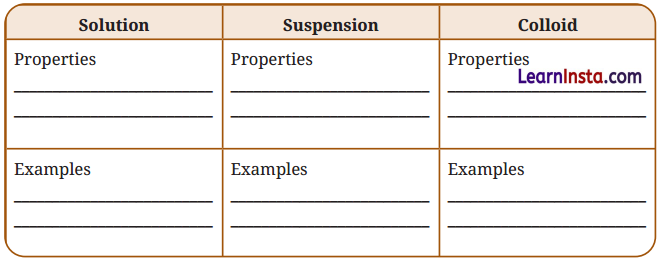
Answer:
(i) Solution
Properties:
- Particles remain evenly distributed
- Particle size less than 1 nm
- Transparent
- Particles do not settle down
- Cannot be separated by filtration
Examples:
- Salt solution
- Brass
(ii) Suspension Properties:
- Particle size greater than 100 nm
- Particles settle down on standing
- Scatters light
- Heterogeneous mixture
- Can be separated by filtration
Examples:
Sand in water
(iii) Colloid Properties:
- Particle size 1-100 nm
- Particles do not settle down
- Scatters light due to the Tyndall effect
- Heterogeneous mixture
- Cannot be separated by filtration
Examples:
- Milk
- Smoke
- Butter
- Mud
Question 4.
Solve the following problems:
(i) A cake recipe uses dry ingredients, namely 75 g of sugar for 420 g of all-purpose flour and 5 g of sodium hydrogencarbonate. Express the concentration of each component in the mixture using an appropriate method.
(ii) A brass alloy contains 70% copper by mass. Calculate the quantities of copper and zinc present in 120 g of brass.
Answer:
(i) Given:
- Sugar = 75 g
- flour = 420 g
- Sodium hydrogencarbonate = 5 g
Total mass of solution = 75 + 420 + 5 = 500 g
Since all components are solids, we use mass by mass percentage (% m/m).
Mass % = \(\frac{\text { Mass of component (solute) }}{\text { Total mass }}\)
- Sugar = \(\frac {75}{500}\) × 100 = 15 %
- Flour = \(\frac {420}{500}\) × 100 = 84 %
- Sodium hydrogencarbonate = \(\frac {5}{500}\) × 100= 1 %
Therefore,
- Sugar = 15%
- Flour = 84%
- Sodium hydrogencarbonate = 1%
(ii) Given:
- Total mass of brass = 120 g
- Copper = 70 % by mass
- Brass is an alloy of copper + zinc
Calculate mass of copper
% m/m = \(\frac{\text { Mass of component }}{\text { Total mass }}\) × 100
or mass of component = \(\frac{\% \mathrm{~m} / \mathrm{m} \times \text { total mass }}{100}\)
= \(\frac{70 \times 120}{100}\) = 84 g
Mass of zinc = Total mass – Mass of copper
= 120 – 84 = 36 g
Therefore,
- Copper = 84 g
- Zinc = 36 g
Question 5.
The label on a cooking oil pack says one litre (910 g). If this oil is mixed with water, will it form a separate layer? If so, which substance will be on top? How will you separate the two layers? Also, draw the diagram of the apparatus used.
Answer:
Yes, cooking oil and water are immiscible liquids – they do not mix and will form two separate layers. Oil is less dense than water, so oil will form the upper layer. Water (denser) will form the lower layer.
Method of separation: Using a separating funnel.
Procedure: Pour the mixture into the separating funnel and allow it to stand until two distinct layers form. Open the stopcock slowly to drain the lower layer (water) into a beaker. Close the stopcock when water is almost fully drained. Then open the stopcock again to collect the upper oil layer in a separate container.
Diagram of Separating Funnel:
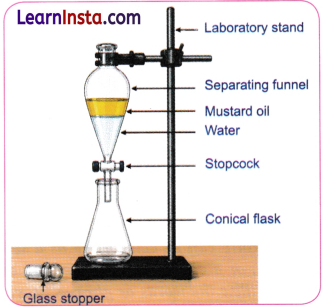
Apparatus:
Separating funnel fixed on a laboratory stand with a stopcock at the bottom and a conical flask to collect each layer.
Question 6.
Assertion (A): Solutions do not exhibit the Tyndall effect.
Reason (R): The particles in solutions are larger than 100 nm, so they cannot scatter light.
Choose the correct option:
(i) Both A and R are true, and R is the correct explanation of A.
(ii) Both A and R are true, but R is not the correct explanation of A.
(iii) A is true, but R is false.
(iv) A is false, but R is true.
Answer:
(iii) A is true, but R is false.
Explanation:
- True solutions have very small particles (less than 1 nm). These particles cannot scatter light. So solutions do not show the Tyndall effect.
- Particles greater than 100 nm belong to suspensions, not solutions.
Question 7.
How would you separate the mixtures given in the Table (below)? Mention the reason for choosing your method. If a mixture cannot be separated, explain why.
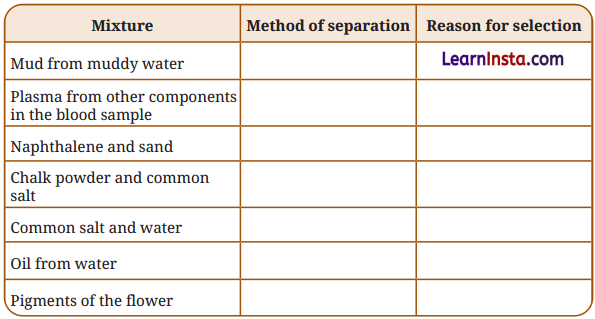
Answer:
| Mixture | Method of Separation | Reason for Selection |
| Mud from muddy water | Centrifugation and or coagulation (using alum) followed by decantation/ filtration | Mud particles are too fine for simple filtration, centrifugation uses centrifugal force to settle particles; alum causes coagulation of fine particles |
| Plasma from other components in the blood sample | Centrifugation | Blood is a colloid/suspension; centrifugation separates heavier components (RBCs, WBCs platelets) from the lighter plasma |
| Naphthalene and sand | Sublimation | Naphthalene sublimes (solid to vapour) on gentle heating while sand does not the vapour |
| Chalk powder and common salt | Dissolve in water → filter (chalk is insoluble, collected on filter paper) → evaporate filtrate to get salt | Chalk is insoluble in water; salt is soluble. Filtration separates insoluble chalk; evaporation recovers salt. |
| Common salt and water | Evaporation or distillation | Evaporation removes water and leaves salt; distillation is used if we also want to recover pure water. |
| Oil from water | Separating funnel | Oil and water are immiscible and have different densities; they form two layers that can be separated using a separating funnel. |
| Pigments of the flower | Paper chromatography | Flower pigments are a mixtures of differently coloured compounds; paper chromatography separates them based on their different rates of movement in a solvent. |
Question 8.
Two miscible liquids, A and B, are present in a mixture. The boiling point of A is 60°C and the boiling point ofB is 90 °C. Suggest a method to separate them. Also, draw a labelled diagram of the method suggested.
Answer:
The boiling points of A (60°C) and B (90°C) differ by 30°C (which is more than 25°C), so simple Distillation can be used to separate them.
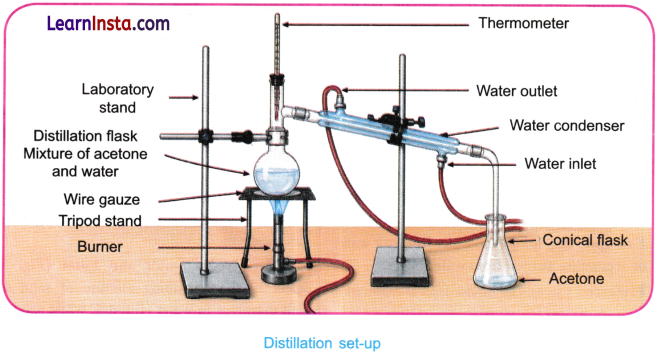
Process:
Heat the mixture in a distillation flask. Liquid A, having the lower boiling point (60°C), vaporises first. The vapour of A passes through the condenser, where it cools and condenses back into liquid and is collected in a conical flask as the distillate. Liquid B, with the higher boiling point (90°C), remains in the distillation flask.
Question 9.
Compare evaporation, crystallization and distillation. In which situation, would you prefer each of these over the others?
Answer:
Comparison of evaporation, crystallization, and distillation, along with when each method is preferred:
Evaporation
- Definition: Removal of solvent (usually water) by heating so that it changes into vapour.
- Use: To obtain a solid solute from its solution when the solvent is not required.
- Example: Getting common salt from seawater.
- Preferred when: Only the solid is needed, not the liquid.
Crystallization
- Definition: Process of forming pure, well¬shaped crystals from a solution by cooling or slow evaporation.
- Use: To obtain pure solid substances in crystalline form.
- Example: Preparing copper sulfate crystals from its solution.
- Preferred when: We want pure crystals instead of just solid residue.
Distillation
- Definition: Heating a liquid to form vapour and then cooling the vapour to get back the liquid.
- Use: To separate and recover pure liquid from a solution, or to separate two miscible liquids with different boiling points.
- Example: Obtaining pure water from salt water, or separating alcohol from water.
- Preferred when: The liquid itself is required in pure form.
Question 10.
Blood is an example of a colloidal mixture,
(i) What would happen if blood behaved like a true suspension inside the body? (ii) In a blood sample, identify the dispersed phase and the dispersion medium.
Answer:
(i) If blood were a true suspension, the solid components (like red blood cells, white blood cells, and platelets) would be large enough to settle down under gravity when left undisturbed. This would mean that the cells would separate from plasma, leading to blockages and failure of circulation. The uniform flow of blood through vessels would not be possible, and the transport of oxygen, nutrients, and waste would be disrupted. In short, life processes would collapse because blood must remain evenly mixed to function properly.
(ii) Blood is a colloidal mixture:
- Dispersed phase: The cells (red blood cells, white blood cells, platelets) and plasma proteins.
- Dispersion medium: Plasma (the liquid part of blood, mostly water with dissolved substances).
Question 11.
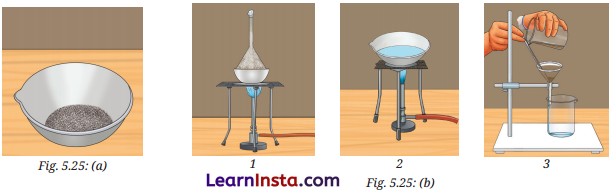
You are given a mixture of sand, common salt and naphthalene (Fig. a below). The Fig. b (below) depicts various steps used to separate the components of this mixture. Identify and write down the correct sequence of separation techniques.
Answer:
To separate a mixture of sand, common salt, and naphthalene, the correct sequence of separation techniques is:
1. Sublimation (Fig. 1): Heat the mixture gently. Naphthalene sublimes (converts directly to vapour) and is collected on the cooler funnel, leaving behind sand and salt.
3. Dissolve in water and Filter (Fig. 3): Add water to the remaining mixture of sand and salt. Salt dissolves in water (filtrate), while sand does not dissolve and is collected on the filter paper as residue.
2. Evaporation/Distillation (Fig. 2): Evaporate the filtrate (salt solution) to recover common salt. All three components – naphthalene, sand, and common salt – are now separated.
So the correct sequence is
1. Sublimation (Fig. 1) → 3. Dissolution (Fig. 3) → 2. Filtration / Evaporation (Fig. 2)
Question 12.
Why is distillation an effective method for separating a mixture of water and acetone?
Answer:
Distillation is effective because:
- Water and acetone are miscible liquids
- They have a large difference in boiling points:
Acetone ≈ 56°C
Water = 100°C - The liquid with the lower boiling point (acetone) vapourizes first.
- The vapour is condensed and collected separately, leaving water behind.
Conclusion:
Distillation works due to the difference in boiling points, allowing separation by selective vapourization and condensation.
Question 13.
Answer the following questions with the help of the data given in the Table below.
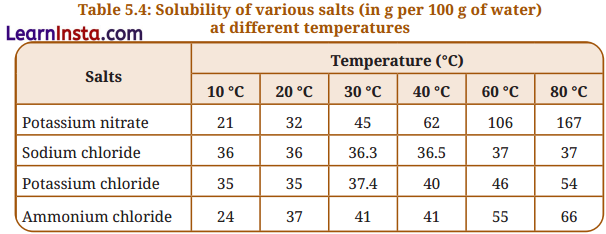
(i) What mass of potassium nitrate would be needed to prepare its saturated solution in 50 g of water at 40 °C?
(ii) A student makes a saturated solution of potassium chloride in water at 80 °C and leaves the solution to cool at room temperature (25 °C). What would she observe as the solution cools? Explain.
(iii) What is the effect of a change in temperature on the solubility of salts? Also, compare the changes in the solubility of the four given salts with increasing temperature from 10 °C to 80 °C.
Answer:
(i) Given: Solubility = 62 g in 100 g water
Mass of Water = 50 g
Calculation:
\(\frac{\text { Mass of Solute × } 50}{\text { Mass of Solution }}=\frac{62 \times 50}{100}\) = 31 g
31 g of potassium nitrate is required.
(ii) At 80°C, the solubility of potassium chloride is 54 g per 100 g of water. At 25°C, solubility is approximately 35 g per 100 g of water (interpolating from the table between 20°C and 30°C values).
As the solution cools from 80°C to 25°C, the solubility drops from 54 g to about 35 g. The extra potassium chloride (54 – 35 = 19 g per 100 g of water) that can no longer remain dissolved will crystallise out. The student would observe white crystals of potassium chloride forming and settling at the bottom of the beaker.
(iii) Effect of temperature: The solubility of all four salts increases with an increase in temperature (for solid solutes in liquid solvents).
Comparison:
Potassium nitrate:
Most dramatic increase – from 21 g at 10°C to 167 g at 80°C.
Solubility increases very rapidly with temperature.
Sodium chloride:
Least change – from 36 g at 10°C to 37 g at 80°C.
Solubility is nearly constant, barely affected by temperature.
Potassium chloride:
Moderate increase – from 35 g at 10°C to 54 g at 80°C.
Steady increase with temperature.
Ammonium chloride:
Significant increase – from 24 g at 10°C to 66 g at 80°C.
Considerable increase with temperature.
Order of increase in solubility with temperature (least to most):
Sodium chloride < Potassium chloride < Ammonium chloride < Potassium nitrate.
Question 14.
Three students, A, B and C, are preparing sugar solutions for an experiment:
- Student A dissolves 20 g of sugar in 80 g of water.
- Student B dissolves 20 g of sugar in 100 g of water.
- Student C dissolves 30 g of sugar in 80 g of water.
(i) Calculate the mass percentage (% m/m) concentration of sugar in each student’s solution.
(ii) Whose solution is the most concentrated? Explain why.
Answer:
(i) Formula:
% m/m = \(\frac{\text { Mass of solute }}{\text { Total mass of solution }}\) × 100
Student A:
Sugar = 20 g
Water = 80 g
Total = 100 g
% m/m = \(\frac{20 \times 100}{100}\) = 20 %
Answer: 20%
Student B:
Sugar = 20 g
Water = 100 g
Total = 120 g
% m/m = \(\frac{20 \times 100}{120}\) = 16.67 %
Answer: 16.67%
Student C:
Sugar = 30 g
Water = 80 g
Total = 110 g
% m/m = \(\frac{30 \times 100}{110}\) = approx. 27.27%
Answer: 27.27%
Student A → 20 %
Student B → 16.67 %
Student C → 27.27 %
(ii) Student C has the highest mass percentage (27.27 %), so it contains the maximum amount of sugar per unit mass of solution.
Question 15.
Identify the separation technique marked as ‘S’.
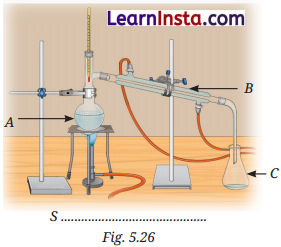
(ii) Label the apparatus A, B and C.
(iii) Which of the following mixtures can be separated by the technique identified above? Use the data given in the table below. Mixtures:
(a) water – acetone
(b) water – salt
(c) acetone – alcohol
(d) sand – salt
(e) alcohol – chloroform

Answer:
(i) Technique : S = Distillation
(ii) Label the apparatus A, B, and C:
- A : Distillation flask
- B: Water condenser
- C : Receiver flask (beaker or conical flask)
(iii) Concept: Simple distillation is used when:
- Liquids are miscible
- Difference in boiling points is greater than 25°C
OR
To separate a liquid from dissolved solids
Analysis using the table:
(a) Water – Acetone (100°C – 56°C = 44°C) → can be separated by simple distillation.
(b) Water – Salt, Salt is non-volatile → can be separated by simple distillation.
(c) Acetone – Alcohol, (56°C – 78°C = 22°C) Difference < 25°C → simple distillation cannot be used to separate the mixture of acetone and alcohol.
(d) Sand – Salt, both are solids. Not separated by distillation.
(e) Alcohol – Chloroform, (78°C – 61°C = 17°C) Difference < 25°C. Not separated by distillation.
(f) Alcohol – Benzene (78°C – 80°C = 2°C) Very small difference, simple distillation can’t be used.
Conclusion:
Simple distillation is effective for mixtures with large boiling point differences (> 25°C) or solutions containing dissolved solids.
(iii) Suitable mixtures:
(a) Water – Acetone
(b) Water – Salt
Class 9 Science Chapter 5 Exploring Mixtures and their Separation Question Answer (InText)
Think It Over (NCERT Textbook Page No. 72)
Question 1.
Why do suspended particles settle in muddy water over time hut not in milk?
Answer:
Muddy water is a suspension. In a suspension, the solid particles are relatively large and simply dispersed in the liquid. Because of gravity, these particles gradually settle down at the bottom if the mixture is left undisturbed. That’s why muddy water clears after standing for some time.
Milk, on the other hand, is a colloid. In a colloid, the particles are much smaller (between 1 nm and 100 nm) and are evenly spread throughout the liquid. These particles are so tiny that they do not settle down under gravity and remain uniformly distributed. This makes milk appear homogeneous and stable even after standing for a long time.
Question 2.
How is evaporation different from boiling?
Answer:
Evaporation and boiling are both processes in which a liquid changes into vapour, but they are different. Evaporation is a slow process that takes place only at the surface of the liquid and can occur at any temperature.
For example, water in a bowl kept in sunlight slowly disappears due to evaporation. Boiling, on the other hand, is a rapid process thatoccurs throughout the liquid when it is heated to its boiling point. At this temperature, bubbles of vapour form inside the liquid and rise to the surface. Evaporation causes cooling because fast-moving molecules escape, while boiling keeps the temperature constant until all the liquid changes into vapour.
Question 3.
Why do you see bright rays of sunlight when it passes through small gaps between the leaves of a dense tree?
Answer:
We see bright rays of sunlight through small gaps between leaves because of the scattering of light by tiny particles in the air.
- The air contains dust, smoke, and tiny water droplets (a colloidal mixture).
- When sunlight passes through gaps in the leaves, it enters these particles.
- The particles scatter the light in different directions.
- This makes the path of light visible as bright rays.
This effect is called the Tyndall effect.
Pause and Ponder (NCERT Textbook Page No. 76)
Question 1.
A common talcum powder contains 4 % m/m zinc oxide, which acts as an antiseptic. How much zinc oxide is present in 300 g of the talcum powder?
Answer:
Here, % m/m =\(\frac{\text { Mass of Solute }}{\text { Mass of Solution }}\) x 100
Given, mass of solute (Zinc oxide) = 4 %
Mass of solution (Talcum powder) = 300 g
Now, mass of solute (ZnO) = \(\frac{\% \mathrm{~m} / \mathrm{m}}{100}\) × Mass of solution
= \(\frac {4}{100}\) × 300 = 12 g
Hence, zinc oxide present in talcum powder = 12 g
Question 2.
Your mother gives you a bottle of orange juice concentrate to mix with water and serve it to your visiting friends. She asks you to mix two tablespoons of the concentrate with water in a glass tumbler. If each tablespoon measures 15 mL and you make 150 mL of juice per person, what is the % v/v of orange juice concentrate in the mixture you prepared?
Answer:
Given: volume of solute concentrate = 2 × 15 = 30 mL
Total volume of the solution (juice) = 150 mL
% (v/v) = \(\frac{\text { Volume of solute }}{\text { Total volume of solution }}\) × 100
= \(\frac {30}{150}\) × 100 = 20%
20% of orange juice concentrate is present in the mixture.
Question 3.
Vinegar, used as a food preservative and additive, contains 5 % v/v acetic acid. Glacial acetic acid is a liquid, i.e., 100% acetic acid. If you want to make vinegar from glacial acetic acid, how would you proceed?
Answer:
% (v/v) = \(\frac{\text { Volume of solute }}{\text { Total volume of solution }}\) × 100
Solute = glacial acetic acid (pure acetic acid, 100%)
Solution = vinegar (acetic acid + water)
Volume of solute = \(\frac{\% \mathrm{v} / \mathrm{v}}{100}\) × Total volume of solution
Suppose we want to prepare 100 mL of vinegar (5% v/v acetic acid):
Volume of acetic acid = \(\frac {5}{100}\) × 100 = 5 mL
So,
Take 5 mL of glacial acetic acid
Add 95 mL of water
Total = 100 mL vinegar (5% v/v)
General rule
- For any required volume of vinegar, always take 5 parts of glacial acetic acid and mix with 95 parts of water.
- This ratio ensures the final solution contains 5% v/v acetic acid.
To make vinegar from glacial acetic acid, measure out 5 mL of glacial acetic acid and dilute it with 95 mL of water to get 100 mL of vinegar (5% v/v). For larger amounts, keep the same ratio of 1 part acid : 19 parts water.
Pause and Ponder (NCERT Textbook Page No. 79)
Question 4.
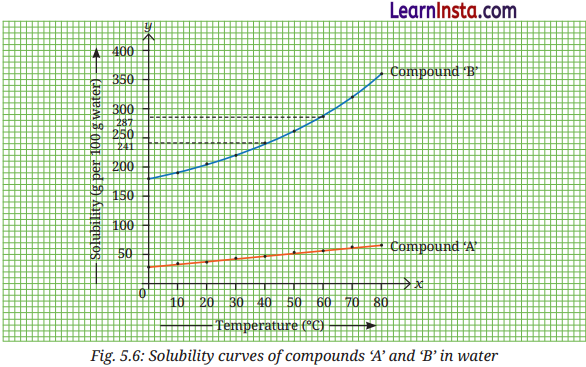
Refer to the solubility’ cun’es given in Activity’ 5.2. (See fig. below) If equal masses of hot, saturated solutions of compounds *A* and ‘B’are cooled from 80 °C to 60 °C, which solution is likely to deposit more solid?
Answer:
Compound B will deposit more solid. Looking at the solubility curves, Compound B shows a steeper decrease in solubility when cooled from 80°C to 60°C, compared to Compound A. Therefore, more of Compound B will crystallise out.
Question 5.
Will there be any change in the size of common salt crystals if the rate of evaporation is increased or decreased? Explain. (Page 79)
Answer:
Yes, the size of common salt crystals depends on the rate of evaporation.
When evaporation is slow, water molecules leave the solution gradually, giving the dissolved salt particles enough time to arrange themselves into larger, well formed crystals. This is why slow evaporation produces big, regular crystals.
On the other hand, when evaporation is fast, water is removed quickly, and the salt particles do not get enough time to settle into a proper crystal lattice. As a result, the crystals formed are small and less regular.
Everyday examples
- If we leave salty water in a dish to evaporate naturally in the shade, we’ll see large crystals forming.
- If we heat the same solution strongly, evaporation is rapid, and we’ll get tiny crystals instead.
Pause and Ponder (NCERT Textbook Page No. 82)
Question 6.
State whether the following statements are True or False. Also, correct the False statements.
(i) Salt can be separated from a salt solution by evaporation or distillation.
Answer:
True.
Salt can be separated from salt solution by evaporation (the water evaporates, leaving salt behind). Distillation can also be used if we want to recover the water as well.
(ii) Distillation can be used for separation of two liquids even when these have the same boiling point.
Answer:
False.
Distillation works only when the two liquids differ in boiling points (by at least about 25°C). If two liquids have the same boiling point, they cannot be separated by distillation.
(iii) In paper chromatography, the solvent level should be above the sample spot at the beginning of the experiment.
Answer:
False.
In paper chromatography, the solvent level should be below the sample spot. If the solvent level is above the spot, the sample will dissolve directly into thesolvent instead of being carried up the paper by capillary action.
(iv) Evaporation and crystallization are the same processes.
Answer:
False.
Evaporation is the process of removing the solvent by heating, leaving the solute behind (but may not give pure crystals). Crystallization is a more precise process that gives pure crystals of the solute by controlled cooling of a saturated solution. Crystallization gives purer and better-formed crystals than simple evaporation.
Pause and Ponder (NCERT Textbook Page No. 84)
Question 7.
Why do immiscible liquids form two separate layers in a separating funnel?
Answer:
Immiscible liquids form two separate layers because they do not mix and have different densities, so the heavier liquid settles at the bottom and the lighter liquid floats on the top.
Question 8.
Is sublimation different from evaporation? Justify.
Answer:
Yes, sublimation is different from evaporation.
- Sublimation is the process in which a solid directly changes into vapour without passing through the liquid state.
- Evaporation is the process in which a liquid changes into vapour at its surface at any temperature below boiling point.
Pause and Ponder (NCERT Textbook Page No. 88)
Question 9.
Clouds are made up of tiny water droplets or ice crystals floating in the air. Based on what you know about solutions, suspensions and colloids, what type of mixture do you think clouds are and why?
Answer:
Clouds are colloids. The tiny water droplets or ice crystals (dispersed phase) are suspended in air (dispersion medium). The particle size is in the colloid range (1-1000 nm). The particles do not settle, the mixture appears uniform, and it shows the Tyndall Effect (the beam of sunlight is visible through clouds). All these are properties of a colloid.
Question 10.
Why do cities with a lot of smoke and dust in the air often look hazy?
Answer:
Cities with a lot of smoke and dust in the air often look hazy because the tiny particles of smoke and dust act as scattering centres for light. Normally, sunlight travels in straight lines and allows us to see objects clearly. But when the air is filled with fine particles, these particles scatter the light in different directions. This scattering reduces the contrast and clarity of objects, making them appear blurred or less distinct.
In scientific terms, this is related to the Tyndall effect, where small particles dispersed in air scatter light. The more particles present, the stronger the scattering, and the hazier the atmosphere looks. That’s why polluted cities or areas with heavy smoke often appear covered in a dull, whitish or grey haze, and distant buildings or landscapes seem faded.
Threads of Curiosity (NCERT Textbook Page No. 85)
Question 1.
The spinning game is a folk dance called phugadi in Marathi and kikli in Punjabi. What is this called in your local language?
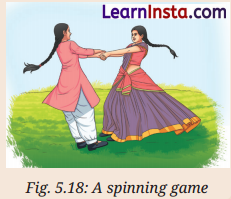
Answer:
It is commonly called “Ghoomar” or “Chakkar wala khel” in many Hindi-speaking regions. (The name may vary depending on the local language and region).