Students can use Exploration Class 9 Science Solutions Chapter 2 Cell The Building Block of Life Question Answer NCERT Solutions as a quick reference guide.
Class 9 Science Exploration Chapter 2 Question Answer
Class 9 Science Ch 2 Cell The Building Block of Life Question Answer
Cell The Building Block of Life Class 9 Questions and Answers (Exercise)
Revise, Reflect, Refine (NCERT Textbook Page No. 24 – 27)
Question 1.
Differentiate between the following pairs of terms based on the clues given in parentheses.
(i) Cell membrane and cell wall (permeability)
(ii) RER and SER (structure)
(iii) Chloroplasts and chromoplasts (pigments)
Answer:
(i) Cell membrane and cell wall (permeability):
The cell membrane is selectively permeable, which means it allows only certain substances to pass through it. The cell wall is permeable and it allows water and dissolved minerals to pass through it freely.
(ii) RER and SER (structure):
Rough Endoplasmic Reticulum (RER) has ribosomes attached to its surface, making its appearance rough under an electron microscope. Smooth Endoplasmic Reticulum (SER) does not have ribosomes on its surface, so it appears smooth.
(iii) Chloroplasts and chromoplasts (pigments):
Chloroplasts contain the green pigment chlorophyll, which helps in photosynthesis. Chromoplasts contain coloured pigments such as yellow, orange, or red, which give bright colours to flowers and fruits.
Question 2.
Two similar animal cells are placed in two different solutions:
- Cell X is placed in pure water.
- Cell Y is placed in a concentrated salt solution.
Cells are observed after some time. Cell X swells, and Cell Y shrinks. Which statement provides the correct explanation for the above observations?
(i) Salt molecules moved into Cell Y, causing it to shrink.
(ii) Water moved into Cell X and more water moved out of Cell Y than the salt solution entered in it.
(iii) Water moved into Cell X and moved out of Cell Y through the cell membrane.
(iv) Solute movement caused osmosis in both cells.
Answer:
(iii) Water moved into Cell X and moved out of Cell Y through the cell membrane. Cell X was placed in pure water (hypotonic solution), so water entered the cell by osmosis, causing it to swell. Cell Y was placed in a concentrated salt solution (hypertonic solution), so water moved out of the cell by osmosis, causing it to shrink.

Question 3.
Look at the diagram of a cell in Fig. Identify the parts labelled from (a) to (g) and correctly match them with their functions given below:
(i) Controlling all the activities of a cell.
(ii) Site of cellular respiration.
(iii) Storage organelle that also provides rigidity to the cell.
(iv) Separates the cell contents from surroundings.
(v) Provides structural rigidity to the cell.
(vi) Packs and stores materials received from ER.
(vii) Helps in manufacturing food.
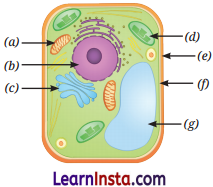
Answer:
Identifying parts labelled (a) to (g) and matching with functions:
(a) Mitochondria – (ii) Site of cellular respiration.
(b) Nucleus – (i) Controlling all the activities of a cell.
(c) Golgi apparatus – (vi) Packs and stores materials received from ER.
(d) Chloroplast – (vii) Helps in manufacturing food.
(e) Cell wall – (v) Provides structural rigidity to the cell.
(f) Cell membrane – (iv) Separates the cell contents from surroundings.
(g) Vacuole – (iii) Storage organelle that also provides rigidity to the cell.
Question 4.
Which of the following option(s) of the pairs of cell organelles are correctly placed under the given categories?
| Present in Plant cells | Absent in animal cells |
| (i) Leucoplast | Cell wall |
| (ii) Mitochondria | Ribosome |
| (iii) Cell wall | Golgi apparatus |
| (iv) Lysosome | Endoplasmic reticulum |
Answer:
Option (i) is correct.
Leucoplast is present in plant cells and cell wall is absent in animal cells.
Question 5.
Two students, Renu and Rohit, were having a discussion on the plastids. Renu emphasised that all parts of the plants, even roots, contain plastids. However, Rohit did not agree with the statement and told her that plastids are absent in plant roots since the roots are underground and do not need to perform photosynthesis. Who is correct? Justify your answer.
Answer:
Renu is correct. All parts of plants, including roots, contain plastids. Roots contain leucoplasts, which are colourless plastids that store food materials like starch. Not ail plastids carry out photosynthesis. While chloroplasts (found mainly in green parts like leaves) carry out photosynthesis, leucoplasts in roots store starch and other food materials. Potato tubers, which are underground stems, store starch in leucoplasts.
Question 6.
Mitochondria and chloroplasts are two important organelles in a plant cell Discuss how these two organelles are structurally and functionally similar to each other, and different from each other.
Answer:
Similarities between Mitochondria and chloroplasts:
- Both are double-membrane organelles.
- Both contain their own DNA and ribosomes and can make some of their own proteins.
- Both are involved in energy-related processes.
Differences between Mitochondria and chloroplasts:
- Mitochondria break down glucose to release energy (cellular respiration) and produce ATP. They are found in both plant and animal cells.
- Chloroplasts capture solar energy and use it to synthesise food (photosynthesis). They contain the green pigment chlorophyll. Chloroplasts are found only in plant cells.
Question 7.
Which of the following pairs of cell organelles contains DNA ?
(i) Chloroplasts, Ribosomes
(ii) Mitochondria, Nucleus
(iii) Golgi bodies, Ribosomes
(iv) Nucleus, Lysosomes
Answer:
(ii) Mitochondria, Nucleus. Both mitochondria and the nucleus contain DNA. Ribosomes, Golgi bodies, and lysosomes do not contain DNA.
Question 8.
A researcher carried out an experiment in which she took two carrots of similar size. She placed one carrot in plain water and the other carrot in concentrated salt solution (Fig. below). After 24 hours she recorded her observations.

(i) What hypothesis does she want to test through this experiment?
(ii) What would you suggest for the improvement of this experiment?
(iii) Why does the carrot in plain water stay stiff and crunchy, but the carrot in concentrated salt solution becomes rubbery and limp?
Answer:
(i) The hypothesis is that a selectively permeable cell membrane allows the movement of water in and out of cells by osmosis, depending on the concentration of the surrounding solution.
(ii) To improve the experiment, the researcher should repeat it multiple times with carrots of the same size, and measure the initial and final weights of the carrots for more reliable results.
(iii) The carrot in plain water stays stiff and crunchy because water enters its cells by osmosis, keeping the cells firm (turgid). The carrot in concentrated salt solution becomes rubbery and limp because water moves out of its cells by osmosis, causing the cells to lose their firmness.
Question 9.
Indicate the presence or absence of following structures in bacterial and animal cells:
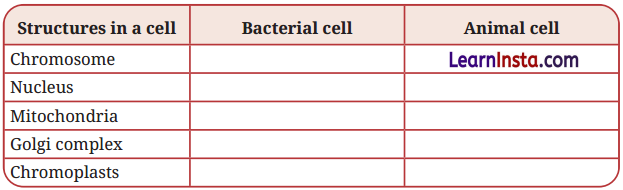
Answer:
| Structures in a Cell | Bacterial Cell | Animal Cell |
| Chromosome | Absent (has nucleoid) | Present |
| Nucleus | Absent | Present |
| Mitochondria | Absent | Present |
| Golgi complex | Absent | Present |
| Chromoplasts | Absent | Present |
Question 10.
Carry out the following experiment:
Take four peeled potato halves and scoop each one out to make potato cups. One of these potato cups should be made from a boiled potato. Place each of the potato cups in a beaker containing water (Fig. below).
Now, set up the experiment as follows:
(a) Keep Cup A empty.
(b) Add one teaspoon sugar in Cup B.
(c) Add one teaspoon salt in Cup C.
(d) Add one teaspoon sugar in the boiled potato in Cup D.
Observe the four potato cups at least two hours and answer the following questions:
(i) Explain why water gathers in the hollowed portion of Cup B and Cup C.
(ii) Why is Cup A necessary for this experiment?
(iii) Explain why water does not gather in the hollowed portions of Cups A and D.
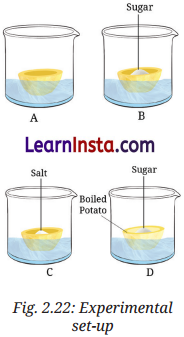
Answer:
Potato cup experiment:
(i) Water gathers in the hollowed portions of Cup B and Cup C because sugar and salt in the cups create a hypertonic solution. Water from the surrounding potato cells moves into the cup through the selectively permeable cell membranes of the potato cells by osmosis.
(ii) Cup A is necessary as a control in the experiment. Since it has no sugar or salt, it shows that water does not gather in the cup on its own, proving that the water collection in Cups B and C is due to osmosis.
(iii) Cup A has no solute, so there is no osmosis. In Cup D, the boiled potato’s cells are dead and their cell membranes are destroyed, so osmosis cannot occur.
Question 11.
Identify the pair that incorrectly matches the cell organelle with its function
(i) Ribosome – Protein synthesis
(ii) SER – Lipid and cellulose synthesis
(iii) Lysosome – Digestion of foreign agents
Answer:
SER and cellulose synthesis is the incorrect match. SER is involved in lipid and hormone synthesis, not cellulose synthesis.
Question 12.
What outcome do you expect, if all the mitochondria are removed from a eukaryotic cell?
Answer:
If all mitochondria are removed, the cell would not be able to carry out cellular respiration. It wouldnot be able to break down glucose and produce ATP (energy currency). Without ATP, the cell would lack energy for all its activities and would finally die.
Question 13.
Which phenomenon inhibits the formation of tumours in the human body? Can plants also develop tumours? Explain.
Answer:
- Contact inhibition is the phenomenon that inhibits the formation of tumours. In normal animal cells, cell division stops when cells come in contact with neighbouring cells.
- Cancer cells lose this property and keep dividing uncontrollably, forming tumours.
- Yes, plants can also develop tumours. However, since plant cells have rigid cell walls, they do not show contact inhibition and follow a different growth pattern.
- Plant tumours can be caused by certain bacteria or viruses.
Question 14.
The cell membrane of a cell is made up of proteins and lipids. Which cell organelles help in the synthesis of cell membrane? Write the path of these compounds from their site of synthesis to the cell membrane and show this through a labelled diagram.
Answer:
- Proteins for the cell membrane are synthesised by the Rough Endoplasmic Reticulum (RER), and lipids are synthesised by the Smooth Endoplasmic Reticulum (SER).
- These components are then transported in vesicles to the Golgi apparatus, where they are modified, sorted, and packaged.
- From the Golgi apparatus, they are transported in vesicles to the cell membrane.
- Path of these compounds from their site of synthesis to the cell membrane is RER/SER → Golgi apparatus → Cell membrane.

Question 15.
What would happen if gametes are formed by mitotic divisions?
Answer:
If gametes were formed by mitosis, each gamete would have the same number of chromosomes as the parent cell. When two such gametes fuse during fertilisation, the resulting cell would have double the normal chromosome number. This would keep doubling with each generation, leading to abnormalities and disruption of normal development.
Question 16.
A farmer, Deepa, was very happy with the harvest of amla (Indian Gooseberry) and lemons on her farm. However, she could sell only one-fourth of the produce in the local market. Recognising that a significant amount of produce may be lost post¬harvest, she employed a traditional yet scientifically sound method to extend the shelf life of amla and lemons. She turned perishable produce into profitable products, such as pickles and sharbat. She used the excess produce to prepare pickles, murabbas, and sharbat by adding appropriate amounts of salt, sugar, or jaggery to small pieces of fruit and their juices. These were then stored in small glass bottles for sale, helping her to prevent the wastage of post¬harvest produce. This shift from farming to agro-processing would strengthen food security and boost the local economy, creating a sustainable model that cuts waste while increasing her income.
Based on the above passage answer the following questions:
(i) Which scientific concept has the farmer applied in the preservation of the farm produce?
(ii) How does the addition of high concentrations of salt and sugar create an environment that prevents the growth of spoilage-causing bacteria and fungi?
(iii) Suggest a healthy recipe of this kind for food preservation.
(iv) What are the scientific values addressed in this case?
Answer:
(i) The scientific concept applied is osmosis. The high concentration of salt or sugar creates a hypertonic environment that draws water out of microorganisms like bacteria and fungi, thus preventing their growth.
(ii) When high concentrations of salt or sugar are added, they create a hypertonic environment around bacteria and fungi. Water moves out of the microbial cells by osmosis, causing them to lose water, shrink, and eventually die or become inactive. This prevents spoilage.
(iii) A healthy recipe for food preservation is the preparation of Lemon pickle which is prepared with lemon pieces, salt, turmeric, and mustard oil. The high salt concentration preserves the pickle by preventing microbial growth through osmosis.
(iv) Scientific values addressed in this case are
- application of scientific concepts (osmosis) in daily life
- reducing food wastage
- sustainable food processing
- economic development and
- food security
Class 9 Science Chapter 2 Cell The Building Block of Life Question Answer (InText)
Think It Over (NCERT Textbook Page No. 8)
Question 1.
Where does a cell come from?
Answer:
A cell comes from a pre-existing cell. New cells are formed by the division of existing cells (Rudolf Virchow in 1855).
Question 2.
How have technological interventions facilitated the creation of new knowledge in understanding the world beyond the naked eye?
Answer:
Technological advances such as the development of the light microscope and the electron microscope have helped scientists to observe structures much smaller than what the human eye can see. Robert Hooke first observed cells in 1665 using a microscope. Electron microscopes use beams of electrons to reveal fine details of cell structure at the nanometre scale, greatly facilitating our understanding of cell biology.
Question 3.
How is the cell structural and functional unit of life?
Answer:
The cell is called ‘the structural unit of life’ because all living organisms are made up of cells. It is ‘functional unit of life’ because all basic life processes such as respiration, nutrition, excretion, and reproduction are carried out within cells.
Question 4.
How does a cell multiply?
Answer:
A cell multiplies by the process of cell division.
There are two main types of cell division
- mitosis (which produces two identical daughter cells for growth and repair) and
- meiosis (which produces four daughter cells with half the chromosome number for sexual reproduction).
Pause and Ponder (NCERT Textbook Page No. 14)
Question 1.
What argument would you give for the necessity of a cell wall in plants usually fixed in one place versus in animals usually moving from one place to the other?
Answer:
Plants cannot move from place to place, so they need a rigid structure to withstand environmental stresses like wind and rain. The cell wall provides this rigidity. Animal cells do not have a cell wall because animals need flexible cells that can change shape to allow movement and functioning of tissues.
Question 2.
What consequences would you predict for a plant cell if its cell wall were to become as flexible as a cell membrane?
Answer:
If the cell wall became as flexible as a cell membrane, the plant cell would lose its rigidity and fixed shape. The plant would not be able to stand upright. When the cell loses or gains water, it would shrink or swell like an animal cell instead of maintaining its shape.
Question 3.
Why is it important to cut the two potato pieces in roughly equal size and measure their initial weight before placing them in different liquids?
Answer:
It is important to keep the size of potato pieces equal so that the experiment gives accurate results. Measuring their initial weight helps in calculating the exact change in weight caused by osmosis. This ensures that the observed changes are due to the different solutions and not due to differences in the size of the potato pieces.
Pause and Ponder (NCERT Textbook Page No. 19)
Question 4.
Do white flowers contain any pigment? Give reasons.
Answer:
White flowers may contain ieucoplasts, which are colourless plastids. They lack coloured pigments like chlorophyll or the pigments found in chromoplasts. They appear white because they reflect all visible light. In some cases, white colour is due to air spaces between cells that scatter light.
Question 5.
Draw a well-labelled schematic diagram of a plant or an animal cell using these clues –
(i) Nucleus appears as a dark and round body inside the cell,
(ii) ER spreads like a network of extended nuclear envelope.
(iii) Mitochondria and chloroplasts are rod shaped.
Answer:
Refer to Fig. (Art. 2.3, Page 14) for a labelled diagram of a plant cell showing cell wall, cell membrane, nucleus, nucleolus, endoplasmic reticulum, mitochondria, cytoplasm, Golgi body, ribosome, vacuole, and chloroplast. For an animal cell, the diagram should show cell membrane, nucleus, nucleolus, endoplasmic reticulum, mitochondria, cytoplasm, ribosome, lysosome, and vacuole.]
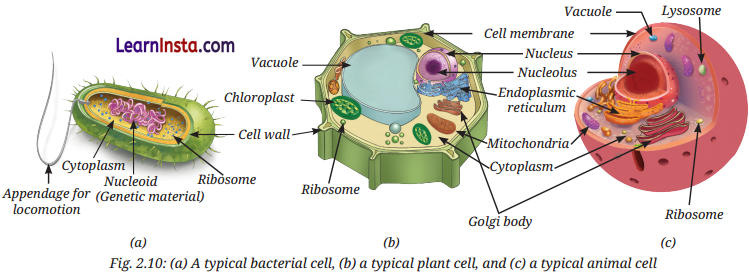
Pause and Ponder (NCERT Textbook Page No. 22)
Question 6.
Instead of many small ones, why does a cell not have a single giant mitochondrion? How does this relate to the concept of surface area?
Answer:
Many small mitochondria have a greater combined surface area compared to one giant mitochondrion of the same total volume. A larger surface area allows more chemical reactions for energy production to occur at the same time. This makes energy production more efficient, as the cell can carry out cellular respiration at multiple sites simultaneously.
Question 7.
If the skin cells start dividing by meiosis instead of mitosis, what do you think will happen to a cut on the skin?
Answer:
If skin cells are divided by meiosis, each new cell would have only half the number of chromosomes. These cells would not function properly because they would lack the full set of genetic instructions needed for normal skin cell activities. The cut would not heal properly, and the body would not be able to replace damaged skin cells with normal, functional cells.
Class 9 Science Chapter 2 Question Answer (Activities)
Activity 2.1:
Let us estimate the size of a cell (NCERT Textbook Page No. 10)
- Take a transparent ruler with millimetre (mm) markings.
- Place the ruler on the stage of microscope, focus on it using the adjustment knob and observe the diameter of the circular field of view through the eyepiece and measure it in mm.
- Convert the diameter from mm to micrometre (pm). Suppose the diameter of the visible field is 5 mm, meaning 5 × 1000 = 5000 pm.
- Remove the ruler and place an onion peel slide on the stage of the microscope.
- Focus on the slide and count the number of cells present along the diameter of the field of view in one straight line.
- Estimate the real size of the cell using the formula:
Unit conversion:
1 millimetre (mm) = 1000 micrometre (µm)
Estimated size of the onion peel cell = \(\frac{\text { Diameter of the visible field in micrometre }}{\text { Number of cells along the diameter }}\)
Answer:
In this activity, students measure the diameter of the circular field of view of the microscope using a ruler.
Suppose the diameter is 5 mm = 5000 µm.
After placing the onion peel slide, if 25 cells are counted along the diameter, the estimated size of one 5000 pm
onion cell = \(\frac{5000 \mu\mathrm{~m}}{25}\) = 200 µm.
If the eyepiece and objective lens are both 10X, then total magnification is 100X, meaning the 200 µm cell appears 100 times larger.
Activity 2.2:
Let us experiment (NCERT Textbook Page No. 11)
- With the help of a kitchen knife, carefully cut a potato into two pieces of roughly equal size (Fig.).
- Measure and record the initial weight of both the pieces using a weighing balance.
- Put one piece of the potato in Beaker A with plain water.
- Put the other piece of the potato in Beaker B with 20 per cent salt or sugar solution.
- Leave them undisturbed for about an hour or until you notice a visible change in the size of the pieces.
- Measure and record the final weight of each piece.
- Calculate the difference between the initial and their final weights.
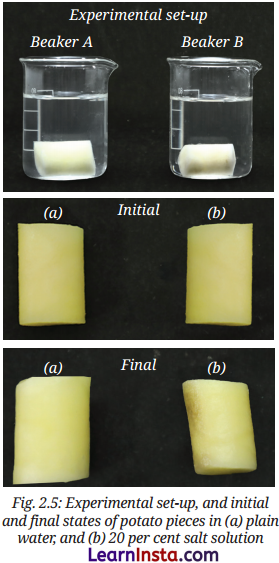
What do you observe?
It is observed that the potato piece swells in Beaker A and the potato piece shrinks in Beaker B.
Answer:
- The potato piece in plain water (Beaker A) swells and gains weight because water enters the potato cells by osmosis (water moves from a region of higher water concentration outside to lower water concentration inside the cells).
- The potato piece in 20% salt solution (Beaker B) shrinks and loses weight because water moves out of the potato cells by osmosis (water moves from higher water concentration inside the cells to lower water concentration in the concentrated salt solution).
What if…? (NCERT Textbook Page No. 12) Based on Activity 2.2
Question 1.
What if mung bean seeds are kept in a concentrated solution after soaking in water for 12 hours? What will happen to them.
Answer:
After soaking in water for 12 hours, the mung bean seeds would have absorbed water and swelled up. When placed in a concentrated solution, water would move out of the seeds by osmosis (from a region of lower solute concentration inside the seed to a region of higher solute concentration outside). The seeds would shrink and become smaller.
Question 2.
What if a cell is kept in salt or sugar solutions of different concentrations?
Answer:
- In a hypotonic solution (lower solute concentration outside), water enters the cell, causing it to swell.
- In a hypertonic solution (higher solute concentration outside), water leaves the cell, causing it to shrink.
- In an isotonic solution (equal solute concentration), there is no net movement of water, and the cell stays the same size.)
Activity 2.3:
Let us investigate (NCERT Textbook Page No. 13)
I.
- Prepare temporary slides of a thin peel of an onion leaf ora Rhoeo (Cradle lily) leaf and mount it with safranin using cover slip to observe plant cells under a microscope.
- Similarly, prepare a temporary slide of cheek cells by gently scraping the inner side of your cheek with a cotton swab or the blunt end of a toothpick.
- Spread the cheek cells on a clean glass slide.
- Add a drop of water followed by a few drops of methylene blue stain and carefully place a coverslip.
- Observe both the slides under a microscope.
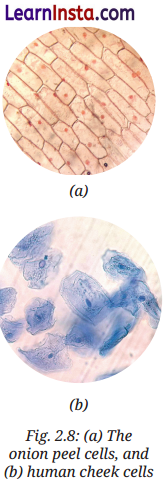
What do you observe?
- Onion peel cells or Rhoeo leaf peel cells are box-shaped and regularly arranged.
- Cheek cells are irregularly arranged.
Why do you think this difference exists?
Answer:
- Under the microscope, onion peel cells appear box-shaped and regularly arranged because they have a rigid cell wall.
- Cheek cells appear irregular in shape because they lack a cell wall.
II.
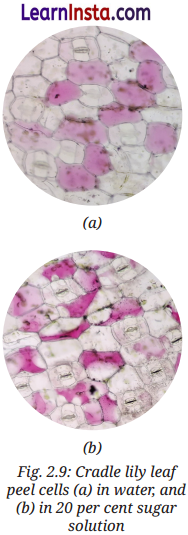
- Prepare two slides of a Rhoeo leaf peel and human cheek cells again.
- Put 20 per cent sugar solution on them.
- Observe them under a microscope after half an hour.
What do you observe?
It is observed that
- The boundaries of the plant cells remain the same but their inner content shrinks, and the space between the inner and outer boundaries increases.
- The cheek cells, on the other hand, have shrunk considerably.
Answer: - When 20% sugar solution is added, plant cells retain their shape due to the rigid cell wall, but the inner contents shrink as the cell membrane pulls away from the cell wall (plasmolysis).
- Cheek cells shrink considerably because they have no cell wall to maintain their shape.
Activity 2.4:
Let us study (NCERT Textbook Page No. 14)
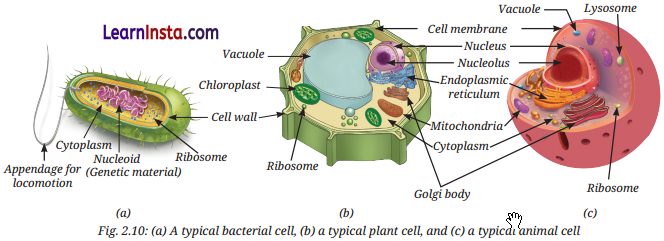
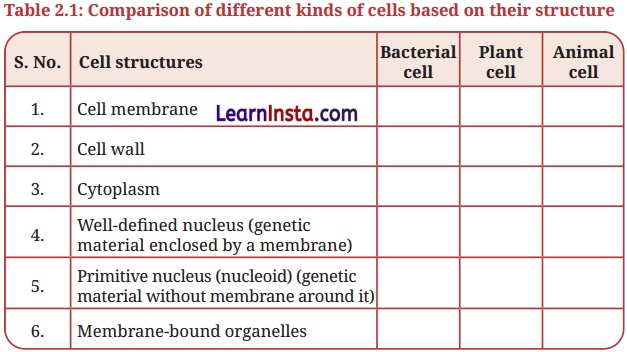
- Study the given diagrams of a bacterial cell, a plant cell, and an animal cell.
- Observe the different structures present in each of them.
- Record your observations in the Table given below:
Answer:
| Cell structures | Bacterial cell | Plant cell | Animal cell |
| 1. Cell membrane | Present | Present | Present |
| 2. Cell wall | Present | Present | Absent |
| 3. Cytoplasm | Present | Present | Present |
| 4. Well-defined nucleus (genetic material enclosed by a membrane) | Absent | Present | Present |
| 5. Primitive nucleus (nucleoid) genetic material without membrane around it) | Present | Absent | Absent |
| 6. Membrane-bound organelles | Absent | Present | Present |
Observations to be recorded in the above Table are:
- Cell membrane is present in all three types of cells.
- Cell wall is present in bacterial and plant cells but absent in animal cells.
- Cytoplasm is present in all three.
- Well-defined nucleus is present in plant and animal cells but absent in bacterial cells.
- Primitive nucleus (nucleoid) is present only in bacterial cells.
- Membrane-bound organelles are present in plant and animal cells but absent in bacterial cells.
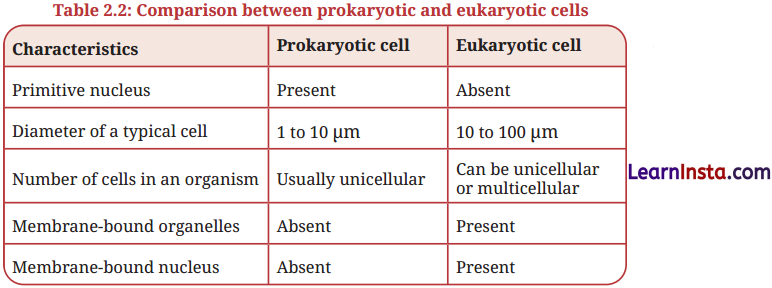
In prokaryotic cells, most cellular activities take place directly in the cytoplasm. In contrast, plant and animal cells have a well-defined nucleus and several membrane-bound organelles. Such cells are called eukaryotic cells (eu means true, and karyon means nucleus). More details of the characteristics of prokaryotic and eukaryotic cells are given in the Table given above.
II. Which of the cells given in the Fig. fall under the categories of prokaryotic and eukaryotic cells?
Answer:
- Bacterial cell is a prokaryotic cell.
- Plant and animal cells are eukaryotic cells.
Activity 2.5:
Let us enhance our skills ((NCERT Textbook Page No. 20)
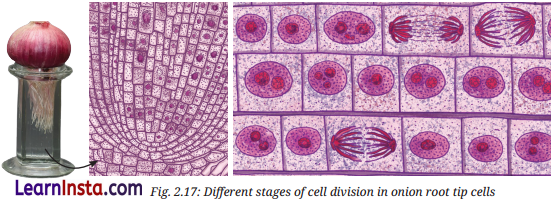
- Take a jar and fill it up with plain water.
- Now, place an onion bulb over the jar in such a way that its base bearing roots is immersed in the water.
- Leave the setup for 5 – 6 days and observe.
Do you observe the roots growing?
Answer:
Yes, growth in roots is observed.
- Cut 2 – 3 cm of the freshly grown roots and transfer them to freshly prepared aceto-alcohol (glacial acetic acid : ethanol :: 1 : 3).
- Keep the root tips in aceto-alcohol for 24 hours.
- Transfer them to 70 per cent ethanol (for preservation).
- Take one or two preserved roots, wash them in water and then, place them on a clean slide.
- Put one drop of dilute Hydrochloric acid (HCl) on the root tips to soften the tissue.
Rinse the roots after 10 – 15 minutes. Then add 2 – 3 drops of aceto-carmine stain on them. - Leave the slide for 5 – 10 minutes and then, gently warm it (with caution) over a spirit lamp.
- Cut the tip portion of the root on the slide and put a coverslip. Gently squash the coverslip with your thumb to spread the cells on the slide.
- Observe the slide under a microscope.
(i) What do you observe? Do you observe the cells of the onion root tip?
(ii) Are they similar in structure?
(iii) Do you find any structural differences in these cells? If yes, why is it so?
Answer:
(i) The cells of a growing tip of root of onion divide continuously. This process is called cell division.
(ii) The cells are not all similar because the growing root tip cells divide continuously.
(iii) (a) Under the microscope, the cells of the onion root tip show different structures because they are at different stages of cell division.
(b) Some cells show well-defined nuclei (interphase), while others show visible chromosomes at various stages of mitosis.
(c) These cells exhibit different structures corresponding to different stages of cell division.