Students rely on Class 9 Science Extra Questions and Class 9th Exploration Chapter 13 Extra Question Answer Earth as a System Energy Matter and Life to improve their grades.
Class 9 Science Chapter 13 Earth as a System Energy Matter and Life Extra Questions
Class 9 Science Chapter 13 Extra Questions on Earth as a System Energy Matter and Life
Earth as a System Energy Matter and Life Class 9 Very Short Question Answer
Question 1.
Name the five spheres of the Earth system.
Answer:
Geosphere, Hydrosphere, Cryosphere, Atmosphere, and Biosphere.
Question 2.
What is insolation?
Answer:
Insolation is the amount of the Sun’s radiation that reaches the Earth’s surface. It is responsible for warming the Earth’s surface and its atmosphere. Under clear sky conditions, maximum insolation reaching Earth’s surface is about 1 kWm-2.
Question 3.
State the value of the solar constant and what it represents.
Answer:
The solar constant is approximately 1.4 kWm-2 (1400 J s-1m-2). It represents the average solar energy received per unit time per unit area perpendicular to the Sun’s rays at the top of Earth’s atmosphere, before any absorption, scattering, or reflection occurs.

Question 4.
What is a valley breeze? When does it occur?
Answer:
A valley breeze is the flow of cooler air from the valley floor up the heated mountain slopes. It occurs during the day, when mountain slopes facing the Sun heat up more rapidly than the valley floor, causing warm air to rise over the slopes and cooler valley air to move up in its place.
Question 5.
State any two greenhouse gases and their role in brief.
Answer:
Carbon dioxide (CO2) and methane (CH4). Water vapour is also mentioned as a greenhouse gas. These gases absorb outgoing infrared radiation re-radiated from Earth’s surface, trapping heat and keeping Earth warm enough for life.
Question 6.
What is eutrophication? Name one human activity that causes it.
Answer:
Eutrophication is the widespread growth of algae in water bodies caused by excessive nitrogen via nitrates being added to rivers and lakes, which depletes oxygen and kills fish. Overuse of nitrogen based fertilisers in agriculture is the main human activity that causes it.
Question 7.
Name the two bacteria involved in nitrogen fixation.
Answer:
Rhizobium and Azotobacter.
Question 8.
What is the composition of the atmosphere by percentage?
Answer:
The atmosphere consists mainly of nitrogen (78 %) and oxygen (21 %), along with small amounts of argon, carbon dioxide, water vapour, and other gases.
Question 9.
What are gyres? In which direction do they rotate in the Southern Hemisphere?
Answer:
Gyres are large circular patterns of moving ocean water masses formed when Earth’s rotation deflects ocean currents. In the Southern Hemisphere, gyres rotate counter-clockwise.
Question 10.
What has been the increase in atmospheric CO2 since 1960?
Answer:
Human activities like burning fossil fuels and deforestation have raised atmospheric CO2 by about 35% since 1960. The amount has increased from 315 ppm to 420 ppm.
Earth as a System Energy Matter and Life Class 9 Short Question Answer
Question 1.
Explain the Urban Heat Island Effect. Why are cities warmer than rural areas?
Answer:
Cities are warmer than surrounding rural areas, especially during summer and at night. This is because cities have more built-up areas with buildings of steel, concrete, and brick, and roads of concrete and asphalt. All these materials have low albedo, they absorb more solar radiation and retain heat, then re-radiate it, warming the city more than surrounding rural areas. This increased re-radiation also increases energy demand for air conditioning, further stressing urban ecosystems.
In contrast, rural areas and forests have more vegetation, which stays cool through shade and plant transpiration, keeping temperatures lower. This phenomenon of cities being warmer than their surroundings is called the Urban Heat Island Effect and shows how human land use can alters local climate.
Question 2.
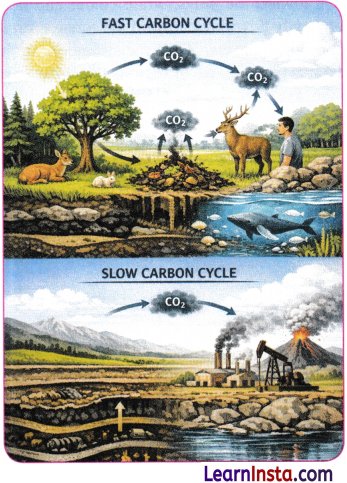
Describe the fast and slow cycles of the carbon cycle.
Answer:
The carbon cycle operates at two very different time scales. In the fast cycle, which happens over days to years, plants convert atmospheric CO2 into glucose through photosynthesis. CO2 is released back into the atmosphere through respiration by plants and animals. When organisms die, CO2 returns to the air through decomposition. In the slow cycle, which happens over millions of years, dead plants and animals get buried and are converted into fossil fuels such as coal, oil, and gas.
When these fuels are burnt for energy, carbon is rapidly released back as CO2 on a very short time scale. The atmosphere and ocean water also continuously exchange CO2. Ocean water absorbs atmospheric CO2 to form carbonate and bicarbonate ions, used by plankton and marine organisms.
Question 3.
Explain how the atmosphere plays two crucial roles in protecting life on Earth.
Answer:
The atmosphere plays two crucial roles in protecting life on Earth. First, it partly absorbs the incoming solar radiation. The ozone layer in the stratosphere blocks most harmful UV rays from reaching the Earth’s surface. Clouds and other gases also absorb some sunlight before they reach the surface. Second, it traps outgoing heat. Earth’s surface absorbs sunlight and re-radiates it in the infrared region. Greenhouse gases like CO2, CH4, and water vapour absorb this re-radiated heat and prevent it from escaping into space.
Without this, the Earth would be too cold for life to survive. However, excess CO2 from human activities enhances this greenhouse effect, causing global warming which, if left unchecked, could make the Earth uninhabitable.
Question 4.
How do ocean currents regulate Earth’s climate? Give one example.
Answer:
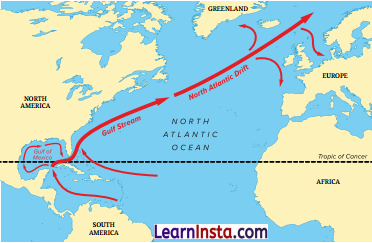
Ocean currents play a major role in regulating Earth’s climate and supporting life. By transporting heat from the equator towards the poles, they reduce temperature differences across the planet. Warm equatorial water travels over the surface toward the poles, while colder and denser water slowly flows back toward the equator through deeper ocean levels. This redistribution of heat moderates the climates of regions the currents pass through.
For example, the North Atlantic Drift is an extension of the Gulf Stream which flows toward the northwestern coast of Europe, carrying warm water. This moderating influence keeps many European ports ice-free during winter even at high latitudes and also supports human activities like trade and commerce.
Question 5.
What would happen to plants and animals on Earth if the biogeochemical cycles were disrupted and stopped? Give examples.
Answer:
If biogeochemical cycles were disrupted and stopped, life on Earth would collapse. If the water cycle stopped, there would be no evaporation, condensation, or precipitation and as a result rivers, lakes, and groundwater would dry up, making agriculture and all terrestrial life impossible. If the carbon cycle stopped, plants could not obtain CO2 for photosynthesis, which would halt food production for all organisms.
If the nitrogen cycle stops, nitrogen compounds would not be returned to the soil. Plants could not synthesise proteins and nucleic acids, soil fertility would collapse, and all food chains would break down. If the oxygen cycle stops, O2 would not be replenished after being consumed in respiration and combustion, making aerobic life impossible. Thus, biogeochemical cycles are essential to sustain life, regulate climate, and maintain environmental balance.
Question 6.
How does climate change affect the water cycle? Explain with examples from the chapter.
Answer:
Climate change is now significantly affecting the water cycle. A warmer atmosphere holds more moisture, causing heavier rains in some areas, for example intensified monsoons in India and droughts elsewhere. Melting glaciers add more water to rivers, raising sea levels in the long run and threatening coastal cities such as Mumbai and Chennai. Sudden bursts of intense rainfall result in more surface runoff that erodes soil, and less infiltration reduces the recharge of groundwater, making sustaining agriculture difficult during dry months. In this way, the water cycle links all the spheres all of which are affected by global warming.
Earth as a System Energy Matter and Life Class 9 Long Question Answer
Question 1.
Describe in detail the nitrogen cycle, naming all the key processes and organisms involved. How would life on Earth be affected if nitrogen were not cycled?
Answer:
Nitrogen is an essential element for the synthesis of proteins and nucleic acids in all living organisms. The largest reservoir of nitrogen is in the atmosphere as nitrogen gas (N2), which is relatively non-reactive and cannot be directly used by plants and animals. The overall movement of nitrogen between air, soil, water, and organisms is the nitrogen cycle, which contains the following key processes:
- Nitrogen fixation:
Nitrogen-fixing bacteria, Rhizobium, found in the root nodules of legumes and Azotobacter, found in soil convert atmospheric N2 into ammonia (NH3). Lightning also fixes tiny amounts of nitrogen as nitrogen oxides. - Nitrification:
Nitrosomonas bacteria convert ammonia into nitrite (NO2–). Nitrobacter then converts nitrite into nitrate (NO3–). Plants can absorb nitrates from the soil. - Assimilation:
Plants absorb nitrates from the soil and use them to build proteins and nucleic acids. Animals obtain nitrogen by consuming plants or other animals. - Ammonification:
When plants and animals die or produce waste, decomposers that are bacteria and fungi break down the organic matter, returning nitrogen compounds like ammonia to the soil. - Denitrification:
Denitrifying bacteria like Pseudomonas convert some nitrates back into nitrogen gas (N2), returning it to the atmosphere and completing the cycle.
If nitrogen were not cycled, soil nitrogen would be rapidly exhausted. Without nitrogen, no proteins or nucleic acids could be formed, meaning all life would cease to exist. Agriculture would completely collapse as soil would become infertile. The food chains would break down from the base, causing extinction of all organisms.
Question 2.
Explain in detail local winds, planetary winds, and ocean currents.
Answer:
Local winds arise due to uneven heating at a small scale. In mountainous regions, slopes and the valley floor do not heat and cool at the same rate. During the day, slopes facing the Sun heat up more rapidly than the valley floor, causing the air over them to warm and rise, creating a low-pressure zone. Cooler air from the valley moves upslope to replace it, this is the valley breeze. After sunset, the situation reverses—slopes lose heat faster and become cooler, while the valley floor remains relatively warmer. Cool, dense air from the slopes sinks into the valley, this is the mountain breeze. Such daily changes in wind direction are commonly experienced in hilly regions like Shimla and Dehradun, where they influence agriculture, temperature regulation, and daily life.
Planetary winds operate on a much larger scale. Intense heating near the equator causes warm air to rise, forming an equatorial low-pressure belt. As this air rises and moves poleward, it cools, becomes denser, and sinks around 30° North and South latitudes, forming sub-tropical high-pressure belts. From here, air flows back toward the equator along Earth’s surface, completing one circulation cycle. Some of this air also moves toward the poles, rising again at around 60° North and South where it meets cold polar air. Earth’s rotation causes all these planetary winds to follow curved paths rather than straight ones, deflecting to the right in the Northern Hemisphere and to the left in the Southern Hemisphere.
Ocean currents are driven by similar forces. Strong planetary winds drag the surface water of oceans through friction, setting large-scale currents in motion. In addition to winds, differences in temperature and salinity, Earth’s rotation, and the distribution of land masses also influence the movement of ocean water. Earth’s rotation deflects this moving water masses into large circular patterns called gyres, rotating clockwise in the Northern Hemisphere and counter-clockwise in the Southern Hemisphere.
Continents further modify these paths by blocking and redirecting currents. Ocean currents play a vital role in regulating Earth’s climate by transporting heat from the equator toward the poles, reducing temperature differences across the planet. For example, the North Atlantic Drift carries warm water toward the northwestern coast of Europe, keeping many ports there ice-free even during winter at high latitudes.
Question 3.
Discuss how human activities have disrupted the biogeochemical cycles and affected Earth’s spheres. What can be done to restore the balance?
Answer:
Human activities have significantly disrupted the biogeochemical cycles across all of Earth’s spheres. Carbon cycle disruption has occurred because of burning fossil fuels and deforestation raising atmospheric CO2 by about 35% since 1960 (from 315 to 420 ppm). This saturates natural carbon sinks like forests and oceans. Excess CO2 intensifies the greenhouse effect, causing global warming, melting glaciers, rising sea levels, and more extreme weather. It also increases ocean absorption, making sea water more acidic, which threatens tiny plankton and coral reefs. Warmer ocean water also reduces the ocean’s capacity to absorb CO2 as an effective carbon sink.
Nitrogen cycle has also been affected as overuse of fertilisers in agriculture adds excessive nitrogen via nitrates to rivers and lakes, causing eutrophication which is the widespread algal blooms that deplete oxygen and kill fish, threatening water bodies and coastal fisheries. Oxygen cycle disruption can also be seen as deforestation reduces photosynthesis, decreasing oxygen production. Vehicular emissions react with sunlight to form ground-level smog and ozone, making city air unhealthy.
Clearing forests also results in decreased transpiration, altered albedo, increased soil erosion, decline in local rainfall, and loss of biodiversity as habitats are destroyed. Lastly even the water cycle has seen disruption as deforestation and climate change intensify the water cycle leading to heavier monsoons in some regions, droughts in others, reduced groundwater recharge, and sea level rise threatening coastal cities.
Restoration measures include The Montreal Protocol which has helped recover the ozone layer by reducing CFC’s. Switching to renewable energy sources like solar and wind, planting trees, saving water, practising sustainable farming, reducing waste, reusing and recycling materials can all help restore balance. India has already planted billions of trees and expanded solar energy significantly.
Earth as a System Energy Matter and Life Class 9 Case Based Questions
I. “From Activity 13.1, we can infer that a disturbance in one sphere can lead to changes in others. For example, less snowfall in winters may lead to less water in the lake in summers, resulting in less water to support the growth of grass. Similarly, on a large scale, warmer Arabian Sea water lead to more evaporation from the sea. This in turn, causes fluctuations in the southwest monsoon, which results in variability in rainfall, bringing floods to some regions of India while leaving others in drought. This disrupts the hydrosphere. At the same time, the rise in atmospheric temperature could eventually accelerate the melting of glaciers and polar ice in the cryosphere, which may lead to the flooding of low-lying regions, and in the long run, it can raise sea levels that may threaten coastal cities. This could disturb the ecosystems within the biosphere by causing a habitat loss.”
Answer the following questions:
Question 1.
What does the passage illustrate about Earth’s spheres?
Answer:
The passage illustrates that Earth’s five spheres, geosphere, hydrosphere, cryosphere, atmosphere, and biosphere are interconnected. A disturbance in one sphere does not remain confined to it but cascades through all the others. This is the fundamental concept of Earth as an integrated system where natural processes like solar radiation, movement of air and water, and nutrient cycling connect the spheres in a delicate balance.
Question 2.
Identify the spheres mentioned in the passage and the specific changes occurring in each.
Answer:
Cryosphere: Melting of glaciers and polar ice due to rising atmospheric temperature.
Hydrosphere: Disruption of rainfall patterns, rise in sea levels threatening coastal cities.
Atmosphere: Warmer Arabian Sea causes more evaporation, causing fluctuations in the southwest monsoon.
Biosphere: Habitat loss as low-lying regions are flooded, disturbing ecosystems.
Question 3.
How does warmer Arabian Sea water affect India’s monsoon, according to the passage?
Answer:
Warmer Arabian Sea water leads to more evaporation from the sea. This increased moisture in the atmosphere causes fluctuations in the southwest monsoon, resulting in variability in rainfall bringing floods to some regions of India while leaving others in drought. This variability disrupts the hydrosphere and affects agriculture and human life across the country.
II. “Human activities like burning fossil fuels and deforestation have raised atmospheric CO2 by about 35% since 1960 (315 ppm to 420 ppm). While some amounts of carbon dioxide are necessary to keep the Earth warm enough to sustain life, the balance is critical. Excessive amounts of CO2 intensify the greenhouse effect leading to global warming, melting of glaciers and Arctic sea ice, rising of sea level and more extreme weather conditions. In India, this may lead to more intense monsoons (warmer air holds more moisture) and threats to agriculture from its changing rainfall patterns. Though fossil fuels still power much of our electricity generation, India is rapidly increasing renewable energy sources, which will help minimise the carbon released into the atmosphere. ”
Answer the following questions:
Question 1.
Why is some CO2 necessary, but excess of CO2 harmful?
Answer:
Some CO2 is necessary because it is a greenhouse gas that traps outgoing infrared radiation from Earth’s surface, keeping the planet warm enough to sustain life. Without CO2 and other greenhouse gases, Earth would be too cold for life to survive. However, excess CO2 intensifies this greenhouse effect beyond the natural balance, causing global warming. This leads to melting of glaciers and Arctic sea ice, rising sea levels, more extreme weather conditions, threats to biodiversity, and disruption of agricultural patterns.
Question 2.
What specific impact could increased CO2 have on India’s monsoon, as mentioned in the passage?
Answer:
The passage states that in India, increased CO2 leading to global warming may result in more intense monsoons. This is because warmer air holds more moisture. The greater moisture content in the atmosphere means when the monsoon arrives, it can deliver heavier and more intense rainfall. This also creates threats to agriculture from changing rainfall patterns some areas may receive too much rain while others may receive too little, making crop planning and water management more difficult.
Question 3.
What solution does the passage suggest for reducing carbon released into the atmosphere?
Answer:
The passage states that India is rapidly increasing renewable energy sources, which will help minimise the carbon released into the atmosphere. Renewable energy sources like solar and wind do not bum fossil fuels, so they do not release CO2 when generating electricity. The chapter elsewhere also mentions planting trees, saving water, practising sustainable farming, and reducing waste as further individual and collective actions to restore the carbon balance.
Earth as a System Energy Matter and Life Extra Questions for Practice
Very Short Answer Type Questions
Question 1.
What is the electromagnetic spectrum?
Question 2.
What role does the ozone layer play in protecting life on Earth?
Question 3.
State two ways in which climate change affects the water cycle.
Question 4.
Name any three human activities that increase greenhouse gas concentrations in the atmosphere.
Question 5.
What are planetary winds?
Short Answer Type Questions
Question 1.
Explain why India receives abundant solar insolation and why this is significant. Also state what happens to the solar constant before insolation reaches Earth’s surface.
Question 2.
Describe the role of ocean currents in regulating Earth’s climate with example.
Question 3.
Explain the oxygen cycle as described in the chapter. How does the balance between photosynthesis and respiration maintain oxygen levels in the atmosphere?
Question 4.
Discuss how human activities disrupt the carbon cycle. What are the consequences of excessive CO2 in the atmosphere?
Long Answer Type Questions
Question 1.
Describe in detail how the Earth’s spheres are interrelated and how disturbance even in one sphere leads to changes in others. Use specific examples from the chapter to illustrate how these spheres function in a delicate balance.
Question 2.
Explain the complete nitrogen cycle, naming all key processes and the specific organisms involved. What would happen to life on Earth if nitrogen were not cycled?
Question 3.
Describe the uneven heating of Earth’s surface due to its shape and latitude. How does this uneven heating, along with the role of the atmosphere, drive global wind systems and influence Earth’s climate?
Case/ Source Based Questions
I. “The ozone layer is vital to life on the Earth because it acts as a protective shield, absorbing harmful UV radiation from the Sun. When ozone molecules are destroyed faster than they are naturally formed, the layer becomes thinner and less effective. In the late 20th century, human-made chemicals called chlorofluorocarbons (CFCs), used in refrigerators and aerosols, caused severe ozone loss over Antarctica, which came to be known as the ozone hole. Increased UV radiation on the Earth can harm living organisms and ecosystems. A global agreement known as the Mon¬treal Protocol reduced the use of CFCs, and the ozone layer is now slowly recovering, showing the power of international scientific cooperation. ”
Answer the following questions:
Question 1.
What is the function of the ozone layer and where is it located?
Question 2.
What caused the ozone hole and where was it observed?
Question 3.
What does the recovery of the ozone layer through the Montreal Protocol demonstrate?
II. Living organisms constantly exchange matter and energy with the air, water, soil and rocks around them. This continuous interaction between the non-living (abiotic) and living (biotic) components of the Earth results in the transfer of matter and energy across various spheres of the Earth. This process ensures that essential nutrients, such as carbon, nitrogen and oxygen are recycled, and remain available to support life on the Earth. This cyclic movement of matter and energy between the abiotic and biotic components is called the biogeochemical cycle. There is a dynamic relationship between different ecosystems. This interconnectedness helps ecosystems recover from disturbances or degradation and maintain environmental balance.”
Answer the following questions:
Question 1.
What is a biogeochemical cycle? Name the four cycles.
Question 2.
Why is the interconnectedness of ecosystems important, according to the passage?
Question 3.
Give one example from the chapter to show how disruption of a biogeochemical cycle affects life on Earth.