These Class 6 Science Curiosity Worksheet and Class 6 Science Chapter 2 Diversity in the Living World Worksheet with Answers are excellent for board exam practice.
Class 6 Science Chapter 2 Diversity in the Living World Worksheet
Class 6 Diversity in the Living World Worksheet
Worksheet On Diversity in the Living World Class 6 – Diversity in the Living World Worksheet Class 6
A. Objective Type Questions
Multiple Choice Questions
Question 1.
Which of the following plants is characterised by the presence of a hard, thin stem and pinkish purple flowers?
(a) Common grass
(b) Holy basil
(c) Lemon grass
(d) Hibiscus
Answer:
(b) Holy basil
Question 2.
Consider the following statements and select the correct ones with respect to common grass.
I. Arrangement of a pair of leaves in the opposite direction.
II. Presence of soft and thin stem.
III. Presence of hard and thin stem.
IV. A single leaf grows alternatively from different points on the stem.
Choose the correct option.
(a) II and IV
(b) III and IV
(c) I and II
(d) I and III
Answer:
(a) II and IV

Question 3.
Which of the following feature is not used as a basis for classifying plants?
(a) Nature of stem
(b) Height of plant
(c) Types of venation
(d) fragrance of fruit
Answer:
(d) fragrance of fruit
Question 4.
Select the incorrect match pair.
(a) Herbs- plants with soft and green stem
(b) Climbers- plants with weak stem that cannot stand upright
(c) Shrubs- small plant with green tender stem
(d) Creepers- plants that creep along the ground
Answer:
(c) Shrubs- small plant with green tender stem
Question 5.
Choose the incorrect match pair.
(a) Hibiscus → Reticulate venation
(b) Grass leaf → Parallel venation
(c) Banana leaf → Parallel venation
(d) Lemon grass → Reticulate venation
Answer:
(d) Lemon grass → Reticulate venation
Question 6.
Raghav observed a leaf with a net-like pattern of veins on both sides of a thick central vein. Based on this description, which of the following features is correct about the plant?
(a) The plant has fibrous root
(b) The plant has parallel venation
(c) The plant has dicot seeds
(d) The plant has monocot seeds
Answer:
(c) The plant has dicot seeds
Question 7.
Which of the following features helps a fish move in water?
(a) Fins and streamlined body ;
(b) Wings and colourful scales
(c) Colourful body and tail
(d) Legs and streamlined body
Answer:
(a) Fins and streamlined body ;
Question 8.
A conical plant with flexible and sloping branches is more likely to be found in which of the following area?
(a) Himalayas of Himachal Pradesh ;
(b) Cold desert of Ladakh
(c) Deserts of Rajasthan
(d) Coastal areas of Kerala
Answer:
(a) Himalayas of Himachal Pradesh ;
Question 9.
Read the following statement about the adaptations found in camel.
(i) Presence of long legs with wide hooves.
(ii) Presence of long hair from head to neck.
(iii) Presence of two humps.
(iv) Excretion of small amount of urine.
Choose the correct pair of sentence that is true for camel living in Rajasthan.
(a) (iii) and (iv)
(b) (ii) and (iii)
(c) (i) and (iv)
(d) (i) and (iii)
Answer:
(c) (i) and (iv)
Question 10.
What is the term used to describe the natural environment where an animal or plant lives?
(a) Ecosystem
(b) Habitat
(c) Biodiversity
(d) Adaptation
Answer:
(b) Habitat
Question 11.
which of the following are the examples of terrestrial habitats?
(a) Deserts, grasslands and oceans
(b) Mountains, grasslands and forests
(c) Deserts, ponds and mountains
(d) Ponds, lakes and rivers
Answer:
(b) Mountains, grasslands and forests
Question 12.
which of the following is the major cause of biodiversity loss?
(a) Pollution control
(b) Planting of trees
(c) Loss of habitat
(d) Establishment of protected areas
Answer:
(c) Loss of habitat
Question 13.
Which of the following statement is correct about sacred groves?
(a) They provide space for agriculture
(b) They are rich in medicinal plants and endangered species
(c) They serves as tourist attractions
(d) They are used for timber and logging
Answer:
(b) They are rich in medicinal plants and endangered species
Fill in the Blanks
Fill in the blanks by choosing the appropriate words from the box given below.
Long hair, Cactus, Adaptations, Climbers, Herbs, Mountains, Venation, Amphibians, Plants and animals
Question 1.
The biodiversity includes different species of …………. and ……….
Answer:
plants and animals
Question 2.
……….. are small plants with soft green stems.
Answer:
Herbs
Question 3.
…….. are plants with weak stems and need support to grow.
Answer:
Climbers
Question 4.
Most leaves have veins and the patterns of these veins is called ………….
Answer:
venation
Question 5.
……….. have thick stem to store water and spines instead of leaves to reduce water loss.
Answer:
Cactus
Question 6.
Camels in cold desert have …….. to keep body warm.
Answer:
long hair
Question 7.
The habitat of rhododendrons plant is ……….
Answer:
mountains
Question 8.
The special features that enable plants and animals to survive in a specific region are called ……….
Answer:
adaptations
Question 9.
………… lives on land as well as in water.
Answer:
Amphibians
True/False
Write ‘T’ for True or ‘F’ for False for the following statements.
Question 1.
Common grass shows alternate arrangement of leaves.
Answer:
True
Question 2.
Each member in the biodiversity of a regions has same roles to play.
Answer:
False, Each member in the biodiversity of a region has a different role to play.
Question 3.
Trees are medium-sized plants with woody stems.
Answer:
False. Trees are tall sized plants with woody stem.
Question 4.
Parallel venation is common in dicot plants like Hibiscus.
Answer:
False. Reticulate venation is common in dicot plants like Hibiscus.
Question 5.
Fish move in water with the help of gills.
Answer:
False, Fish moves in water with the help of fins and tail.
Question 6.
Streamlined body of the fish helps to reduce the friction and aids in swimming.
Answer:
True
Question 7.
Cactus are plants with thick and dry stems found in the deserts of Rajasthan.
Answer:
False, Cactus are plants with thick and fleshy stems found in the deserts of Rajasthan.
Question 8.
The plants on mountains have fleshy stems.
Answer:
False, The plants in deserts have fleshy stems.
Question 9.
The place where a plant and animal lives is called its habitat.
Answer:
True
Question 10.
Sacred groves are considered as a treasure of biodiversity which is protected by a community.
Answer:
True
Match the Following
Question 1.
Match the Column I with Column II.
| Column I | Column II |
| (a) Herbs | (i) Mango |
| (b) Shrubs | (ii) Tomato |
| (c) Trees | (iii) Rose |
| (d) Amphibians | (iv) Frogs |
| (e) Aquatic Animals | (v) Fish |
| (f) Monkey | (vi) Desert adaptation |
| (g) Camel | (vii) Terrestrial |
(a) ………..
(b) ……….
(c) ……….
(d) ………
(e) ……….
Answer:
(a) (ii)
(b) (iii)
(c) (i)
(d) (iv)
(e) (v)
(f) (vii)
(g) (vi)
Question 2.
Match the images given in Column I with their correct names in Column II.
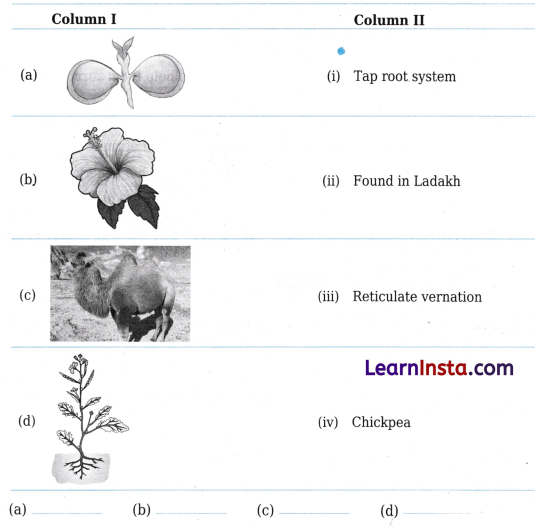
Answer:
(a) (iv)
(b) (iii)
(c) (ii)
(d) (i)
Assertion-Reason Questions
Given below are two statements. One is labelled as Assertion (A) and other is labelled as Reason (R). Choose the correct answer from the options given below.
(a) Both A and R are true and R is the correct explanation of A.
(b) Both A and R are true, but R is not the correct explanation of A.
(c) If A is true, but R is false.
(d) If A is false, but R is true.
Question 1.
Assertion (A) Different kinds of plants bear variety of stems.
Reason (R) Plants whose branches start higher on stem, away from the ground are known as trees.
Answer:
(b) Both A and R are true, but R is not the correct explanation of A.
Different kinds of plants bear a variety of stems because each type of stem serves a specific function depending on the plant’s habitat.
Question 2.
Assertion (A) Roots are different in all the plants.
Reason (R) Roots can be categorised as taproot or fibrous root.
Answer:
(b) Both A and R are true, but R is not the correct explanation of A.
The roots are different in all plants because they help the plant get water, nutrients and stay stable in different environments.
Question 3.
Assertion (A) Deodar trees are conical in shape and are generally found in Himachal Pradesh.
Reason (R) Deodar trees have thick and hard branches to help them survive them cold winter.
Answer:
(c) A is true, but R is false. R can be corrected as The deodar trees have flexible and sloping branches that help to slide the snow off them.
Question 4.
Assertion (A) Camel can survive without food for a long period of time.
Reason (R) Camels stores food in their hump to survive in the hot desert.
Answer:
(a) Both A and R are true and R is the correct explanation of A.
Question 5.
Assertion (A) The place where organisms live is called habitat.
Reason (R) The plants and animals that live on land are said to live in terrestrial habitats.
Answer:
(b) Both A and R are true, but R is not the correct explanation of A.
The habitat of plants and animals provides them food, water, air and shelter for their survival.
Case Based Questions
One day, a student went to the school garden and saw some plants with long, thin green leaves. The leaves were smooth and had a pattern of lines running parallel to each other. These plants were growing in big, thick patches and looked really healthy. The student also noticed that the roots of these plants spread out wide under the soil, helping them stay strong and find water.
Question 1.
What type of plants did the student observe in the garden?
(a) Clover
(b) Grass
(c) Dandelions
(d) Lettuce
Answer:
(b) Grass
Question 2.
What type of roots do these plants have?
(a) Tap roots
(b) Fibrous roots
(c) Bulbous roots
(d) Adventitious roots
Answer:
(b) Fibrous roots
Question 3.
Why are the roots important for these plants?
(a) They help the plants grow taller
(b) They help the plants stay strong and find water
(c) They make the leaves bigger
(d) They produce flowers
Answer:
(b) They help the plants stay strong and find water
B. Subjective Type Questions
Define the following terms
Question 1.
Herbs
Question 2.
Venation
Question 3.
Habitat
Question 4.
Amphibians
Very Short Answer Type Questions
Question 1.
How is a whale similar to a fish in adaptation to life in water?
Question 2.
Give two adaptations in animals found in the mountain habitat.
Question 3.
List the environmental factors that influence a habitat.
Question 4.
Name any three types of terrestrial habitat.
Short Answer Type Questions
Question 1.
Each member in the biodiversity of a region has a different role to play. Justify the statement.
Question 2.
How can we group animals?
Question 3.
What is the importance of grouping of plants and animals?
Question 4.
Differentiate between :
(a) reticulate and parallel venation.
(b) tap roots and fibrous roots.
(c) monocot and dicot plants.
Question 5.
Describe any two adaptations seen in desert plants.
Question 6.
Does the movement of animals depend upon their surroundings?
Question 7.
Write a short note on Save Silent Valley Movement.
Question 8.
Why does the biodiversity of a region vary from that of another?
Question 9.
Which features help camels to survive in the desert?
Question 10.
Define adaptation. What adaptations do Deodar tree and Rhododendron have to survive?
Question 11.
The populations of the Bengal Tiger, Cheetah, and Great Indian Bustard have declined in India due to loss of natural habitats caused by human activities. Name some projects initiated by government to protect them.
Long Answer Type Questions
Question 1.
Manu’s mother maintains a kitchen garden. One day, she was digging out radish from the soil. She told Manu that radish is a kind of root. Examine a radish and write what type of root it is. What type of venation would you observe in the leaves of radish plant?
Question 2.
Based on the information in the table, find out examples of these plants for each group.
| Group | Type of Seed | Type of Root | Examples |
| A | Monocot Tap root | Tap root | |
| B | Dicot Fibrous roots | Fibrous root |
(a) What other similarity do plants of group A have?
(b) What other similarity do plants of group B have?
Question 3.
Why are the Rhododendron in Nilgiri and in Sikkim look different? What are the various visible difference between them?
Question 4.
Observe the labelled part of a duck in the picture given below. What differences do you observe in the feet of the duck compared to the other birds? Which activity would the duck be able to perform using this part?

Question 5.
Write a short note on Traditionally Protected Forests.
Skill Based Activities
Question 1.
Jaya went to Rajasthan and Ladakh for her vacation. She spotted camels at both these places and was surprised to find various differences between the two. Why do you think camels show such differences at these two places?
Question 2.
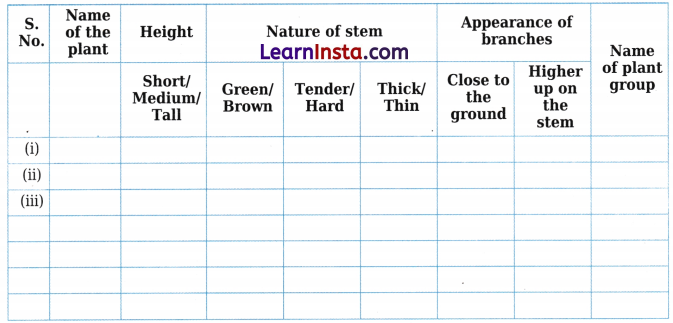
Let us go on a nature walk again for some interesting observations.
- Look closely at the heights of different plants. Are these plants shorter than you, as tall as you, or taller than you?
- Is the stem brown or green? Touch and feel their stems and try to bend them gently. Can you bend the stem easily, or is it stiff? Take care that stems do not break.
- Also, observe from where the branches of the plants arise-whether they arise close to the ground or higher up on the stem.
Write your observations in table given below
Question 3.
Explore the contributions of Divya Mudappa, Usha Lachunga, Ghazala Shahabuddin, Nandini Velho, Vidya Athreya, Uma Ramakrishnan and Divya Karnad towards biodiversity in India. Prepare a report of the work done by any three of them.
Question 4.
Interact with elders in your family or neighbourhood to find out various plants and animals that they do not see now but were seen earlier. Collect pictures of these plants and animals and paste them in a scrapbook. Find out more about them from internet.
Question 5.
Find out about ‘Project Tiger’ and other similar projects initiated in India to protect the biodiversity. Prepare a poster and present it in your class.