Students rely on Class 9 Science Extra Questions and Class 9th Exploration Chapter 2 Extra Question Answer Cell The Building Block of Life to improve their grades.
Class 9 Science Chapter 2 Cell The Building Block of Life Extra Questions
Class 9 Science Chapter 2 Extra Questions on Cell The Building Block of Life
Cell The Building Block of Life Class 9 Very Short Question Answer
Question 1.
What is the limit of resolution of the human eye?
Answer:
0.1 mm.
Question 2.
Name the instrument used to observe cells in a school laboratory.
Answer:
Light microscope (Compound microscope).
Question 3.
Who first observed cells and in which year?
Answer:
Robert Hooke, in 1665.
Question 4.
What material did Robert Hooke examine to discover cells?
Answer:
A thin slice of cork.
Question 5.
What type of microscope is used to observe structures at the nanometre scale?
Answer:
Electron microscope.

Question 6.
What is another name for the cell membrane?
Answer:
Plasma membrane.
Question 7.
Name the process by which water moves through a selectively permeable membrane.
Answer:
Osmosis.
Question 8.
What is the main component of the plant cell wall?
Answer:
Cellulose.
Question 9.
What happens to a plant cell in a hypertonic solution?
Answer:
The inner contents of the cell shrink as the cell membrane pulls away from the cell wall.
Question 10.
Which model describes the structure of the cell membrane?
Answer:
Fluid-mosaic model.
Question 11.
What are prokaryotic cells?
Answer:
Cells that lack a well-defined nucleus and membrane-bound organelles.
Example: bacteria.
Question 12.
Name the organelle that is called the post office of the cell.
Answer:
Golgi apparatus.
Question 13.
What is the function of ribosomes?
Answer:
Protein synthesis.
Question 14.
What is the energy currency of the cell?
Answer:
ATP (Adenosine Triphosphate).
Question 15.
What are the three types of plastids?
Answer:
Chloroplasts, chromoplasts, and leucoplasts.
Question 16.
What is cell division?
Answer:
The process by which new cells are formed from pre-existing cells.
Question 17.
How many daughter cells are produced in mitosis?
Answer:
Two.
Question 18.
Where does meiosis occur in the human body?
Answer:
In the testes (males) and ovaries (females).
Question 19.
What is the importance of meiosis?
Answer:
It is important for sexual reproduction and creates genetic diversity.
Question 20.
What happens during fertilisation with respect to chromosome number?
Answer:
The original chromosome number is restored.
Question 21.
Who proposed that all animals are made of cells?
Answer:
Theodor Schwann (1839).
Question 22.
What is contact inhibition?
Answer:
The process by which cell division stops when cells come in contact with neighbouring cells.
Question 23.
What is totipotency?
Answer:
The ability of a single plant cell to develop into a complete plant under suitable conditions.
Question 24.
Who proposed the idea of totipotency?
Answer:
Gottlieb Haberlandt (1902).
Question 25.
What is a tumour?
Answer:
An abnormal mass of cells formed due to uncontrolled cell division.
Cell The Building Block of Life Class 9 Short Question Answer
Question 1.
How is the total magnification of a compound microscope calculated?
Answer:
The total magnification of a compound microscope is calculated by multiplying the magnifying power of the eyepiece lens by the magnifying power of the objective lens. For example, if both the eyepiece and objective lens have a magnifying power of 10X, the total magnification will be 10 × 10 = 100X.
Question 2.
How do electron microscopes differ from light microscopes?
Answer:
Electron microscopes use a beam of electrons instead of visible light, allowing much higher magnification and resolution. Fine details of cell structure at the nanometre scale can be seen under electron microscope, while light microscopes are limited in their magnification and resolution.
Question 3.
Explain why plant cells do not shrink in size when placed in a concentrated salt solution, while animal cells do.
Answer:
- Plant cells have a rigid cell wall outside the cell membrane. When placed in a concentrated solution, water moves out by osmosis, and the inner contents shrink, but the cell wall maintains the shape and size of the cell.
- Animal cells lack a cell wall, so when water moves out, the entire cell shrinks.
Question 4.
Distinguish between a hypotonic solution and a hypertonic solution with reference to a cell.
Answer:
- In a hypotonic solution, the solute concentration outside the cell is less than inside, so water enters the cell and the cell swells.
- In a hypertonic solution, the solute concentration outside is more than inside, so water leaves the cell and it shrinks.
Question 5.
Differentiate between prokaryotic and eukaryotic cells.
Answer:
| Prokaryotic cell | Eukaryotic cell |
| 1. Size of a cell is generally small. | Cell size is generally large. |
| 2. Nuclear region or nucleoid is not surrounded by nuclear membrane. | Nucleus is present with nuclear membrane surrounding the chromation materials. |
| 3. Nucleous is absent. | Nucleous is present in the nucleus. |
| 4. Membrane-bound cell organelles like mitochondria are absent. | Membrane bound cell organelles like mitochondria, chloroplast are present. |
| 5. It contains single chromatin material called nucleoid. | It contains more than one chromosome in nucleus. |
Question 6.
Why are lysosomes called the clean-up system of the cell?
Answer:
- Lysosomes contain digestive enzymes that can break down unwanted proteins, carbohydrates, fats, and damaged parts of the cell.
- By digesting waste materials and worn-out organelles, they keep the cell clean and healthy.
- The breakdown products are released into the cytoplasm and may be reused.
Question 7.
What are chromoplasts? What is their function?
Answer:
- Chromoplasts are plastids that contain coloured pigments other than chlorophyll (such as yellow, orange, or red pigments).
- They are found in flower petals and fruits.
- Their bright colours help attract pollinators for pollination and fruit-eating animals that aid in seed dispersal.
Question 8.
What happens if there are errors in mitosis?
Answer:
Errors in mitosis lead to uncontrolled cell division, which can result in the formation of tumours and an abnormal number of chromosomes in body cells. This can lead to cancer.
Question 9.
What is the importance of meiosis?
Answer:
Meiosis occurs in reproductive cells.
- Meiosis is important for sexual reproduction because it ensures that when gametes from two parents fuse during fertilisation, the original chromosome number is restored.
- It also creates genetic variation among offspring, which is why children resemble their parents but are not exactly the same.
Question 10.
State the three main postulates of the Cell Theory.
Answer:
(i) All living organisms are made up of one or more cells.
(ii) The cell is the basic unit of structure and function in living beings.
(iii) All cells arise from pre-existing cells.
Question 11.
How do cancer cells differ from normal cells?
Answer:
- Normal cells grow in a controlled manner, perform their functions, and die naturally when no longer needed.
- Cancer cells lose this control and keep dividing uncontrollably, ignoring contact inhibition.
- They form tumours and can invade nearby tissues or spread to other parts of the body.
Cell The Building Block of Life Class 9 Long Question Answer
Question 1.
Describe the significance of the microscope in the study of cells. Mention three features of a microscope that have been improved over the years.
Answer:
- The microscope is an essential tool for studying cells because cells are too small to be seen with the unaided eye. Robert Hooke first observed cells in 1665 using a self-designed microscope.
- Since then, microscopes have become increasingly powerful. The three main features that have been improved over the years are:
- Resolution, which is the measure of clarity and the ability to distinguish two closely placed objects as separate.
(ii) Contrast, which is the difference in brightness between various parts of an object, making details more visible.
(iii) Magnification, which is the ability to make objects appear larger. - These improvements have made the microscope a powerful tool, from the light microscope used in school laboratories to the electron microscope that reveals structures at the nanometre scale.
Question 2.
Describe the fluid-mosaic model of the cell membrane. How does its structure help in the movement of substances?
Answer:
- The fluid-mosaic model explains the structure of the cell membrane. According to this model, the cell membrane is made up of a lipid bilayer (two layers of fat molecules) with proteins embedded in them.
- The fat molecules have water-attracting heads facing outwards and water-repelling tails facing inwards. The molecules can move making the membrane fluid.
- Proteins are scattered like tiles in a mosaic pattern.
- These proteins act as gatekeepers, helping substances pass through the membrane.
- Some proteins form channels that allow specific molecules to enter or exit the cell, while others help in transporting substances against the concentration gradient.
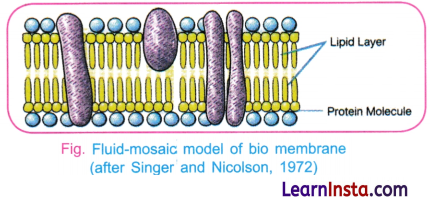
This selective permeability of the cell membrane is essential for maintaining the internal environment of the cell.
Question 3.
Describe the structure and functions of mitochondria. Why are they called the powerhouse of the cell?
Answer:
Mitochondria are double-membrane organelles found in almost all eukaryotic cells. The outer membrane is smooth and porous, while the inner membrane is folded into finger-like projections called cristae. The cristae increase the surface area for chemical reactions.
Inside the mitochondria, glucose and other molecules are broken down during cellular respiration. The energy released from this process is stored in the form of ATP (Adenosine Triphosphate), which is used for most cellular activities.
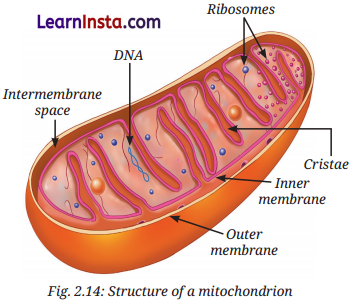
Since mitochondria supply the energy needed for most cellular processes, they are called the powerhouse of the cell. Mitochondria have their own DNA and ribosomes, which allows them to make some of their own proteins.
Question 4.
Compare the structure of a plant cell and an animal cell (at least five differences).
Answer:
| Plant cell | Animal cell |
| 1. The outermost covering of the plant cell is cell wall formed of cellulose. Cell wall is present outer to plasma membrane or cell membrane. | The outermost covering of the animal cell is plasma membrane. Cell wall is absent. |
| 2. Large central vacuole is present | Vacuoles are of small size or absent and temporary. |
| 3. Because of large central vacuole, cell organelles and nucleus lie towards the boundary wall or periphery of the cell. | Nucleus lies in the centre of the cell and other cell organelles also lie surrounding it. |
| 4. Plastids are present. | Plastids are absent. |
| 5. Centrioles are absent. Polar caps help in the formation of spindle apparatus during cell division. | Centrioles are present within the centrosome which help in the formation of spindle apparatus during cell division. |
| 6. Simple form of Golgi apparatus called dictyosome is present. | Golgi apparatus is single highly complex and prominent structure. |
Question 5.
Describe the process and significance of meiosis.
Answer:
- Meiosis is a type of cell division that occurs only in cells of reproductive organs. In meiosis, the parent cell divides twice. In the first division, two daughter cells are formed, each with half the number of chromosomes of the parent cell.
- In the second division (similar to mitosis), each of these daughter cells divides again, forming a total of four daughter cells.
- Each daughter cell has half the chromosome number. In males, meiosis produces sperms in the testes, and in females, it produces eggs in the ovaries.
- In plants, meiosis forms pollen grains in anthers and egg cells in ovaries.
- Meiosis is important for sexual reproduction because it ensures that when gametes from two parents fuse during fertilisation, the original chromosome number is restored.
- It also creates genetic variation among offspring, which is why children resemble their parents but are not exactly the same.
Question 6.
How is mitosis different from meiosis?
Answer:
| Mitosis | Meiosis |
| 1. It occurs in all organisms. | It occurs in sexually reproducing organisms. |
| 2. It takes place in somatic cells. | It takes place in reproductive cells. |
| 3. It continues throughout the life of multicellular organisms. | It occurs only during sexual reproduction. |
| 4. It is a single division and produces two daughter cells. | It is double division which produces four daughter cells. |
| 5. It can take place in both diploid and haploid cells. | Meiosis occurs only in diploid cells. |
| 6. It maintains the chromosome number. | It reduces the chromosome number to half. |
| 7. It occurs many times, i.e., A cell can undergo repeated mitosis. | Meiosis occurs only once i.e., during sexual reproduction. |
| 8. It is a simple division which takes less time to complete. | It is complicated and takes longer time to complete. |
| 9. It does not introduce variations. | It introduces variations as crossing over occurs in one step of Meiosis. |
| 10. It takes part in repair, healing and multiplication of cells. | It takes part in the formation of gametes during reproduction. |
Question 7.
(a) Explain the Cell Theory and its significance.
(b) Explain what happens when cell growth is not properly controlled.
Answer:
(a) The Cell Theory was formulated through the combined work of Schleiden (1838), Schwann (1839), and Virchow (1855). It states
(i) All living organisms are made up of one or more cells.
(ii) The cell is the basic unit of structure and function.
(iii) All cells arise from pre-existing cells. This theory is proved from bacteria to humans, and explains the continuity of life through cell division.
(b)(i) When cell growth is not properly controlled, problems arise.
(ii) Normal cells show contact inhibition, meaning they stop dividing when they touch neighbouring cells.
(iii) Cancer cells lose this control and divide uncontrollably, forming tumours. These tumours may be benign (non-spreading) or malignant (cancerous, capable of invading nearby tissues and spreading to other body parts).
(iv) Errors in meiosis can lead to genetic disorders and developmental problems.
Cell The Building Block of Life Class 9 Case Based Question
I. Read the passage and answer
A student performed an experiment. She took two pieces of potato of roughly equal size. She placed one piece in plain water (Beaker A) and the other in a 20% salt solution (Beaker B). After one hour, she measured the weight of each piece. The piece in Beaker A had gained weight and swelled, while the piece in Beaker B had lost weight and shrunk.
Answer the following questions:
Question 1.
What process caused the change in weight of the potato pieces?
Answer:
Osmosis.
Question 2.
Why did the potato piece in Beaker A gain weight?
Answer:
The potato piece in plain water gained weight because water entered the potato cells by osmosis. The concentration of water was higher outside the cells than inside, so water moved into the cells through the selectively permeable cell membrane.
Question 3.
What type of solution is the 20% salt solution for the potato cells?
Answer:
Hypertonic solution (the solute concentration outside the cell is greater than inside).
II. Read the passage and answer
In 1838, Matthias Schleiden reported that all plants are made up of cells. In 1839, Theodor Schwann found that all animals are also made up of cells. Later, in 1855, Rudolf Virchow stated that new cells are formed only from pre-existing cells. Together, their work led to the formulation of the Cell Theory.
Answer the following questions:
Question 1.
State the three postulates of the Cell Theory.
Answer:
(1) All living organisms are made up of one or more cells.
(2) The cell is the basic unit of structure and function in living beings.
(3) All cells arise from pre-existing cells.
Question 2.
Why is the Cell Theory called the unifying principle of biology?
Answer:
It is called the unifying principle because it applies to all living organisms, from bacteria to humans, and explains how life continues through cell division.
Question 3.
Who stated that all cells arise from pre-existing cells?
Answer:
Rudolf Virchow (1855).
III. Read the passage and answer
Scientist J. Craig Venter and his team studied the complete DNA sequence of a bacterium called Mycoplasma mycoides. They chemically synthesised an exact copy of this DNA in the laboratory. They then removed the DNA from a closely related bacterium but kept the rest of the cell intact. They inserted the synthetic DNA into this cell. The cell started to grow and divide following the instructions from the synthetic DNA.
Answer the following questions:
Question 1.
What did this experiment demonstrate?
Answer:
This experiment demonstrated that DNA controls the structure and activities of a cell.
Question 2.
Did the scientists create a completely new cell from scratch?
Answer:
No. Only the DNA was synthetic. The other parts of the cell (cytoplasm, cell membrane, etc.) were taken from an already existing living cell.
Question 3.
Where is DNA located in a eukaryotic cell?
Answer:
DNA is located in the nucleus, as part of chromosomes.
Question 4.
Name two cell organelles that have their own DNA.
Answer:
Mitochondria and chloroplasts (plastids).
Cell The Building Block of Life Extra Questions for Practice
Very Short Answer Type Questions
Question 1.
Define diffusion.
Question 2.
What is the function of the nuclear membrane?
Question 3.
Name the plastid responsible for the red colour of tomatoes.
Question 4.
What are genes?
Question 5.
What is cell sap?
Question 6.
Name the scientist who proposed the Cell Theory about animals.
Question 7.
What type of cell division forms gametes?
Question 8.
What is the function of cristae in mitochondria?
Question 9.
What is cell culture?
Short Answer Type Questions
Question 1.
Explain what happens to a cheek cell when placed in a concentrated salt solution.
Question 2.
Differentiate between chloroplasts and leucoplasts.
Question 3.
Why do plant cells have both a cell wall and a cell membrane?
Question 4.
What is the role of Golgi apparatus in a cell?
Question 5.
How do mitochondria and chloroplasts suggest an evolutionary connection with bacteria?
Question 6.
Describe the importance of cell division for living organisms.
Long Answer Type Questions
Question 1.
(a) Describe the structure of the nucleus and its role in the cell.
(b) What are chromosomes and what is the position of DNA in chromosome?
Question 2.
(a) Explain osmosis with the help of an experiment.
(b) What is the difference between osmosis and diffusion?
Question 3.
Describe the different types of cell organelles found in a eukaryotic cell and their functions.
Question 4.
(a) Compare mitosis and meiosis.
(b) Why are both types of cell division important for living organisms?
Question 5.
(a) Explain the Cell Theory.
(b) Discuss what happens when cell division is not properly controlled.
Question 6.
Draw a well-labelled diagram of a plant cell and describe the function of any five organelles.
Question 7.
(a) Describe the structure of the cell membrane according to the fluid-mosaic model.
(b) Explain how substances move across the cell membrane.