Students can use Our Wondrous World Class 5 Solutions Chapter 8 Clothes How Things are Made Class 5 Questions and Answers as a quick reference guide.
Class 5 EVS Chapter 8 Clothes How Things are Made Question Answer
Clothes How Things are Made Class 5 EVS Question Answer
Our Wondrous World Class 5 EVS Chapter 8 Question Answer – Class 5 EVS Clothes How Things are Made Question Answer
Patterns with Threads (Page 131)
What do you see in the picture?
Answer:
In the picture we can see a male baya weaver bird making a pouch-shaped nest using grass.

Discuss (Page 133)
Have you seen products woven out of natural material at home or elsewhere? What are they?
Answer:
Yes, I have seen products woven out of natural material. They are quite common and can be seen both at home and in other places. Here are some examples:
- Mats: Made from bamboo, palm leaves cane, or grass.
- Baskets: Woven from cane, bamboo, jute or date palm leaves.
- Furniture: Such as chairs or stools made from wood, rattan or cane.
Activity 1 (Page 133)
1. Take 5-6 strips of blue paper and tape them at the top of a surface.
2. Take another set of yellow paper strips and weave them through – over, under, over, under.
3. Keep repeating until you get a mat.
4. Can you use this method to make a basket?
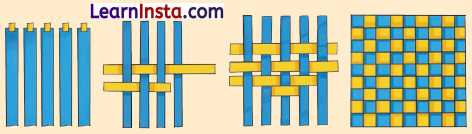
Try using materials other than paper, such as strings, ropes, ribbons or reeds.
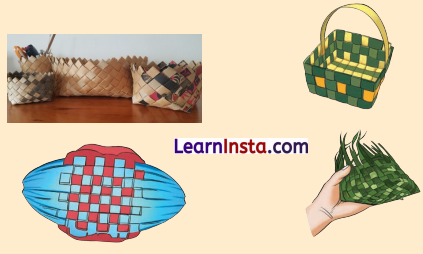
Answer:
Students should follow the steps and try the activity themselves as directed.
Think (Page 134)
Question 1.
What can you find in your classroom that is woven? If we weave with threads instead of paper strips, it becomes cloth.
Answer:
In a classroom, one might find woven items such as mats, baskets, or even woven chairs. These items could be made from materials like bamboo, jute, or palm leaves. If threads are used instead of paper strips, the result would be cloth, which can be used to make things like clothes, bags, or other fabric items.
Activity 2 (Page 134)
Look at a piece of cloth through a magnifying glass or by using zoom on a mobile phone camera. It could be a shirt or something you are wearing. Can you see the amazing crisscross pattern?

Answer:
(Suggested answer) Yes, when I look at a piece of cloth through a magnifying glass or use the zoom on my mobile phone camera, I can see the criss-cross pattern clearly. The threads of the fabric are woven together in a pattern, with vertical threads crossing over horizontal ones, creating the texture of the cloth.
Note: Students should observe this pattern themselves, as directed.
Activity 3 (Page 135)
– Take a ball of cotton and gently pull it out to make a strand.
– Now, try twisting the strand slowly with your fingers. Notice how it becomes stronger as you pull it in a spin.
– Take a pencil. Now, wind your cotton strand onto your pencil, by twisting and adding more cotton to your ball.

Answer:
Students should follow the steps and try the activity themselves as directed.
Activity 4 (Page 138)
Look at some clothes, bags or other things you use every day. List some of the materials that you have used. Are they made from natural or synthetic fibres? Then, write one thing you like about it in the table below.

Answer:
| Item | Natural | Synthetic | What I Like About It? |
| Shirt | Cotton | — | Soft and comfortable to wear |
| Bag | — | Nylon | Strong, light and water-resistant. |
| Sweater | Wool | — | Keeps me warm and cozy during cold weather. |
| Raincoat | — | Polyster | It’s waterproof, lightweight and keeps me dry in the rain. |
Activity 5 (Page 139)
In small groups, collect fresh leaves of palash, teak, jackfruit or similar broad leaves. If leaves are not available, try using paper.
Also, collect some small twigs like toothpicks. Now, using the leaves or pieces of paper and the toothpicks, pin them together to create a plate or a spoon.

Answer:
Students should follow the steps and try the activity themselves as directed.
Activity 6 (Page 139)
Have you ever tried stitching? You will need a needle and thread to stitch a piece of fabric together. Can you fix a tear or sew a button? Let us learn simple stitching.
Answer:
I haven’t really done stitching myself, but I know it involves using a needle and thread to join pieces of cloth or fix something torn. I have seen my mother sew a button back on when it falls off or stitch up a tear in clothes. It’s a useful skill that helps make clothes last longer.
Think (Page 139)
Question 1.
Have you ever seen someone stitching at home or in your neighbourhood? What were they making or fixing?
Answer:
Yes, I have seen people stitching at home or in the neighbourhood. They were often fixing clothes, such as stitching torn shirts or pants, or making items like quilts, bags, or even traditional embroidery pieces. In some cases, people also stitch to decorate fabrics with intricate designs, which is common in many cultures.
Question 2.
Look at your shirt or school bag. Can you find where the pieces have been stitched together?
Answer:
Yes, if I look at my shirt or school bag, I can see where the pieces have been stitched together. For example, on my shirt, the fabric is stitched along the sides, around the sleeves, and at the collar. On my school bag, the edges of the pockets, straps, and zippers are all stitched to keep everything in place. There are usually extra stitches at the corners to make it stronger and more durable.
Activity 7 (Page 140)
Let us begin by learning the basic running stitch.
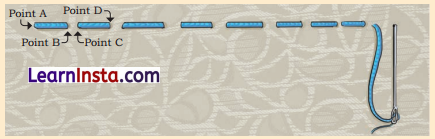
1. Take a piece of thread through a needle. Tie a knot at one end of the thread.
2. Start from the back of the cloth. Bring the needle up at Point A.
3. Push the needle down at Point B.
4. Bring it up at Point C , then down at Point D .
5. Keep going-up, down, up, down-in a straight line.
6. This is called a running stitch.
Answer:
Students should follow the steps and try the activity themselves as directed under the guidance of an adult.
Activity 8 (Pages 140-141)
Stitching Clothes Together
Now, let us use this stitch to bring two pieces of cloth together.
1. Collect small cloth pieces left over at a tailor’s shop or some pieces of old cloth.
2. Lay one piece of cloth flat on the table. Place the second piece of cloth on top of it, slightly overlapping it.
3. Now, use a needle and thread to do a simple running stitch to join them together.
4. Add more pieces to create a table cloth, mat, coaster, cleaning cloth or any material of your interest.

Answer:
Students should follow the steps and try the activity themselves as directed under the supervision of an adult.
Where else can we use running stitches in daily life? (Page 141)
Answer:
Running stitches can be used in mending clothes, sewing buttons, making handkerchiefs, doing embroidery, and adding decorative borders to fabrics.
If one thread breaks in your stitching, what do you think will happen to the rest of the stitches? (Page 141)
Answer:
If one thread breaks, especially near the beginning or end, the rest of the stitches can come apart or become loose.
Let us reflect (Pages 143-144)
Question 1.
Have you ever reused or recycled an old piece of cloth? What did you or your family make from it?
Answer:
Yes, I have reused and recycled old pieces of cloth in creative and useful ways:
- Turned old T-shirts into cleaning cloths and dusters.
- Used old jeans to make bags, aprons, and pencil pouches.
- Cut torn bedsheets to make floor mats and small quilts.
- Used baby clothes to make soft toys.
- Made curtains from worn-out sarees and dupattas.
Question 2.
If one thread breaks in a stitched cloth or in a woven mat, what might happen? Why is each thread important?
Answer:
When threads in a stitched cloth or woven mat breaks, it can affect the overall strength and durability of the material. Here’s what can happen:
In a stitched cloth:
- At first, only a small part of the stitch may loosen.
- But if the broken thread is a part of a continuous line of stitching, the stitch may start to open up more and more with use or washing.
- Overtime, the cloth may tear further at the seam unless it is mended quickly.
In a woven mat:
1. If one strand breaks in a woven mat, the weave becomes loose. Slowly, the mat may start to unravel and loose its shape. Fixing it early by stitching or tying back the strand will keep it strong.
Each thread is like a part of a team; they work together to keep the material strong and intact.
Question 3.
Visit a tailor’s shop or a handloom store with an adult. What tools or machines did you see being used there?
Answer:
When I visited a tailor’s shop, I noticed several tools and machines being used to make or alter clothes. The tools I saw included: measuring tape, scissors, needles, sewing-machines, thread, chalk or fabric marker, pins and seam ripper.
These tools help the tailor in measuring, cutting, stitching and adjusting fabric to create the perfect garment.
Question 4.
Find out what kind of weaving or stitching work is famous in your area or state. Name it.
Answer:
(Suggested answer) I live in Lucknow, Uttar Pradesh, which is famous for Chikankari, a beautiful form of hand embroidery.
Question 5.
We should not throw the old clothes away. Why?
Answer:
We should not throw old clothes away because they can be reused or recycled. We can turn them into mats, bags, or use them for cleaning. Recycling helps reduce waste and gives the clothes a new purpose. Moreover, we can donate them to the needy people.
Question 6.
Below are the jumbled-up steps of the life cycle of a moth. Read and number them from 1 to 6 in the correct order.
Adult moth comes out of the cocoon.
Eggs hatch into tiny caterpillars.
Silk moth lays eggs.
The cycle begins again.
Caterpillars eat mulberry leaves and grow big.
Caterpillars spin cocoons around themselves.
Answer:
Silk moth lays eggs.
Eggs hatch into tiny caterpillars.
Caterpillars eat mulberry leaves and grow big.
Caterpillars spin cocoons around themselves.
Adult moth comes out of the cocoon.
The cycle begins again.
Question 7.
Bring 5-6 pieces of different types of clothes from home or nearby tailors (leftover scraps). Observe the material closely and complete the table. Ask an elder or search in your book to find out whether it is made from cotton, wool, silk, jute, polyester or nylon.

Answer:
| Cloth Piece No. | How does it feel? (smooth, rough) | Thick/Thin | Shiny (Yes/No) |
Stretchy (Yes/No) |
What do you think it is made of? |
| 1 | Smooth | Thin | Yes | No | Silk |
| 2 | Rough | Thick | No | Yes | Wool |
| 3 | Smooth | Thin | No | No | Polyester |
| 4 | Rough | Thick | No | No | Jute |
| 5 | Smooth | Thick | Yes | No | Cotton |