Working through Class 4 English Notes Chapter 6 Braille Summary in English simplifies the understanding of long chapters.
Braille Summary in English
Summary of Braille Class 4
Braille Summary
Louis Braille, a French boy, lost his eyesight at the age three due to an accident with a sharp tool. In 1819, at ten, he joined the Royal Institute for Young Blind Persons in Paris, where he learned using tactile methods like wood, cloth and pins. Inspired by Captain Charles Barbier de la Serre’s “Night Writing,” Louis simplified it to create the Braille alphabet. Braille uses raised dots to represent each letter of the English alphabet, enabling reading through touch. Braille books are thicker than regular books because the raised dots require more space.
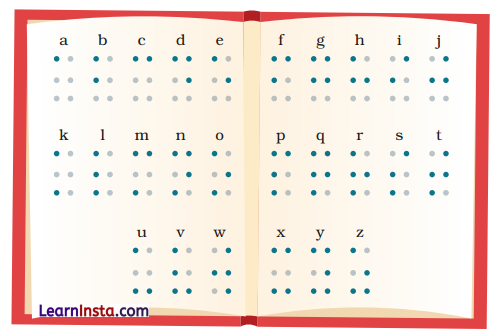
The system is not only for the blind; sighted people can also learn and write in Braille. The chapter includes activities like writing in Braille, discussing eye safety, and practicing past tense grammar. It encourages empathy through tactile experiments, such as feeling raised shapes with closed eyes. Students are asked to think about assisting visually impaired peers, like using large-font printouts. The chapter ends with a self-assessment to evaluate learning through poems, vocabulary, and group work.
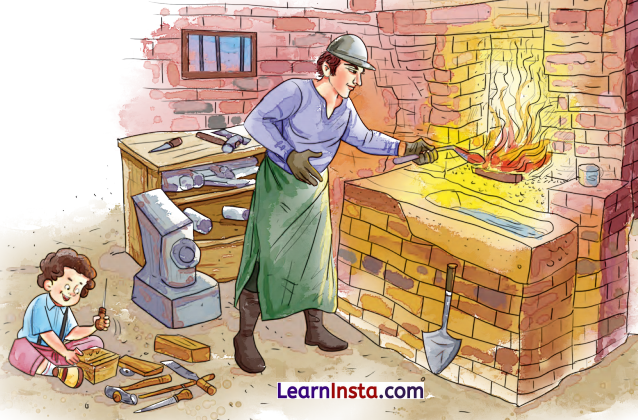
This chapter is about Louis Braille, a little boy from France. When he was three years old, he was playing outside his home. His father was a blacksmith and was working nearby. Louis had an accident while playing with a sharp thing from his father’s tools and lost his eyesight.
At the age of ten, Louis got admission in the Royal Institute for Young Blind Persons in Paris. There, he learned letters using wood cloth, or pins arranged in pincushions.
Around that time, a soldier named Captain Charles Barbier invented a system called Night Writing. It used raised dots and dashes so soldiers could read in the dark. But it was too difficult to use.
Louis studied it and made it simpler. He created the Braille alphabet, a system of raised dots that people with blindness could read by touch.
Braille books are thicker than normal books because the dots need more space. Today, both blind and sighted people can learn Braille and use it to read and write.

Braille Word Meanings
Blacksmith – A person who makes/repairs iron tools – लोहार
Pierced – Poked through sharply – छेदा, बींधा
Blind – Unable to see – अंधा
Admission – Entry into an institution – प्रवेश
Pincushions – Small cushions to hold pins – पिन तकिया
Invented – Created something new – आविष्कार किया
Alphabet – Set of letters in a language – वर्णमाला
Teenager – A person aged 13-19 – किशोर
Simplified – Made easier – सरल बनाया

Braille – Raised-dot system for blind readers – ब्रेल लिपि
Symbol – A sign representing something – चिह्न
Blacksmith – A person who makes or repairs things with iron or metal
Pierced – Went into or through something with a sharp point
Institute – A school or place for learning
Pincushions – Small cushions used to hold pins and needles
Invented – Created something new for the first time
Raised dots – Small dots that are lifted from the surface and can be felt by touch
Symbol – A sign or mark that represents something
Sighted – A person who can see