Experts have designed these Class 9 Science Notes and Exploration Chapter 9 Atomic Foundations of Matter Class 9 Notes for effective learning.
Class 9 Science Chapter 9 Atomic Foundations of Matter Notes
Class 9 Science Exploration Chapter 9 Notes
Class 9 Science Chapter 9 Notes – Class 9 Atomic Foundations of Matter Notes
→ Anion: An anion is a negative ion formed when an atom gains one or more electrons, like Cl– (chloride ion).
→ Bond: A chemical bond is the force that holds atoms together in a molecule or compound. It makes atoms stable by sharing or transferring electrons.
→ Cation: A cation is a positive ion formed when an atom loses one or more electrons, like Na+ (sodium ion).
→ Cinnabar: Cinnabar is a bright red mineral ore consisting of mercury and sulphur (HgS). It was used as a painting and colouring agent in ancient times.
→ Combustible: Combustible means something that can catch fire and bum easily, like paper or wood – they bum when heated in air.
→ Combustion: Combustion is a fast chemical reaction where a substance bums in air (oxygen) to make heat and light, like a candle flame.
→ Compound: A compound is a pure substance made from two or more different elements chemically combined, like water (H2O) from hydrogen and oxygen.
→ Covalent Bond: Covalent bond is formed by sharing valence electrons between atoms. It makes molecules, common in elements like H2 or compounds like H2O.

→ Covalent Compounds: Covalent compounds are made by sharing electrons between atoms. They form molecules with low melting points, like water (H2O) or CO2.
→ Double Bond: A double bond forms when two atoms share two pairs of electrons, like O = O in oxygen gas (O2).
→ Duplet: Duplet means 2 electrons in the outer shell, making small atoms stable, like hydrogen (H) or helium (He) with 2 electrons.
→ Formula Unit: Formula unit is the simplest group of atoms/ions in an ionic compound’s formula, like NaCl (one Na+ and one Cl–), not a molecule.
→ Formula Unit Mass: Formula unit mass is the total atomic mass of atoms/ions in one formula unit of an ionic compound, like NaCl: 23 + 35.5 = 58.5 u.
→ Ionic Bond: Ionic bond forms when one atom gives electrons to another, making + and – charged ions that attract, it forms crystals like NaCl.
→ Matter: Matter is anything that has mass and takes up space. Everything around us – air, water, rocks – is made of tiny particles called atoms that form matter.
→ Molecules: A molecule is a group of two or more atoms joined by chemical bonds. It’s electrically neutral and acts as one unit, like H2O.
→ Octet: Octet means 8 electrons in the outer shell, making most atoms stable, like neon (Ne) – atoms bond to reach this.
→ Polyatomic Ion: A polyatomic ion is a group of atoms bonded together with an overall charge, like SO42- (sulfate) or NH4+ (ammonium).
→ Single Bond: A single bond forms when two atoms share one pair of electrons, like H – H in hydrogen gas (H2) or H – O – H in water.
Introduction
Matter is made up of tiny particles called atoms, which are the basic building blocks of everything around us. The idea of the atom has developed over time through different scientific models.
Law of Conservation of Mass
The Law of Conservation of Mass states that the total mass of substances present before and after a chemical reaction remains the same. In other words, matter can neither be created nor destroyed in a chemical reaction.
This law was proposed by Antoine Lavoisier in 1789. He showed through experiments that the mass of reactants equals the mass of products in any chemical reaction.
Hence, for any type of chemical reaction, the total mass of the reactants and the products involved is conserved.
In a chemical reaction, two or more molecules interact to produce new compounds; they are called reactants, whereas the newly formed compounds are called products.
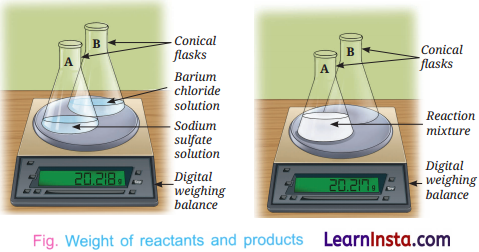
Formula:
Mass of the reactants = Mass of the products
For example,
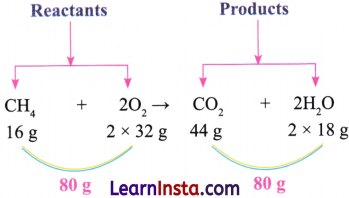
Example 1:
If heating 12.0 grams of calcium carbonate (CaCO3) produces 6.4 g of carbon dioxide (CO2) and 5.6 g of calcium oxide (CaO), show that these observations are in agreement with the law of conservation of mass.
Solution:
We know that,
Mass of the reactants = Mass of the products

12.0 g of reactant = 12.0 g (6.4 g + 5.6 g) of products
Because the mass of the reactant is equal to the mass of the products, the observations are in agreement with the law of conservation of mass.
Law of Constant Proportions
According to Law of Constant Composition or Proportions, all pure samples of a compound contain the same elements combined together in the same proportion by mass.
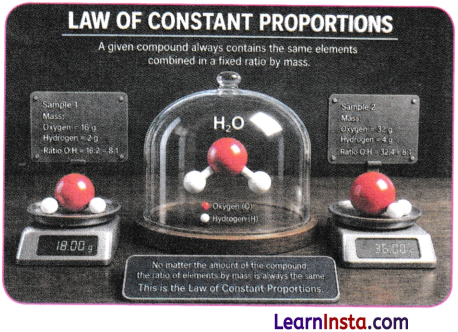
For example, a sample of water would always contain hydrogen and oxygen in the ratio of 1 : 8 by mass irrespective of the source of water. If we decompose 100 grams of pure water by passing electricity through it then we get 11 grams of hydrogen and 89 grams of oxygen showing that hydrogen and oxygen are combined together in water in the same constant proportion of 1 : 8 by weight. This is also called Law of Definite Proportions or sometimes Proust’s Law.
Example 2:
Water (H2O) contains hydrogen and oxygen in the mass ratio of 2 : 16. If 4 g of hydrogen reacts completely, how much oxygen is needed to form water?
Solution:
We know
Mass of element required = \(\frac{\text { given mass ratio }}{\text { other mass ratio }}\) × given mass
Now,
Mass of oxygen required = \(\frac{16}{2}\) × 4 = 32 g
Example 3:
Carbon dioxide (CO2) contains carbon and oxygen in the mass ratio of 12 : 32. If 24 g of carbon reacts completely, how much oxygen is needed to form CO2?
Solution:
Mass of element required = \(\frac{\text { given mass ratio }}{\text { other mass ratio }}\) × given mass
Now,
Mass of oxygen required = \(\frac{32}{12}\) × 24 = 64 g.
Dalton’s Atomic Theory
Dalton’s Atomic Theory states that:
- Matter is made up of tiny, indivisible particles called atoms.
- Atoms of the same element are identical in mass and properties.
- Atoms of different elements differ in mass and properties.
- Atoms combine in simple whole-number ratios to form compounds.
- Atoms cannot be created or destroyed in chemical reactions; they only rearrange.
- The relative number and types of atoms in a compound remain constant
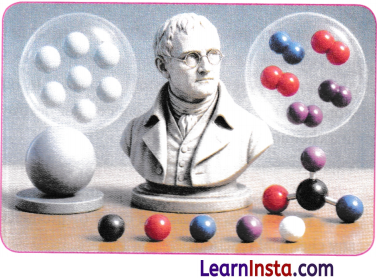
This theory led the foundation for modern chemistry, explaining the laws of chemical combination and giving a scientific basis to the idea that atoms are the fundamental units of matter.
How Atoms Combine?
Atoms of the same element can combine to form molecules, such as a hydrogen molecule made of two hydrogen atoms. Atoms of different elements combine to form molecules of compounds, like hydrogen chloride formed from hydrogen and chlorine atoms.
When atoms combine to form molecules, they do so by either sharing or transferring their valence electrons.
In the case of sharing, atoms contribute one or more of their valence electrons to be jointly used, creating a covalent bond. For example, in a water molecule, hydrogen and oxygen share electrons to achieve stability.
In the case of transfer, one atom donates its valence electron(s) to another atom, or accepts electrons from another, resulting in the formation of ions that attract each other through opposite charges. This is known as an ionic bond, as seen in sodium chloride where sodium transfers an electron to chlorine.
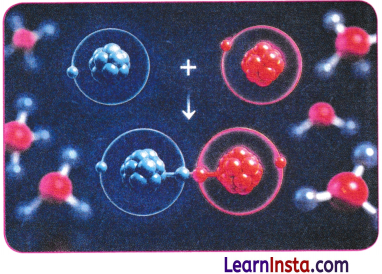
In both cases, the combination of atoms leads to a decrease in the total energy of the system compared to the separate atoms, making the new arrangement more stable. The force that holds these atoms together in this stable state is called a chemical bond, and it is the fundamental reason why matter exists in the form of molecules and compounds rather than isolated atoms.
Bonding by Sharing of Electrons — Covalent Bond
A. Molecules of Elements
Atoms need a complete outer shell (2 in K, or 8 in L and M) to stay stable, just like helium or neon. Instead of giving or taking electrons, they share some outer ones with another atom. This sharing makes a covalent bond that holds the atoms together as a group called a molecule.
A covalent bond is a type of chemical bond formed when two atoms share electrons to achieve stability in their outermost shell. This sharing allows each atom to complete its valence shell and follow the octet rule (or duet rule in the case of hydrogen). Covalent bonds are common in molecules like water (H2O), methane (CH4), and oxygen (O2).
A single bond is a specific kind of covalent bond where only one pair of electrons is shared between two atoms.
A single covalent bond is usually represented by drawing a single line between the symbols of the two atoms. For example, in a hydrogen molecule (H2), each hydrogen atom contributes one electron, and together they share a pair of electrons. This shared pair is shown as: H – H.
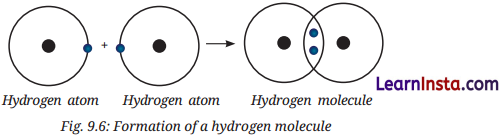
A double covalent bond is formed when two atoms share two pairs of electrons between them. This type of bond is stronger than a single bond because more electrons are involved in holding the atoms together.
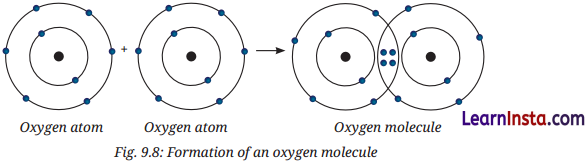
For example, in an oxygen molecule (O2), each oxygen atom has six valence electrons and needs two more to complete its octet. Therefore, the two oxygen atoms share two pairs of electrons, resulting in a double bond.
This is generally depicted by drawing two lines between the symbols of the atoms: O = O
Here, the “=” sign represents the double bond, showing that two pairs of electrons are shared.
B. Molecules of Compounds
Atoms of different elements share electrons to form compound molecules. One H atom shares with one Cl atom to make HCl, hydrogen chloride gas. Two H atoms share with one O atom to make H2O, water we drink. The new molecules has its own special traits, like water being liquid while H and O gases mix differently.
C. Naming Covalent Compounds
To name them, count each kind of atom and use prefix-es: mono- for 1 (often skipped on first name), di- for 2, tri- for 3. Say the first element’s name, then the second with “-ide” ending. Examples: CO is carbon monoxide (one C, one O), CO2 is carbon dioxide (one C, two O), PCl3 is phosphorus trichloride (one P, three Cl).
Bonding by Electron Transfer – Ionic Bond
Here, one atom gives one or more outer electrons to another atom. The giver becomes positive (+) called cation, the taker negative (-) called anion. These opposites pull each other strongly, forming a big crystal pattern, not a single molecule. It’s very stable but breaks apart in water.
A. Naming Ionic Compounds
Name the positive part first, then the negative part ending in “-ide.” For example, NaCl is sodium chloride (table salt). If the positive part can have different charges, add a Roman numeral: FeCl2 is iron(II) chloride, FeCl3 is iron (III) chloride.
Writing Chemical Formulae
Writing chemical formulae is an essential part of chemistry because it shows the composition of compounds in terms of the symbols of elements and the number of atoms present. The method of writing formulae differs for ionic compounds and covalent compounds.
→ Writing Chemical Formulae of Covalent Compounds
To write the chemical formulae of covalent compounds, a systematic method is followed:
- Write the symbols of the constituent elements of the compound. For example, for carbon dioxide, write C and O.
- Write the valencies of these elements. Carbon has a valency of 4, and oxygen has a valency of 2.
- Crossover the valencies of the combining atoms and write them as subscripts after the symbols of elements. In this case, the valency of carbon (4) goes to oxygen, and the valency of oxygen (2) goes to carbon. This gives the formula CO2.
Example: Water (H2O)
- Symbols: H and O
- Valencies: H = 1, O = 2
- Crossover: H2O
→ Writing Chemical Formulae of Ionic Compounds:
To write the chemical formula of an ionic compound, follow these steps:
Step 1. Write the symbol of the cation first, followed by the symbol of the anion.
Step 2. Write the charges under the symbols (not as superscripts).
Step 3. Criss-cross the charges (only the numbers) to get the subscripts.
Step 4. Simplify the subscripts by dividing them by a common factor if any.
The chemical formula gives the simplest ratio of elements in a compound. So after criss-crossing, always check if the subscripts can be reduced.
Example: If you get subscripts 2 and 4 → divide both by 2 → get 1 and 2. These simplified numbers are then used as the final subscripts in the formula.
Note:
The charges on the ions are not indicated in the formula of the compound.
The formula for aluminium oxide:
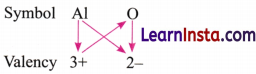
Formula: Al2O3
Properties of the Ionic and the Covalent Compounds
Ionic compounds form by electron transfer, making + and – charged particles that stick in a giant crystal. They are hard solids at room temperature with very high melting points (like NaCl at 801 °C) because strong forces hold the crystal tight. They conduct electricity only when melted or dissolved in water (ions can then move) but not as solids, and most dissolve well in water.
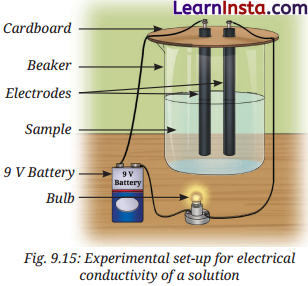
Covalent compounds form by sharing electrons, making small molecules with weak forces between them. They have low melting points, so many are gases (like CH4), liquids (H2O), or soft solids that melt easily. They don’t conduct electricity (no free charges) and solubility varies – polar ones like sugar dissolve in water, others like oil don’t.
Molecular Mass of Covalent Compounds
Molecular mass is the sum of the atomic masses of all atoms in one molecule of a covalent compound. It tells the mass of a single molecule.
For H2O (water):
H = 1,
O = 16,
so 2 × 1 + 16 = 18 u.
For CO2 (carbon dioxide):
C = 12,
O = 16,
so 12 + 2 × 16 = 44 u.
Formula Unit Mass of Ionic Compounds
In ionic compounds, the simplest whole-number ratio of cations and anions is called a formula unit. Since ionic compounds exist as large lattices rather than discrete molecules, the formula unit represents the basic repeating unit of the structure. The formula unit mass is the sum of the atomic masses of all the ions present in that formula unit.
For example, NaCl has a formula unit mass of 23 + 35.5 = 58.5 u.
For NaCl (sodium chloride):
Na = 23,
Cl = 35.5,
so 23 + 35.5 = 58.5 u.
For CaO (calcium oxide):
Ca = 40,
O = 16,
so 40 + 16 = 56 u.